CC-004 · Waste · Recycling & separation
'Strong progress' in waste separation
Not substantiated High confidence Draft: right of reply pending
Parts of this claim
The claim is split into parts that are tested separately, as in the report below. Each part has its own number.
- CC-004A Mixed waste down over 30%, to 95.5 million kg from about 141 million kg (Ministry [1])Arithmetic correct (−32%). No start year; not a published statistic. Direction consistent with Eurostat landfill data.
- CC-004B Organic waste a record 30 million kg in 2025 (Ministry [1])2025 data not yet published by NSO. 2024 NSO data show organic-bag collections rising. Treated organic waste is reported as landfilled, not recycled [6].
- CC-004C About 412 million kg diverted from landfill over five years (Minister Dalli [1])Not reconcilable with Eurostat (271 kt recycled or recovered, 2020–24). Scope, years and method not stated.
- CC-004D Malta records strong progress in waste separation (Ministry [1])Separated collections and the recycling rate have risen, faster than in most EU states. “Strong” is relative to Malta’s past, not to its targets.
- CC-004E The Long-Term Waste Management Plan is working; real and measurable outcomes (Minister Dalli [1])Outcome measures: 16.7% recycled, 79% landfilled; 2020 target missed, 2025 on course to be missed, now without postponement [3, 6, 8]. The release does not report them.
Claim Check 004 · Statistics and EU law
More waste separated, but how much recycled?
Testing a public claim about waste in Malta against Eurostat, NSO and EU targets
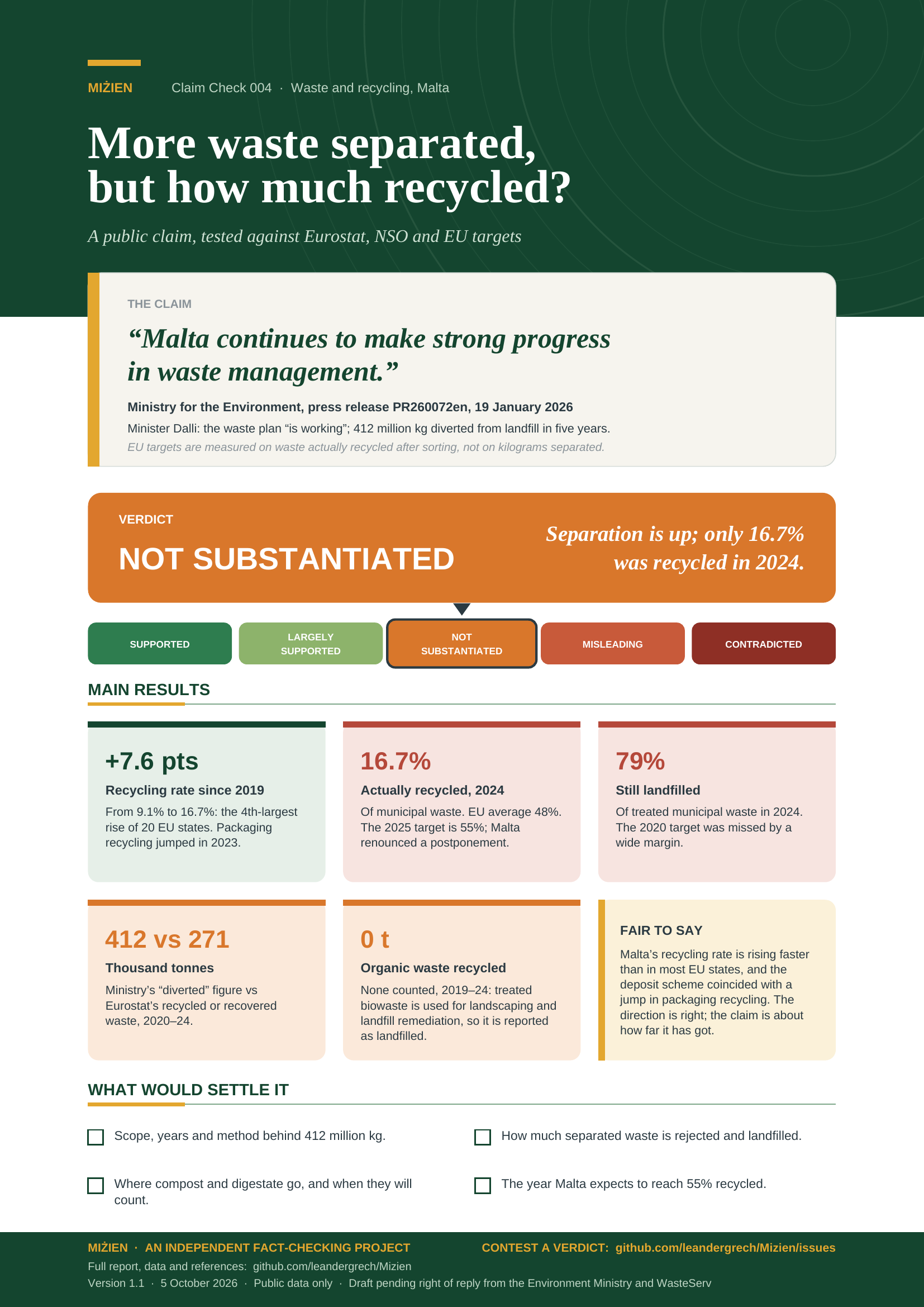
“Malta continues to make strong progress in waste management.”
Ministry for the Environment, Energy and Public Cleanliness, press release PR260072en, 19 January 2026.
Minister Dalli: “our Long-Term Waste Management Plan is working”; 412 million kg diverted.
Verdict: Not substantiated Separation is up, but 16.7% was recycled in 2024 and 79% landfilled
Version 1.1 · 5 October 2026
TL;DR
On 19 January 2026 the Ministry for the Environment said Malta was making “strong progress” in waste separation: mixed waste down by over 30% to 95.5 million kg, a record 30 million kg of organic waste, and about 412 million kg diverted from landfill over five years. The Minister said the Long-Term Waste Management Plan “is working”. We tested these statements against the measure EU law uses, the share of municipal waste that is actually recycled, and against the European Commission’s own assessments of Malta.
- Separation and recycling are both rising. The recycling rate rose from 9.1% (2019) to 16.7% (2024), the 4th-largest rise of the 20 EU states with data for both years. Packaging recycling rose from 30.8% to 43.4% in 2023, the deposit scheme’s first full year.
- But the level is far from the target. 16.7% is the second-lowest of the 20 states with 2024 data (EU average 48%). The target is 55% by 2025, and Malta renounced a postponement in November 2024.
- Four-fifths still goes to landfill. 79% of treated municipal waste in 2024. In 2023 the Commission listed Malta among 10 states at risk of missing both 2025 targets.
- Collected organic waste does not count as recycled. Treated biowaste is used for landscaping and landfill remediation, so it is reported as landfilled. Counting all 30 million kg would lift the rate to about 25%.
- The 412 million kg cannot be reconciled with published data. Eurostat records 271 thousand tonnes recycled or energy-recovered in 2020–2024; the release gives no scope, years or method.
- Verdict: not substantiated. Progress is real and faster than in most EU states, but “the plan is working” and the diversion figure are stated more strongly than the published evidence allows.
- Supported
- Largely supported
- Not substantiated
- Misleading
- Contradicted
What would move the verdict up
The scope, years and method behind 412 million kg, reconciled with NSO and Eurostat; sorting-plant reject rates showing most separated waste is recycled; compost and digestate put to uses that count as recycling; an official projection showing Malta will reach 55% by a stated date.
What would move it down
Evidence that “diverted” counts collected weight including rejects later landfilled, or includes construction waste; a 2025 recycling rate no higher than 2024.
IN THIS REPORT
1 The claim and what we could verify
The claim is the Department of Information press release PR260072en of 19 January 2026, read in full [1]. It reports a press conference by Minister Miriam Dalli and WasteServ CEO Richard Bilocca. A copy on publicservice.gov.mt (23 January) could not be opened [2]. Our candidate file also cited ERA’s “68% recycled” figure; reading ERA’s statement in full [9] shows it is explicitly about construction and demolition waste, so it is not part of this claim and our earlier note has been corrected.
| Source | What it says | Our access | Status |
|---|---|---|---|
| Ministry press release, 19 Jan 2026 [1] | Mixed waste down over 30%, now 95.5 million kg, “down from approximately 141 million kg”. Organic waste a record 30 million kg in 2025. Commercial mixed waste −1.1% (2024–25). Minister: “our Long-Term Waste Management Plan is working”; “we have diverted roughly 412 million kilogrammes of waste away from landfill over the past five years”. | Read in full in a browser (site blocks automated access). | The claim |
| NSO, Municipal Waste 2024 [4]; Solid Waste Management 2024 [5] | 353,525 t municipal waste generated; 79.2% of treated municipal waste landfilled; 58,156 t recycled. Household separate collections up. | Salient points read. | Primary data |
| Eurostat [3] | Recycling rates for all EU-27 states, treatment routes and packaging rates. | Downloaded 2 and 5 Oct 2026. | Primary data |
| European Commission, early-warning report, June 2023 [8], with its Malta annex [12] | Malta at risk of missing both 2025 targets (municipal and packaging) and far from the 2035 landfill target; compost used for landscaping and landfill remediation. | Read in full (EU Publications Office), 5 Oct 2026. | EU assessment |
| European Commission, Environmental Implementation Review 2025, Malta [6] | Missed the 2020 target by a large margin; on course to miss 2025. Postponement notified (Dec 2023), packaging part not accepted, then renounced (Nov 2024). Treated biowaste reported as landfilled. | Waste chapter (pp. 3–11) read in full, 5 Oct 2026. | EU assessment |
2 Method
Question. Do the figures in the release show “strong progress” and a plan that “is working”, when tested against the recycling and landfill measures that Malta’s EU obligations use?
Evidence. Eurostat municipal-waste tables (cei_wm011, env_wasmun, cei_wm020) and NSO releases, downloaded or read on 2 October 2026, and cei_wm011 for all EU-27 states, downloaded on 5 October 2026; the Waste Framework Directive as amended in 2018 [7]; the Commission’s 2023 early-warning report and its Malta annex [8, 12] and its 2025 Environmental Implementation Review for Malta [6], read in full from the EU Publications Office on 5 October 2026. All percentages are recomputed by script (tools/cc-004-report/calc.py; outputs in data/cc-004/). A Crossref search found no peer-reviewed study of Malta’s municipal waste system; one observational study on collection policy is used for context [10].
Grades. Official statistics and EU assessments: C. The collection-policy study: B. Verdicts follow Appendix A.
3 Separated, recycled, diverted
The release uses three different measures, and they are easy to run together.
- 1. Separated (collected) weight. Kilograms placed in organic, grey or green bags, glass banks or the deposit scheme. This is an input: it includes contamination and items that sorting plants later reject.
- 2. Recycled weight. Under Article 11a of the Waste Framework Directive, recycled municipal waste is the weight that, “having undergone all necessary checking, sorting and other preliminary operations”, enters the recycling operation [7]. This is the outcome the 55% target is measured on.
- 3. Diverted from landfill. Not defined in the release. It could mean weight collected separately, weight recycled, or weight sent anywhere but landfill (including energy recovery and exports).
4 What the data show
| Indicator | Malta | EU-27 / target | Source | Grade |
|---|---|---|---|---|
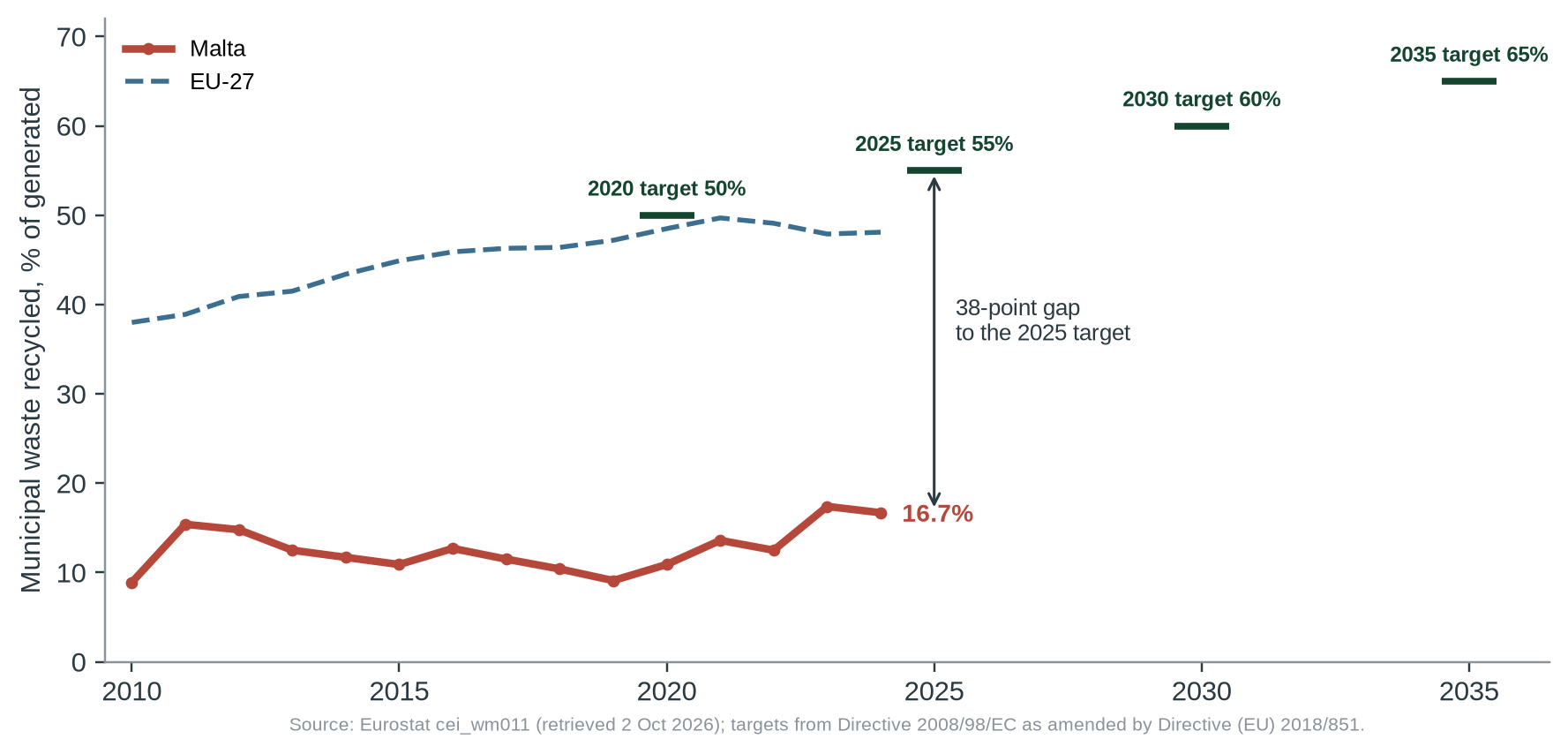
| Municipal recycling rate, 2024 | 16.7% | 48.1% / 55% by 2025 | Eurostat cei_wm011 [3] | C |
| Municipal recycling rate, 2019 | 9.1% | 47.2% | Eurostat [3] | C |
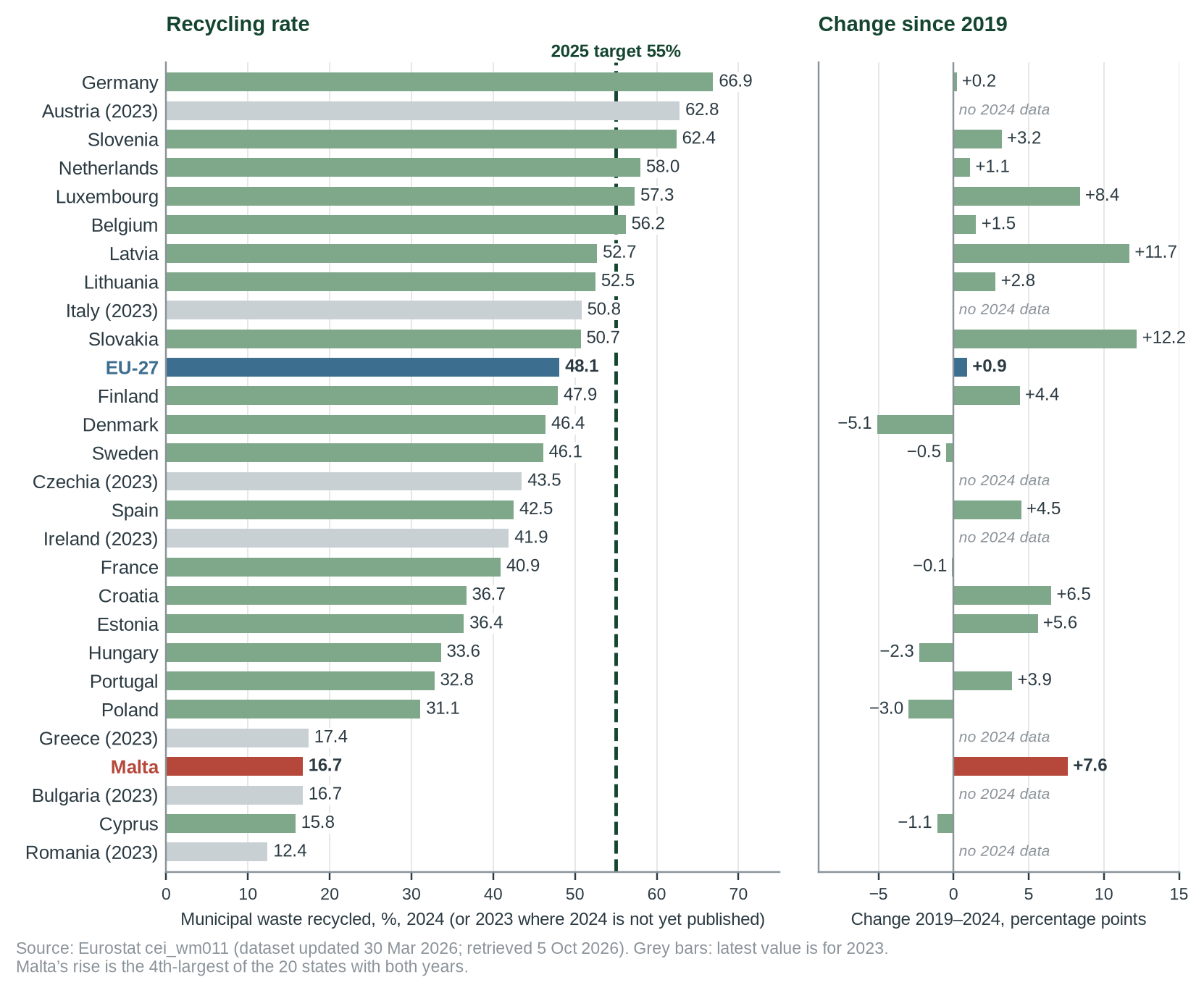
| Change in recycling rate, 2019 to 2024 | +7.6 points | 4th-largest rise of 20 states | Eurostat [3] | C |
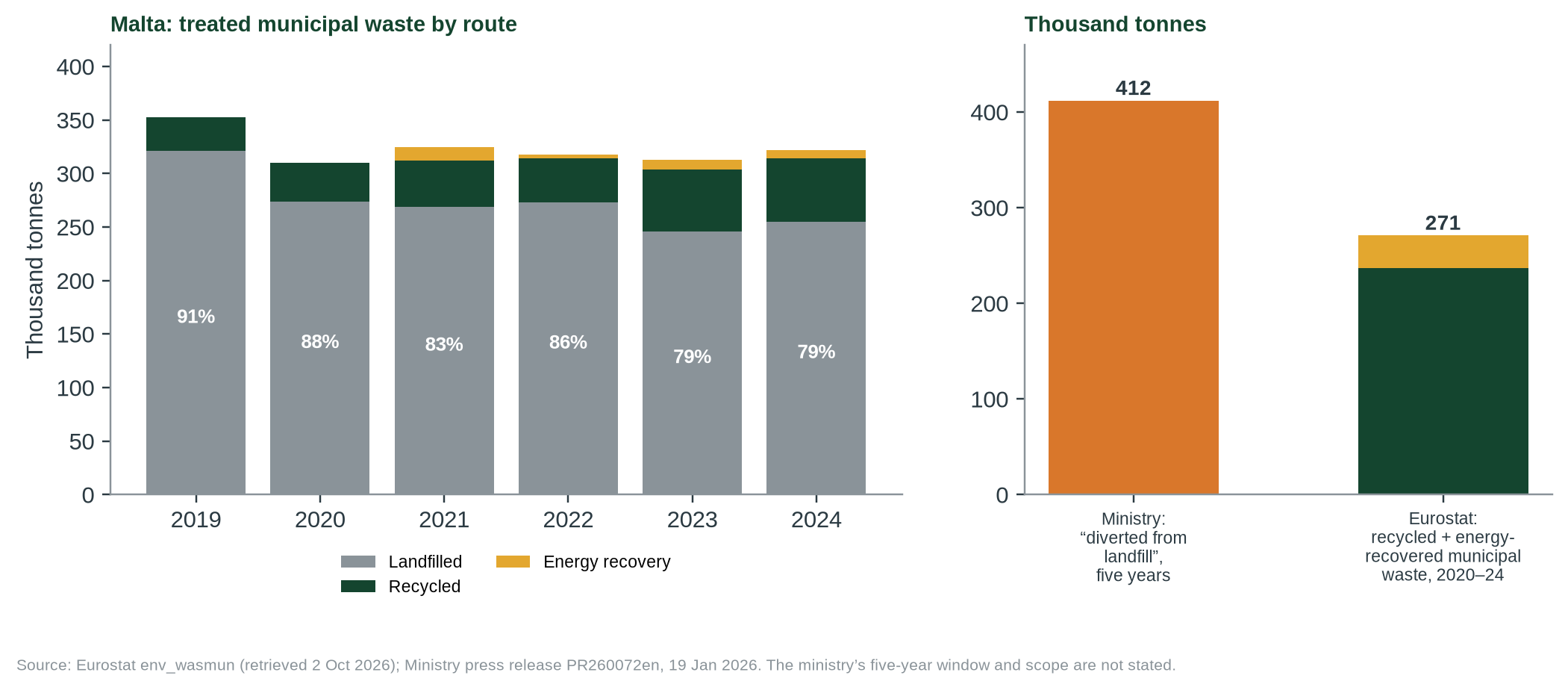
| Landfilled share of treated municipal waste, 2024 | 79% | – | Eurostat env_wasmun; NSO [3, 4] | C |
| Landfilled municipal waste, 2019 to 2024 | 321 to 255 kt (−21%) | – | Eurostat [3] | C |
| Municipal waste generated, 2019 to 2024 | 351 to 354 kt (+1%) | – | Eurostat [3] | C |
| Recycled + energy-recovered, 2020–2024 | 271 kt | Ministry: 412 million kg “diverted” | Eurostat [3]; [1] | C |
| Composting and digestion counted as recycling, 2019–2024 | 0 t each year | – | Eurostat env_wasmun (RCY_C_D) [3] | C |
| Packaging recycling rate, 2022 to 2023 | 30.8% to 43.4% | 67.4% (2023) / 65% by 2025 | Eurostat cei_wm020 [3] | C |
| Plastic packaging recycling rate, 2022 to 2023 | 13.8% to 31.9% | 41.7% (2023) / 50% by 2025 | Eurostat cei_wm020 [3] | C |
| Deposit refund scheme, 2023: containers collected / recycled | 78% / 74% | – | Commission [6, p. 11], citing ERA | C |
| 2020 municipal target | Missed by a large margin | 50% | Commission [6, p. 3] | C |
Values in data/cc-004/checks.csv. kt = thousand tonnes = million kg. Deposit-scheme rates are shares of containers placed on the market, as reported; we did not recompute them.
Malta among the EU-27
Reading across the data
- The direction is right, and the pace is above the EU norm. The recycling rate nearly doubled from 2019, the landfilled tonnage fell by a fifth while generation stayed flat, and only three states with comparable data raised their rate faster (Figure 3).
- The level is far from the target. At the 2019–2024 pace of about 1.5 points a year, reaching 55% would take roughly 25 years (an illustrative straight-line extrapolation, not a forecast). Malta notified the Commission in December 2023 that it intended to postpone the 2025 targets; the Commission did not accept the packaging part, and in November 2024 Malta renounced the postponement [6, p. 8]. As we read it, the 2025 deadline therefore applies in full.
- Packaging recycling jumped in 2023. All packaging rose from 30.8% to 43.4%, plastic from 13.8% to 31.9% and glass from 43.3% to 65.2% [3]. The deposit refund scheme began in November 2022; the Commission reports that in 2023 it collected 78% of the beverage containers placed on the market and recycled 74% [6, p. 11]. That the scheme drove the jump is our inference: the timing fits, but the data cannot separate it from other changes. Packaging is still 21.6 points below its 2025 target of 65%.
- Separately collected organic waste does not show up as recycling, and the Commission says why. Eurostat records zero tonnes of Maltese municipal waste recycled by composting or digestion in each year from 2019 to 2024. Treated biowaste “is used for landscaping and landfill remediation” and is “consequently reported as landfilled” [6, p. 9]. The 2023 annex also noted the landscaping and landfill use, and recommended using compost and digestate for land improvement and as fertiliser [12, pp. 2–3]. Even if all 30 million kg of organic waste the release reports for 2025 were counted as recycled, the rate would be about 25% (indicative: 2025 tonnage against 2024 totals).
- Measurement is hard where waste is exported. The Commission notes that Malta finds it “particularly challenging” to measure how much waste actually enters recycling because it relies on exports, and that sorted packaging is stored until there is enough to ship, so annual rates fluctuate [6, pp. 9–10].
- The 412 million kg is about 140 thousand tonnes more than Eurostat’s recycled and energy-recovered municipal waste for 2020–2024. If the ministry’s five years are 2021–2025, the 2025 figure would have to exceed 170 thousand tonnes to close the gap, more than two and a half times the 2024 level. The figure may include commercial or non-municipal streams; the release does not say.
5 Where the evidence points different ways
Q1 Is separation the right thing to measure?
USEFUL, NOT SUFFICIENTEVIDENCE FOR THE CLAIM'S IMPRESSION
Separation at source is a precondition for high-quality recycling, and the measures Malta introduced (mandatory separation, gate fees, weekly organics) match those associated with higher recycling elsewhere [10]. Household separate collections rose in 2024 [5].
EVIDENCE AGAINST
EU targets are set on recycled weight after sorting [7]. Malta’s recycling rate is about a third of the EU average and 38 points below the 2025 target [3]. Separated weight can rise while rejects are landfilled.
Q2 Is the trend fast enough to call it strong progress?
ON CURRENT DATA, NOEVIDENCE FOR THE CLAIM'S IMPRESSION
The recycling rate rose from 9.1% to 16.7% in five years, the 4th-largest rise of 20 EU states (Figure 3). Packaging recycling rose 12.6 points in 2023. Separation measures began in 2023 and may take time to show. Mixed waste fell by over 30% on the ministry’s figures [1].
EVIDENCE AGAINST
In 2023 the Commission listed Malta among 10 states “at risk of missing both the targets for municipal and all packaging waste for 2025” [8, p. 3] and 13 “still far from” the 2035 landfill target [8, p. 10]. Its 2025 review says the 2020 target was missed “by a large margin” [6, p. 3]. The rate dipped from 17.4% (2023) to 16.7% (2024) [3].
Q3 Do the release’s own numbers add up?
CANNOT BE CHECKEDEVIDENCE FOR THE CLAIM'S IMPRESSION
The 141 to 95.5 million kg change is −32%, consistent with “over 30%”. Landfilled municipal waste fell 21% in 2019–2024 [3], the same direction.
EVIDENCE AGAINST
No start year is given for 141 million kg, and “mixed waste” is not a published NSO or Eurostat series. The 412 million kg exceeds Eurostat’s recycled and recovered tonnage by about 140 thousand tonnes.
Q4 Does 16.7% understate what Malta recycles?
PARTLY; IT IS STILL THE TESTEVIDENCE FOR THE CLAIM'S IMPRESSION
Organic waste is collected and treated but, because the output is used for landscaping and landfill remediation, it is reported as landfilled [6, p. 9]. Exports make the tonnage entering recycling hard to measure, and stored packaging makes annual rates swing [6, pp. 9–10].
EVIDENCE AGAINST
EU law counts only waste that enters a recycling operation [7]; the Commission states that the treatment of organic waste in Malta “does not qualify as recycling” [6, p. 11]. Counting all 30 million kg of organic waste would lift the rate to about 25%, still 30 points short of 55%.
6 Testing the claim
| Sub-claim | Said by | What the evidence shows | Rating |
|---|---|---|---|
| A. Mixed waste down over 30%, to 95.5 million kg from about 141 million kg | Ministry [1] | Arithmetic correct (−32%). No start year; not a published statistic. Direction consistent with Eurostat landfill data. | UNVERIFIABLE AS STATED |
| B. Organic waste a record 30 million kg in 2025 | Ministry [1] | 2025 data not yet published by NSO. 2024 NSO data show organic-bag collections rising. Treated organic waste is reported as landfilled, not recycled [6]. | PLAUSIBLE |
| C. About 412 million kg diverted from landfill over five years | Minister Dalli [1] | Not reconcilable with Eurostat (271 kt recycled or recovered, 2020–24). Scope, years and method not stated. | NOT SUBSTANTIATED |
| D. Malta records strong progress in waste separation | Ministry [1] | Separated collections and the recycling rate have risen, faster than in most EU states. “Strong” is relative to Malta’s past, not to its targets. | PARTLY SUPPORTED |
| E. The Long-Term Waste Management Plan is working; real and measurable outcomes | Minister Dalli [1] | Outcome measures: 16.7% recycled, 79% landfilled; 2020 target missed, 2025 on course to be missed, now without postponement [3, 6, 8]. The release does not report them. | NOT SUBSTANTIATED |
7 Verdict and requests for evidence
Separation is up, but only 16.7% of municipal waste was recycled in 2024 (target 55% by 2025) and 79% of treated waste was landfilled. Confidence: high.
Why. (1) Separate collection is rising and the recycling rate has improved from a very low base, faster than in most EU states, so “progress in waste separation” is supported. (2) The release presents collected weight and an undefined “diverted” figure as evidence that the plan “is working”, but the outcome measures used by EU law show 16.7% recycled and 79% landfilled, far from the 55% target for 2025, which Malta has chosen not to postpone. The Commission’s 2023 and 2025 assessments reach the same conclusion. (3) The 412 million kg figure cannot be reconciled with published statistics. We chose Not substantiated rather than Misleading because the release is framed around separation, where its direction is right, and because the ministry may hold data that explain the 412 figure. Confidence is high because three Commission assessments and Eurostat agree on the outcome; the unexplained 412 figure is a caveat, not a gap in the finding.
What this verdict does not say. It does not say the figures are invented, that separation measures were wrong, or that anyone acted in bad faith. A checkable statement would read: “Separate collection rose to X t; after sorting, Y t entered recycling, raising the recycling rate to Z%. We expect to reach 55% by [year].”
Evidence we are asking for
- The years, waste streams (household, commercial, deposit scheme, construction) and measurement point behind “412 million kg diverted from landfill”.
- The start year and definition of “mixed waste” in the 141 to 95.5 million kg comparison.
- Reject rates at sorting plants: how much separately collected grey- and green-bag waste is landfilled after sorting.
- How much compost and digestate the organic waste produced, where it was used, and when its use is expected to count as recycling.
- Malta’s expected 2025 municipal recycling rate, and the year in which the plan expects to reach 55%.
8 Limitations
- This is a statistical check. No peer-reviewed study of Malta’s municipal waste system was found; the one study used [10] is from England and Wales and is read as an abstract.
- 2025 statistics are not yet published, so the ministry’s 2025 figures cannot be checked and the five-year windows may not match. Seven EU states have not yet published 2024 recycling rates.
- We read NSO salient points, not the full NSO tables.
- The Commission’s 2025 review uses data to 2022, and its deposit-scheme rates come from ERA; we did not recompute them. The link between the deposit scheme and the 2023 packaging jump is our inference.
- The publicservice.gov.mt version of the release could not be opened; we assume it matches the DOI text.
References
- [1] Ministry for the Environment, Energy and Public Cleanliness (19 Jan 2026). Malta records strong progress in waste separation. Press release PR260072en. (Read in full in a browser on 2 Oct 2026.) https://www.gov.mt/en/Government/DOI/Press%20Releases/Pages/2026/01/19/PR260072en.aspx
- [2] Malta records strong progress in waste separation (23 Jan 2026). publicservice.gov.mt. (Not read.) https://publicservice.gov.mt/en/news/malta-records-strong-progress-in-waste-separation
- [3] Eurostat. Recycling rate of municipal waste (cei_wm011); Municipal waste by waste management operations (env_wasmun); Recycling rate of packaging waste (cei_wm020). Retrieved 2 Oct 2026; cei_wm011 for all EU-27 states retrieved 5 Oct 2026. https://ec.europa.eu/eurostat/databrowser/view/cei_wm011/default/table
- [4] National Statistics Office (2 Dec 2025). Municipal Waste: 2024. News Release 225/2025. https://nso.gov.mt/municipal-waste-2024/
- [5] National Statistics Office (17 Feb 2026). Solid Waste Management: 2024. News Release 023/2026. https://nso.gov.mt/solid-waste-management-2024/
- [6] European Commission (7 Jul 2025). 2025 Environmental Implementation Review: Country Report – Malta. SWD(2025) 318 final. Waste chapter, pp. 3–11, read in full (via the EU Publications Office, 5 Oct 2026). Summary page: op.europa.eu/webpub/env/eir-country-reports-summaries/en/malta.html. https://eur-lex.europa.eu/legal-content/EN/TXT/?uri=CELEX:52025SC0318
- [7] Directive (EU) 2018/851 of the European Parliament and of the Council of 30 May 2018 amending Directive 2008/98/EC on waste. OJ L 150, 14.6.2018, p. 109. Articles 11(2) and 11a. https://eur-lex.europa.eu/legal-content/EN/TXT/?uri=CELEX:32018L0851
- [8] European Commission (8 Jun 2023). Report identifying Member States at risk of not meeting the 2025 preparing for re-use and recycling target for municipal waste, the 2025 recycling target for packaging waste and the 2035 municipal waste landfilling reduction target (early-warning report). COM(2023) 304 final. Read in full. https://eur-lex.europa.eu/legal-content/EN/TXT/?uri=CELEX:52023DC0304
- [9] Environment and Resources Authority (19 Feb 2025). NSO data reveals positive trends in sustainability and resource recovery. https://era.org.mt/press-releases/nso-data-reveals-positive-trends-in-sustainability-and-resource-recovery/
- [10] Wilansky J., Cao K. (2026). A comparison of municipal waste collection policies to optimize recycling rates: evidence from England and Wales. Waste Management 210:115258. doi:10.1016/j.wasman.2025.115258. (Abstract read.) https://doi.org/10.1016/j.wasman.2025.115258
- [11] MiŻien. Scripts and outputs: tools/cc-004-report/fetch_eurostat.py, calc.py, figures.py; data/cc-004/checks.csv.
- [12] European Commission (8 Jun 2023). The early warning report for Malta. Commission Staff Working Document SWD(2023) 195 final, accompanying COM(2023) 304. Read in full. https://eur-lex.europa.eu/legal-content/EN/TXT/?uri=CELEX:52023SC0195
Appendix A: series standards and verdict scale
Every investigation in this series follows the same rules so that verdicts are comparable and challengeable.
| Verdict | Meaning |
|---|---|
| SUPPORTED | Evidence consistently backs the claim as stated. |
| LARGELY SUPPORTED | Backed by the evidence, with minor caveats that do not change the substance. |
| NOT SUBSTANTIATED | Stated more strongly than the evidence offered or available allows. May be true in some conditions but has not been shown. |
| MISLEADING | Omits material facts so that the overall impression is inaccurate, even if individual statements are defensible. |
| CONTRADICTED | The available evidence points against the claim. |
Confidence
High: multiple independent lines of evidence agree. Moderate: evidence is relevant but incomplete or indirect. Low: evidence is thin, second-hand or conflicting.
Evidence grades
A experiment · B observational study with a control or gradient · C review, guidance or official statistics · D assertion or anecdote. ◆ marks a source known only second-hand.
Standards
- Quote the speaker, not the headline, with outlet and date, and link the original where possible.
- Separate the claim from the evidence offered for it, and say who made which statement.
- Grade the evidence and show differing views side by side where the evidence is unsettled.
- State what we could not access or verify, and what would change the verdict either way.
- Ask for the missing evidence in specific, answerable requests.
- Offer a right of reply where a check finds a claim Not substantiated, Misleading or Contradicted (or a pledge Not measurable, Off track or Missed), before wider circulation, and append responses.
- Correct errors openly with a version number and change log.
- Whistle-blow only on evidence: a verdict of Misleading or Contradicted requires documents or data that can be shown, not inference.
- Check every side. Government, opposition, NGOs and developers are held to the same standard.
Appendix B: revision log
| Version | Date | Change |
|---|---|---|
| 1.0 | 2 Oct 2026 | First issue. Draft pending right of reply from the Ministry for the Environment, Energy and Public Cleanliness and WasteServ. |
| 1.1 | 5 Oct 2026 | Upgrade: the Commission’s early-warning report [8] and Malta annex [12] read directly (second-hand marker removed); its 2025 review [6] read in full (postponement renounced; biowaste reported as landfilled). New Figure 3 (EU-27); verified fairness points (+7.6 points, 4th of 20; packaging and deposit scheme); new Q4. Maintainer decision (5 Oct 2026): confidence raised from moderate to high, because three Commission documents and Eurostat now agree. Verdict unchanged. |
Sources and archived copies
-
Malta records strong progress in waste separation, gov.mt press release, 19 Jan 2026.
Original · fetched and fingerprinted 2026-10-04; no public snapshot yet
The claim. Read in full in a browser on 2 Oct 2026 (site blocks automated access). -
Malta records strong progress in waste separation (Public Service), publicservice.gov.mt, 23 Jan 2026.
Original · not yet archived
Not read: site blocks automated access. -
2025 Environmental Implementation Review: Country Report - Malta (SWD(2025) 318 final), European Commission, 7 Jul 2025.
Original · fetched and fingerprinted 2026-10-10; no public snapshot yet
Waste chapter (pp. 3-11) read in full on 5 Oct 2026 via the EU Publications Office (celex 52025SC0318). Postponement notified Dec 2023, renounced Nov 2024 (p. 8); treated biowaste reported as landfilled (p. 9). Summary page https://op.europa.eu/webpub/env/eir-country-reports-summaries/en/malta.html -
Early warning report on Member States at risk of missing the 2025 municipal and packaging waste targets (COM(2023) 304 final), European Commission, 8 Jun 2023.
Original · Archived copy
Read in full on 5 Oct 2026. Malta among 10 states at risk of missing both 2025 targets (p. 3) and 13 still far from the 2035 landfill target (p. 10). -
The early warning report for Malta (SWD(2023) 195 final), European Commission, 8 Jun 2023.
Original · fetched and fingerprinted 2026-10-10; no public snapshot yet
Read in full on 5 Oct 2026. Compost used for landscaping and landfill remediation (p. 2). -
NSO data reveals positive trends in sustainability and resource recovery, ERA, 19 Feb 2025.
Original · Archived copy
The 68% recycled figure is explicitly for construction and demolition waste (2023). - Solid Waste Management 2024, NSO, 17 Feb 2026. Original · fetched and fingerprinted 2026-10-04; no public snapshot yet
- Municipal Waste: 2024 (NR 225/2025), NSO, 2 Dec 2025. Original · not yet archived
- Recycling rate of municipal waste (cei_wm011) and env_wasmun, Eurostat, retrieved 2 and 5 Oct 2026. Original · fetched and fingerprinted 2026-10-10; no public snapshot yet
Right of reply
The body concerned has not yet been asked to reply. Its response will be published here, beside the verdict.
Connections
How this claim relates to the others: who made it, the themes it shares with other claims, and the patterns it shows. A connection is a reason to read two checks side by side. It does not make either one right or wrong. How connections are found.
Who made it
Miriam Dalli, Minister for the Environment and Energy for Ministry for the Environment WasteServ
Other claims by Miriam Dalli 2
- CC-027 Power cuts: heat, not generation (not yet checked)
- CC-051 'Over 30% of our seas protected' (Misleading)
Other claims by Ministry for the Environment 5
- CC-003 Per-capita emissions vs 2030 projection (Misleading)
- CC-010 Tree-planting counts (Largely supported)
- CC-022 'Lowest electricity burden in the EU' (Largely supported)
- CC-029 First offshore wind farm (Largely supported)
- CC-048 Sea urchins recovering (not yet checked)
Other claims by WasteServ 2
Linked directly 11
Claims that share a theme with this one. A theme is a cause, a mechanism, a target or a way of presenting figures that the editors have found in several claims; its strength says how close the link is.
Waste and construction Shared material flow · Weak (indicative)
Inert mineral waste dominates Malta's recycling statistics, which ties waste claims to development projects. ERA and NSO confirm construction waste was about 2.2 of 2.9 Mt generated in 2023; the link to specific projects is still indicative.
- CC-002 Comino tree compensation (Largely supported)
- CC-008 Flyovers and congestion (Not substantiated)
- CC-017 Land reclamation outside the Freeport (Not substantiated)
- CC-081 Landfill share rising (not yet checked)
- CC-079 Waste-to-energy: 4.5% of energy (Misleading)
- CC-111 EU: 621 kg of waste a head, 74% landfilled (Supported)
- CC-117 EU: Malta missed recycling targets (reasoned opinion) (not yet checked)
Selective-metric pattern Rhetorical pattern · Pattern, not causal
A favourable metric is cited while the regulator-relevant metric looks worse. Useful for tagging, not for implying a common cause.
Same pattern
Pattern tags name a recurring way a claim can mislead. They describe the statement, not the speaker.
Selective metric
A favourable metric is cited while the regulator-relevant metric looks worse.
- CC-002 Comino tree compensation (Largely supported)
- CC-003 Per-capita emissions vs 2030 projection (Misleading)
- CC-009 More RO, less WSC groundwater (Largely supported)
- CC-025 Per-capita emissions down 44% since 2005 (Largely supported)
- CC-026 EU's largest rise in emissions (Largely supported)
- CC-079 Waste-to-energy: 4.5% of energy (Misleading)
- CC-114 PN: only EU state with rising emissions intensity (Misleading)
Input-as-outcome
Effort counted (trees planted, kilograms separated) is presented as if it were the result (trees surviving, recycling rate).
Two steps away 30
Not linked to this claim directly, but linked to a claim that is. These are found by following the links, not chosen by the editors, so they are looser: they show where one theme meets another.
- CC-001 Upper Barrakka concrete (Not substantiated)through Waste and constructionCC-002Sealed soil and concrete or Waste and constructionCC-008Sealed soil and concrete or Selective-metric patternCC-010Replanting as currency
- CC-011 Ten minutes' walk to green space (pledge: Not measurable)through Selective-metric patternCC-0032030 carbon target
- CC-012 Ta' Qali gravel and grass (Contradicted)through Waste and constructionCC-002Sealed soil and concrete or Waste and constructionCC-008Sealed soil and concrete
- CC-013 Permits keep property prices in check (Largely supported)through Waste and constructionCC-017Planning, housing and land take
- CC-014 Fewer enforcement notices, fewer illegalities (Misleading)through Waste and constructionCC-017Planning, housing and land take
- CC-016 Shore-to-ship: 90% less harbour pollution (Misleading)through Selective-metric patternCC-003Transport, air and climate or Selective-metric patternCC-007Transport, air and climate or Waste and constructionCC-008Transport, air and climate
- CC-018 IMF 'confirms' MDA on housing (Largely supported)through Waste and constructionCC-017Planning, housing and land take
- CC-019 830,000 m2 of land lost in five years (Not substantiated)through Waste and constructionCC-002Sealed soil and concrete or Waste and constructionCC-008Sealed soil and concrete or Waste and constructionCC-017Planning, housing and land take
- CC-020 EP study: noise law not the cause (Largely supported)through Selective-metric patternCC-007Compliance-not-health pattern
- CC-021 Malta-Gozo tunnel traffic (not yet checked)through Selective-metric patternCC-003Transport, air and climate or Selective-metric patternCC-007Transport, air and climate or Waste and constructionCC-008Transport, air and climate
- CC-025 Per-capita emissions down 44% since 2005 (Largely supported)through Selective-metric patternCC-0032030 carbon target
- CC-026 EU's largest rise in emissions (Largely supported)through Selective-metric patternCC-003Transport, air and climate
- CC-033 Delimara: 'much cleaner air' (not yet checked)through Selective-metric patternCC-007Compliance-not-health pattern
- CC-035 PM2.5 death rate down two-thirds (Largely supported)through Selective-metric patternCC-007Transport, air and climate
- CC-054 Project Green: 100,000 m2 a year (not yet checked)through Selective-metric patternCC-010Replanting as currency
- CC-056 Central Link: 'only 254 trees' (not yet checked)through Waste and constructionCC-008Replanting as currency
- CC-057 1,649 compensation trees (not yet checked)through Selective-metric patternCC-010Replanting as currency
- CC-063 Construction waste: 'standstill' warning (Not substantiated)through Waste and constructionCC-017Waste and construction
- CC-069 82 million bus trips (not yet checked)through Waste and constructionCC-008Transport, air and climate
- CC-072 EUR 15m to take cars off the road (not yet checked)through Waste and constructionCC-008Transport, air and climate
- CC-076 36 more vehicles a day (Supported)through Waste and constructionCC-008Transport, air and climate
- CC-080 EUR 75m organic plant (not yet checked)through Waste and constructionCC-079Waste and construction
- CC-094 Commission: Malta to emit more in 2030 than in 2005 (Supported)through Selective-metric patternCC-0032030 carbon target
- CC-101 EU: no registration or prior authorisation of water abstraction in Malta (Largely supported)through Waste and constructionCC-117EU findings of unmet obligations
- CC-109 EU: transport is 48% of effort-sharing emissions (Largely supported)through Selective-metric patternCC-0032030 carbon target or Waste and constructionCC-008Transport, air and climate
- CC-110 EU: 37.7% of new cars zero-emission (Supported)through Selective-metric patternCC-007Selective-metric pattern
- CC-114 PN: only EU state with rising emissions intensity (Misleading)through Selective-metric patternCC-003Selective-metric pattern
- CC-115 Chamber: congestion cost EUR 770m, 3.4% of GDP (Not substantiated)through Waste and constructionCC-008Transport, air and climate
- CC-128 EU: Malta missed the water-plan timetable (not yet checked)through Waste and constructionCC-117EU findings of unmet obligations
- CC-129 EU: Malta has not updated its air pollution programme (not yet checked)through Waste and constructionCC-117EU findings of unmet obligations
Three steps away 21
One step further again. At this distance a connection says more about how the themes fit together than about this claim.
- CC-009 More RO, less WSC groundwater (Largely supported)through Waste and constructionCC-117EU findings of unmet obligationsCC-101Water chain: farm waste, sewage, sea, aquifer
- CC-022 'Lowest electricity burden in the EU' (Largely supported)through Selective-metric patternCC-0032030 carbon targetCC-025Selective-metric pattern
- CC-024 Renewables target for 2030 (Not substantiated)through Selective-metric patternCC-0032030 carbon targetCC-0112030 carbon target
- CC-031 Gozo, first climate-neutral region (Largely supported)through Selective-metric patternCC-003Transport, air and climateCC-026Shared emissions figures
- CC-039 Net Zero Impact Utility (pledge: Not measurable)through Waste and constructionCC-117EU findings of unmet obligationsCC-101Water chain: farm waste, sewage, sea, aquifer
- CC-047 Nitrates in the aquifer (Largely supported)through Waste and constructionCC-117EU findings of unmet obligationsCC-101Water chain: farm waste, sewage, sea, aquifer
- CC-058 96% of farmland in use (not yet checked)through Waste and constructionCC-002Sealed soil and concreteCC-019Planning, housing and land take
- CC-059 Subsidies are 20% of farm output (not yet checked)through Waste and constructionCC-002Sealed soil and concreteCC-019Farmland and farming pressure
- CC-060 7,000 first-time buyers helped (not yet checked)through Waste and constructionCC-017Planning, housing and land takeCC-013Planning, housing and land take
- CC-062 Construction is 9-14% of the economy (Largely supported)through Waste and constructionCC-017Planning, housing and land takeCC-018Planning, housing and land take
- CC-071 EUR 100m a year for free buses (Not substantiated)through Waste and constructionCC-008Transport, air and climateCC-069Transport, air and climate
- CC-075 Seventh in the EU for cars (Misleading)through Selective-metric patternCC-007Selective-metric patternCC-110Transport, air and climate
- CC-082 35 quarries for construction waste (not yet checked)through Waste and constructionCC-017Waste and constructionCC-063Waste and construction
- CC-104 PN: Malta fails EU noise law (not yet checked)through Selective-metric patternCC-007Compliance-not-health patternCC-020Noise governance
- CC-105 ADPD: no study of Freeport and airport noise (Largely supported)through Selective-metric patternCC-007Compliance-not-health patternCC-020Noise governance
- CC-108 Net-zero impact on the groundwater environment (pledge: Not measurable)through Waste and constructionCC-117EU findings of unmet obligationsCC-101Water chain: farm waste, sewage, sea, aquifer
- CC-118 Council: Malta second-highest water stress, groundwater failing (Largely supported)through Waste and constructionCC-117EU findings of unmet obligationsCC-101Water chain: farm waste, sewage, sea, aquifer
- CC-120 EP study: 54,000 exposed to road noise, likely an underestimate (Largely supported)through Selective-metric patternCC-007Compliance-not-health patternCC-020Noise governance
- CC-123 KPMG: 8,716 residential units approved in 2024, up 7.4% (not yet checked)through Waste and constructionCC-002Sealed soil and concreteCC-019Planning, housing and land take
- CC-127 EU: Malta has the lowest organic share in the EU (not yet checked)through Waste and constructionCC-002Sealed soil and concreteCC-019Farmland and farming pressure
- CC-130 NGOs: ODZ racecourse policy ends protection (not yet checked)through Waste and constructionCC-002Sealed soil and concreteCC-019Farmland and farming pressure
Timeline
What was said, what was published before and after it, and each step of this check, in date order. Statements and sources carry the date they were published. The steps of the check carry the date the research was done, from the check's research log. Other statements by the same body on the same topic show whether a position was repeated, changed or corrected.
2018
- 14 June 2018 Evidence published Directive (EU) 2018/851 amending Directive 2008/98/EC on waste, Official Journal of the EU
2023
- 8 June 2023 Evidence published Early warning report on Member States at risk of missing the 2025 municipal and packaging waste targets and the 2035 landfill target, COM(2023) 304 final, European Commission
- 8 June 2023 Evidence published The early warning report for Malta, SWD(2023) 195 final, European Commission
- 26 June 2023 Earlier statement by WasteServ on Waste CC-079 Waste-to-energy: 4.5% of energy (Misleading)
2025
- 19 February 2025 Statement published ERA welcomes progress in recycling (2023 NSO data), ERA
- 19 February 2025 Statement published NSO data reveals positive trends in sustainability and resource recovery, ERA
- 2025 Evidence published Environmental Implementation Review 2025: Malta, European Commission (OP)
- 7 July 2025 Evidence published 2025 Environmental Implementation Review: Country Report – Malta, SWD(2025) 318 final, European Commission
- 2 December 2025 Evidence published Municipal Waste: 2024 (NR 225/2025), NSO
2026
- 19 January 2026 The statement Ministry for the Environment, Energy and Public Cleanliness (Minister Dalli); WasteServ (this claim)
- 19 January 2026 Statement published Malta records strong progress in waste separation, gov.mt press release
- 23 January 2026 Statement published Malta records strong progress in waste separation (Public Service), publicservice.gov.mt
- 17 February 2026 Evidence published Solid Waste Management 2024, NSO
- 13 April 2026 Later statement by WasteServ on Waste CC-080 EUR 75m organic plant (not yet checked)
- 2 October 2026 Version 1.0: first issue First issue. Draft pending right of reply from the Ministry for the Environment, Energy and Public Cleanliness and WasteServ.
- 5 October 2026 Version 1.1 Upgrade: the Commission’s early-warning report [8] and Malta annex [12] read directly (second-hand marker removed); its 2025 review [6] read in full (postponement renounced; biowaste reported as landfilled). New Figure 3 (EU-27); verified fairness points (+7.6 points, 4th of 20; packaging and deposit scheme); new Q4. Maintainer decision (5 Oct 2026): confidence raised from moderate to high, because three Commission documents and Eurostat now agree. Verdict unchanged. Verdict in this version: Not substantiated, high confidence.
- 5 October 2026 Evidence reviewed
2027
- 5 October 2027 Coming up: Evidence review due Each finished check is reviewed against new evidence within a year.
Every change to this claim's record is public: history of the record.
Download the report and flyer