CC-024 · Climate & Energy · Renewables
Renewables target for 2030
Not substantiated Moderate confidence Pledge: On track as of 15 September 2026 Draft: right of reply pending
The pledge in this claim
On track as of 15 September 2026
On track: published progress is at or ahead of a straight-line path (or the pledge's own milestones) to the target by the deadline.
Eurostat 17.2% in 2024 vs 15.5% on the plan path; 18.8% provisional for 2025. Rise is from heating and cooling; the Commission rates 24.5% below its 28% formula result. Delivery against the plan figure only.
A pledge gets a label, not a verdict. The verdict above (Not substantiated) is for the factual part of the claim.
- Target
- 24.5% renewables share of gross final energy consumption in 2030 (summary: 25%)
- Made by
- Government of Malta
- Made in
- Final updated NECP 2021-2030 (submitted 7 Jan 2025) (7 January 2025)
- Deadline
- 31 December 2030
All pledges and how they are labelled · See it on the pledges timeline
Parts of this claim
The claim is split into parts that are tested separately, as in the report below. Each part has its own number.
- CC-024A “Increase the Renewable Energy contribution from 11.5% to 25%” (Plan p. 22 [1])11.5% is the earlier contribution; 25% is the summary ambition and 24.5% the projection and trajectory end-point (pp. 21, 82–83).
- CC-024B “…diversification in onshore and offshore technologies” as means to the 2030 share (Plan p. 22 [1])The summary lists offshore technologies as a means; the projection counts no offshore wind in 2030 (p. 83: “not envisaged to be completed and commissioned by 2030”).
- CC-024C Onshore means (solar PV on land, biogas, biofuels, heat pumps) deliver the 24.5% (Plan p. 83 [1])Named, but the plan gives no points of share per technology; the Commission notes PV support is not quantified [2]. PV: 241 MWp (2023) to 350 MWp (2030) is the plan’s own figure (pp. 74, 84).
- CC-024D Malta will reach the 2030 share (Plan [1])17.2% in 2024 against 15.5% on the plan’s own path; the Commission rates the plan’s 2025/2027 points and its 24.5% below its reference points and formula. A target, rated as a pledge.
Claim Check 024 · Climate and energy
Renewables by 2030: onshore and offshore?
Testing Malta’s 2030 renewable-energy target against its own plan and Eurostat data
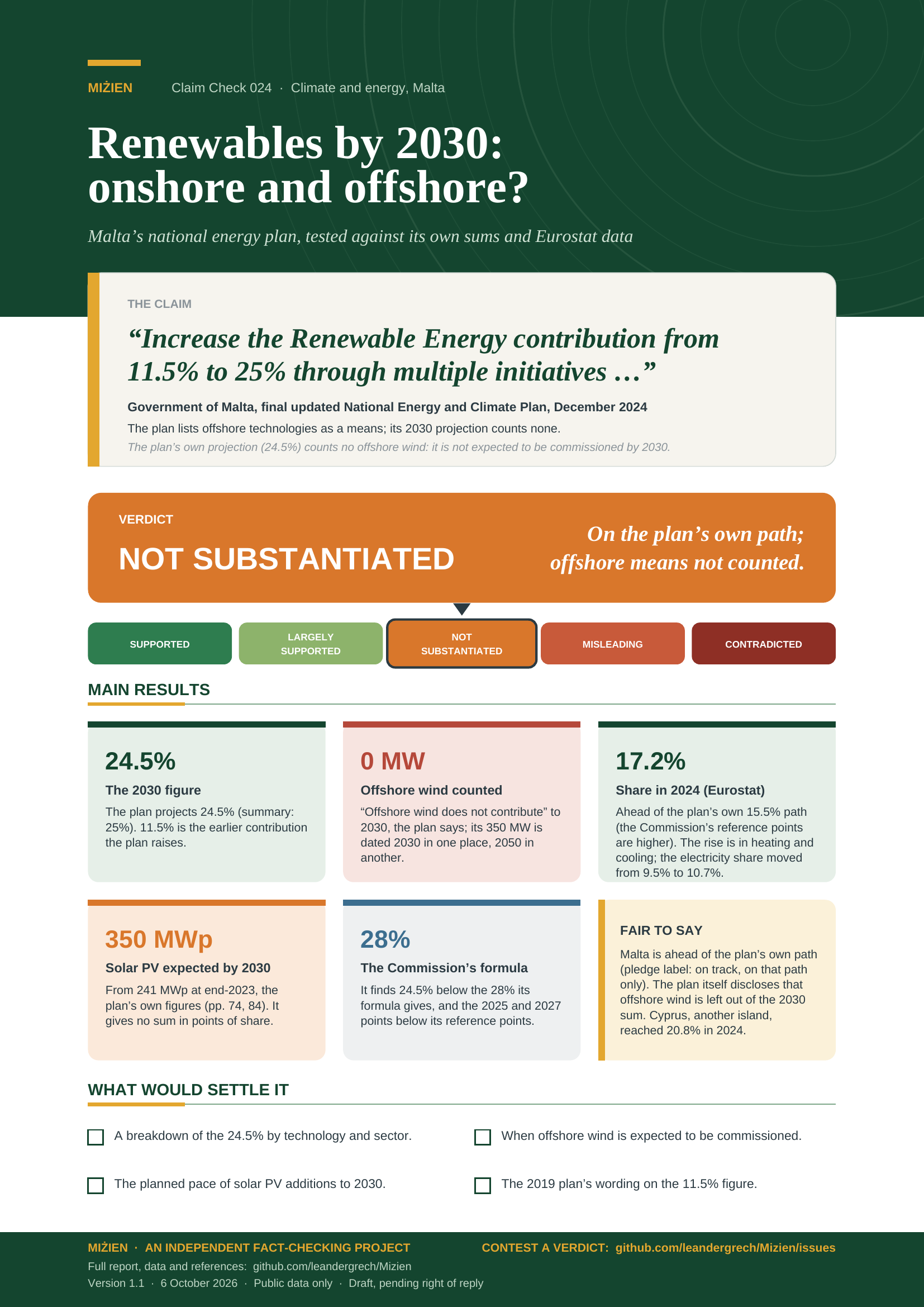
“Increase the Renewable Energy contribution from 11.5% to 25% through multiple initiatives …”
Government of Malta, final updated National Energy and Climate Plan, p. 22 (December 2024).
The summary lists offshore technologies as a means; the plan’s 2030 projection counts no offshore wind.
Verdict: Not substantiated Plan’s own path; offshore not counted
Version 1.1 · 6 October 2026
TL;DR
Malta’s final updated National Energy and Climate Plan (December 2024) puts Malta’s 2030 renewables share at 24.5% of gross final energy consumption (summarised as “25%”), up from an earlier 11.5%. The plan’s own calculation does not count offshore wind, which it says will not be commissioned by 2030; the 2030 figure rests on solar PV on land, biogas, biofuel blending and heat-pump ambient heat. Malta is ahead of the plan’s own yearly path (17.2% in 2024 against 15.5%), but the gain has come from heating and cooling, not from solar electricity. The Commission found the plan’s 2025 and 2027 points below its EU reference points (18%, 22%), the 24.5% below the 28% its formula gives, and that the plan does not quantify what solar support will deliver.
- The target is 24.5% (25% in summaries), not 11.5%. The plan says it raises the contribution “from 11.5% to 25%” (p. 22) and projects 24.5% in 2030 (p. 83).
- Offshore wind is not in the sum. “Offshore wind does not contribute to Malta’s RES contribution … as it is not envisaged to be completed and commissioned by 2030” (p. 83). Yet the plan’s summary table lists offshore technologies among the means (p. 22).
- Solar PV is part of it, but not quantified in points. The plan expects 350 MWp by 2030 (p. 84), from 241 MWp at end-2023 (p. 74): about 15.6 MWp a year. The Commission notes PV support is not quantified.
- Progress is ahead of the plan’s own path, but heat-driven. Eurostat: 17.2% in 2024 (plan 15.5%). The rise came from heating and cooling; the electricity share moved only 9.5% to 10.7% since 2020. The Commission rates the 24.5% below its 28% formula.
- Verdict: not substantiated (moderate confidence); pledge: on track. On the plan’s own path (Commission benchmarks are higher); offshore as a means is not in its 2030 sum.
- Supported
- Largely supported
- Not substantiated
- Misleading
- Contradicted
What would move the verdict up
A dated, quantified breakdown showing how much each of solar PV, biogas, biofuels and heat pumps adds to the 24.5%; or a commissioning date and grid connection for offshore wind inside 2030.
What would move it down
Eurostat data showing the share falling behind the plan’s path, or the plan being revised so that the 2030 share depends on projects that are not built.
IN THIS REPORT
1 The claim and what we could verify
Our intake record paraphrased Malta’s updated National Energy and Climate Plan (NECP) 2021–2030 as saying Malta would reach its 2030 renewable-energy contribution “through solar PV and offshore wind”. The plan does not say that, so that paraphrase is not rated. We rate only the plan’s own words, read in the copy the European Commission publishes [1]: the summary table (p. 22) says it will raise the contribution “through multiple initiatives to focus on more diversification in onshore and offshore technologies”, and the projection (pp. 82–83) gives 24.5% in 2030.
| Source | What it says | Our access | Status |
|---|---|---|---|
| Government of Malta, final updated NECP, summary table, pp. 21–22 [1] | “Increase Malta’s ambition to a renewable energy share of 25% by 2030”; “Increase the Renewable Energy contribution from 11.5% to 25% through multiple initiatives to focus on more diversification in onshore and offshore technologies”. | Read in full (381 pages). | The claim |
| Same plan, section 2.1.2, pp. 82–84 [1] | “expected to amount to 24.5% in 2030”; 16.5% in 2025, 20.7% in 2027. Offshore wind “does not contribute … as it is not envisaged to be completed and commissioned by 2030”. “Solar PV is expected to reach 350 MWp by 2030”. | Read in full. | The claim, detailed |
| European Commission, assessment of the final NECP, SWD(2025) 140, Malta extract [2] | 24.5% “is below the 28%” from the Annex II formula; trajectories below reference points; support for solar PV not quantified. | Read. | Primary evidence |
| Eurostat nrg_ind_ren; NSO PV release NR 111/2025 [3, 4] | Malta’s actual share to 2025 (provisional); PV capacity 252.3 MWp at end-2024 ◆. | Eurostat read by API; NSO page blocked (403), figures second-hand ◆ (context only). | Data |
| 2019 NECP (source of the “11.5%”) | Not read: the agency’s host was refused to scripts. | The 11.5% is taken from the 2024 plan’s own wording. | Gap |
2 Method
Question. Is the 2030 renewables contribution what the plan says, will it be reached the way the claim says, and is progress on the plan’s own path?
Evidence. We read the plan’s renewables sections and every passage that mentions offshore wind or PV capacity, then the Commission’s assessment of the plan. We downloaded Eurostat’s renewable-share series (nrg_ind_ren; Malta, Cyprus as an island comparator, EU-27) on 5 October 2026 and recomputed every comparison with a script (tools/cc-024-report/calc.py; outputs in data/cc-024/). Plan and Commission figures are typed with printed page numbers into necp_commission_inputs.csv. Peer-reviewed literature is context only: this is a check of a document against statistics, and we found no paper that tests the plan.
Grades. Official statistics and EU assessments are grade C; the plan itself is grade D as evidence of what will happen (a statement of intent). Verdicts and pledge labels follow Appendix A.
3 What the plan says
Three figures circulate and the plan contains all of them. 11.5% is the earlier contribution that the summary table says is being raised. 25% is the ambition in the summary table. 24.5% is the figure in the plan’s projection and indicative trajectory (Table 3), the one the Commission assessed. A reader quoting “25%” is quoting the plan’s summary; “11.5%” is out of date.
The 24.5% is built, the plan says, from “additional effort to deploy solar PV systems on land”, biogas from waste facilities, higher biofuel blending in transport, and “ambient cooling captured by air-to-air heat pumps” (p. 83). It then adds: “offshore wind does not contribute to Malta’s RES contribution shown in the Table as it is not envisaged to be completed and commissioned by 2030.” Elsewhere the plan commits to “a minimum of 350MW of offshore renewable generation capacity … by 2030” (p. 25) and, in another section, to 350 MW “by 2050” (p. 78), as a non-binding TEN-E agreement. The plan therefore lists offshore energy among its means, while counting none of it towards 2030.
4 What the data show
| Indicator | Malta | Comparator | Source | Grade |
|---|---|---|---|---|
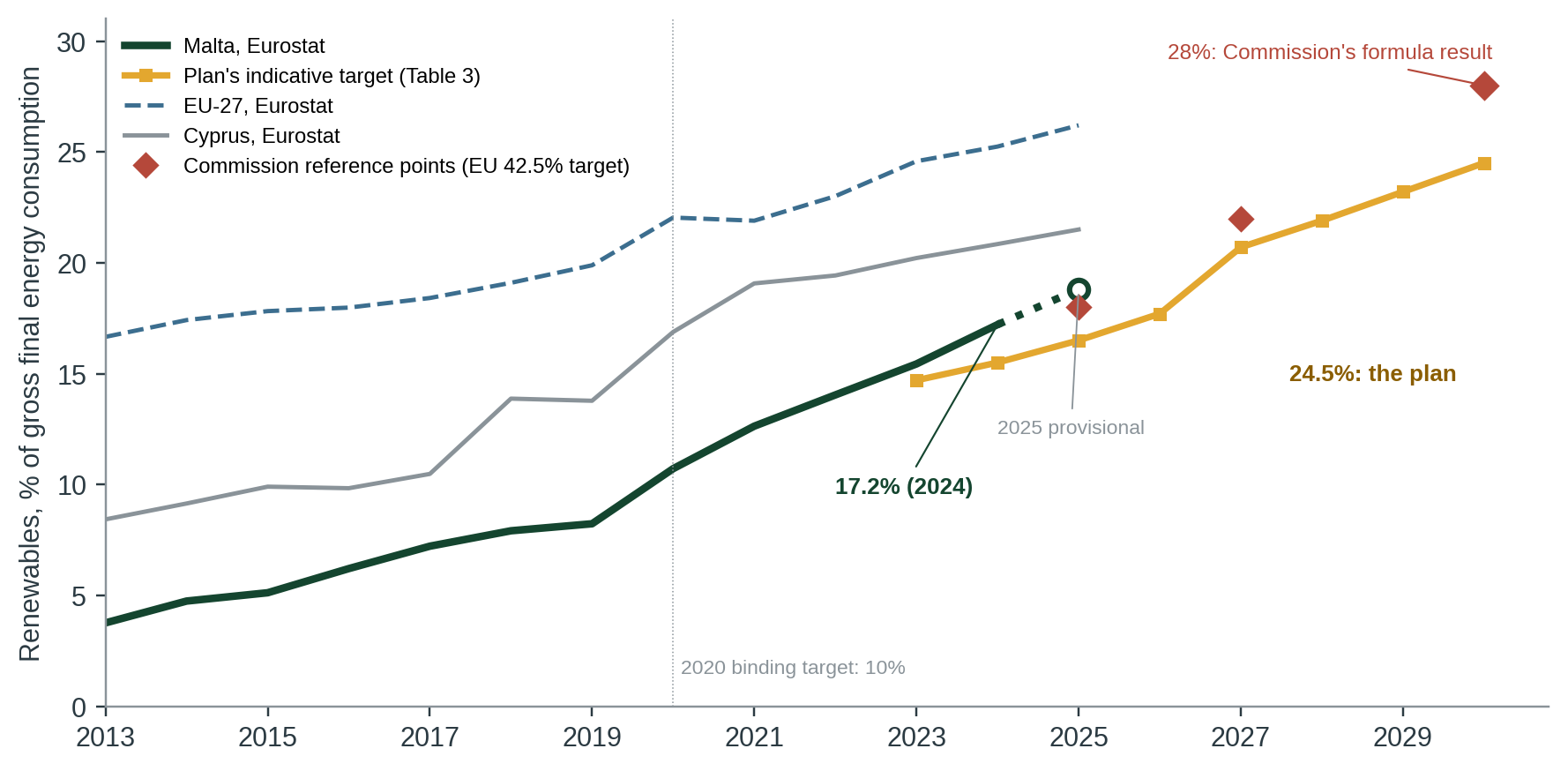
| Renewables share, 2024 | 17.2% | Plan path 15.5%; EU-27 25.2%; Cyprus 20.8% | Eurostat [3]; plan p. 83 | C |
| Renewables share, 2025 (provisional) | 18.8% | Plan path 16.5%; Commission reference point 18% | Eurostat [3]; [2] | C |
| Straight line from 2020 outturn (10.7%) to 24.5%, value in 2024 | 16.2% | Actual +1.0 point above | calc.py | C |
| Rise needed per year, 2024 to 2030 | 1.2 points | 2020–2024 average 1.6 points | calc.py | C |
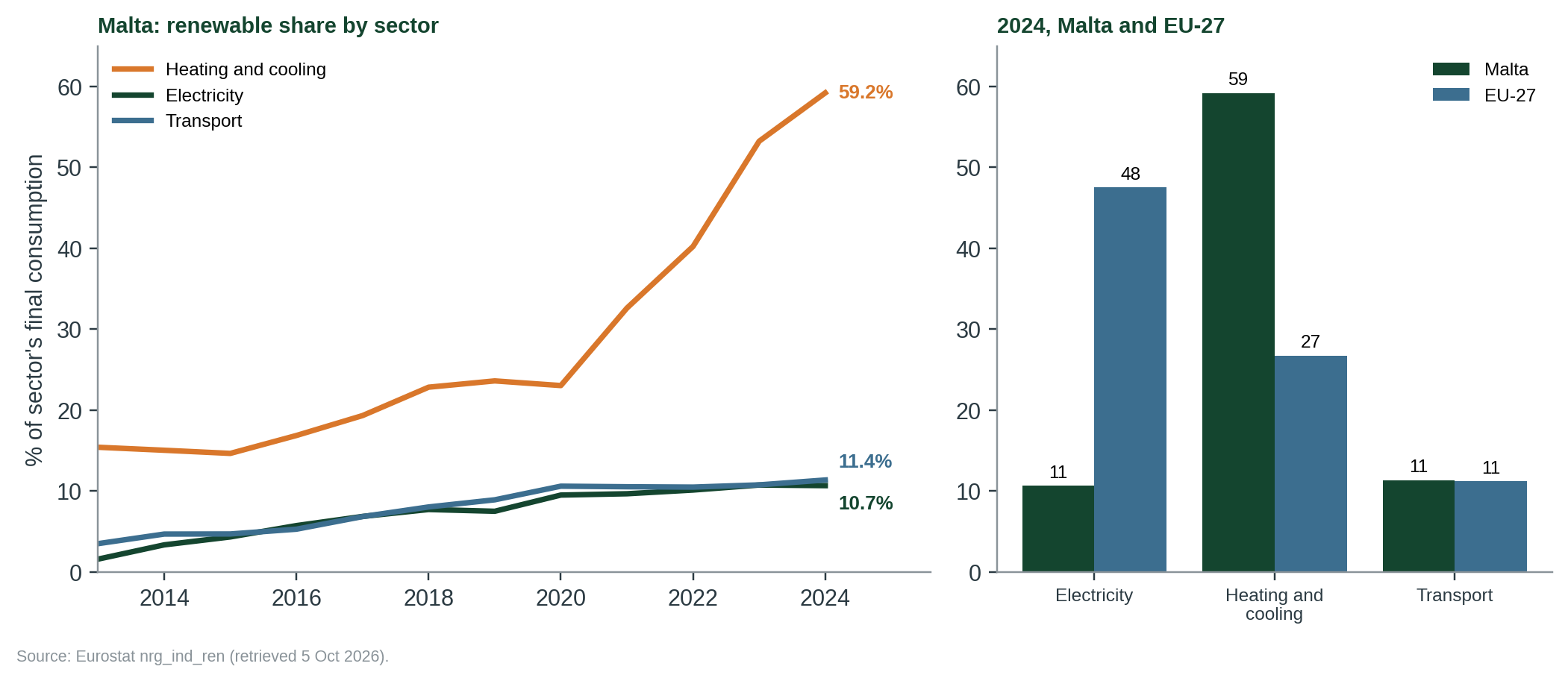
| Electricity share, 2020 to 2024 | 9.5% to 10.7% | EU-27 47.5% (2024) | Eurostat [3] | C |
| Heating and cooling share, 2020 to 2024 | 23.0% to 59.2% | EU-27 26.7% (2024) | Eurostat [3] | C |
| Transport share, 2020 to 2024 | 10.6% to 11.4% | EU-27 11.2% (2024) | Eurostat [3] | C |
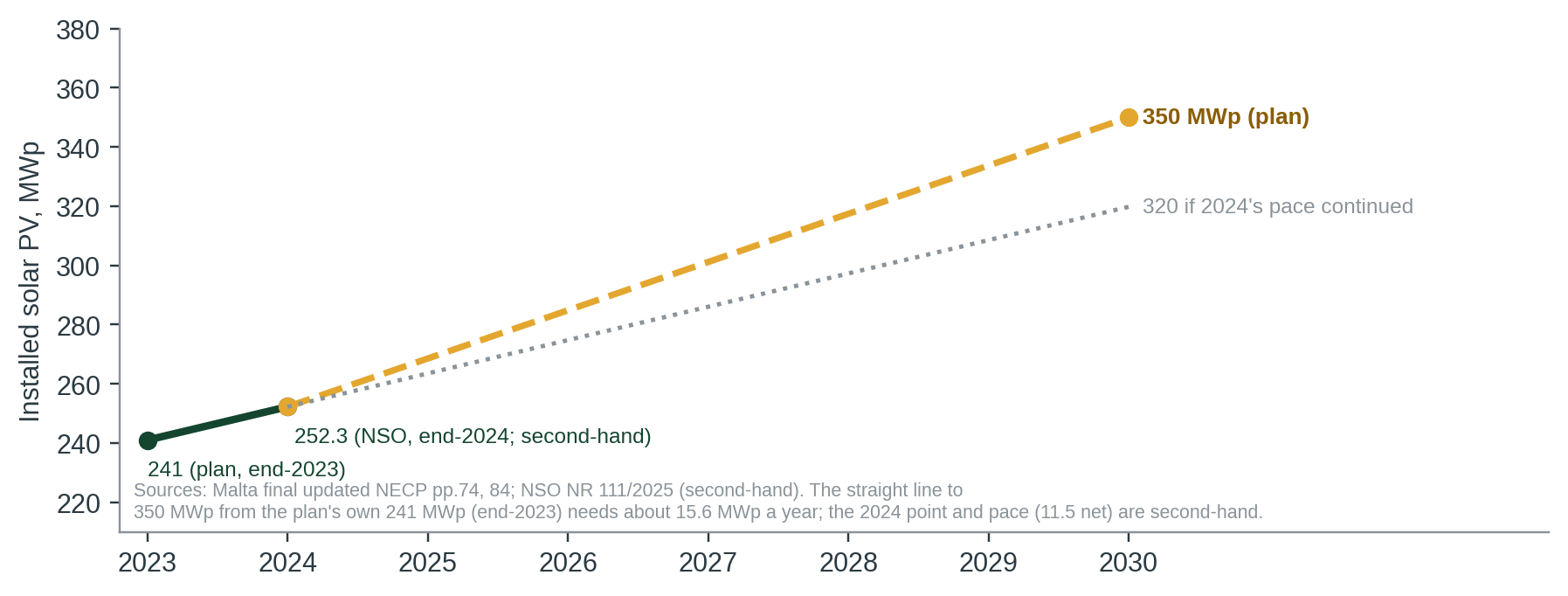
| Solar PV capacity, end-2023 / end-2024 ◆ | 241 / 252.3 ◆ MWp | Plan: 350 MWp by 2030 | Plan p. 74; NSO [4] ◆ (second-hand) | C |
| PV to add per year to reach 350 MWp from the plan’s 241 MWp (end-2023) | 15.6 MWp | 2024 net addition 11.5 MWp ◆, context only | Plan pp. 74, 84; calc.py | C |
| 2030 contribution: plan / Commission formula | 24.5% / 28% | 3.5 points below | Plan p. 83; [2] | C |
Values in data/cc-024/checks.csv. Eurostat now shows 14.04% for 2022, the plan 13.4%: the series is revised, so year-on-year comparisons use one vintage (retrieved 5 Oct 2026).
Reading across the data
- Malta is ahead of the plan’s own path in 2023, 2024 and (provisionally) 2025, and, if the 2025 figure holds, above the Commission’s 18% reference point for that year.
- The lead is built on heat, not on solar power. The electricity share, where PV counts, rose about one point in four years. The heating and cooling share more than doubled from 2020 to 2024, which is consistent with the plan’s reliance on ambient heat from heat pumps. The Commission’s counting rule for air-to-air heat pumps may drive much of that increase; we cannot split the effect by technology because the plan does not.
- PV needs a faster pace than 2024’s, on second-hand data. The plan’s own figures (241 MWp at end-2023, 350 MWp by 2030) imply about 15.6 MWp a year. Against that, NSO’s 2024 net addition of 11.5 MWp ◆ (second-hand) is lower. A rough output check ◆ (326.5 GWh ÷ 252.3 MWp, about 1,290 kWh per kWp) divides by end-year capacity and so understates the yield per kWp; we do not rely on it. How many points of share PV adds cannot be said from sourced inputs, because the plan does not give it.
- Cyprus, another island, is 3.6 points ahead of Malta (20.8% vs 17.2% in 2024) and the EU-27 average is 8 points ahead.
5 Where the evidence points different ways
Q1 Is offshore wind a means to the 2030 share?
LISTED, BUT NOT COUNTEDWHAT THE SUMMARY SAYS
The summary table lists “onshore and offshore technologies” as the means and the plan commits to 350 MW offshore under TEN-E (pp. 22, 25) [1].
WHAT THE PROJECTION SAYS
The projection excludes offshore wind in terms, because it is not expected to be commissioned by 2030, and the plan gives 350 MW “by 2050” in another section (pp. 83, 78) [1].
Q2 Is Malta on track for 24.5%?
ON THE PLAN’S OWN PATH; HEAT-DRIVENEVIDENCE OF PROGRESS
Eurostat shows 17.2% in 2024 against 15.5% on the plan’s path, and 18.8% provisional in 2025 against 16.5% [3].
EVIDENCE OF GAPS
The Commission rates the plan’s 2025 and 2027 points (16.5%, 20.7%) below its reference points (18%, 22%) and the 2030 share below its 28% formula result; the lead is in heating and cooling, with electricity share nearly flat [2, 3].
Q3 Is solar PV enough?
NOT SHOWNFOR
PV is Malta’s main local source, 241 MWp by 2023, and support schemes are kept (pp. 74, 84) [1].
AGAINST
The plan does not quantify what PV support delivers; the Commission says so [2]. The 2024 addition reported second-hand (11.5 MWp net ◆) was below the 15.6 MWp a year the plan’s figures imply [4].
6 Testing the claim
| Sub-claim | Said by | What the evidence shows | Rating |
|---|---|---|---|
| A. “Increase the Renewable Energy contribution from 11.5% to 25%” | Plan p. 22 [1] | 11.5% is the earlier contribution; 25% is the summary ambition and 24.5% the projection and trajectory end-point (pp. 21, 82–83). | ACCURATE, ROUNDED |
| B. “…diversification in onshore and offshore technologies” as means to the 2030 share | Plan p. 22 [1] | The summary lists offshore technologies as a means; the projection counts no offshore wind in 2030 (p. 83: “not envisaged to be completed and commissioned by 2030”). | NOT SUPPORTED |
| C. Onshore means (solar PV on land, biogas, biofuels, heat pumps) deliver the 24.5% | Plan p. 83 [1] | Named, but the plan gives no points of share per technology; the Commission notes PV support is not quantified [2]. PV: 241 MWp (2023) to 350 MWp (2030) is the plan’s own figure (pp. 74, 84). | NOT QUANTIFIED |
| D. Malta will reach the 2030 share | Plan [1] | 17.2% in 2024 against 15.5% on the plan’s own path; the Commission rates the plan’s 2025/2027 points and its 24.5% below its reference points and formula. A target, rated as a pledge. | ON TRACK (PLEDGE) |
7 Verdict, pledge and requests for evidence
On the plan’s own path; offshore technologies, listed as a means, are not in its 2030 sum. Confidence: moderate.
Why. (1) The plan’s summary (p. 22) lists “offshore technologies” among the means of reaching the higher contribution, while its own projection counts no offshore wind by 2030 (p. 83): the stated means is not carried into its sum. (2) The plan gives no points of share per technology, and the Commission found its support for solar PV unquantified and its 24.5% below the 28% its formula gives. Under our scale, a statement made more strongly than the evidence offered allows is Not substantiated. We did not use Misleading: the plan itself discloses the exclusion of offshore wind in its body text. (The record’s earlier wording, “11.5%” as the 2030 figure, was a record issue, not the plan’s, and is not part of this reasoning.)
What this does not say. It does not say the plan is wrong to include offshore wind as an ambition, that the 24.5% will be missed, or that anyone acted in bad faith. A fuller summary would read: “Malta projects 24.5% renewables in 2030, mainly from solar PV on land, biogas, biofuels and heat pumps; offshore wind is planned but not counted.”
Evidence we are asking for
- A breakdown of the 24.5% by technology and sector (PV, biogas, biofuels, heat pumps), in points or ktoe.
- The date by which offshore wind is expected to be commissioned and what share it would add.
- The pace of PV additions planned for 2025–2030 and the support measures behind it.
- The 2019 NECP’s wording on the 11.5% contribution, to confirm the earlier figure.
8 Limitations
- The claim record’s earlier wording was our intake’s paraphrase, not a quotation. We rated only the plan’s own sentences.
- The NSO PV figures ◆ (252.255 MWp, 11.792 MWp connected, 0.262 MW decommissioned, 326.5 GWh) were read from a web-search summary of release NR 111/2025; nso.gov.mt returns 403 to scripts. They agree with the plan’s 241 MWp at end-2023 (implied 240.7). They are second-hand, context only, and decide no rating. The yield figure (about 1,290 kWh per kWp) divides generation by end-of-year capacity and so understates yield.
- The heating and cooling jump (23.0% to 59.2%) may owe much to the Commission’s counting rule for ambient heat from air-to-air heat pumps; we cannot separate that from other causes.
- The pledge is dated 7 January 2025 (submission to the Commission), not December 2024 (the plan’s date), because the submission (Commission publication page) is the dated, formal act; the claim record keeps the plan’s own date.
- The 2019 NECP could not be read, so “11.5% is the earlier contribution” rests on the 2024 plan’s wording.
- Eurostat’s 2025 value is provisional and the series is revised; the 2022 value differs from the plan’s.
- We could not convert PV, biofuels or heat pumps into points of share: the plan gives no such sums and we did not use assumed rates.
- Commission page numbers are the printed pages of SWD(2025) 140; the extract’s date is taken from the file (May 2025).
- The Commission’s reference points are for the EU’s 42.5% target and are a benchmark, not a legal limit on Malta.
References
- [1] Government of Malta (Dec 2024). Final updated National Energy and Climate Plan 2021–2030 (English), 381 pp., as published by the European Commission. Printed pages cited: 21–22, 25, 74, 78, 82–84, 279. https://commission.europa.eu/publications/malta-final-updated-necp-2021-2030-submitted-2025_en
- [2] European Commission (May 2025). Assessment of the final updated NECPs, Commission Staff Working Document SWD(2025) 140, Malta extract, Table 1 (p. 160) and section 2.2 (p. 163). https://commission.europa.eu/document/download/bf1c1e17-293c-4c50-92ca-1ae663ab6cae_en?filename=MT_Extract_SWD+2025_140.pdf
- [3] Eurostat. Share of energy from renewable sources (nrg_ind_ren), updated 15 Sep 2026, retrieved 5 Oct 2026. https://ec.europa.eu/eurostat/databrowser/view/nrg_ind_ren/default/table
- [4] National Statistics Office Malta (24 Jun 2025). Renewable Energy from Photovoltaic Panels (PVs): 2024, NR 111/2025. (Figures second-hand; page returned 403.) ◆ https://nso.gov.mt/energy/renewable-energy-from-photovoltaic-panels-pvs-2024/
- [5] European Commission (18 Dec 2023). Recommendation on the draft updated NECP of Malta, C(2023) 9610 final (read; context for the 28% formula). https://commission.europa.eu/system/files/2023-12/Recommendation_draft_updated_NECP_Malta_2023.pdf
- [6] Miżien. Calculation script and outputs: tools/cc-024-report/calc.py; data/cc-024/checks.csv.
Appendix A: series standards and verdict scale
Every investigation in this series follows the same rules so that verdicts are comparable and challengeable.
| Verdict | Meaning |
|---|---|
| SUPPORTED | Evidence consistently backs the claim as stated. |
| LARGELY SUPPORTED | Backed by the evidence, with minor caveats that do not change the substance. |
| NOT SUBSTANTIATED | Stated more strongly than the evidence offered or available allows. May be true in some conditions but has not been shown. |
| MISLEADING | Omits material facts so that the overall impression is inaccurate, even if individual statements are defensible. |
| CONTRADICTED | The available evidence points against the claim. |
Pledge labels
A pledge is a promise of future action, so it cannot be true or false when it is made. It gets one of these labels instead of a verdict, with the date of the evidence behind it.
| Pledge label | Meaning |
|---|---|
| NOT MEASURABLE | The pledge as worded has no definition, baseline or date against which delivery could be checked. |
| NOT YET DUE | Measurable; the deadline or term has not passed and no progress data have been published yet. |
| ON TRACK | Published progress is at or ahead of a straight-line path (or the pledge's own milestones) to the target by the deadline. |
| OFF TRACK | Published progress is behind that path, and the target has not yet been shown to be met or missed. |
| MET | Documents or data show the target was reached, by the deadline if one was set. |
| MISSED | The deadline or term has passed, and documents or data that can be shown say the target was not reached. |
Confidence
High: multiple independent lines of evidence agree. Moderate: evidence is relevant but incomplete or indirect. Low: evidence is thin, second-hand or conflicting.
Evidence grades
A experiment · B observational study with a control or gradient · C review, guidance or official statistics · D assertion or anecdote. ◆ marks a source known only second-hand.
Standards
- Quote the speaker, not the headline, with outlet and date, and link the original where possible.
- Separate the claim from the evidence offered for it, and say who made which statement.
- Grade the evidence and show differing views side by side where the evidence is unsettled.
- State what we could not access or verify, and what would change the verdict either way.
- Ask for the missing evidence in specific, answerable requests.
- Offer a right of reply where a check finds a claim Not substantiated, Misleading or Contradicted (or a pledge Not measurable, Off track or Missed), before wider circulation, and append responses.
- Correct errors openly with a version number and change log.
- Whistle-blow only on evidence: a verdict of Misleading or Contradicted requires documents or data that can be shown, not inference.
- Check every side. Government, opposition, NGOs and developers are held to the same standard.
Appendix B: revision log
| Version | Date | Change |
|---|---|---|
| 1.0 | 5 Oct 2026 | First issue. Draft pending right of reply from the Energy and Water Agency and the responsible Ministry. |
| 1.1 | 6 Oct 2026 | Corrections after the 6 Oct audit: claim restated to the plan’s own words (p. 22) and sub-claims rebuilt on them; verdict reasoning based on the p. 22 / p. 83 tension; “on track” qualified as the plan’s own path with the Commission caveat; tag removed; NSO PV figures marked second-hand and dropped as headline and deciding number; heat-pump counting caveat added; pledge date explained. Pending right of reply. |
Sources and archived copies
-
Malta's National Energy and Climate Plan (updated, December 2024), Energy and Water Agency, Dec 2024.
Original · fetched and fingerprinted 2026-10-10; no public snapshot yet
Primary plan; the agency's copy sits behind a captcha. Same plan as submitted, below. -
Malta - Final updated NECP 2021-2030 (submitted in 2025), European Commission, 7 Jan 2025.
Original · fetched and fingerprinted 2026-10-10; no public snapshot yet
The plan as submitted (381 pages). Read 5 Oct 2026; quoted passages and printed page numbers in literature/CC-024/primary-source.md (summary table pp. 21-22; projection and Table 3 pp. 82-83; PV p. 84; offshore p. 25 and p. 78). -
Assessment of the final updated NECPs, SWD(2025) 140: Malta extract, European Commission, May 2025.
Original · fetched and fingerprinted 2026-10-10; no public snapshot yet
24.5% below the 28% formula result; 2025 and 2027 points below reference points; PV support not quantified (Table 1, section 2.2). -
Share of energy from renewable sources (nrg_ind_ren), Eurostat, 15 Sep 2026.
Original · fetched and fingerprinted 2026-10-10; no public snapshot yet
Malta 17.2% in 2024; 2025 provisional. Retrieved 5 Oct 2026 (data/cc-024/). -
Renewable Energy from Photovoltaic Panels (PVs): 2024 (NR 111/2025), National Statistics Office, 24 Jun 2025.
Original · Archived copy
252.255 MWp at end-2024 (second-hand). Page returns 403 to scripts; figures second-hand via a search summary; context only.
Right of reply
The body concerned has not yet been asked to reply. Its response will be published here, beside the verdict.
Connections
How this claim relates to the others: who made it, the themes it shares with other claims, and the patterns it shows. A connection is a reason to read two checks side by side. It does not make either one right or wrong. How connections are found.
Who made it
Other claims by Government of Malta 39
- CC-003 Per-capita emissions vs 2030 projection (Misleading)
- CC-004 'Strong progress' in waste separation (Not substantiated)
- CC-006 Spring hunting derogation (Not substantiated)
- CC-010 Tree-planting counts (Largely supported)
- CC-012 Ta' Qali gravel and grass (Contradicted)
- CC-016 Shore-to-ship: 90% less harbour pollution (Misleading)
- CC-017 Land reclamation outside the Freeport (Not substantiated)
- CC-021 Malta-Gozo tunnel traffic (not yet checked)
- CC-022 'Lowest electricity burden in the EU' (Largely supported)
- CC-023 Second interconnector by 2026 (not yet checked)
- CC-025 Per-capita emissions down 44% since 2005 (Largely supported)
- CC-027 Power cuts: heat, not generation (not yet checked)
- CC-029 First offshore wind farm (Largely supported)
- CC-031 Gozo, first climate-neutral region (Largely supported)
- CC-032 Solar flowers, first in Europe (Contradicted)
- CC-041 Sewage plants compliant by 2026 (not yet checked)
- CC-043 13 Blue Flag beaches (not yet checked)
- CC-044 2,400 tonnes from storm tunnels (not yet checked)
- CC-045 Do 20 km of tunnels manage flooding? (Not substantiated)
- CC-048 Sea urchins recovering (not yet checked)
- CC-051 'Over 30% of our seas protected' (Misleading)
- CC-054 Project Green: 100,000 m2 a year (not yet checked)
- CC-055 Manoel Island back to the public (Supported)
- CC-060 7,000 first-time buyers helped (not yet checked)
- CC-061 260 homes 30% below market (not yet checked)
- CC-064 Grand Harbour regeneration (not yet checked)
- CC-068 Marsaskala marina shelved (not yet checked)
- CC-069 82 million bus trips (not yet checked)
- CC-072 EUR 15m to take cars off the road (not yet checked)
- CC-073 Cab trips up 68% (not yet checked)
- CC-077 Metro: first section early 2030s (not yet checked)
- CC-078 Gozo Channel: +511,000 passengers (not yet checked)
- CC-083 Record tourism, 'future-proofed' (not yet checked)
- CC-086 Comino kiosks tendered from 2026 (pledge: Missed)
- CC-087 177 illegal short lets (not yet checked)
- CC-090 20 heat-linked deaths (not yet checked)
- CC-095 EUR 400m to keep bills low (Not substantiated)
- CC-096 Fish farms moved 6 km offshore (not yet checked)
- CC-103 Heat-death locations "within three months" (not yet checked)
Linked directly 4
Claims that share a theme with this one. A theme is a cause, a mechanism, a target or a way of presenting figures that the editors have found in several claims; its strength says how close the link is.
2030 carbon target Shared target · Weak (indicative)
The Climate Action Authority and the 2026 Labour manifesto (priority 18) both state a 40% cut in carbon emissions by 2030 against 2005, without saying whether it covers total or effort-sharing emissions.
Renewables delivery Shared target · Weak (indicative)
Claims about how much of Malta's energy is renewable and when more will arrive: the 2030 renewables target (CC-024), the first offshore wind farm (CC-029) and the Council's July 2026 statement that the share is 17.2% and almost all solar (CC-119). Indicative until a report tests the figures against Eurostat generation data.
Two steps away 4
Not linked to this claim directly, but linked to a claim that is. These are found by following the links, not chosen by the editors, so they are looser: they show where one theme meets another.
- CC-003 Per-capita emissions vs 2030 projection (Misleading)through 2030 carbon targetCC-0112030 carbon target
- CC-022 'Lowest electricity burden in the EU' (Largely supported)through Renewables deliveryCC-124Energy subsidies
- CC-095 EUR 400m to keep bills low (Not substantiated)through Renewables deliveryCC-124Energy subsidies
- CC-113 EEA: Malta among highest fossil-fuel subsidies relative to GDP (Largely supported)through Renewables deliveryCC-124Energy subsidies
Three steps away 12
One step further again. At this distance a connection says more about how the themes fit together than about this claim.
- CC-004 'Strong progress' in waste separation (Not substantiated)through 2030 carbon targetCC-0112030 carbon targetCC-003Selective-metric pattern
- CC-007 Within EU limits vs WHO guideline (Largely supported)through 2030 carbon targetCC-0112030 carbon targetCC-003Transport, air and climate
- CC-008 Flyovers and congestion (Not substantiated)through 2030 carbon targetCC-0112030 carbon targetCC-003Transport, air and climate
- CC-010 Tree-planting counts (Largely supported)through 2030 carbon targetCC-0112030 carbon targetCC-003Selective-metric pattern
- CC-016 Shore-to-ship: 90% less harbour pollution (Misleading)through 2030 carbon targetCC-0112030 carbon targetCC-003Transport, air and climate
- CC-021 Malta-Gozo tunnel traffic (not yet checked)through 2030 carbon targetCC-0112030 carbon targetCC-003Transport, air and climate
- CC-025 Per-capita emissions down 44% since 2005 (Largely supported)through 2030 carbon targetCC-0112030 carbon targetCC-0032030 carbon target
- CC-026 EU's largest rise in emissions (Largely supported)through 2030 carbon targetCC-0112030 carbon targetCC-003Transport, air and climate
- CC-051 'Over 30% of our seas protected' (Misleading)through Renewables deliveryCC-124Energy subsidiesCC-022Selective-metric pattern
- CC-094 Commission: Malta to emit more in 2030 than in 2005 (Supported)through 2030 carbon targetCC-0112030 carbon targetCC-0032030 carbon target
- CC-109 EU: transport is 48% of effort-sharing emissions (Largely supported)through 2030 carbon targetCC-0112030 carbon targetCC-0032030 carbon target
- CC-114 PN: only EU state with rising emissions intensity (Misleading)through 2030 carbon targetCC-0112030 carbon targetCC-003Selective-metric pattern
Similar wording
Claims whose own words overlap with this one, with the words they share. Found by comparing the wording of the claims, not their verdicts; a lead to read them together, not a finding.
- CC-119 Council: renewables 17.2% of energy, almost all solar (not yet checked)shares: renewable, final, energy
Timeline
What was said, what was published before and after it, and each step of this check, in date order. Statements and sources carry the date they were published. The steps of the check carry the date the research was done, from the check's research log. Other statements by the same body on the same topic show whether a position was repeated, changed or corrected.
2023
- 18 December 2023 Evidence published Recommendation on the draft updated NECP of Malta, C(2023) 9610, European Commission
2024
- 24 October 2024 Reported Malta aiming to increase renewable energy share to 25% by 2030 with offshore wind farms favoured, The Malta Independent
- 25 October 2024 Reported Malta plans 25 pc renewables by 2030, climate neutrality by 2050 (IANS wire), The Hans India
- December 2024 The statement Government of Malta (NECP 2021-2030, updated) (this claim)
- December 2024 Statement published Malta's National Energy and Climate Plan (updated, December 2024), Energy and Water Agency
2025
- 6 May 2025 Later statement by Ministry for the Environment on Climate & Energy CC-022 'Lowest electricity burden in the EU' (Largely supported)
- May 2025 Evidence published Assessment of the final updated NECPs, SWD(2025) 140: Malta extract, European Commission
- 24 June 2025 Evidence published Renewable Energy from Photovoltaic Panels (PVs): 2024 (NR 111/2025), National Statistics Office
- 22 July 2025 Later statement by Ministry for the Environment on Climate & Energy CC-029 First offshore wind farm (Largely supported)
- 21 October 2025 Later statement by Clint Camilleri and Parliamentary Secretariat for Public Works on Climate & Energy CC-032 Solar flowers, first in Europe (Contradicted)
- 13 November 2025 Later statement by Ministry for the Environment on Climate & Energy CC-003 Per-capita emissions vs 2030 projection (Misleading)
- November 2025 Later statement by Government of Malta on Climate & Energy CC-025 Per-capita emissions down 44% since 2005 (Largely supported)
2026
- 21 July 2026 Later statement by Miriam Dalli and Robert Abela on Climate & Energy CC-027 Power cuts: heat, not generation (not yet checked)
- 15 September 2026 Evidence published Share of energy from renewable sources (nrg_ind_ren), Eurostat
- 15 September 2026 Pledge label: On track 24.5% renewables share of gross final energy consumption in 2030 (summary: 25%)
- 25 September 2026 Later statement by Clint Camilleri on Climate & Energy CC-031 Gozo, first climate-neutral region (Largely supported)
- 30 September 2026 Later statement by Clyde Caruana on Climate & Energy CC-095 EUR 400m to keep bills low (Not substantiated)
- 4 October 2026 Added to the claims to check
- 5 October 2026 Check started Worker B started the check after the maintainer supplied the NECP wording (literature/CC-024/primary-source.md).
- 5 October 2026 Exact wording found Verbatim plan wording read in the Commission copy (pp. 21-22, 25, 78, 82-84); the claim record paraphrase is not the plan's wording.
- 5 October 2026 Note Eurostat nrg_ind_ren (Malta, Cyprus, EU-27), Commission assessment SWD(2025) 140, NSO PV capacity (second-hand) analysed in data/cc-024/.
- 5 October 2026 Version 1.0: first issue First issue. Draft pending right of reply from the Energy and Water Agency and the responsible Ministry.
- 6 October 2026 Version 1.1 1.1: corrections after the 6 Oct 2026 audit: claim restated to the plan's words, sub-claims rebuilt, second-hand PV figures demoted, pledge caveat added, tag removed. Verdict in this version: Not substantiated, moderate confidence.
- 6 October 2026 Note Pledge linked to Labour manifesto 2022 pledge 378 (same cycle): the NECP named there is the plan whose 2030 renewables share this check examines; no renewables share is stated in the manifesto. Search recorded.
- 6 October 2026 Evidence reviewed
- 6 October 2026 Correction Audit corrections: the sub-claims now rate only the plan's own wording (p. 22, pp. 82-83), not the intake paraphrase "solar PV and offshore wind"; verdict reasoning rests on the p. 22 listing of offshore technologies against p. 83 (no offshore wind by 2030) and no longer on "11.5% is superseded"; NSO PV figures marked second-hand and removed as flyer headline and deciding number (replaced by the plan's 241 to 350 MWp, about 15.6 MWp a year); yield caveat added; tag Promise-without-baseline removed; "On track" restated as on the plan's own path with the Commission caveat. Verdict unchanged. all corrections
- 6 October 2026 Clarification Claim text and title lines restated to the plan's words; heat-pump counting caveat added; pledge date (7 Jan 2025 submission vs December 2024 plan) explained in caveats; status wording "pending right of reply". all corrections
2027
- 6 October 2027 Coming up: Evidence review due Each finished check is reviewed against new evidence within a year.
2030
- 31 December 2030 Coming up: Pledge deadline
Every change to this claim's record is public: history of the record.
Download the report and flyer