CC-118 · Water · Water supply & groundwater
Council: Malta second-highest water stress, groundwater failing
Largely supported High confidence Draft: no right of reply needed
Parts of this claim
The claim is split into parts that are tested separately, as in the report below. Each part has its own number.
- CC-118A Seasonal WEI+ reached 66.7% in Q3 2023, indicating severe water scarcityExact match to the EEA chart [2]; above Eurostat’s 40% severe line [3]. An annual figure would be 30.1%.
- CC-118B That is the second-highest among EU Member StatesSecond after Cyprus on the EEA chart and the four-year average; third on Eurostat’s annual 2023 value (Romania higher).
- CC-118C 58% of surface water bodies (by number) at good or high ecological status11 of 19 [4]; 97% by area.
- CC-118D 45% of surface water bodies at good chemical status9 of 20 [4]; needs the territorial sea in the denominator; 47% without. Basis not stated.
- CC-118E 82% of groundwater bodies (by area) failed quantitative status81.96% by area [4]; 27% by number. Corroborated by borehole trends [5].
- CC-118F 100% of groundwater bodies failed chemical status15 of 15 [4].
Claim Check 118 · Water, checked
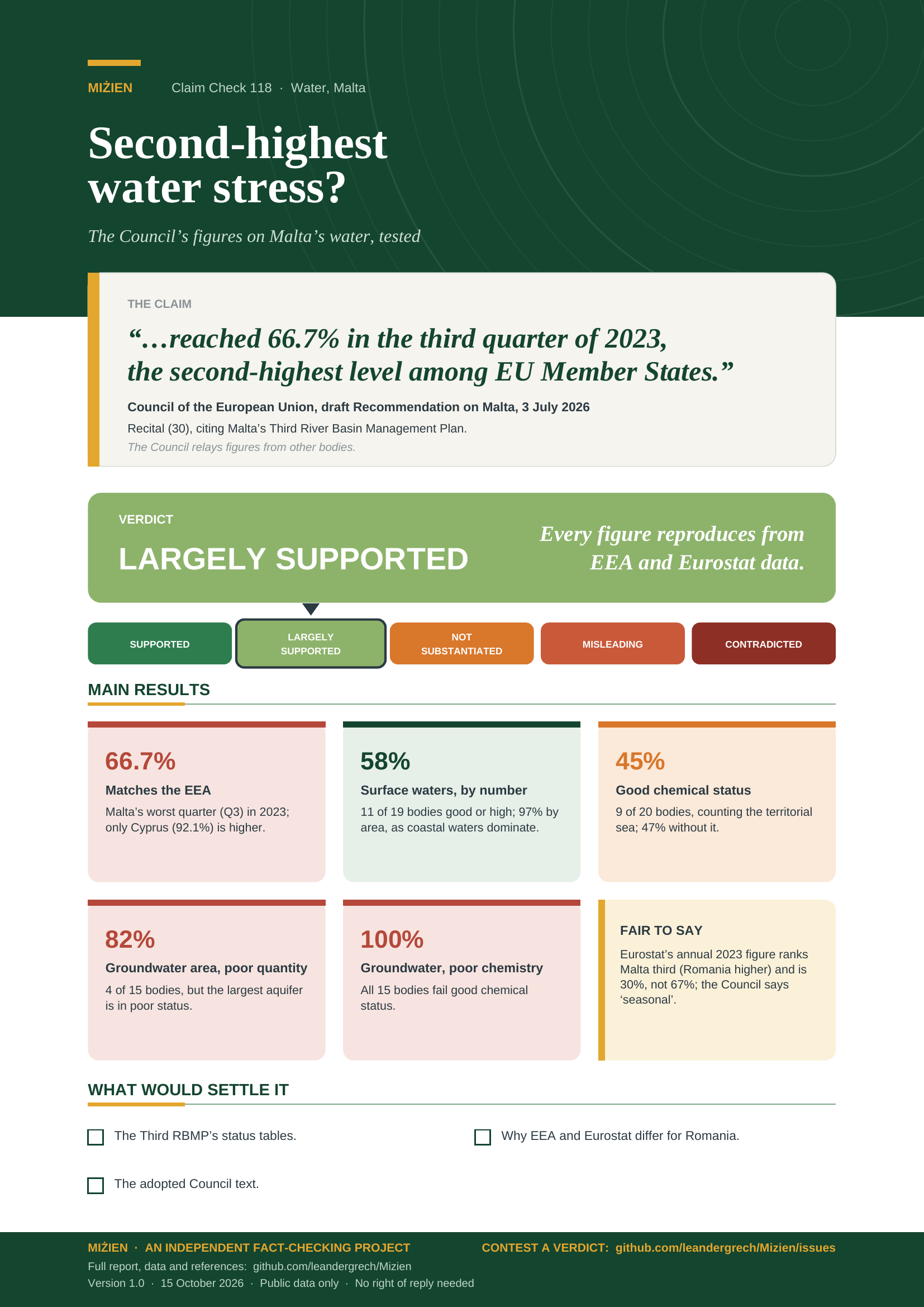
Second-highest water stress, groundwater failing?
Testing the Council’s figures on Malta’s water against the EEA and Eurostat
“…the seasonal Water Exploitation Index Plus (WEI+), which reached 66.7% in the third quarter of 2023…”
Council of the European Union, draft Recommendation on Malta, 3 July 2026, recital (30).
“…the second-highest level among EU Member States.”
Verdict: Largely supported All figures reproduce; ranking and one basis are caveated
Version 1.0 · 15 October 2026
TL;DR
The Council of the European Union’s draft Recommendation on Malta (3 July 2026, recital 30) says that Malta’s seasonal Water Exploitation Index Plus (WEI+) “reached 66.7% in the third quarter of 2023, the second-highest level among EU Member States”, and, citing Malta’s Third River Basin Management Plan, that only 58% of surface water bodies (by number) reached good or high ecological status, 45% good chemical status, and that 82% of groundwater bodies (by area) failed good quantitative status and 100% failed good chemical status [1]. We reproduced each figure from the European Environment Agency (EEA) and Eurostat.
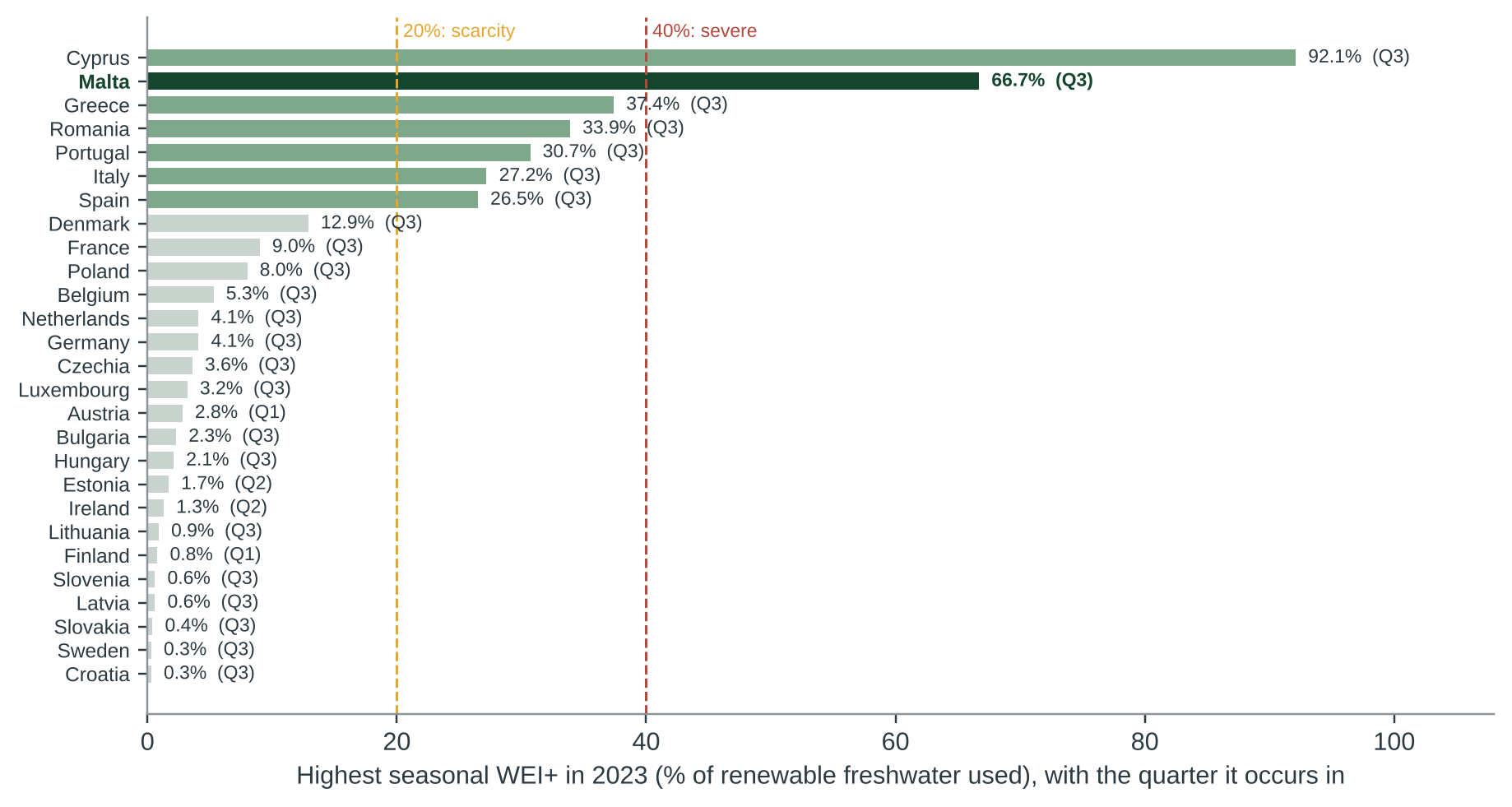
- The water-stress figure is the EEA’s, and the ranking holds. The EEA’s 2023 chart gives Malta 66.7% in Q3; only Cyprus (92.1%) is higher, and Greece is next at 37.4% [2]. Only Cyprus and Malta reach Eurostat’s 40% line for severe scarcity [3].
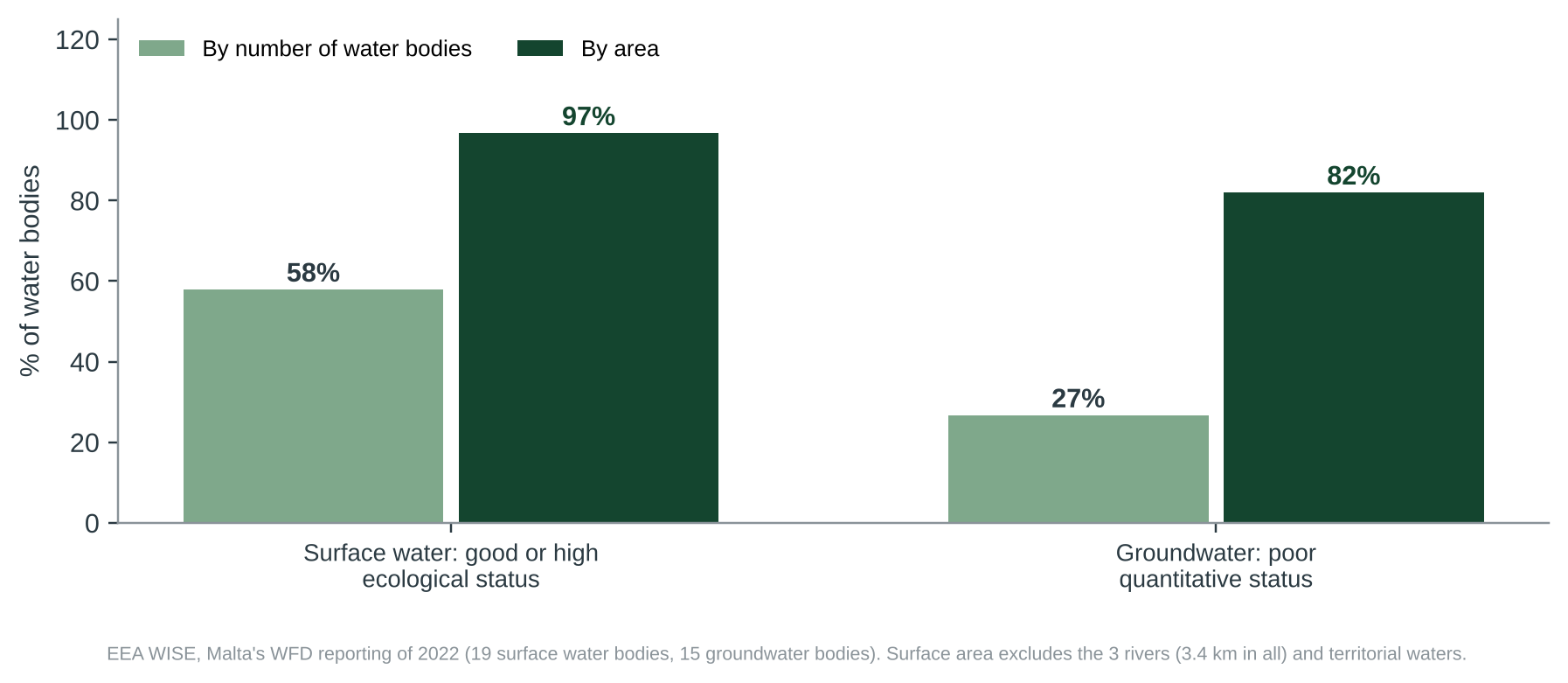
- Surface water: the percentages reproduce, but ‘by number’ matters. 11 of 19 bodies are good or high (58%) [4]. Nine coastal bodies hold 99.96% of the area; by area the figure is 97%.
- The 45% for chemical status counts the territorial waters. 9 of 20 bodies are good (45%); the 20th is the territorial sea, whose status is ‘Unknown’. Without it, 9 of 19 is 47%.
- Groundwater: 82% and 100% reproduce. 292.5 of 356.9 km² is in poor quantitative status (82%); 4 of 15 bodies by number. All 15 are in poor chemical status [4].
- Verdict: largely supported (high confidence). Caveats: the ranking depends on the series, the 45% basis is unstated, and we did not read the plan itself.
- Supported
- Largely supported
- Not substantiated
- Misleading
- Contradicted
What would make it ‘Supported’
The plan’s own tables showing the same counts and bases, and an explanation of the EEA–Eurostat gap for Romania.
What would lower it
A plan version with different counts, or a corrected series that moves Malta out of the top two.
IN THIS REPORT
1 The claim and its source
The wording is recital (30) of the draft Council Recommendation on Malta’s economic, social, employment, structural and budgetary policies, document 11130/26 of 3 July 2026 (PDF p. 16 of 22), a General Secretariat note to the Council committees [1]. It is a draft; we did not find the adopted text. The Council relays figures from the Commission’s 2026 country report and from Malta’s Third River Basin Management Plan (RBMP), neither of which we read.
| Council’s words (recital 30) | Basis given |
|---|---|
| “the seasonal Water Exploitation Index Plus (WEI+), which reached 66.7% in the third quarter of 2023, the second-highest level among EU Member States, indicating severe water scarcity” | None named |
| “only 58% of surface water bodies (by number) attained good or high ecological status, while just 45% met good chemical status” | Third RBMP; ‘by number’ stated for the first figure only |
| “82% of groundwater bodies (by area) failed to achieve good quantitative status, and 100% did not meet good chemical status” | Third RBMP; ‘by area’ stated for the first figure only |
2 Method
Question. Do the cited figures match the official data, and do the stated bases (‘seasonal’, ‘by number’, ‘by area’) change what they mean?
Evidence. The EEA’s indicator chart of each country’s worst seasonal WEI+ in 2023 [2]; Eurostat’s annual WEI+ (sdg_06_60) and its metadata [3]; the EEA’s WISE database of Malta’s 2022 Water Framework Directive reporting, which holds each water body’s status and area [4]; and the Energy and Water Agency’s 2024 technical document on groundwater levels [5]. We recomputed every share in tools/cc-118-report/calc.py from data/cc-118/ (source URLs and retrieval date in each file). Because the plan itself was refused to scripts, we use the WISE copy of Malta’s reporting as the stand-in; that the Council’s percentages come out exactly is the evidence they share a source.
Grades. All sources are official statistics or regulator data (grade C). Water-body status is self-reported by Malta to the EEA. No peer-reviewed paper is needed to reproduce the counts; two reviews give context [6, 7].
3 Water scarcity: the WEI+ figure
WEI+ is water consumption (abstraction less return flows) as a percentage of renewable freshwater resources. Eurostat’s metadata treats values above 20% as a sign of scarcity and 40% or more as severe scarcity, and warns that annual national values “may therefore mask water stress, which occurs on a seasonal or regional basis” [3].
| Measure (2023) | Malta | Comparison | Source |
|---|---|---|---|
| Worst seasonal WEI+ (EEA chart) | 66.7% (Q3), rank 2 of 27 | Cyprus 92.1%; Greece 37.4%; Romania 33.9% | EEA [2] |
| Annual WEI+ (Eurostat VAL_A) | 30.1%, rank 3 | Cyprus 75.3%; Romania 47.4% | Eurostat [3] |
| Four-year average (Eurostat AVG_4Y) | 33.4%, rank 2 | Cyprus 72.2%; Romania 27.9% | Eurostat [3] |
The Council’s number is the EEA’s, and Malta is second. Eurostat’s annual 2023 series ranks Malta third because it gives Romania 47.4%, higher than the 33.9% worst quarter in the EEA chart, which cannot both hold under one method; the series differ in vintage (Eurostat updated 28 April 2026, EEA chart November 2025) and we could not explain the difference. Ranking Malta second is therefore right on the indicator the Council names (seasonal) and on the four-year average, not on the 2023 annual value.
4 Water bodies: status counts
Malta reported 19 surface water bodies (9 coastal, 5 transitional, 3 river, 2 lake) plus its territorial sea, and 15 groundwater bodies [4]. Territorial waters carry only a chemical status, which is ‘Unknown’ in the data.
| Council figure | What the data give | Result |
|---|---|---|
| 58% of surface water bodies good or high ecological status (by number) | 11 of 19: coastal 8 of 9, transitional 3 of 5, river 0 of 3, lake 0 of 2. Assessed 2017–2022. | 58%, reproduced |
| 45% good chemical status | 9 of 20 including the territorial sea (status ‘Unknown’); 9 of 19 without it (47%). The 9 are the coastal bodies; all 10 river, lake and transitional bodies fail. | 45%, reproduced with 20 |
| 82% of groundwater bodies (by area) failed quantitative status | 292.5 of 356.9 km² (Malta, Marfa, Pwales and Gozo bodies). By number 4 of 15 (27%). Assessed 2021. | 82%, reproduced |
| 100% failed chemical status | 15 of 15 bodies, all poor. | 100%, reproduced |
The groundwater picture is corroborated by the Energy and Water Agency’s monitoring: 21 of 35 boreholes show a significant negative water-level trend over 2000–2021 in its Table 1 (the text says 62.9%, or 22) [5]. The EEA data show the chemical-status variant that excludes ubiquitous persistent substances is identical to the headline for every Maltese surface body, so that exclusion does not explain the failures [4].
5 Where the evidence points different ways
Q1 Is ‘severe water scarcity’ right?
YES AT THE PEAK, NOT ANNUALLYEVIDENCE FOR THE CLAIM'S IMPRESSION
The seasonal peak of 66.7% is far above Eurostat’s 40% line for severe scarcity, and only Cyprus and Malta are above it [2, 3].
EVIDENCE AGAINST
Eurostat’s annual 2023 value for Malta is 30.1%, in the 20–40% band of ‘scarcity’, and Eurostat warns annual values can mask seasonal stress [3].
Q2 Is surface water quality ‘poor’?
DEPENDS ON THE COUNTEVIDENCE FOR THE CLAIM'S IMPRESSION
By number only 58% reach good or high ecological status and 45% good chemical status, so almost half the bodies fall short.
EVIDENCE AGAINST
By area 97% of surface water is at good or high ecological status, because nine coastal bodies hold 99.96% of it; the failing bodies are ten small lagoons, saltpans, lakes and wadis.
6 Testing the claim
| Sub-claim | What the evidence shows | Rating |
|---|---|---|
| A. Seasonal WEI+ reached 66.7% in Q3 2023, indicating severe water scarcity | Exact match to the EEA chart [2]; above Eurostat’s 40% severe line [3]. An annual figure would be 30.1%. | SUPPORTED |
| B. That is the second-highest among EU Member States | Second after Cyprus on the EEA chart and the four-year average; third on Eurostat’s annual 2023 value (Romania higher). | LARGELY SUPPORTED |
| C. 58% of surface water bodies (by number) at good or high ecological status | 11 of 19 [4]; 97% by area. | SUPPORTED |
| D. 45% of surface water bodies at good chemical status | 9 of 20 [4]; needs the territorial sea in the denominator; 47% without. Basis not stated. | LARGELY SUPPORTED |
| E. 82% of groundwater bodies (by area) failed quantitative status | 81.96% by area [4]; 27% by number. Corroborated by borehole trends [5]. | SUPPORTED |
| F. 100% of groundwater bodies failed chemical status | 15 of 15 [4]. | SUPPORTED |
7 Verdict and requests for evidence
Every figure reproduces from EEA and Eurostat data; the ranking and the 45% depend on the dataset and the denominator. Confidence: high. No right of reply needed.
Why. (1) Five of the six figures reproduce exactly and the sixth (45%) reproduces with a defensible denominator. (2) The caveats are minor: the ranking depends on the series, and ‘by number’ gives a harsher picture of surface waters than area does, as the Council’s own wording signals. Our scale calls that Largely supported.
What this verdict does not say. It does not say Malta’s water is well managed or that the status classes are the right yardstick; it says the Council’s numbers match the official data.
Evidence we are asking for
- From the Energy and Water Agency or ERA: the Third RBMP’s status tables, to confirm the counts and the basis of the 45%.
- From the EEA and Eurostat: why Romania’s 2023 annual WEI+ (47.4%) exceeds its worst-quarter value in the EEA chart (33.9%).
- From the Council: the adopted text of the Recommendation and the document in which the WEI+ sentence first appears.
8 Limitations
- We did not read the Third RBMP (era.org.mt returned 403), the Commission’s 2026 country report or the adopted Recommendation. The WISE data are Malta’s 2022 reporting; the plan is dated March 2024 and could differ.
- Status classes use the WISE legends (codes read from the services’ own legend); the Water Framework Directive was not re-read.
- The EEA chart was read from the page’s embedded data; we have no independent copy of its underlying dataset.
- The EWA borehole table has 35 rows; its text reports one more negative trend than the rows show. We cite both.
- Only the two WEI+ series and one plan year were tested; later 2024–2026 values were not available.
References
- [1] Council of the European Union (3 Jul 2026). Draft Council Recommendation on Malta’s economic, social, employment, structural and budgetary policies, 11130/26, recital (30). (Read in full; draft.) https://data.consilium.europa.eu/doc/document/ST-11130-2026-INIT/en/pdf
- [2] European Environment Agency. Worst seasonal water scarcity conditions for European countries in 2023, measured by WEI+ (indicator page, modified 28 Nov 2025; chart data read 15 Oct 2026). https://www.eea.europa.eu/en/analysis/indicators/use-of-freshwater-resources-in-europe-1/worst-seasonal-water-scarcity-conditions
- [3] Eurostat. Water exploitation index, plus (WEI+), sdg_06_60, and reference metadata (updated 28 Apr 2026; retrieved 15 Oct 2026). https://ec.europa.eu/eurostat/cache/metadata/en/sdg_06_60_esmsip2.htm
- [4] European Environment Agency. WISE Water Framework Directive database, Malta, 2022 reporting (surface and groundwater bodies); queried 15 Oct 2026. https://water.discomap.eea.europa.eu/arcgis/rest/services/WISE_WFD/
- [5] Energy and Water Agency (May 2024). Technical Document in support of the 3rd RBMP: Monitoring Results for the Groundwater Quantitative Status Assessment, Table 1. https://energywateragency.gov.mt/wp-content/uploads/2024/05/Technical-Document-Status-of-the-Quantitative-monitoring-network_Final.pdf
- [6] Hartfiel L., Soupir M., Kanwar R. (2020). Malta’s Water Scarcity Challenges: Past, Present, and Future Mitigation Strategies for Sustainable Water Supplies. Sustainability 12(23). doi:10.3390/su12239835 (Crossref-verified; abstract read.) https://doi.org/10.3390/su12239835
- [7] Casadei S., Peppoloni F., Pierleoni A. (2020). A New Approach to Calculate the Water Exploitation Index (WEI+). Water 12(11). doi:10.3390/w12113227 (Crossref-verified; abstract read.) https://doi.org/10.3390/w12113227
- [8] Miżien. Data and calculations: data/cc-118/; tools/cc-118-report/.
Appendix A: series standards and verdict scale
Every investigation in this series follows the same rules so that verdicts are comparable and challengeable.
| Verdict | Meaning |
|---|---|
| SUPPORTED | Evidence consistently backs the claim as stated. |
| LARGELY SUPPORTED | Backed by the evidence, with minor caveats that do not change the substance. |
| NOT SUBSTANTIATED | Stated more strongly than the evidence offered or available allows. May be true in some conditions but has not been shown. |
| MISLEADING | Omits material facts so that the overall impression is inaccurate, even if individual statements are defensible. |
| CONTRADICTED | The available evidence points against the claim. |
Confidence
High: multiple independent lines of evidence agree. Moderate: evidence is relevant but incomplete or indirect. Low: evidence is thin, second-hand or conflicting.
Evidence grades
A experiment · B observational study with a control or gradient · C review, guidance or official statistics · D assertion or anecdote. ◆ marks a source known only second-hand.
Standards
- Quote the speaker, not the headline, with outlet and date, and link the original where possible.
- Separate the claim from the evidence offered for it, and say who made which statement.
- Grade the evidence and show differing views side by side where the evidence is unsettled.
- State what we could not access or verify, and what would change the verdict either way.
- Ask for the missing evidence in specific, answerable requests.
- Offer a right of reply where a check finds a claim Not substantiated, Misleading or Contradicted (or a pledge Not measurable, Off track or Missed), before wider circulation, and append responses.
- Correct errors openly with a version number and change log.
- Whistle-blow only on evidence: a verdict of Misleading or Contradicted requires documents or data that can be shown, not inference.
- Check every side. Government, opposition, NGOs and developers are held to the same standard.
Appendix B: revision log
| Version | Date | Change |
|---|---|---|
| 1.0 | 15 Oct 2026 | First issue. Verdict Largely supported. No right of reply needed. |
Sources and archived copies
-
Council Recommendation on the economic, social, employment, structural and budgetary policies of Malta (draft, 11130/26), Council of the European Union, General Secretariat, 2026-07-03.
Original · not yet archived
The claim, recital (30). Full text extracted and read on 11 Oct 2026. It is a draft note to Coreper/Council; check the adopted text. The figures are taken from the Commission 2026 country report and from Malta's Third River Basin Management Plan.
Right of reply
Not needed: this check finds the claim supported. A right of reply is sought when a check finds a claim Not substantiated, Misleading or Contradicted.
Connections
How this claim relates to the others: who made it, the themes it shares with other claims, and the patterns it shows. A connection is a reason to read two checks side by side. It does not make either one right or wrong. How connections are found.
Who made it
Other claims by Council of the European Union 1
Linked directly 4
Claims that share a theme with this one. A theme is a cause, a mechanism, a target or a way of presenting figures that the editors have found in several claims; its strength says how close the link is.
Water chain: farm waste, sewage, sea, aquifer Shared cause · Strong
The Commission blames farm waste in the sewers for poor treatment; agricultural nitrates are behind groundwater failure. Treated water also feeds 'new water' irrigation.
Two steps away 6
Not linked to this claim directly, but linked to a claim that is. These are found by following the links, not chosen by the editors, so they are looser: they show where one theme meets another.
- CC-005 “92% excellent” bathing water (Supported)through Water chain: farm waste, sewage, sea, aquiferCC-009Water chain: farm waste, sewage, sea, aquifer or Water chain: farm waste, sewage, sea, aquiferCC-041Water chain: farm waste, sewage, sea, aquifer
- CC-039 Net Zero Impact Utility (pledge: Not measurable)through Water chain: farm waste, sewage, sea, aquiferCC-009Water chain: farm waste, sewage, sea, aquifer or Water chain: farm waste, sewage, sea, aquiferCC-101Water chain: farm waste, sewage, sea, aquifer
- CC-108 Net-zero impact on the groundwater environment (pledge: Not measurable)through Water chain: farm waste, sewage, sea, aquiferCC-009Water chain: farm waste, sewage, sea, aquifer or Water chain: farm waste, sewage, sea, aquiferCC-101Water chain: farm waste, sewage, sea, aquifer
- CC-117 EU: Malta missed recycling targets (reasoned opinion) (not yet checked)through Water chain: farm waste, sewage, sea, aquiferCC-101EU findings of unmet obligations
- CC-128 EU: Malta missed the water-plan timetable (not yet checked)through Water chain: farm waste, sewage, sea, aquiferCC-101EU findings of unmet obligations
- CC-129 EU: Malta has not updated its air pollution programme (not yet checked)through Water chain: farm waste, sewage, sea, aquiferCC-101EU findings of unmet obligations
Three steps away 5
One step further again. At this distance a connection says more about how the themes fit together than about this claim.
- CC-004 'Strong progress' in waste separation (Not substantiated)through Water chain: farm waste, sewage, sea, aquiferCC-101EU findings of unmet obligationsCC-117Waste and construction
- CC-042 'From Blue Flag to Red Alert' (Largely supported)through Water chain: farm waste, sewage, sea, aquiferCC-009Water chain: farm waste, sewage, sea, aquiferCC-005Water chain: farm waste, sewage, sea, aquifer
- CC-043 13 Blue Flag beaches (not yet checked)through Water chain: farm waste, sewage, sea, aquiferCC-009Water chain: farm waste, sewage, sea, aquiferCC-005Water chain: farm waste, sewage, sea, aquifer
- CC-081 Landfill share rising (not yet checked)through Water chain: farm waste, sewage, sea, aquiferCC-101EU findings of unmet obligationsCC-117Waste and construction
- CC-111 EU: 621 kg of waste a head, 74% landfilled (Supported)through Water chain: farm waste, sewage, sea, aquiferCC-101EU findings of unmet obligationsCC-117Waste and construction
Similar wording
Claims whose own words overlap with this one, with the words they share. Found by comparing the wording of the claims, not their verdicts; a lead to read them together, not a finding.
- CC-101 EU: no registration or prior authorisation of water abstraction in Malta (Largely supported)shares: surface, bodies, groundwater
Timeline
What was said, what was published before and after it, and each step of this check, in date order. Statements and sources carry the date they were published. The steps of the check carry the date the research was done, from the check's research log. Other statements by the same body on the same topic show whether a position was repeated, changed or corrected.
2024
- May 2024 Evidence published Technical Document: Groundwater Quantitative Status Assessment, 3rd RBMP, Energy and Water Agency
2026
- 3 July 2026 The statement Council of the European Union (this claim)
- 3 July 2026 Statement published Council Recommendation on the economic, social, employment, structural and budgetary policies of Malta (draft, 11130/26), Council of the European Union
- 11 October 2026 Added to the claims to check
- 15 October 2026 Evidence published Worst seasonal water scarcity conditions for European countries in 2023 (WEI+), European Environment Agency
- 15 October 2026 Evidence published Water exploitation index, plus (WEI+), sdg_06_60 and metadata, Eurostat
- 15 October 2026 Evidence published WISE WFD database, Malta 2022 reporting (surface and groundwater bodies), European Environment Agency
- 15 October 2026 Check started Check started by worker C. Council recital (30) of draft Recommendation 11130/26 re-read in full from the Council register (PDF p. 16 of 22).
- 15 October 2026 Exact wording found Verbatim found. EEA indicator chart data, Eurostat sdg_06_60 and metadata, EEA WISE Malta 2022 reporting and the EWA May 2024 groundwater technical document retrieved. Third RBMP (era.org.mt) refused to scripts; adopted Council text not found.
- 15 October 2026 Version 1.0: first issue First issue. Largely supported (high). No right of reply needed. Verdict in this version: Largely supported, high confidence.
- 15 October 2026 Evidence reviewed
2027
- 15 October 2027 Coming up: Evidence review due Each finished check is reviewed against new evidence within a year.
Every change to this claim's record is public: history of the record.
Download the report and flyer