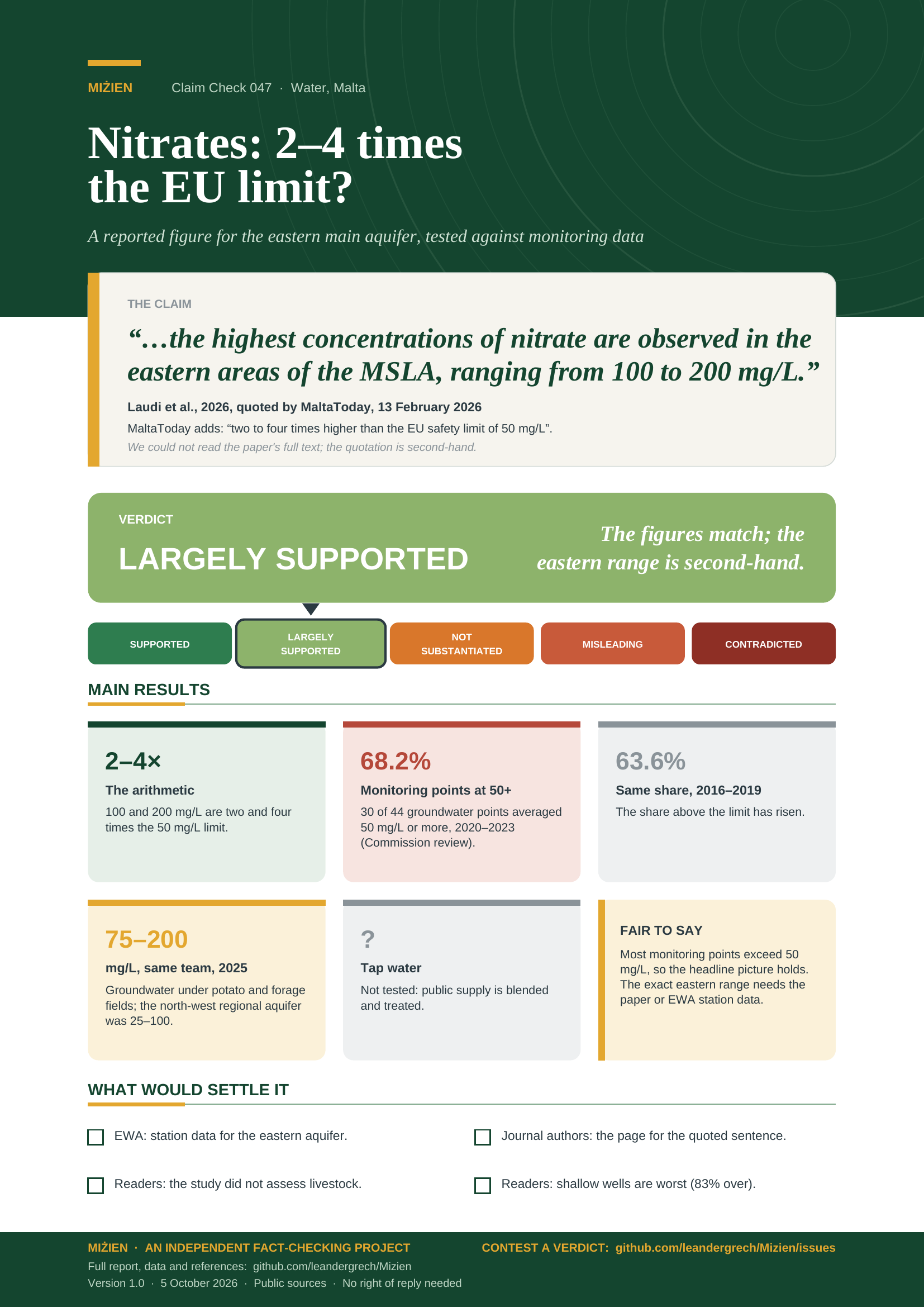
CC-047 · Water · Water supply & groundwater
Nitrates in the aquifer
Largely supported Moderate confidence Draft: no right of reply needed
Parts of this claim
The claim is split into parts that are tested separately, as in the report below. Each part has its own number.
- CC-047A Nitrate in the eastern areas of the main aquifer is 100–200 mg/L (MaltaToday, quoting Laudi et al. [1])Matches the team’s 2025 abstract (75–200 mg/L under potato/forage fields). Full text not read.
- CC-047B That is two to four times the EU limit of 50 mg/L (MaltaToday [1])100/50 = 2 and 200/50 = 4; 50 mg/L is the Nitrates Directive and drinking-water threshold.
- CC-047C Groundwater nitrate is a widespread problem in Malta (MaltaToday [1])30 of 44 monitoring points at 50 mg/L or more, 2020–2023; up from 63.6% [4].
Claim Check 047 · Water and groundwater
Nitrates in Malta’s main aquifer?
Testing a reported 100–200 mg/L, two to four times the EU limit
“…the highest concentrations of nitrate are observed in the eastern areas of the MSLA, ranging from 100 to 200 mg/L.”
Laudi et al., J. Hydrol.: Regional Studies, 2026, as quoted by MaltaToday, 13 Feb 2026.
MaltaToday: “two to four times higher than the EU safety limit of 50 mg/L”.
Verdict: Largely supported Figures match the study; eastern range second-hand
Version 1.0 · 5 October 2026
TL;DR
On 13 February 2026 MaltaToday reported on a peer-reviewed study of nitrate in Malta’s groundwater. The article quotes the study: “the highest concentrations of nitrate are observed in the eastern areas of the MSLA, ranging from 100 to 200 mg/L”, and adds that this is “two to four times higher than the EU safety limit of 50 mg/L”. We checked the arithmetic and tested the picture against the Commission’s own review of Malta’s monitoring data.
- The arithmetic and the limit are right. 100 and 200 mg/L are two and four times 50 mg/L, the nitrate limit in the Nitrates Directive and the drinking-water standard.
- The picture is confirmed by independent monitoring. The Commission’s 2020–2023 review of Malta’s Energy and Water Agency data finds 30 of 44 groundwater monitoring points (68.2%) with an average of 50 mg/L or more, up from 63.6% in 2016–2019.
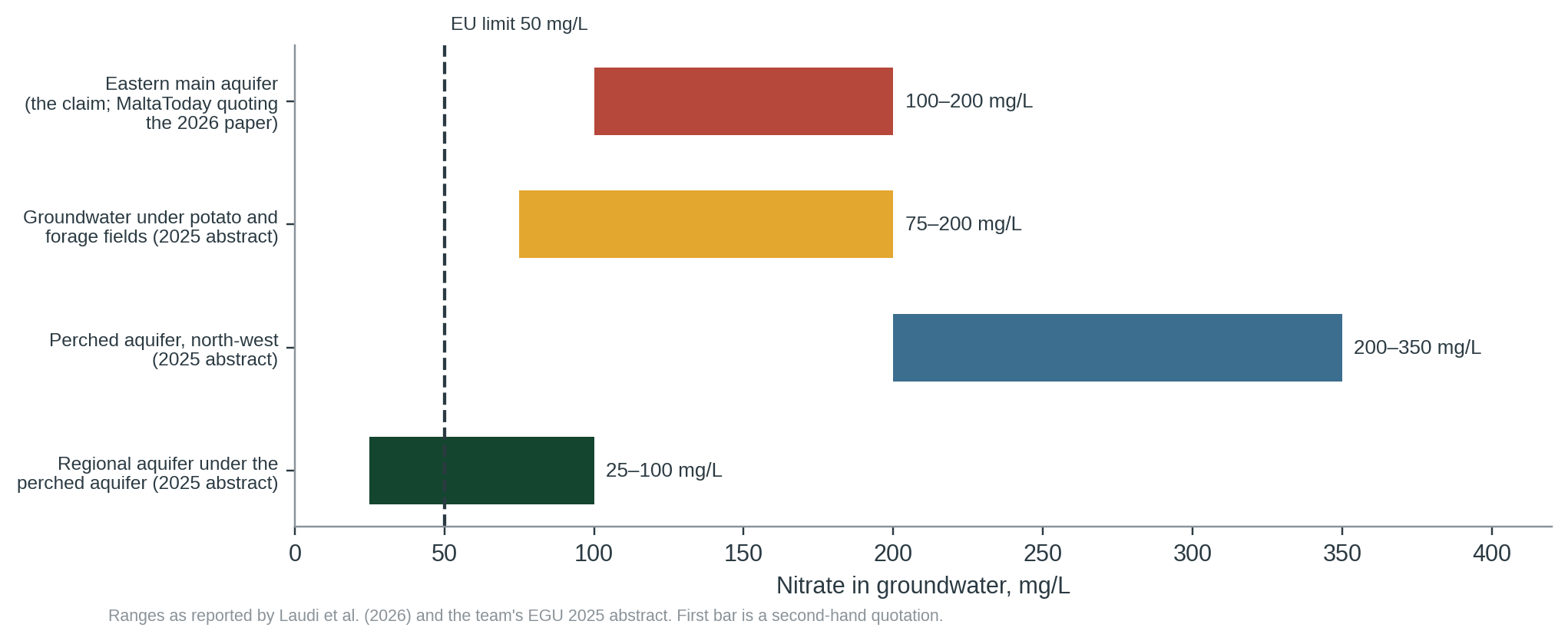
- The 100–200 mg/L figure matches the research team’s own earlier abstract. A 2025 EGU abstract by the same group gives 75–200 mg/L for groundwater under potato and forage fields in the central and eastern areas, and 25–100 mg/L in the regional aquifer under the north-western perched aquifer.
- We could not read the paper’s full text. The sentence is therefore a second-hand quotation (via MaltaToday). Independent data do not give the eastern aquifer’s range separately.
- Verdict: largely supported (moderate confidence). The figures are the study’s and the direction is confirmed; the exact eastern range rests on a quotation we could not check in the paper.
- Supported
- Largely supported
- Not substantiated
- Misleading
- Contradicted
What would move the verdict up
The paper’s full text confirming the 100–200 mg/L sentence, with EWA station data for the eastern aquifer, would move this to Supported.
What would move it down
Station data showing the eastern aquifer’s typical values well below 100 mg/L, or a statement in the paper that the range is a local maximum.
IN THIS REPORT
1 The claim and what we could verify
The claim record came from a MaltaToday article by James Debono, “Potatoes and intensive farming: A slow-moving threat to Malta’s groundwater”, 13 February 2026 [1]. We read it on 5 October 2026. The relevant paragraph says: “In the eastern areas of the main aquifer, the report notes: ‘Specifically, the highest concentrations of nitrate are observed in the eastern areas of the MSLA, ranging from 100 to 200 mg/L.’ This is two to four times higher than the EU safety limit of 50 mg/L.” The words inside quotation marks are the paper’s; the comparison with the limit is the outlet’s. The paper is Laudi, Dahan, Sapiano, Schembri, Galea, Busuttil, Mangion and Turkeltaub (2026), Journal of Hydrology: Regional Studies 64:103162 [2].
| Source | What it says | Our access | Status |
|---|---|---|---|
| MaltaToday, 13 Feb 2026 [1] | Quotes the paper (100–200 mg/L, eastern MSLA) and adds “two to four times higher than the EU safety limit”. | Read in full. | The claim |
| Laudi et al. (2026), J. Hydrol.: Reg. Stud. [2] | Open-access (CC BY) study: 16 vadose-zone stations, five years; potato farming the dominant nitrate source for the main aquifer. | Crossref and OpenAlex abstract only; full text blocked ◆. | Primary study |
| Laudi et al. (2025), EGU abstract [3] | Groundwater under potato and forage fields 75–200 mg/L; perched aquifer 200–350; regional aquifer 25–100. | Abstract read (Crossref). | Same team, earlier |
| European Commission, SWD(2026) 232, Malta fiche [4] | Of 44 groundwater points, 68.2% average 50 mg/L or more (2020–2023). | Read in full (PDF). | Independent |
2 Method
Question. Is the quoted range reported accurately, is the comparison with the EU limit correct, and does independent monitoring agree with the picture?
Evidence. We transcribed the Commission’s figures into data/cc-047/, with source and retrieval date, and ran tools/cc-047-report/calc.py to test the arithmetic (multiples of 50 mg/L; shares times 44 stations give whole numbers; depth classes add up to 30 points). We compared the ranges in the team’s 2025 abstract with the 2026 quotation.
Grades. Laudi et al. (2026): B (observational study, monitoring network). Commission fiche: C (official statistics from national reporting). MaltaToday: D as evidence, used only as the locator. Verdicts follow the scale in Appendix A.
3 What the data show
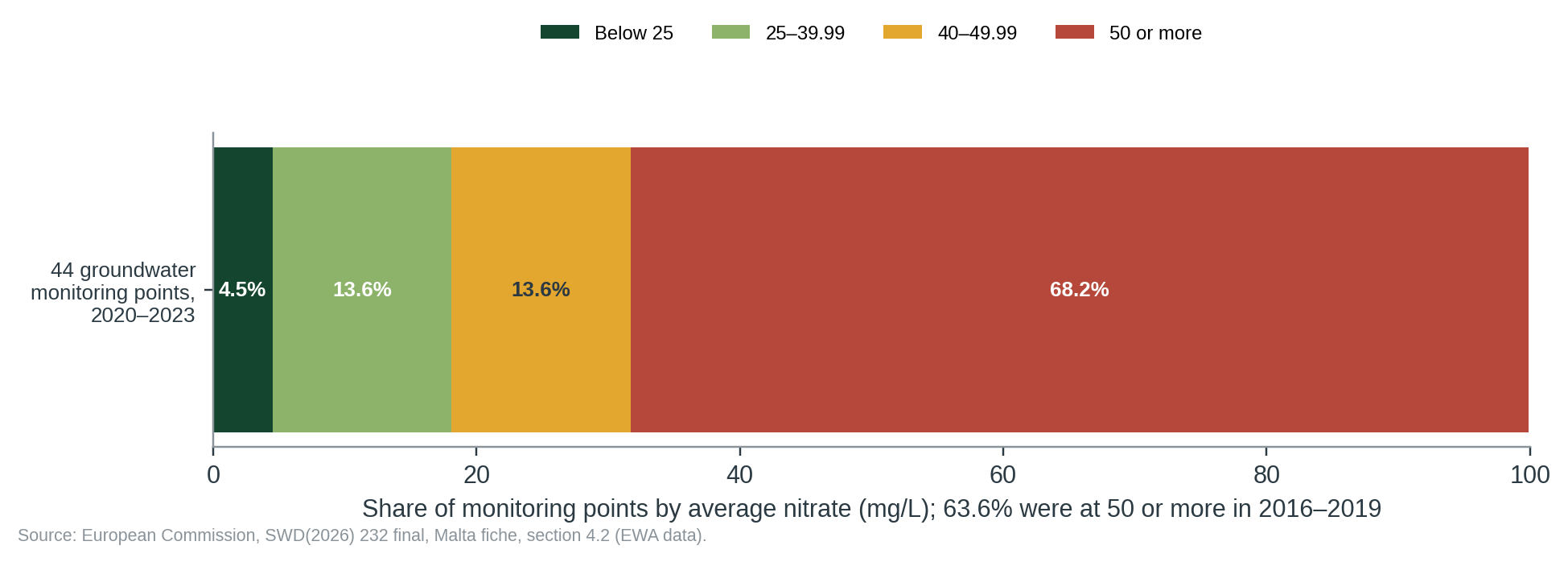
Thirty points (68.2%) average 50 mg/L or more, six (13.6%) are at 40–49.99 mg/L, six at 25–39.99 and two below 25. The share at 50 or more rose from 63.6% (28 points) in 2016–2019. The Commission counts 35 nitrate pollution hotspots (79.5% of points) and notes that among points already at 50 or more, 88.9% were rising. The highest share is among shallow (5–15 m) wells at 83.3%. Whole-island averages per station are not published, so the Commission data cannot confirm “100–200 mg/L” for the eastern aquifer; they confirm that exceedance is the norm, not the exception.
4 Where the evidence points different ways
Are the eastern aquifer’s nitrates 100–200 mg/L?
BROADLY YES, AS A RANGEFOR
The quoted sentence (study, via MaltaToday) and the team’s 2025 abstract (75–200 mg/L under potato and forage fields; central and eastern areas) are consistent. Commission data show most points at 50 or more.
CAVEATS
The 2025 abstract gives 25–100 mg/L for the regional aquifer beneath the north-west perched aquifer, so values differ widely by area. “Highest concentrations” are a range at the top, not a typical value for every well.
5 Testing the claim
| Sub-claim | Said by | What the evidence shows | Rating |
|---|---|---|---|
| A. Nitrate in the eastern areas of the main aquifer is 100–200 mg/L | MaltaToday, quoting Laudi et al. [1] | Matches the team’s 2025 abstract (75–200 mg/L under potato/forage fields). Full text not read. | LIKELY |
| B. That is two to four times the EU limit of 50 mg/L | MaltaToday [1] | 100/50 = 2 and 200/50 = 4; 50 mg/L is the Nitrates Directive and drinking-water threshold. | ACCURATE |
| C. Groundwater nitrate is a widespread problem in Malta | MaltaToday [1] | 30 of 44 monitoring points at 50 mg/L or more, 2020–2023; up from 63.6% [4]. | CONFIRMED |
6 Verdict and requests for evidence
The figures are the study’s and independent monitoring agrees on the picture; the eastern range rests on a quotation we could not check. Confidence: moderate.
Why. The arithmetic is right, the limit is the right one, and the Commission’s review of Malta’s own monitoring shows exceedance at most points. Why not Supported. The central sentence is a second-hand quotation, and no independent dataset gives the eastern aquifer’s range. What this verdict does not say. It does not say that the aquifer water reaching taps exceeds 50 mg/L: public supply is blended and treated, and we did not test tap-water data.
Evidence we are asking for
- From the Energy and Water Agency: station-level nitrate data for the eastern Mean Sea Level Aquifer, 2020–2025.
- From the authors or the journal: the paper’s page for the 100–200 mg/L sentence (open access).
7 Limitations
- We could not read the full text of Laudi et al. (2026); ScienceDirect refuses scripted access. The quoted sentence is second-hand, and the 2025 abstract is a conference abstract, not peer-reviewed in the same way.
- The Commission figures are per-station averages of annual means; they do not give an aquifer-wide mean.
- The study did not assess animal husbandry, which MaltaToday notes is a major nitrate source.
- We did not test whether groundwater levels translate to drinking-water levels.
References
- [1] Debono J. (13 February 2026). Potatoes and intensive farming: A slow-moving threat to Malta’s groundwater. MaltaToday. https://www.maltatoday.com.mt/news/national/139611/potatoes_and_intensive_farming_a_slowmoving_threat_to_maltas_groundwater
- [2] Laudi L., Dahan O., Sapiano M., Schembri M., Galea L., Busuttil E., Mangion J. & Turkeltaub T. (2026). Tracing nitrate fate in Malta’s hydrogeological system using an intensive vadose-groundwater monitoring network. Journal of Hydrology: Regional Studies 64:103162. doi:10.1016/j.ejrh.2026.103162. ◆ (abstract only). https://doi.org/10.1016/j.ejrh.2026.103162
- [3] Laudi L., Dahan O., Sapiano M., Schembri M. & Turkeltaub T. (2025). Using vadose zone data to determine agricultural impact on groundwater pollution. EGU General Assembly abstract EGU25-13344. doi:10.5194/egusphere-egu25-13344. https://doi.org/10.5194/egusphere-egu25-13344
- [4] European Commission (2026). Member State country fiche, Malta, on the implementation of Directive 91/676/EEC 2020–2023, SWD(2026) 232 final, Part 20/27 (Council doc. 12018/26 ADD 19). https://data.consilium.europa.eu/doc/document/ST-12018-2026-ADD-19/en/pdf
- [5] MiŻien. Data and calculation: data/cc-047/; tools/cc-047-report/calc.py.
Appendix A: series standards and verdict scale
Every investigation in this series follows the same rules so that verdicts are comparable and challengeable.
| Verdict | Meaning |
|---|---|
| SUPPORTED | Evidence consistently backs the claim as stated. |
| LARGELY SUPPORTED | Backed by the evidence, with minor caveats that do not change the substance. |
| NOT SUBSTANTIATED | Stated more strongly than the evidence offered or available allows. May be true in some conditions but has not been shown. |
| MISLEADING | Omits material facts so that the overall impression is inaccurate, even if individual statements are defensible. |
| CONTRADICTED | The available evidence points against the claim. |
Confidence
High: multiple independent lines of evidence agree. Moderate: evidence is relevant but incomplete or indirect. Low: evidence is thin, second-hand or conflicting.
Evidence grades
A experiment · B observational study with a control or gradient · C review, guidance or official statistics · D assertion or anecdote. ◆ marks a source known only second-hand.
Standards
- Quote the speaker, not the headline, with outlet and date, and link the original where possible.
- Separate the claim from the evidence offered for it, and say who made which statement.
- Grade the evidence and show differing views side by side where the evidence is unsettled.
- State what we could not access or verify, and what would change the verdict either way.
- Ask for the missing evidence in specific, answerable requests.
- Offer a right of reply where a check finds a claim Not substantiated, Misleading or Contradicted (or a pledge Not measurable, Off track or Missed), before wider circulation, and append responses.
- Correct errors openly with a version number and change log.
- Whistle-blow only on evidence: a verdict of Misleading or Contradicted requires documents or data that can be shown, not inference.
- Check every side. Government, opposition, NGOs and developers are held to the same standard.
Appendix B: revision log
| Version | Date | Change |
|---|---|---|
| 1.0 | 5 Oct 2026 | First issue. Verdict Largely supported (moderate confidence); no right of reply needed. |
Sources and archived copies
-
Potatoes and intensive farming: A slow-moving threat to Malta's groundwater, MaltaToday, 2026-02-13.
Original · Archived copy
The claim; quotes the paper in quotation marks. The 'two to four times the EU limit' comparison is the outlet's. Read 5 Oct 2026. -
Tracing nitrate fate in Malta's hydrogeological system using an intensive vadose-groundwater monitoring network, Journal of Hydrology: Regional Studies 64:103162, 2026.
Original · fetched and fingerprinted 2026-10-05; no public snapshot yet
The study (open access, CC BY). Crossref verified; abstract read; full text not retrievable, so the quoted sentence is second-hand. -
Using vadose zone data to determine agricultural impact on groundwater pollution (EGU25-13344), EGU General Assembly 2025, 2025.
Original · fetched and fingerprinted 2026-10-05; no public snapshot yet
Same team; 75-200 mg/L under potato/forage fields, 25-100 mg/L regional aquifer. -
Member State country fiche, Malta: Nitrates Directive 2020-2023, SWD(2026) 232 final, Part 20/27, European Commission, 2026-07-15.
Original · Archived copy
Independent: 30 of 44 groundwater points average 50 mg/L or more (2020-2023).
Right of reply
Not needed: this check finds the claim supported. A right of reply is sought when a check finds a claim Not substantiated, Misleading or Contradicted.
Connections
How this claim relates to the others: who made it, the themes it shares with other claims, and the patterns it shows. A connection is a reason to read two checks side by side. It does not make either one right or wrong. How connections are found.
Linked directly 3
Claims that share a theme with this one. A theme is a cause, a mechanism, a target or a way of presenting figures that the editors have found in several claims; its strength says how close the link is.
Water chain: farm waste, sewage, sea, aquifer Shared cause · Weak (indicative)
The Commission blames farm waste in the sewers for poor treatment; agricultural nitrates are behind groundwater failure. Treated water also feeds 'new water' irrigation.
Two steps away 7
Not linked to this claim directly, but linked to a claim that is. These are found by following the links, not chosen by the editors, so they are looser: they show where one theme meets another.
- CC-005 “92% excellent” bathing water (Supported)through Water chain: farm waste, sewage, sea, aquiferCC-009Water chain: farm waste, sewage, sea, aquifer
- CC-039 Net Zero Impact Utility (pledge: Not measurable)through Water chain: farm waste, sewage, sea, aquiferCC-009Water chain: farm waste, sewage, sea, aquifer or Water chain: farm waste, sewage, sea, aquiferCC-101Water chain: farm waste, sewage, sea, aquifer
- CC-041 Sewage plants compliant by 2026 (not yet checked)through Water chain: farm waste, sewage, sea, aquiferCC-118Water chain: farm waste, sewage, sea, aquifer
- CC-108 Net-zero impact on the groundwater environment (pledge: Not measurable)through Water chain: farm waste, sewage, sea, aquiferCC-009Water chain: farm waste, sewage, sea, aquifer or Water chain: farm waste, sewage, sea, aquiferCC-101Water chain: farm waste, sewage, sea, aquifer
- CC-117 EU: Malta missed recycling targets (reasoned opinion) (not yet checked)through Water chain: farm waste, sewage, sea, aquiferCC-101EU findings of unmet obligations
- CC-128 EU: Malta missed the water-plan timetable (not yet checked)through Water chain: farm waste, sewage, sea, aquiferCC-101EU findings of unmet obligations
- CC-129 EU: Malta has not updated its air pollution programme (not yet checked)through Water chain: farm waste, sewage, sea, aquiferCC-101EU findings of unmet obligations
Three steps away 5
One step further again. At this distance a connection says more about how the themes fit together than about this claim.
- CC-004 'Strong progress' in waste separation (Not substantiated)through Water chain: farm waste, sewage, sea, aquiferCC-101EU findings of unmet obligationsCC-117Waste and construction
- CC-042 'From Blue Flag to Red Alert' (Largely supported)through Water chain: farm waste, sewage, sea, aquiferCC-009Water chain: farm waste, sewage, sea, aquiferCC-005Water chain: farm waste, sewage, sea, aquifer
- CC-043 13 Blue Flag beaches (not yet checked)through Water chain: farm waste, sewage, sea, aquiferCC-009Water chain: farm waste, sewage, sea, aquiferCC-005Water chain: farm waste, sewage, sea, aquifer
- CC-081 Landfill share rising (not yet checked)through Water chain: farm waste, sewage, sea, aquiferCC-101EU findings of unmet obligationsCC-117Waste and construction
- CC-111 EU: 621 kg of waste a head, 74% landfilled (Supported)through Water chain: farm waste, sewage, sea, aquiferCC-101EU findings of unmet obligationsCC-117Waste and construction
Timeline
What was said, what was published before and after it, and each step of this check, in date order. Statements and sources carry the date they were published. The steps of the check carry the date the research was done, from the check's research log. Other statements by the same body on the same topic show whether a position was repeated, changed or corrected.
2025
- 2025 Evidence published Using vadose zone data to determine agricultural impact on groundwater pollution (EGU25-13344), Laudi et al.
2026
- 13 February 2026 The statement MaltaToday (this claim)
- 2026 Evidence published Tracing nitrate fate in Malta's hydrogeological system (J. Hydrol.: Reg. Stud. 64:103162), Laudi et al.
- 15 July 2026 Evidence published Malta country fiche, Nitrates Directive 2020-2023, SWD(2026) 232 final Part 20/27, European Commission
- 4 October 2026 Added to the claims to check
- 5 October 2026 Exact wording found MaltaToday article (13 Feb 2026) read in full; it quotes the paper's sentence 'the highest concentrations of nitrate are observed in the eastern areas of the MSLA, ranging from 100 to 200 mg/L'. The comparison with the EU limit is the outlet's.
- 5 October 2026 Note Paper verified in Crossref and OpenAlex (abstract); full text blocked (ScienceDirect 403, Elsevier API needs key). The same team's EGU 2025 abstract read. Commission SWD(2026) 232 Malta fiche read and section 4 transcribed; arithmetic tested in calc.py.
- 5 October 2026 Version 1.0: first issue First issue. Verdict Largely supported (moderate confidence); no right of reply needed. Verdict in this version: Largely supported, moderate confidence.
- 5 October 2026 Evidence reviewed
2027
- 5 October 2027 Coming up: Evidence review due Each finished check is reviewed against new evidence within a year.
Every change to this claim's record is public: history of the record.
Download the report and flyer