CC-006 · Nature & Wildlife · Hunting & birds
Spring hunting derogation
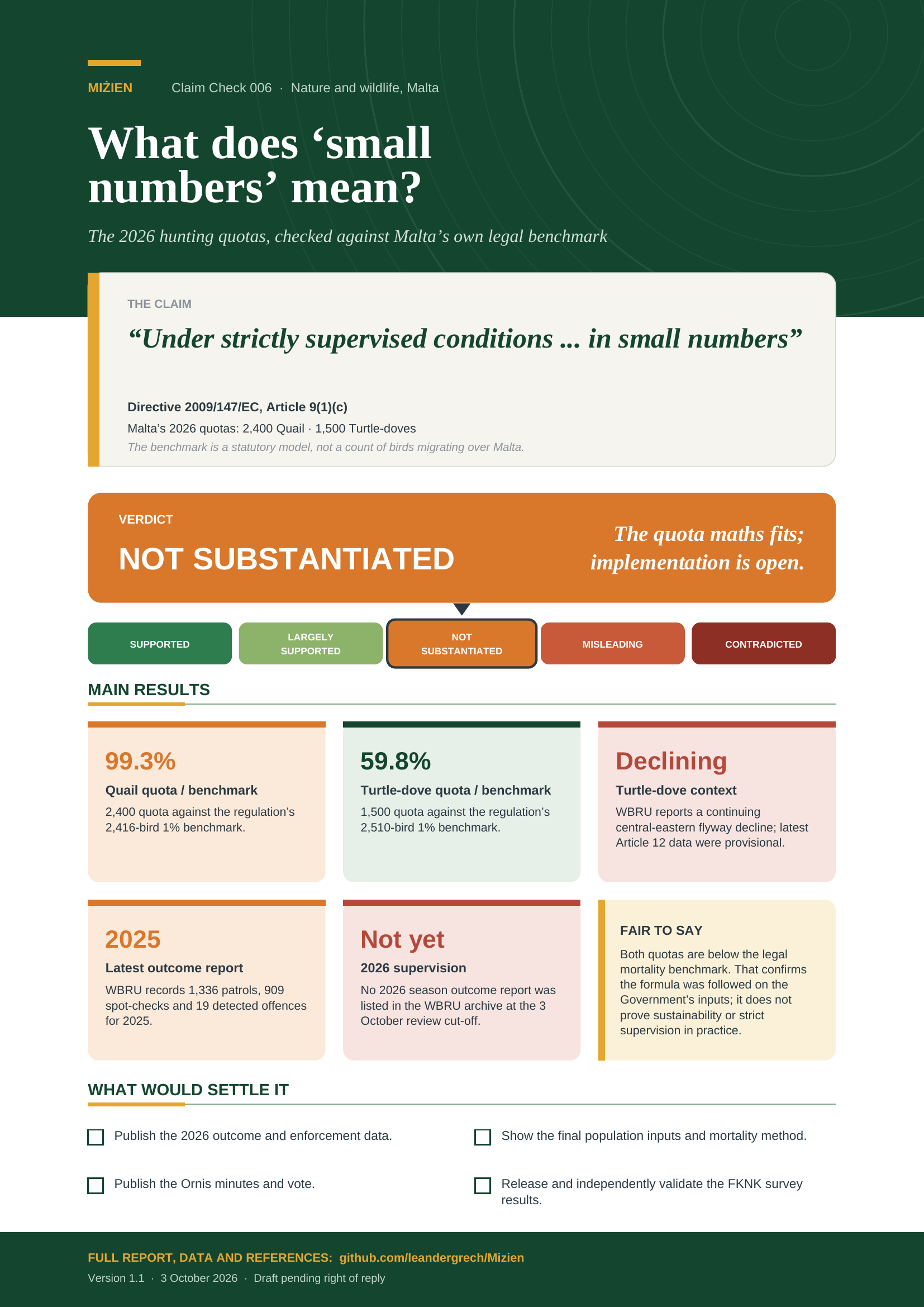
Not substantiated Moderate confidence Draft: right of reply pending
Claim Check 006 · Nature and wildlife, Malta
What does ‘small numbers’ mean?
Malta’s 2026 spring-hunting quotas, checked against their statutory mortality benchmark
“Under strictly supervised conditions ... in small numbers”
Directive 2009/147/EC, Article 9(1)(c)
Malta’s 2026 quotas: 2,400 Quail · 1,500 Turtle-doves
Verdict: Not substantiated The arithmetic checks out; wider claims do not.
Version 1.1 · 3 October 2026
TL;DR
Malta’s 2026 spring-hunting regulations define “small numbers” as a sample in the order of 1% of a population’s total annual mortality. Their own calculations put the Quail benchmark at 2,416 birds and the Turtle-dove benchmark at 2,510. The national quotas were 2,400 and 1,500 respectively.
- The legal numbers are reproducible. The Quail quota is 99.3% of its stated 1% benchmark; the Turtle-dove quota is 59.8%.
- That is a statutory comparison, not a population survey. The legislation defines the reference population as EU regions whose birds mainly pass through Malta. The benchmark is derived from model inputs, not a direct count of birds at Malta.
- Turtle-dove numbers are declining. WBRU’s March 2026 status report describes a continuing central-eastern flyway decline and says the latest Article 12 data were still provisional.
- Rules exist; 2026 supervision is not yet independently assessable. The law incorporates licence controls. WBRU’s 2025 report documents inspections, spot-checks and offences, but no 2026 outcome report was listed by the review cut-off.
- Verdict: not substantiated for the broader impression. The quota sizes sit within the regulation’s mortality benchmark. That alone does not establish ecological sustainability or prove strict supervision in practice.
- Supported
- Largely supported
- Not substantiated
- Misleading
- Contradicted
| Species | Quota | 1% mortality benchmark | Quota / benchmark |
|---|---|---|---|
| Common Quail | 2,400 | 2,416 | 99.3% |
| European Turtle-dove | 1,500 | 2,510 | 59.8% |
What would move the verdict up
The 2026 season outcome report, official bag totals, full enforcement records, and final population data for 2019–2024.
What would move it down
Evidence that the legal calculation uses incorrect inputs, quotas exceed the applicable benchmark, or the stated licensing and enforcement controls were not applied.
IN THIS REPORT
1 The wording and laws
This check assesses whether Malta’s 2026 derogation met both Article 9(1)(c) conditions behind the “small” and “strictly supervised” description. The Directive permits derogations only under strictly supervised conditions, on a selective basis, and for birds in small numbers [11]. The exact official English PDFs for Legal Notices 80 and 81 were opened through Legislation Malta and inspected on 3 October 2026 [1–2].
The regulations also set the operative season and national quota. Quail could be hunted from 13 April to 3 May 2026; Turtle-dove from 20 April to 3 May. Both periods ran from two hours before sunrise to noon. The Minister could terminate a season by notice [1–2]. The separate 17 April Gazette notice authorising research capture and tagging of four Turtle-doves is not the recreational hunting derogation [3].
A contemporaneous MaltaToday report states that Ornis voted for these dates and quotas on 30 March [4]. The WBRU public minutes archive lists meetings only through 2024 [13], so the committee’s original 2026 wording and vote could not be checked directly. We therefore attribute the tested wording to the enacted regulations, not to an unpublished committee minute.
2 How we checked the calculation
We transcribed the mortality estimates and quotas printed in each regulation, then recalculated the quota as a share of total annual mortality and as a share of the regulation’s rounded 1% benchmark. Inputs and formulas are in data/cc-006/checks.csv; the calculation is reproducible with data/cc-006/calc.py. Values are rounded to one decimal place in this report.
| Species | Modelled annual mortality | 1% printed in law | Quota | Quota / mortality | Quota / 1% |
|---|---|---|---|---|---|
| Common Quail | 241,638 | 2,416 | 2,400 | 0.993% | 99.3% |
| European Turtle-dove | 251,032 | 2,510 | 1,500 | 0.598% | 59.8% |
Evidence grades. Legal Notices and WBRU technical reports: C (official regulatory or monitoring records). The 2016 peer-reviewed harvest analysis: B, but its estimates are historical and have wide uncertainty. FKNK and BirdLife Malta monitoring statements: D for independent inference; they are used to identify each organisation’s position and observations, not as population estimates.
3 What the benchmark does and does not say
On the statutory calculation, both quotas are at or below the legal order-of-1% mortality benchmark. The Quail limit is close to the full benchmark; the Turtle-dove limit is about three-fifths of it. That comparison supports the limited statement that the quotas were set within the benchmark written into the regulations [1–2].
It does not establish how many birds actually crossed Malta, how many were killed, or what fraction of a population can withstand the added mortality. The reference population is defined across EU source regions. A calculated cap is not a field count and is not a direct test of population response.
The March 2026 WBRU assessment reports an 11% Pan-European decline in Turtle-doves over 2015–2024 and an 88% decline since 1980. It says the central-eastern flyway continued to decline and that the latest Article 12 submissions were provisional at the time of assessment [5]. This is material context for conservation risk; it does not by itself show that the specific 2026 quota exceeded the statutory formula.
Caruana-Galizia and Fenech’s peer-reviewed study compared spring and autumn harvest and estimated historic effects from hunter records and independent harvest figures [6]. The independent series covers 1980–1992; its population denominators are older and its estimates have wide error margins. We do not apply its historic percentages to the 2026 quotas.
4 Supervision: rules and implementation
What can the public record establish?
IMPLEMENTATION DATA INCOMPLETEEVIDENCE FOR THE CLAIM'S IMPRESSION
The 2026 regulations make the season subject to the established framework and Special Hunting Licence conditions. The latest WBRU outcome report available at review records 1,336 patrols/field inspections, 909 spot-checks and 19 detected offences during the 2025 spring season [7]. This is evidence of an enforcement operation in 2025.
EVIDENCE AGAINST
The 2025 counts do not establish 2026 supervision. BirdLife Malta’s April/May 2026 reports describe field observations and suspected illegal targeting; they are stakeholder monitoring accounts, not an official or independently audited enforcement total [8–9]. The WBRU Spring Hunting Derogations page did not list a 2026 outcome report at the 3 October 2026 cut-off [12].
FKNK’s 7 April statement says it would conduct surveys to estimate a “sustainability index” and invite members to submit voluntary forms recording the sex of harvested birds [10]. This is useful evidence of a stakeholder monitoring initiative, but voluntary member records are not a substitute for official bag-reporting and enforcement data. The existence of a survey does not demonstrate strict supervision.
The original candidate summary bundled the statutory mortality benchmark with a broad claim about strict supervision. The evidence supports the benchmark arithmetic; the public record available for this check does not establish the 2026 enforcement outcome. The two conclusions should not be collapsed.
5 Verdict, limits and evidence needed
The statutory quota comparison checks out; 2026 supervision and ecological effect remain unproven.
Why. The regulations set quotas below the 1% mortality benchmark they define as “small numbers”. The Quail quota is 99.3% of the stated benchmark; the Turtle-dove quota is 59.8%. But those ratios only confirm consistency with the regulations’ own mortality model. They do not show current harvest impact or prove that the season was strictly supervised in practice. The latest official season-outcome data available at review are for 2025. For the broader characterization “very small and strictly supervised”, the evidence available is incomplete, so the verdict is Not substantiated (moderate confidence).
What this verdict does not say. It does not say the legal notices’ arithmetic is wrong, that the quotas were exceeded, or that the derogation was unlawful. The 2026 outcome and final population data could change the assessment.
Evidence that would settle the open parts
- The 30 March 2026 Ornis minutes or another primary record of the vote and recommendations.
- WBRU’s 2026 outcome report, with actual bag totals, licence-holder reporting, inspections, detected offences and outcomes.
- The final 2019–2024 Article 12 population data and transparent derivation of each mortality input.
- The FKNK survey protocol, raw anonymised results and independent validation of its “sustainability index”.
Right of reply. Not sought in this draft, at the maintainer’s direction. Handle before wider circulation.
6 Sources
- [1] Government of Malta, L.N. 80/2026, Quail, regulations 3–7. https://legislation.mt/eli/ln/2026/80/eng
- [2] Government of Malta, L.N. 81/2026, Turtle-dove, regulations 3–7. https://legislation.mt/eli/ln/2026/81/eng
- [3] Government Gazette No. 21,626, Notice 622, 17 April 2026 (separate research-capture derogation). https://www.gov.mt/en/Government/DOI/Government%20Gazette/Government%20Notices/Pages/2026/04/GovNotices1704extra.aspx
- [4] MaltaToday, “Ornis Committee votes in favour of opening spring hunting season”, 30 March 2026 (secondary account). https://www.maltatoday.com.mt/news/national/140671/ornis_committee_votes_in_favour_of_opening_spring_hunting_season_
- [5] WBRU, Conservation Status of Common Quail and European Turtle-dove, March 2026. https://wbru.gov.mt/wp-content/uploads/2026/04/Conservation-Status-of-Common-Quail-and-Turtle-Dove-Mar-2026.pdf
- [6] Caruana-Galizia & Fenech, Bird Conservation International 26(1), 29–38 (2016), DOI 10.1017/S0959270915000325. https://doi.org/10.1017/S0959270915000325
- [7] WBRU, Report on the Outcome of the 2025 Spring Hunting Season in Malta, June 2025. https://wbru.gov.mt/wp-content/uploads/2026/04/2025-SH-Derogation-Report.pdf
- [8] BirdLife Malta, “Majority of hunters illegally target Turtle-doves during first week of spring season”, 20 April 2026. https://birdlifemalta.org/2026/04/majority-of-hunters-illegally-target-turtle-doves-during-first-week-of-spring-season/
- [9] BirdLife Malta, “On the Frontlines: May 2026 Newsletter”, 13 May 2026. https://birdlifemalta.org/2026/05/on-the-frontlines-may-2026-newsletter/
- [10] FKNK, “Spring hunting season in the Maltese Islands 2026: The FKNK will again carry out scientific studies”, 7 April 2026. https://www.huntinginmalta.org.mt/post/spring-hunting-season-in-the-maltese-islands-2026the-fknk-will-again-carry-out-scientific-studies
- [11] Directive 2009/147/EC on the conservation of wild birds, Article 9(1)(c). https://eur-lex.europa.eu/legal-content/EN/TXT/?uri=CELEX:32009L0147
- [12] WBRU, Spring Hunting Derogations (official reports index; checked 3 October 2026). https://wbru.gov.mt/en/resources/reports-and-statistics/sprin-hunting-derogations/
- [13] WBRU, Ornis Committee (official minutes archive; checked 3 October 2026). https://wbru.gov.mt/en/the-department/ornis-committee/
Sources and archived copies
- Environmental Implementation Review 2025: Malta, European Commission (OP), 2025. Original · Archived copy
- Malta greenlights 2026 spring hunting season, CABS (Committee Against Bird Slaughter), 1 Apr 2026. Original · Archived copy
- Spring hunting for turtle dove set to return after Ornis votes in favour, MaltaToday, n/d. Original · Archived copy
- The importance of spring hunting in Malta on European Turtle-Dove and Common Quail populations, Humboldt-Universität zu Berlin (edoc), n/d. Original · Archived copy
-
Conservation of Wild Birds (Declaration on a Derogation for a 2026 Spring Hunting Season for Quail) Regulations, 2026 (L.N. 80 of 2026), Government of Malta, 30 March 2026.
Original · fetched and fingerprinted 2026-10-10; no public snapshot yet
Regulation 3 defines small numbers; regulation 4 calculates 1% of total annual mortality as 2,416. -
Conservation of Wild Birds (Declaration on a Derogation for a 2026 Spring Hunting Season for Turtle Dove) Regulations, 2026 (L.N. 81 of 2026), Government of Malta, 30 March 2026.
Original · fetched and fingerprinted 2026-10-10; no public snapshot yet
Regulation 3 defines small numbers; regulation 4 calculates 1% of total annual mortality as 2,510. - Directive 2009/147/EC on the conservation of wild birds, Article 9(1)(c), European Parliament and Council, 30 November 2009. Original · fetched and fingerprinted 2026-10-10; no public snapshot yet
-
Conservation Status of Common Quail and European Turtle-dove, March 2026, Wild Birds Regulation Unit, March 2026.
Original · not yet archived
Official status report presented to the Malta Ornis Committee on 30 March 2026; Article 12 submissions were provisional at publication. -
Spring Hunting Derogations, Wild Birds Regulation Unit, 2026-10-03.
Original · not yet archived
Checked 3 October 2026; the latest listed season outcome report is for 2025. No 2026 outcome report is listed. -
Ornis Committee, Wild Birds Regulation Unit, 2026-10-03.
Original · not yet archived
Checked 3 October 2026; the public minutes archive lists meetings only through 2024, so 2026 minutes were not available there.
Right of reply
The body concerned has not yet been asked to reply. Its response will be published here, beside the verdict.
Connections
How this claim relates to the others: who made it, the themes it shares with other claims, and the patterns it shows. A connection is a reason to read two checks side by side. It does not make either one right or wrong. How connections are found.
Who made it
Other claims by Government of Malta 39
- CC-003 Per-capita emissions vs 2030 projection (Misleading)
- CC-004 'Strong progress' in waste separation (Not substantiated)
- CC-010 Tree-planting counts (Largely supported)
- CC-012 Ta' Qali gravel and grass (Contradicted)
- CC-016 Shore-to-ship: 90% less harbour pollution (Misleading)
- CC-017 Land reclamation outside the Freeport (Not substantiated)
- CC-021 Malta-Gozo tunnel traffic (not yet checked)
- CC-022 'Lowest electricity burden in the EU' (Largely supported)
- CC-023 Second interconnector by 2026 (not yet checked)
- CC-024 Renewables target for 2030 (Not substantiated)
- CC-025 Per-capita emissions down 44% since 2005 (Largely supported)
- CC-027 Power cuts: heat, not generation (not yet checked)
- CC-029 First offshore wind farm (Largely supported)
- CC-031 Gozo, first climate-neutral region (Largely supported)
- CC-032 Solar flowers, first in Europe (Contradicted)
- CC-041 Sewage plants compliant by 2026 (not yet checked)
- CC-043 13 Blue Flag beaches (not yet checked)
- CC-044 2,400 tonnes from storm tunnels (not yet checked)
- CC-045 Do 20 km of tunnels manage flooding? (Not substantiated)
- CC-048 Sea urchins recovering (not yet checked)
- CC-051 'Over 30% of our seas protected' (Misleading)
- CC-054 Project Green: 100,000 m2 a year (not yet checked)
- CC-055 Manoel Island back to the public (Supported)
- CC-060 7,000 first-time buyers helped (not yet checked)
- CC-061 260 homes 30% below market (not yet checked)
- CC-064 Grand Harbour regeneration (not yet checked)
- CC-068 Marsaskala marina shelved (not yet checked)
- CC-069 82 million bus trips (not yet checked)
- CC-072 EUR 15m to take cars off the road (not yet checked)
- CC-073 Cab trips up 68% (not yet checked)
- CC-077 Metro: first section early 2030s (not yet checked)
- CC-078 Gozo Channel: +511,000 passengers (not yet checked)
- CC-083 Record tourism, 'future-proofed' (not yet checked)
- CC-086 Comino kiosks tendered from 2026 (pledge: Missed)
- CC-087 177 illegal short lets (not yet checked)
- CC-090 20 heat-linked deaths (not yet checked)
- CC-095 EUR 400m to keep bills low (Not substantiated)
- CC-096 Fish farms moved 6 km offshore (not yet checked)
- CC-103 Heat-death locations "within three months" (not yet checked)
Linked directly 0
Not yet linked to another claim by a theme.
Same pattern
Pattern tags name a recurring way a claim can mislead. They describe the statement, not the speaker.
Conditional-turned-unconditional
A statement with a stated condition is reported or repeated without it.
Timeline
What was said, what was published before and after it, and each step of this check, in date order. Statements and sources carry the date they were published. The steps of the check carry the date the research was done, from the check's research log. Other statements by the same body on the same topic show whether a position was repeated, changed or corrected.
2009
- 30 November 2009 Evidence published Directive 2009/147/EC on the conservation of wild birds, Article 9(1)(c), European Parliament and Council
2016
- March 2016 Evidence published The importance of spring hunting in Malta on European Turtle-Dove and Common Quail populations, Cambridge University Press / Bird Conservation International
2018
- 21 June 2018 Evidence published Judgment in Commission v Malta, Case C-557/15, Court of Justice of the European Union
2024
- 19 September 2024 Evidence published Judgment in Commission v Malta, Case C-23/23, Court of Justice of the European Union
2025
- June 2025 Evidence published Report on the Outcome of the 2025 Spring Hunting Season in Malta, Wild Birds Regulation Unit
- 2025 Earlier statement by Miriam Dalli on Nature & Wildlife CC-051 'Over 30% of our seas protected' (Misleading)
- 9 July 2025 Earlier statement by Ministry for the Environment and Ministry for Agriculture, Fisheries and Animal Rights on Nature & Wildlife CC-048 Sea urchins recovering (not yet checked)
2026
- March 2026 Evidence published Conservation Status of Common Quail and European Turtle-dove, March 2026, Wild Birds Regulation Unit
- 30 March 2026 The statement Government of Malta, applying Directive 2009/147/EC (this claim)
- 30 March 2026 Reported Ornis Committee votes in favour of opening spring hunting season, MaltaToday
- 30 March 2026 Evidence published Government of Malta, LN 80/2026: Quail spring hunting season, Legislation Malta
- 30 March 2026 Evidence published Government of Malta, LN 81/2026: Turtle-dove spring hunting season, Legislation Malta
- 1 April 2026 Evidence published Malta greenlights 2026 spring hunting season, CABS (Committee Against Bird Slaughter)
- 7 April 2026 Statement published Spring hunting season in the Maltese Islands 2026: FKNK will again carry out scientific studies, FKNK / Hunting in Malta
- 17 April 2026 Evidence published Government Notices published in Gazette 21,626, 17 April 2026, Government of Malta
- 20 April 2026 Statement published Majority of hunters illegally target Turtle-doves during first week of spring season, BirdLife Malta
- 13 May 2026 Statement published On the Frontlines: May 2026 Newsletter, BirdLife Malta
- 3 October 2026 Version 1.1 Report and flyer updated to version 1.1. The date of version 1.0 is not recorded in the report. Verdict in this version: Not substantiated, moderate confidence.
- 3 October 2026 Evidence reviewed
2027
- 3 October 2027 Coming up: Evidence review due Each finished check is reviewed against new evidence within a year.
Every change to this claim's record is public: history of the record.
Download the report and flyer