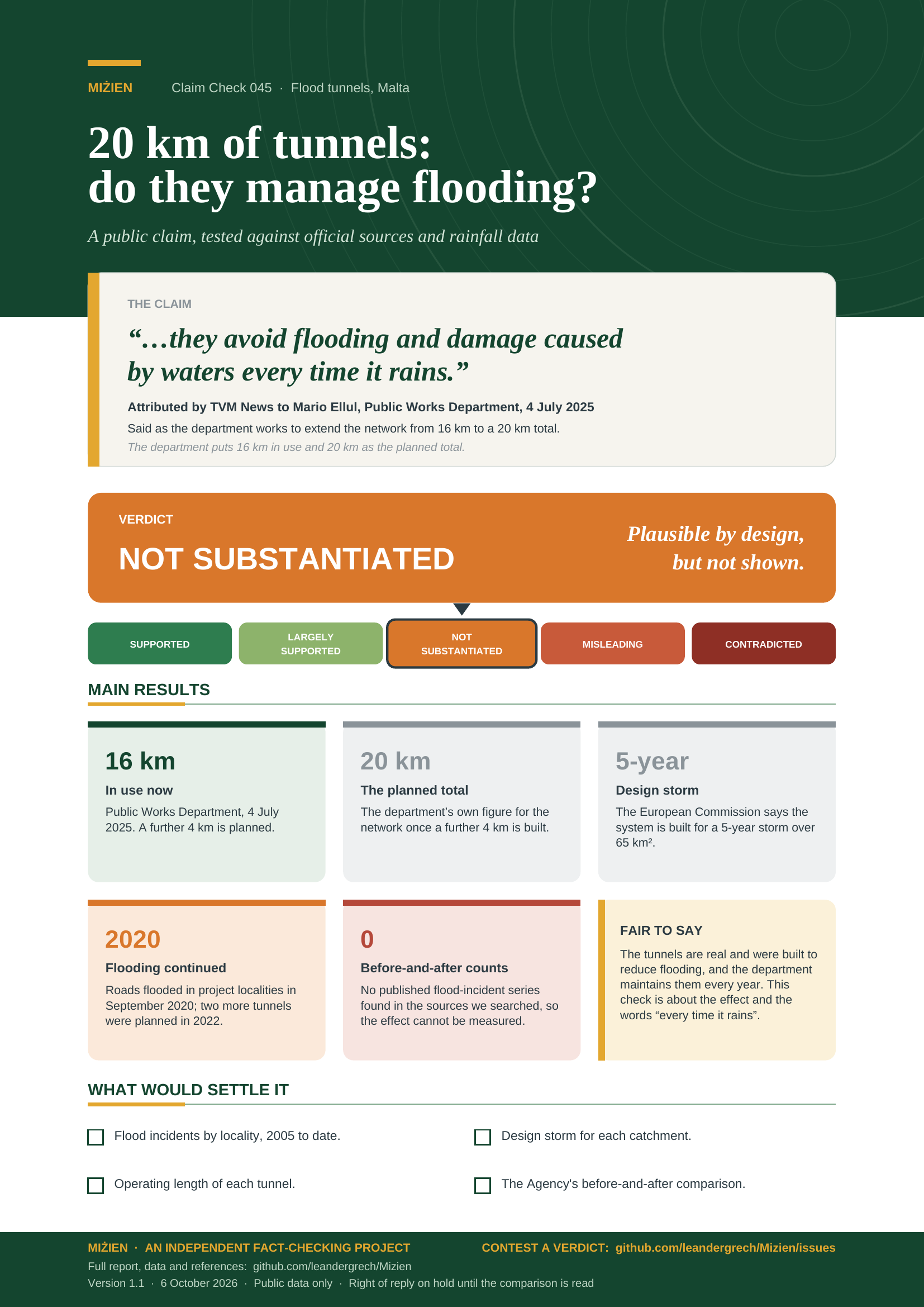
CC-045 · Water · Flood relief
Do 20 km of tunnels manage flooding?
Not substantiated Moderate confidence Draft: right of reply on hold
Parts of this claim
The claim is split into parts that are tested separately, as in the report below. Each part has its own number.
- CC-045A 16 km in use, 20 km as the planned total (department’s own figures)Stated as 16 km in use, 4 km planned, 20 km total (department, 4 Jul 2025) [1]; about 16 km in 2020 [4]. The MaltaToday headline’s “20 km … helped” is headline wording, not rated.
- CC-045B They are designed to reduce flooding65 km², 5-year storm, 165,000 expected beneficiaries (Commission, 2013) [3].
- CC-045C The infrastructure is in use “to reduce flooding” (department, as summarised by TVM)Plausible from design; no before-and-after incident data found in the sources searched. Flooding reported in project localities in 2020 [4] and new tunnels planned in 2022 [2]. The Agency’s own comparison is not published in what we read [9].
- CC-045D The systems “avoid flooding … every time it rains” (attributed to Ellul, “particularly for the Birkirkara localities”)A 5-year design is exceeded by larger storms; no source shows how often flooding is prevented [1, 3, 4, 8].
Claim Check 045 · Flood tunnels
Do 20 km of tunnels manage flooding?
Testing a public claim about Malta’s flood-relief network against official sources and rainfall data
“…they avoid flooding and damage caused by waters every time it rains.”
Attributed by TVM News to Mario Ellul, Public Works Department, 4 July 2025.
Said alongside a plan to extend the network from 16 km to a 20 km total.
Verdict: Not substantiated Plausible by design; effect not shown
Version 1.1 · 6 October 2026
TL;DR
On 4 July 2025 Malta’s Public Works Department said its flood-relief canals, tunnels and culverts are being extended “from 16 km to 20 km”, and its director of the Coastal and Stormwater Unit, Mario Ellul, said these systems “avoid flooding and damage caused by waters every time it rains.” (TVM News attributes this to him). A MaltaToday headline, which we use only to locate the claim, reads “20 kilometres of underground tunnel helped Malta manage its flooding problems”; that is headline wording, not the department’s, and is not rated. We tested the department’s own statements against official sources and daily rainfall data.
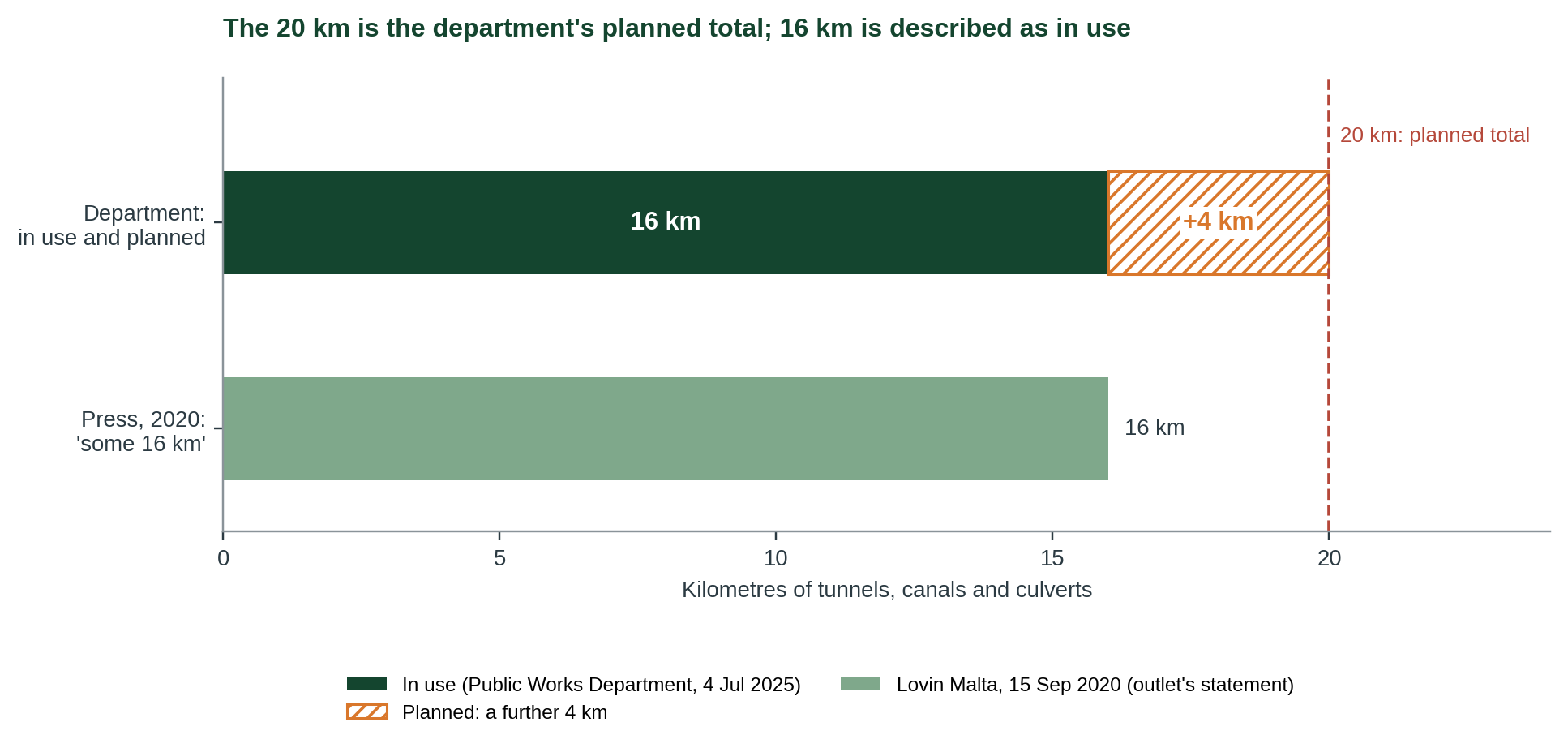
- The department’s own figures separate what exists from what is planned. It describes 16 km as in use and a further 4 km as still to be built, to reach a total of 20 km [1]. A 2020 news report also gave about 16 km [4]. We do not rate the headline’s “20 km” (Figure 1).
- Design capacity is documented; outcomes are not. The European Commission describes a system that covers 65 km², is designed for a storm with a 5-year return period and is expected to benefit about 165,000 people [3]. In the sources we searched (Method) we found no published multi-year count of flood incidents, insurance claims or road closures before and after the works; the Energy and Water Agency says it compared the effect by modelling, but we found no results in its published plan [9].
- Flooding has continued, and new tunnels are being planned. A news report of 15 September 2020 describes flooded roads in the project’s own localities [4]. In 2022 the department planned two more tunnels, at Mosta and Mater Dei, for flooding that persists in those places [2].
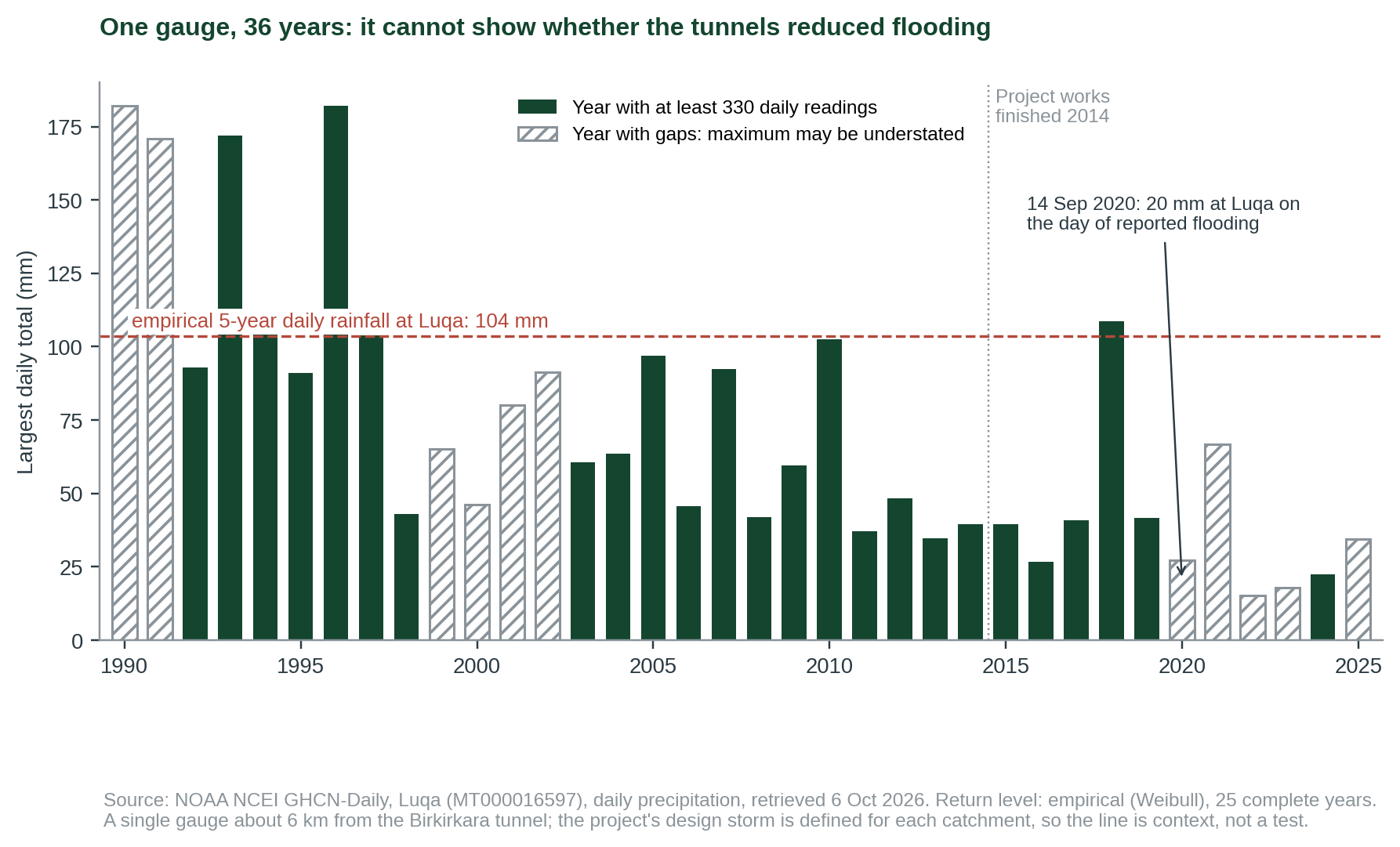
- “Every time it rains” is stronger than the evidence. A system built for a 5-year storm will be exceeded by larger storms, and no source shows how often it prevents flooding. Our one rain gauge cannot test this (Figure 2).
- Verdict: not substantiated (moderate confidence). The tunnels exist and are designed to reduce flooding, so an effect is plausible. The verdict rests on two sub-claims: the effect in practice is not shown (C), and “every time it rains” is stronger than the evidence (D).
- Supported
- Largely supported
- Not substantiated
- Misleading
- Contradicted
What would move the verdict up
A published series of flood incidents (emergency calls, road closures or insurance claims) for the tunnelled catchments, showing a fall after the works, or the Energy and Water Agency’s before-and-after comparison [9] showing that flooding is avoided in storms up to the design level. Either would move the verdict to Largely supported.
What would move it down
Evidence that the same localities flooded as often or as badly after the works in storms below the design level. That would move the verdict to Contradicted.
IN THIS REPORT
1 The claim and what we could verify
The check began from a MaltaToday headline, “20 kilometres of underground tunnel helped Malta manage its flooding problems” [5]. That page, which carries no speaker we could read, is refused to scripts (HTTP 403), so we saw only its headline and a search summary. A headline is not the speaker’s wording and we do not rate it. We therefore looked for the public statement behind it. The nearest in date and wording is a press release of the Parliamentary Secretariat for Public Works of 4 July 2025, reported with direct quotes by the public broadcaster’s news service, TVM News [1]. The release itself is on gov.mt, which refuses scripts [6]. TVM publishes its English text as a translation from Maltese, so wording below is TVM’s English rendering.
| What was said | Form | Our access |
|---|---|---|
| The department “is working to increase from 16 km to 20 km the infrastructure of canals, tunnels and culverts in use to reduce flooding” | TVM’s summary, no quotation marks [1]; the next paragraph, also indirect speech, says Ellul explained that extra works would bring “the total to 20 km” | Read in full |
| “These are very important systems for the country, particularly for the Birkirkara localities, because they avoid flooding and damage caused by waters every time it rains.” | Pull-quote attributed by TVM to Mario Ellul, Public Works Department; the page prints no quotation marks [1] | Read in full |
| “As a department, we are making sure the underground infrastructure, including tunnels and culverts, is cleaned and maintained regularly” | Pull-quote attributed by TVM to Parliamentary Secretary Omar Farrugia; no quotation marks printed [1] | Read in full |
| “20 kilometres of underground tunnel helped Malta manage its flooding problems” | Headline of a MaltaToday article, undated [5] | Headline and search summary only |
2 Method
Question. Are there about 20 km of flood tunnels, and is there evidence that they have helped Malta manage flooding?
Evidence. We read the department’s statement as reported by TVM News [1, 2], the European Commission’s project page [3] and a 2020 news report [4]. For rainfall we used the daily record of the Luqa gauge from NOAA’s Global Historical Climatology Network [7], 1990–2025. We computed annual maxima for years with at least 330 daily readings and an empirical 5-year level (Weibull plotting position), with a script (tools/cc-045-report/calc.py). We searched Crossref and OpenAlex for a peer-reviewed evaluation of the Maltese tunnels and found none; OpenAlex was rate-limited on the day.
Search for flood-incident data (6 October 2026). The verdict depends on whether a before-and-after record of flooding exists, so we searched for one. Web searches, run for the Civil Protection Department, insurers, parliamentary questions, the National Statistics Office and the Energy and Water Agency (EWA), returned no incident series; they led us to four documents we opened: EWA’s Preliminary Flood Risk Assessment (2019) [8], its 2nd Flood Risk Management Plan (2024) [9], its flood hazard and risk maps report (2020) [10] and the Insurance Association Malta’s page on Storm Harry (2026) [11]. We searched the three EWA texts by keyword and read the sections on the tunnel project and on past floods; we did not read them end to end. They hold modelled hazard maps and one-event figures, not a multi-year count of incidents. We did not browse the Civil Protection Department, National Statistics Office, parliamentary-questions or news archives directly, and the Public Works Department page on rainwater relief returned HTTP 403. We therefore say only that we found no such series, not that none exists. The search log is in literature/CC-045/notes.md.
Grades. The department statement is grade D (assertion, no data) for effect and C for length. The Commission page is grade C (official description, design figures). The rainfall record is grade C (official observations), used as context only.
3 What the sources say
Length. The Commission’s page does not give a total length; it names four basins and nine localities [3]. Lovin Malta, in 2020, wrote of “some 16 kilometres of mostly underground tunnels” and €54 million [4]. The department in 2025 gives 16 km in use and 20 km as the planned total [1]. The department’s own count includes canals and culverts, not tunnels only, so “20 km of underground tunnel” is also a looser description than the department’s.
Design and expected benefit. The Commission says the infrastructure “covers 65 km² of the Maltese territory and is capable of handling a storm with a return period of 5 years”, and that “experts predict” it benefits some 165,000 residents [3]. These are design and forecast figures from 2013, before the works finished.
What continued afterwards. On 15 September 2020 Lovin Malta reported flooded roads, power cuts and overflowing drains and quoted the minister blaming an unusually heavy downpour and unfinished road works [4]. In 2022 the department said it would dig two further tunnels, one near Mater Dei Hospital and one under Valletta Road in Mosta, to deal with flooding in those places [2]. Both are consistent with a network that reduces flooding where it reaches and leaves some places exposed; neither measures how much it reduced.
What the Energy and Water Agency says. The Agency’s 2019 assessment says the project was designed for 5-year rainfall events, “thereby significantly reducing” their consequences in four sub-catchments, and that it also increased resilience to rarer events [8]. That is an official statement without incident data. Its 2nd Flood Risk Management Plan (2024) records that a comparison “ante and post-operam” of flood hazard and risk was carried out and shared with stakeholders [9]. The plan text we searched gives no results from that comparison, and the hazard maps are predictive: they do not use past floods except to validate them [10]. The comparison is a lead we have not seen.
4 What the data show
Reading across the data
- The length differs by source. 16 km in use and 20 km planned (department, 2025) [1]; about 16 km (press, 2020) [4]. The claim’s 20 km matches only the planned total.
- The rainfall record cannot test the effect. The gauge is about 6 km from the Birkirkara tunnel. Luqa recorded 20.1 mm on 14 September 2020, the day before Lovin Malta’s report of flooding [4], below the 2-year level of 59 mm: localised downpours are not captured by one gauge.
- The record is incomplete after 2019. 2020–2023 and 2025 have many missing days, so only six years from 2015 are complete. We therefore make no before-and-after comparison of storms.
- One storm at Luqa since 2014 exceeded the empirical 5-year level: 108.7 mm on 10 February 2018. We found no sourced account of flooding that day, so we draw no conclusion from it.
5 Where the evidence points different ways
Do the tunnels reduce flooding?
NOT SHOWNEVIDENCE FOR THE CLAIM'S IMPRESSION
Design: a 5-year storm capacity over 65 km² and an expected 165,000 beneficiaries [3]. The department says the systems “avoid flooding” and spends a team on maintenance [1]. Reservoirs store rainwater for farmers [1].
EVIDENCE AGAINST
Flooded roads in the project’s localities in September 2020 [4]; two further tunnels planned in 2022 for places that still flood [2]. No before-and-after incident data have been published in the sources we searched (Method).
How long is the network?
NOT RATEDEVIDENCE FOR THE CLAIM'S IMPRESSION
The department: 16 km in use, 20 km as the planned total [1]. A MaltaToday headline says 20 km [5].
EVIDENCE AGAINST
16 km in use (department) [1]; about 16 km (Lovin Malta, 2020) [4].
6 Testing the claim
| Sub-claim | What the evidence shows | Rating |
|---|---|---|
| A. 16 km in use, 20 km as the planned total (department’s own figures) | Stated as 16 km in use, 4 km planned, 20 km total (department, 4 Jul 2025) [1]; about 16 km in 2020 [4]. The MaltaToday headline’s “20 km … helped” is headline wording, not rated. | NOT RATED |
| B. They are designed to reduce flooding | 65 km², 5-year storm, 165,000 expected beneficiaries (Commission, 2013) [3]. | SUPPORTED |
| C. The infrastructure is in use “to reduce flooding” (department, as summarised by TVM) | Plausible from design; no before-and-after incident data found in the sources searched. Flooding reported in project localities in 2020 [4] and new tunnels planned in 2022 [2]. The Agency’s own comparison is not published in what we read [9]. | NOT SHOWN |
| D. The systems “avoid flooding … every time it rains” (attributed to Ellul, “particularly for the Birkirkara localities”) | A 5-year design is exceeded by larger storms; no source shows how often flooding is prevented [1, 3, 4, 8]. | OVERSTATED |
7 Verdict and requests for evidence
Plausible from design, but no outcome data show the effect and “every time it rains” exceeds a 5-year design. Confidence: moderate.
Why. The verdict rests on sub-claims C and D. (1) The network exists and was built to reduce flooding (B). (2) We found no published flood-incident series before and after the works in the sources we searched, so the effect in practice (C) rests on design figures and the department’s statement. (3) The strongest wording, “every time it rains” (D), is above the 5-year design level. (4) The length (A) is not part of the verdict: the department’s figures separate 16 km in use from the 20 km planned total, and the headline is not rated.
What this verdict does not say. It does not say the tunnels do not work, that flooding is worse, or that anyone misdescribed the project. The published record cannot show their effect either way.
Evidence we are asking for
- Flood incidents (emergency calls, road closures, insurance or compensation claims) for Birkirkara, Msida, Gżira, Qormi, Marsa, Żabbar and Marsaskala, 2005 to date.
- The Storm Water Master Plan and the design-storm basis of each catchment, and the operating length by tunnel.
- Hourly rainfall for flood days from the Malta Meteorological Office and the department’s own gauges.
- The gov.mt release of 4 July 2025, and the Energy and Water Agency’s ante and post-operam comparison of the flood relief project [9].
8 Limitations
- We could not read the MaltaToday article or the gov.mt release (HTTP 403); we rely on TVM News’s account of the release and on the article’s headline and a search summary (◆ second-hand).
- TVM’s English text is a translation of a statement in Maltese. TVM prints the Ellul and Farrugia sentences as attributed pull-quotes without quotation marks, so we quote TVM’s text, not a transcript.
- The rainfall record is one gauge, with gaps after 2019; it gives context, not a test. The 5-year level is empirical (25 complete years) and is not the project’s design storm.
- We did not find peer-reviewed work on the Maltese tunnels. We found no flood-incident data in a partial search (Method), so the report cannot say whether flooding fell. The Agency’s own before-and-after comparison [9] was not seen.
References
- [1] TVM News (4 Jul 2025). 2,400 tonnes of waste removed from 16 km of stormwater tunnels. Reports the Parliamentary Secretariat for Public Works release; statements of Mario Ellul and Omar Farrugia. https://tvmnews.mt/en/news/2400-tonnes-of-waste-removed-from-16-km-of-stormwater-tunnels/
- [2] TVM News (28 Aug 2022). Underground tunnels being excavated to alleviate flooding. https://tvmnews.mt/en/news/underground-tunnels-being-excavated-to-alleviate-flooding/
- [3] European Commission, Inforegio (15 Oct 2013). Fighting floods in Malta (National Flood Relief Project). https://ec.europa.eu/regional_policy/projects/projects-database/fighting-floods-in-malta_en
- [4] Lovin Malta (15 Sep 2020). An underground tunnel and millions in road investment later, Malta is still flooding. https://lovinmalta.com/opinion/analysis/an-underground-tunnel-and-millions-in-road-investment-later-but-malta-is-still-flooding/
- [5] MaltaToday (undated). 20 kilometres of underground tunnel helped Malta manage its flooding problems. ◆ Headline and search summary only (HTTP 403). https://www.maltatoday.com.mt/environment/nature/107804/20_kilometres_of_underground_tunnel_helped_malta_manage_its_flooding_problems
- [6] Government of Malta, Department of Information (4 Jul 2025). Press release by the Parliamentary Secretariat for Public Works: over 2,400 tonnes of waste collected annually from 16 kilometres of stormwater tunnels. ◆ Not read (HTTP 403); cited through [1]. https://www.gov.mt/en/Government/DOI/Press%20Releases/Pages/2025/07/04/pr251213en.aspx
- [7] NOAA National Centers for Environmental Information. Global Historical Climatology Network daily, station MT000016597 (Luqa), precipitation. Retrieved 6 Oct 2026. https://www.ncei.noaa.gov/access/services/data/v1?dataset=daily-summaries&stations=MT000016597&dataTypes=PRCP&format=csv
- [8] Energy and Water Agency (2019). Preliminary Flood Risk Assessment for the Malta River Basin District 2019. Keyword search and reading of the National Flood Relief Project sections; not read end to end. https://www.energywateragency.gov.mt/wp-content/uploads/2020/09/Preliminary-Flood-Risk-Assessment-for-the-Malta-River-Basin-District-2019.pdf
- [9] Energy and Water Agency (2024). 2nd Flood Risk Management Plan for the Malta River Basin District, measure FLD1. Keyword search; not read end to end. https://energywateragency.gov.mt/wp-content/uploads/2024/02/2nd-Flood-Risk-Management-Plan-Final.pdf
- [10] Energy and Water Agency (2020). Flood Hazard Maps and Flood Risk Maps for the Malta River Basin District (final draft). Keyword search and reading of the methodology section. https://energywateragency.gov.mt/wp-content/uploads/2022/09/FHM-and-FRM_11_12_2020_Final_Draft.pdf
- [11] Insurance Association Malta (24 Mar 2026). Storm Harry leaves EUR 12m in damage claims, majority from flooding. Single-event figures; the full Sunday Times of Malta article was not read. https://maltainsurance.org/general/storm-harry-leaves-e12m-in-damage-claims-majority-from-flooding/
Appendix A: series standards and verdict scale
Every investigation in this series follows the same rules so that verdicts are comparable and challengeable.
| Verdict | Meaning |
|---|---|
| SUPPORTED | Evidence consistently backs the claim as stated. |
| LARGELY SUPPORTED | Backed by the evidence, with minor caveats that do not change the substance. |
| NOT SUBSTANTIATED | Stated more strongly than the evidence offered or available allows. May be true in some conditions but has not been shown. |
| MISLEADING | Omits material facts so that the overall impression is inaccurate, even if individual statements are defensible. |
| CONTRADICTED | The available evidence points against the claim. |
Confidence
High: multiple independent lines of evidence agree. Moderate: evidence is relevant but incomplete or indirect. Low: evidence is thin, second-hand or conflicting.
Evidence grades
A experiment · B observational study with a control or gradient · C review, guidance or official statistics · D assertion or anecdote. ◆ marks a source known only second-hand.
Standards
- Quote the speaker, not the headline, with outlet and date, and link the original where possible.
- Separate the claim from the evidence offered for it, and say who made which statement.
- Grade the evidence and show differing views side by side where the evidence is unsettled.
- State what we could not access or verify, and what would change the verdict either way.
- Ask for the missing evidence in specific, answerable requests.
- Offer a right of reply where a check finds a claim Not substantiated, Misleading or Contradicted (or a pledge Not measurable, Off track or Missed), before wider circulation, and append responses.
- Correct errors openly with a version number and change log.
- Whistle-blow only on evidence: a verdict of Misleading or Contradicted requires documents or data that can be shown, not inference.
- Check every side. Government, opposition, NGOs and developers are held to the same standard.
Appendix B: revision log
| Version | Date | Change |
|---|---|---|
| 1.0 | 6 Oct 2026 | First issue. Draft pending right of reply from the Public Works Department. |
| 1.1 | 6 Oct 2026 | Corrections after the 6 Oct 2026 audit: the claim and sub-claims now restate the department’s own wording (the MaltaToday headline and sub-claim A are not rated); the verdict is stated to rest on C and D; the unsourced word “solved” removed; the Ellul and Farrugia sentences described as TVM pull-quotes without quotation marks; a logged search for flood-incident data and the Energy and Water Agency’s documents added; layout fixed. Verdict unchanged. Right of reply on hold until the Energy and Water Agency’s before-and-after comparison is read. |
Sources and archived copies
-
2,400 tonnes of waste removed from 16 km of stormwater tunnels, TVM News, 4 Jul 2025.
Original · Archived copy
Primary wording, read in full and re-checked 6 Oct 2026. English text is TVM's translation of the Maltese release; the "16 km to 20 km" sentence and the "total to 20 km" sentence are TVM's indirect speech; the Ellul and Farrugia sentences are pull-quotes attributed by TVM (the page prints no quotation marks). -
Press release by the Parliamentary Secretariat for Public Works, 2,400 tonnes from 16 km of stormwater tunnels, Government of Malta, Department of Information, 4 Jul 2025.
Original · not yet archived
Original release; not read (HTTP 403 to scripts). Cited through TVM News. -
20 kilometres of underground tunnel helped Malta manage its flooding problems, MaltaToday, n/d.
Original · Archived copy
Locates the claim; its headline is not the department's wording and is not rated. Headline and search summary only (HTTP 403); speaker and date not read. -
Fighting floods in Malta, European Commission, Inforegio, 15 Oct 2013.
Original · fetched and fingerprinted 2026-10-10; no public snapshot yet
Design figures: 65 km2, 5-year storm, about 165,000 beneficiaries (expected). -
An underground tunnel and millions in road investment later, Malta is still flooding, Lovin Malta, 15 Sep 2020.
Original · fetched and fingerprinted 2026-10-10; no public snapshot yet
Flooding reported in project localities; about 16 km, EUR 54 million (outlet's statement). -
Underground tunnels being excavated to alleviate flooding, TVM News, 28 Aug 2022.
Original · fetched and fingerprinted 2026-10-10; no public snapshot yet
Two further tunnels planned (Mosta, Mater Dei). -
Preliminary Flood Risk Assessment for the Malta River Basin District 2019, Energy and Water Agency, 2019.
Original · not yet archived
Project designed for 5-year events; official statement, no incident data. Keyword search and partial reading. -
2nd Flood Risk Management Plan for the Malta River Basin District, Energy and Water Agency, 2024.
Original · not yet archived
Says an ante and post-operam comparison of the flood relief project was carried out and shared with stakeholders (measure FLD1); no results in the text searched. Keyword search and partial reading. -
Flood Hazard Maps and Flood Risk Maps for the Malta River Basin District, Energy and Water Agency, Dec 2020.
Original · not yet archived
Predictive maps; past floods used only to validate them. Keyword search and partial reading. -
Storm Harry leaves EUR 12m in damage claims, majority from flooding, Insurance Association Malta, 24 Mar 2026.
Original · not yet archived
Single-event claims figures only; the underlying Sunday Times of Malta article was not read. -
GHCN-Daily, Luqa (MT000016597), precipitation, NOAA NCEI, retrieved 6 Oct 2026.
Original · not yet archived
Context only; one gauge, gaps after 2019.
Right of reply
On hold until the Energy and Water Agency's before-and-after comparison is read: the reply would rest on a document we have not yet read. Once it is read, a draft will go to the body concerned with a deadline, and its response will be published here.
Connections
How this claim relates to the others: who made it, the themes it shares with other claims, and the patterns it shows. A connection is a reason to read two checks side by side. It does not make either one right or wrong. How connections are found.
Who made it
Public Works Department Government of Malta
Other claims by Government of Malta 39
- CC-003 Per-capita emissions vs 2030 projection (Misleading)
- CC-004 'Strong progress' in waste separation (Not substantiated)
- CC-006 Spring hunting derogation (Not substantiated)
- CC-010 Tree-planting counts (Largely supported)
- CC-012 Ta' Qali gravel and grass (Contradicted)
- CC-016 Shore-to-ship: 90% less harbour pollution (Misleading)
- CC-017 Land reclamation outside the Freeport (Not substantiated)
- CC-021 Malta-Gozo tunnel traffic (not yet checked)
- CC-022 'Lowest electricity burden in the EU' (Largely supported)
- CC-023 Second interconnector by 2026 (not yet checked)
- CC-024 Renewables target for 2030 (Not substantiated)
- CC-025 Per-capita emissions down 44% since 2005 (Largely supported)
- CC-027 Power cuts: heat, not generation (not yet checked)
- CC-029 First offshore wind farm (Largely supported)
- CC-031 Gozo, first climate-neutral region (Largely supported)
- CC-032 Solar flowers, first in Europe (Contradicted)
- CC-041 Sewage plants compliant by 2026 (not yet checked)
- CC-043 13 Blue Flag beaches (not yet checked)
- CC-044 2,400 tonnes from storm tunnels (not yet checked)
- CC-048 Sea urchins recovering (not yet checked)
- CC-051 'Over 30% of our seas protected' (Misleading)
- CC-054 Project Green: 100,000 m2 a year (not yet checked)
- CC-055 Manoel Island back to the public (Supported)
- CC-060 7,000 first-time buyers helped (not yet checked)
- CC-061 260 homes 30% below market (not yet checked)
- CC-064 Grand Harbour regeneration (not yet checked)
- CC-068 Marsaskala marina shelved (not yet checked)
- CC-069 82 million bus trips (not yet checked)
- CC-072 EUR 15m to take cars off the road (not yet checked)
- CC-073 Cab trips up 68% (not yet checked)
- CC-077 Metro: first section early 2030s (not yet checked)
- CC-078 Gozo Channel: +511,000 passengers (not yet checked)
- CC-083 Record tourism, 'future-proofed' (not yet checked)
- CC-086 Comino kiosks tendered from 2026 (pledge: Missed)
- CC-087 177 illegal short lets (not yet checked)
- CC-090 20 heat-linked deaths (not yet checked)
- CC-095 EUR 400m to keep bills low (Not substantiated)
- CC-096 Fish farms moved 6 km offshore (not yet checked)
- CC-103 Heat-death locations "within three months" (not yet checked)
Linked directly 0
Not yet linked to another claim by a theme.
Same pattern
Pattern tags name a recurring way a claim can mislead. They describe the statement, not the speaker.
Input-as-outcome
Effort counted (trees planted, kilograms separated) is presented as if it were the result (trees surviving, recycling rate).
Similar wording
Claims whose own words overlap with this one, with the words they share. Found by comparing the wording of the claims, not their verdicts; a lead to read them together, not a finding.
- CC-044 2,400 tonnes from storm tunnels (not yet checked)shares: tunnels, every, stormwater
Timeline
What was said, what was published before and after it, and each step of this check, in date order. Statements and sources carry the date they were published. The steps of the check carry the date the research was done, from the check's research log. Other statements by the same body on the same topic show whether a position was repeated, changed or corrected.
2013
- 15 October 2013 Evidence published Fighting floods in Malta, European Commission, Inforegio
2020
- 15 September 2020 Reported An underground tunnel and millions in road investment later, Malta is still flooding, Lovin Malta
2022
- 28 August 2022 Reported Underground tunnels being excavated to alleviate flooding, TVM News
2024
- 2024 Earlier statement by Government of Malta on Water CC-041 Sewage plants compliant by 2026 (not yet checked)
2025
- 4 July 2025 The statement Public Works Department; Government of Malta (this claim)
- 4 July 2025 Statement published TVM News: 2,400 tonnes of waste removed from 16 km of stormwater tunnels, TVM News
- 4 July 2025 Statement published Press release: 2,400 tonnes from 16 km of stormwater tunnels, Government of Malta (DOI)
- 4 July 2025 Statement by Parliamentary Secretariat for Public Works on Water CC-044 2,400 tonnes from storm tunnels (not yet checked)
2026
- 2026 Later statement by Government of Malta on Water CC-043 13 Blue Flag beaches (not yet checked)
- 4 October 2026 Added to the claims to check
- 6 October 2026 Check started Picked up by worker C. The claim record came from a MaltaToday headline (403 to scripts); searched for the public statement behind it.
- 6 October 2026 Exact wording found Verbatim wording found in TVM News, 4 Jul 2025 (Public Works Department: 16 km in use, 20 km planned; Ellul quote). Original gov.mt release refused (403).
- 6 October 2026 Version 1.0: first issue First issue. Verdict Not substantiated (moderate), pending right of reply from the Public Works Department.
- 6 October 2026 Note Data pull: NOAA NCEI GHCN-Daily precipitation for Luqa (MT000016597), 1990 to 5 Oct 2026, retrieved from the NCEI access service (data/cc-045/ghcnd_luqa_prcp_raw.csv). Many gaps in 2020 to 2023 and 2025.
- 6 October 2026 Note Rainfall calculation: annual daily maxima for years with at least 330 readings, empirical 5-year level (Weibull) of 104 mm at Luqa, one storm above it since 2014 (10 Feb 2018); tools/cc-045-report/calc.py, outputs in data/cc-045/. Context only; the gauge cannot test the effect.
- 6 October 2026 Note Search for flood-incident data (CPD, insurers, parliamentary questions, NSO, EWA/ERA, news): no multi-year incident series found; opened the Energy and Water Agency's PFRA 2019, 2nd FRMP 2024 and flood maps report 2020 (keyword search, partial reading) and the Insurance Association Malta's Storm Harry page. The FRMP says a before-and-after comparison exists but gives no results. Log in literature/CC-045/notes.md.
- 6 October 2026 Version 1.1 1.1: corrections after the 6 Oct 2026 audit: claim restated to the speaker's wording, sub-claim A not rated, verdict basis stated (C and D), unsourced word removed, quotation marks wording corrected, flood-incident search logged, layout fixed. Verdict unchanged. Verdict in this version: Not substantiated, moderate confidence.
- 6 October 2026 Evidence reviewed
- 6 October 2026 Correction Audit corrections. claim.text and quote restated to the department's and Ellul's own wording as printed by TVM; the MaltaToday headline is no longer part of the rated claim. Sub-claim A re-scoped to the department's own figures and not rated (it was rated Overstated on the headline's 20 km); C and D re-worded to the department's wording; the verdict is stated to rest on C and D and is unchanged (Not substantiated, moderate). Removed the word 'solved' from the fairness note (no cited source uses it). Wording about Ellul and Farrugia changed from 'direct quotes' to pull-quotes attributed by TVM, without printed quotation marks. all corrections
- 6 October 2026 Clarification 'No flood-incident series was found' now carries its search log and is worded 'not found in the sources searched'. Added references 8 to 11 (EWA documents, Insurance Association Malta). Layout of the report fixed (table of contents with its heading, section 6 and 7 on one page with the verdict box and its reasoning). Status wording: pending right of reply. all corrections
2027
- 6 October 2027 Coming up: Evidence review due Each finished check is reviewed against new evidence within a year.
Every change to this claim's record is public: history of the record.
Download the report and flyer