CC-120 · Noise
EP study: 54,000 exposed to road noise, likely an underestimate
Largely supported Moderate confidence Draft: no right of reply needed
Parts of this claim
The claim is split into parts that are tested separately, as in the report below. Each part has its own number.
- CC-120A 54,000 exposed to road noise and 11,100 to aircraft noise above 55 dB LdenBoth figures are in the EEA’s Table 2.1 for Malta [2]. Reported counts of exposed people, from Malta’s END reporting.
- CC-120B The road figure is likely a considerable underestimateThe EEA says the Directive’s coverage limits mean its findings likely understate the true impact [2, s. 1.4]; the study applies this to Malta. The size for Malta is not quantified.
- CC-120C Malta has the lowest number of premature deaths a year (not per capita)30 against Estonia 80, the lowest of 27 [2]; the study’s 20 is superseded. The study correctly says this is not per capita.
- CC-120D Malta has among the lowest DALYs per capita of the Member States4th lowest of 27 on END thresholds (tied); 11th lowest on WHO levels, below the median [2]. The study quotes 100, the EEA now shows 150.
Claim Check 120 · Noise
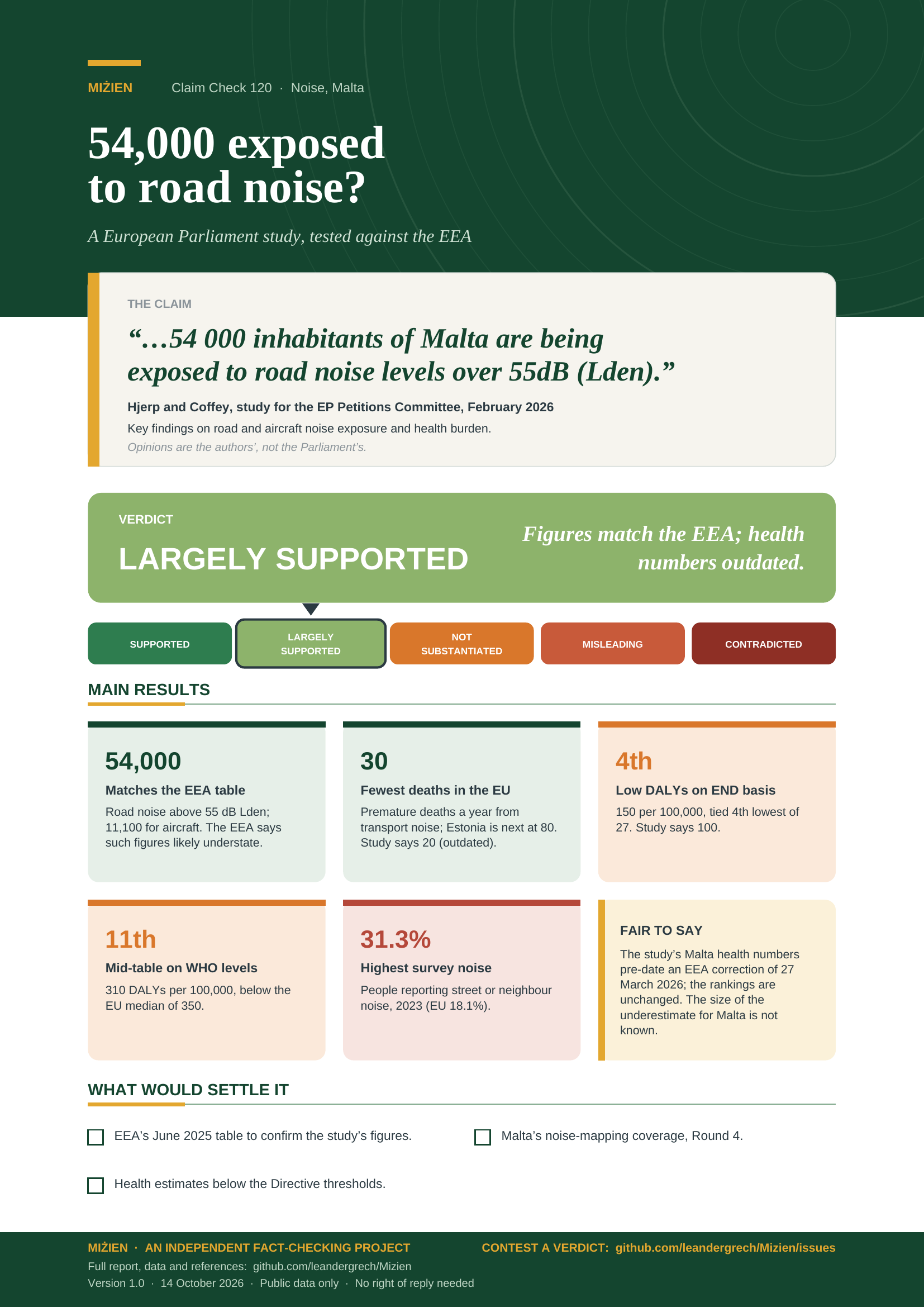
54,000 exposed to road noise: right, and too low?
Testing a European Parliament study’s Malta noise figures against the European Environment Agency
“An estimated 54 000 inhabitants of Malta are being exposed to road noise levels over 55dB (Lden).”
Hjerp and Coffey (Ecocentric Consulting), study for the European Parliament’s Committee on Petitions, February 2026.
Key findings (PE 783.089).
Verdict: Largely supported Figures match the EEA; health numbers outdated
Version 1.0 · 14 October 2026
TL;DR
A study for the European Parliament’s Committee on Petitions (February 2026) reports that “An estimated 54 000 inhabitants of Malta are being exposed to road noise levels over 55dB (Lden), compared to 11 100 in the case of aircraft noise levels.” It adds that the road figure is likely a considerable underestimate and that Malta has the lowest number of noise-related premature deaths a year (not per capita) and among the lowest DALYs per capita in the EU. We traced each figure to the European Environment Agency (EEA) report the study relies on.
- The exposure figures are exactly the EEA’s. 54,000 people on roads and 11,100 for aircraft above 55 dB Lden are in the EEA’s country table (Table 2.1). Roads affect about 5 times as many people as aircraft.
- ‘Underestimate’ is the EEA’s caution, applied to Malta. The EEA says its findings “likely represent a considerable underestimation” because the Directive covers only major infrastructure and large agglomerations. It does not quantify this for Malta, and neither do we.
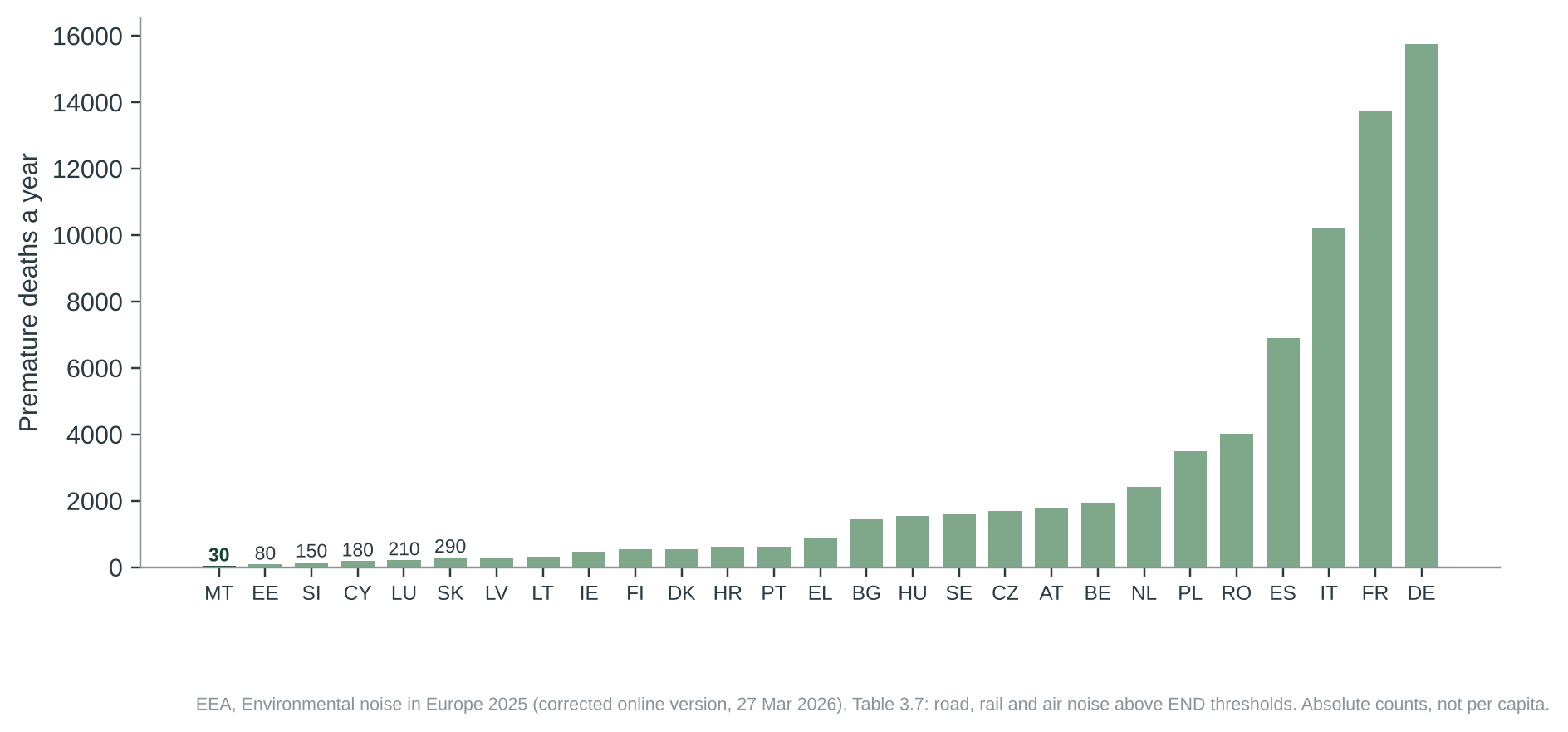
- The ‘lowest deaths’ claim holds, as an absolute count. 30 premature deaths a year in the EEA’s current table (the study quotes 20; the EEA corrected its figures after the study), the lowest of 27; the next is Estonia with 80. Per head Malta is second-lowest (5.8 per 100,000).
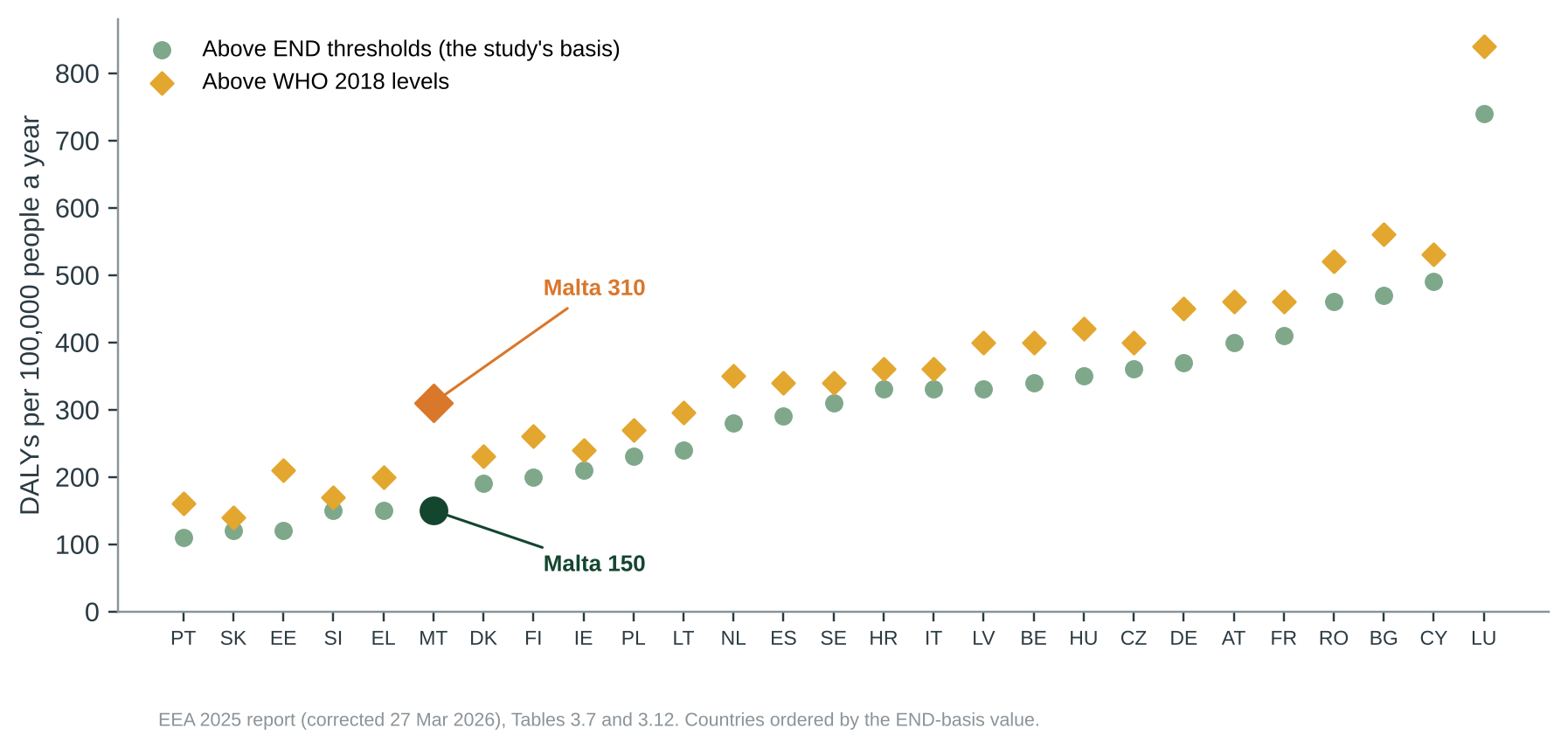
- ‘Among the lowest DALYs’ holds on the Directive’s thresholds only. Malta’s 150 DALYs per 100,000 is the 4th-lowest of 27 (tied). On the EEA’s WHO-level estimate it is 310, 11th lowest and below the median.
- Verdict: largely supported (moderate confidence). The figures trace to the EEA; the caveats are the study’s outdated health numbers, an unquantified underestimate and the dependence of the DALY ranking on the threshold used.
- Supported
- Largely supported
- Not substantiated
- Misleading
- Contradicted
What would move the verdict up
A study version using the corrected EEA health numbers and stating the WHO-basis result would make this ‘Supported’.
What would move it down
Evidence that Malta’s END reporting is incomplete in a way that changes the ranking, or a corrected EEA table that moves Malta out of the lowest group.
IN THIS REPORT
1 The claim and what we could verify
The statements are in the key findings of the study by Peter Hjerp and Clare Coffey (Ecocentric Consulting), commissioned by the European Parliament’s Committee on Petitions, PE 783.089, February 2026 [1]. We read the full text. The opinions are the authors’, not the Parliament’s official position. The study takes the numbers from the EEA report Environmental noise in Europe 2025 [2], which we also read, so this check tests the study’s Malta figures against their source.
| What the study says | Where | Access |
|---|---|---|
| “An estimated 54 000 inhabitants of Malta are being exposed to road noise levels over 55dB (Lden), compared to 11 100 in the case of aircraft noise levels.” | Key findings, p. 14 [1] | Read in full |
| The road number “is likely to be a considerable underestimation” because the Directive “only covers major road, rail and airport infrastructures and agglomerations of more than 100,000 inhabitants”. | Key findings; s. 2.3 [1] | Read in full |
| “Malta has the lowest number of noise related premature deaths/year rate (not per capita).” | Key findings [1] | Read in full |
| “It has among the lowest noise related DALYs (per capita) of all EU Member States.” | Key findings [1] | Read in full |
2 Method
Question. Are the study’s Malta figures and rankings correct, and what do they leave out?
Evidence. The EEA report’s country tables for people exposed (Table 2.1, p. 23–24), and for premature deaths and DALYs per 100,000 people based on the Directive’s thresholds (Table 3.7, p. 58) and on WHO levels (Table 3.12, p. 64) [2]; Eurostat population on 1 January 2022 [3] to put counts on a per-head basis; Eurostat’s survey indicator on street and neighbour noise for context [4]. Numbers are recomputed by tools/cc-120-report/calc.py from data/cc-120/. Ranks are among the 27 Member States; ties share the best rank.
Grades. The EEA tables are modelled estimates from official country reports (grade C, regulator report); the study is a commissioned expert report (grade C). No peer-reviewed paper is needed to reproduce the figures, and we did not re-derive the EEA’s exposure–response model. Verdicts follow the five-point scale in Appendix A.
3 What the sources say
The Environmental Noise Directive requires Member States to report how many people live above 55 dB Lden (day-evening-night average) and 50 dB Lnight for major roads, railways, airports and agglomerations above 100,000 inhabitants [1, 2]. It sets no limit values. The EEA states that its assessment “does not fully account for all urban areas, roads, railways, airports, or other noise sources” and that its findings “likely represent a considerable underestimation of the true impact” [2, s. 1.4, p. 20]. That sentence refers to Europe-wide findings; the study applies it to Malta’s road number.
The EEA cautions that “results from various countries might not be directly comparable”, because countries differ in network coverage within urban areas and in modelling detail [2, s. 1.5]. This applies to every ranking below. The EEA’s health figures were corrected: the report’s page states that an error in several health estimates, found after publication in June 2025, was corrected in the online version on 27 March 2026 [2]. The study (February 2026) predates the correction.
The study draws Malta’s health figures from the EEA’s June 2025 table and says the DALY figure “may suggest Malta is bucking a trend” of small, dense countries having higher health impacts [1, p. 18]. We did not open the June 2025 version; the difference between the study’s 20 deaths and 100 DALYs per 100,000 and the corrected 30 and 150 is consistent with the EEA’s correction, but we cannot confirm the cause.
4 What the data show
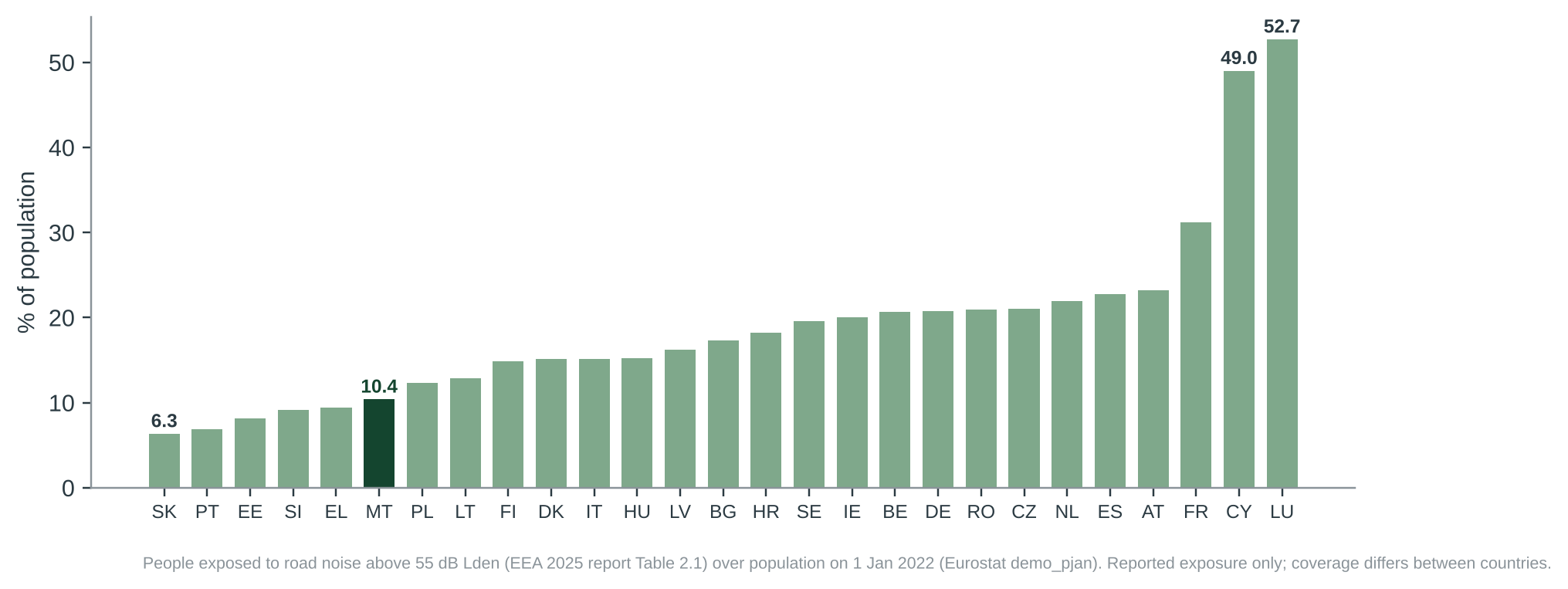
Malta’s road number is 54,000 and its aircraft number 11,100 in the EEA table, identical to the study. Together with no railways, 65,100 people (13% of the population) are above the Directive’s Lden threshold; for the night indicator the figure is 37,400 (7%) [2]. Absolute health burdens are small because the population is small.
| Indicator | Malta | Comparison | Source | Grade |
|---|---|---|---|---|
| Road, Lden ≥ 55 dB / aircraft | 54,000 / 11,100 | study: same | EEA Table 2.1 [2] | C |
| Premature deaths a year (END basis) | 30 (rank 1) | Study: 20; next: Estonia 80 | EEA Table 3.7 [2] | C |
| Deaths per 100,000 (END basis) | 5.8 (rank 2) | lowest: Slovakia 5.3 | calculated [2, 3] | C |
| DALYs per 100,000 (END basis) | 150 (rank 4, tied) | Study: 100; lowest: Portugal 110 | EEA Table 3.7 [2] | C |
| DALYs per 100,000 (WHO levels) | 310 (rank 11) | EU median 350; lowest: Slovakia 140 | EEA Table 3.12 [2] | C |
| Street or neighbour noise, 2023 (survey) | 31.3% | EU-27 18.1%; Malta 1st | Eurostat ilc_mddw01 [4] | C |
All values in data/cc-120/checks.csv. Ranks use 27 Member States; 1 = lowest burden. The survey row measures perceived noise from all sources and is not part of the study’s claim.
5 Where the evidence points different ways
Q1 Is Malta’s noise burden among the lowest in the EU?
DEPENDS ON THE THRESHOLDEVIDENCE FOR THE CLAIM'S IMPRESSION
On the Directive’s reporting thresholds Malta has the fewest premature deaths, the second-lowest rate per head and the 4th-lowest DALY rate of 27.
EVIDENCE AGAINST
On WHO’s recommended levels, which the EEA also tabulates, Malta’s DALY rate is 310, 11th lowest and below the EU median of 350, and its death rate per head ranks 9th.
Q2 Does low modelled exposure mean little noise?
NOT WHAT THE DATA SAYEVIDENCE FOR THE CLAIM'S IMPRESSION
The Directive-based figures show Malta with a low share of people exposed to road noise (10.4%, 6th lowest) and the study notes Malta has the lowest share of urban inhabitants exposed.
EVIDENCE AGAINST
Eurostat’s household survey puts Malta first in the EU for noise from neighbours or the street (31.3% against 18.1%) [4], and the study itself says END-covered sources are not “necessarily the main focus or cause of Maltese noise complaints”.
Q3 Are the study’s health figures current?
OUTDATED FIGURES, SAME RANKSEVIDENCE FOR THE CLAIM'S IMPRESSION
The study cites 20 deaths and 100 DALYs per 100,000 for Malta.
EVIDENCE AGAINST
The EEA’s corrected table now shows 30 and 150. Malta is still lowest for deaths and, using either set of values, 1st or 4th for DALYs (1st with 100; tied 4th with 150).
6 Testing the claim
| Sub-claim | What the evidence shows | Rating |
|---|---|---|
| A. 54,000 exposed to road noise and 11,100 to aircraft noise above 55 dB Lden | Both figures are in the EEA’s Table 2.1 for Malta [2]. Reported counts of exposed people, from Malta’s END reporting. | SUPPORTED |
| B. The road figure is likely a considerable underestimate | The EEA says the Directive’s coverage limits mean its findings likely understate the true impact [2, s. 1.4]; the study applies this to Malta. The size for Malta is not quantified. | LARGELY SUPPORTED |
| C. Malta has the lowest number of premature deaths a year (not per capita) | 30 against Estonia 80, the lowest of 27 [2]; the study’s 20 is superseded. The study correctly says this is not per capita. | SUPPORTED |
| D. Malta has among the lowest DALYs per capita of the Member States | 4th lowest of 27 on END thresholds (tied); 11th lowest on WHO levels, below the median [2]. The study quotes 100, the EEA now shows 150. | LARGELY SUPPORTED |
7 Verdict and requests for evidence
The figures trace to the EEA and the rankings hold; the study’s health numbers are outdated and the DALY ranking depends on the threshold. Confidence: moderate.
Why. (1) The exposure numbers are the EEA’s own. (2) Malta is lowest for absolute premature deaths and among the lowest per head on the Directive’s basis, as the study says. (3) The caveats are that the study’s health figures predate the EEA’s correction, the underestimate for Malta is not quantified, and on WHO levels Malta is mid-table. These do not change the substance, which our scale calls Largely supported.
What this verdict does not say. It does not say that Malta is quiet, that the Directive’s thresholds protect health, or that the modelled health burden is exact. It addresses only whether the study’s figures and rankings are what the EEA data show.
Evidence we are asking for
- The EEA’s June 2025 table, to confirm that the study’s 20 deaths and 100 DALYs come from it.
- Malta’s noise-mapping coverage under Round 4, to size the underestimate for roads.
- Health-impact estimates for Malta below the Directive’s thresholds, if the EEA publishes them by country.
8 Limitations
- Health burdens are modelled by the EEA from exposure–response relationships; we did not re-derive them, and small countries’ values are rounded to the nearest 10.
- Countries differ in noise-mapping detail and coverage, so cross-country ranks are indicative [2, s. 1.5].
- Per-head deaths use Eurostat’s population on 1 January 2022 and the EEA’s counts; the EEA’s own reference population may differ slightly.
- We read the EEA report as published on 27 March 2026 (the corrected version). The June 2025 version was not opened, so why the study’s numbers differ is inferred.
- The ‘considerable underestimation’ wording is the EEA’s statement about its assessment as a whole; we did not find a Malta-specific estimate.
References
- [1] Hjerp P., Coffey C. (2026). Analysing Malta’s implementation of Directive 2002/49/EC on the Assessment and Management of Environmental Noise. European Parliament, PE 783.089. doi:10.2861/6278624. (Read in full.) https://doi.org/10.2861/6278624
- [2] European Environment Agency (2025; online version corrected 27 Mar 2026). Environmental noise in Europe 2025. EEA Report 05/2025. doi:10.2800/5134480 (resolves via doi.org; not in Crossref). Tables 2.1, 3.7, 3.12; sections 1.4–1.5. (Read; CC BY 4.0.) https://www.eea.europa.eu/en/analysis/publications/environmental-noise-in-europe-2025
- [3] Eurostat. demo_pjan Population on 1 January by age and sex; retrieved 14 Oct 2026. https://ec.europa.eu/eurostat/databrowser/view/demo_pjan
- [4] Eurostat. ilc_mddw01 Noise from neighbours or from the street (EU-SILC); retrieved 5 Oct 2026 (CC-020 data). https://ec.europa.eu/eurostat/databrowser/view/ilc_mddw01
- [5] Miżien. Data and calculations: data/cc-120/; tools/cc-120-report/calc.py.
Appendix A: series standards and verdict scale
Every investigation in this series follows the same rules so that verdicts are comparable and challengeable.
| Verdict | Meaning |
|---|---|
| SUPPORTED | Evidence consistently backs the claim as stated. |
| LARGELY SUPPORTED | Backed by the evidence, with minor caveats that do not change the substance. |
| NOT SUBSTANTIATED | Stated more strongly than the evidence offered or available allows. May be true in some conditions but has not been shown. |
| MISLEADING | Omits material facts so that the overall impression is inaccurate, even if individual statements are defensible. |
| CONTRADICTED | The available evidence points against the claim. |
Confidence
High: multiple independent lines of evidence agree. Moderate: evidence is relevant but incomplete or indirect. Low: evidence is thin, second-hand or conflicting.
Evidence grades
A experiment · B observational study with a control or gradient · C review, guidance or official statistics · D assertion or anecdote. ◆ marks a source known only second-hand.
Standards
- Quote the speaker, not the headline, with outlet and date, and link the original where possible.
- Separate the claim from the evidence offered for it, and say who made which statement.
- Grade the evidence and show differing views side by side where the evidence is unsettled.
- State what we could not access or verify, and what would change the verdict either way.
- Ask for the missing evidence in specific, answerable requests.
- Offer a right of reply where a check finds a claim Not substantiated, Misleading or Contradicted (or a pledge Not measurable, Off track or Missed), before wider circulation, and append responses.
- Correct errors openly with a version number and change log.
- Whistle-blow only on evidence: a verdict of Misleading or Contradicted requires documents or data that can be shown, not inference.
- Check every side. Government, opposition, NGOs and developers are held to the same standard.
Appendix B: revision log
| Version | Date | Change |
|---|---|---|
| 1.0 | 14 Oct 2026 | First issue. No right of reply needed (verdict Largely supported). |
Sources and archived copies
-
Analysing Malta's implementation of Directive 2002/49/EC on the Assessment and Management of Environmental Noise (PE 783.089), European Parliament, Policy Department for Citizens, Equality and Culture, 2026-02.
Original · fetched and fingerprinted 2026-10-04; no public snapshot yet
The claim: Key findings, PDF p. 14 (also section 3). Text extracted and read on 11 Oct 2026. The same study is the source of CC-020; this is a different claim from it. -
Malta noise fact sheet 2022, European Environment Agency, 2022.
Original · fetched and fingerprinted 2026-10-10; no public snapshot yet
Locator for the Directive exposure figures; superseded as the evidence by the EEA report below. -
Environmental noise in Europe 2025 (EEA Report 05/2025; online version corrected 27 Mar 2026), European Environment Agency, 2025-06 (corrected 2026-03-27).
Original · Archived copy
The study's source for the Malta figures. Full report read 14 Oct 2026 (Tables 2.1, 3.7, 3.12; sections 1.4-1.5). doi:10.2800/5134480, resolves via doi.org, not in Crossref. CC BY 4.0. -
Population on 1 January by age and sex (demo_pjan), Eurostat, retrieved 14 Oct 2026.
Original · Archived copy
Population for per-head calculations (data/cc-120/).
Right of reply
Not needed: this check finds the claim supported. A right of reply is sought when a check finds a claim Not substantiated, Misleading or Contradicted.
Connections
How this claim relates to the others: who made it, the themes it shares with other claims, and the patterns it shows. A connection is a reason to read two checks side by side. It does not make either one right or wrong. How connections are found.
Who made it
European Parliament Committee on Petitions (commissioned study)
Other claims by European Parliament Committee on Petitions (commissioned study) 1
Linked directly 3
Claims that share a theme with this one. A theme is a cause, a mechanism, a target or a way of presenting figures that the editors have found in several claims; its strength says how close the link is.
Noise governance Shared target · Weak (indicative)
Claims about whether Malta maps, plans for and acts on noise under Directive 2002/49/EC and the WHO guidelines: the 2026 EP study, the PN petition and ADPD's call for a Freeport and airport study.
Two steps away 1
Not linked to this claim directly, but linked to a claim that is. These are found by following the links, not chosen by the editors, so they are looser: they show where one theme meets another.
- CC-007 Within EU limits vs WHO guideline (Largely supported)through Noise governanceCC-020Compliance-not-health pattern
Three steps away 9
One step further again. At this distance a connection says more about how the themes fit together than about this claim.
- CC-003 Per-capita emissions vs 2030 projection (Misleading)through Noise governanceCC-020Compliance-not-health patternCC-007Transport, air and climate
- CC-004 'Strong progress' in waste separation (Not substantiated)through Noise governanceCC-020Compliance-not-health patternCC-007Selective-metric pattern
- CC-008 Flyovers and congestion (Not substantiated)through Noise governanceCC-020Compliance-not-health patternCC-007Transport, air and climate
- CC-010 Tree-planting counts (Largely supported)through Noise governanceCC-020Compliance-not-health patternCC-007Selective-metric pattern
- CC-016 Shore-to-ship: 90% less harbour pollution (Misleading)through Noise governanceCC-020Compliance-not-health patternCC-007Transport, air and climate
- CC-021 Malta-Gozo tunnel traffic (not yet checked)through Noise governanceCC-020Compliance-not-health patternCC-007Transport, air and climate
- CC-033 Delimara: 'much cleaner air' (not yet checked)through Noise governanceCC-020Compliance-not-health patternCC-007Compliance-not-health pattern
- CC-035 PM2.5 death rate down two-thirds (Largely supported)through Noise governanceCC-020Compliance-not-health patternCC-007Transport, air and climate
- CC-110 EU: 37.7% of new cars zero-emission (Supported)through Noise governanceCC-020Compliance-not-health patternCC-007Selective-metric pattern
Similar wording
Claims whose own words overlap with this one, with the words they share. Found by comparing the wording of the claims, not their verdicts; a lead to read them together, not a finding.
- CC-020 EP study: noise law not the cause (Largely supported)shares: noise, study, ecocentric
Timeline
What was said, what was published before and after it, and each step of this check, in date order. Statements and sources carry the date they were published. The steps of the check carry the date the research was done, from the check's research log. Other statements by the same body on the same topic show whether a position was repeated, changed or corrected.
2026
- February 2026 The statement Peter Hjerp and Clare Coffey (Ecocentric Consulting), study for the European Parliament Committee on Petitions (PE 783.089) (this claim)
- February 2026 Statement published Analysing Malta's implementation of Directive 2002/49/EC on the Assessment and Management of Environmental Noise (PE 783.089), key findings p. 14, European Parliament, Policy Department
- February 2026 Statement by European Parliament Committee on Petitions (commissioned study) on Noise CC-020 EP study: noise law not the cause (Largely supported)
- 11 October 2026 Added to the claims to check
- 14 October 2026 Check started Check started by worker C. Primary wording (study key findings, PE 783.089) re-read from the europarl PDF; the study takes its Malta figures from the EEA report Environmental noise in Europe 2025.
- 14 October 2026 Exact wording found Verbatim found in the study (key findings p. 14; s. 2.3 pp. 16-18). EEA report read in full text (Tables 2.1, 3.7, 3.12; ss. 1.4-1.5); Eurostat demo_pjan retrieved. The EEA page notes a corrigendum to health estimates, incorporated 27 Mar 2026.
- 14 October 2026 Version 1.0: first issue First issue. Largely supported (moderate). No right of reply needed. Verdict in this version: Largely supported, moderate confidence.
- 14 October 2026 Evidence reviewed
2027
- 14 October 2027 Coming up: Evidence review due Each finished check is reviewed against new evidence within a year.
Every change to this claim's record is public: history of the record.
Download the report and flyer