CC-101 · Water · Water supply & groundwater
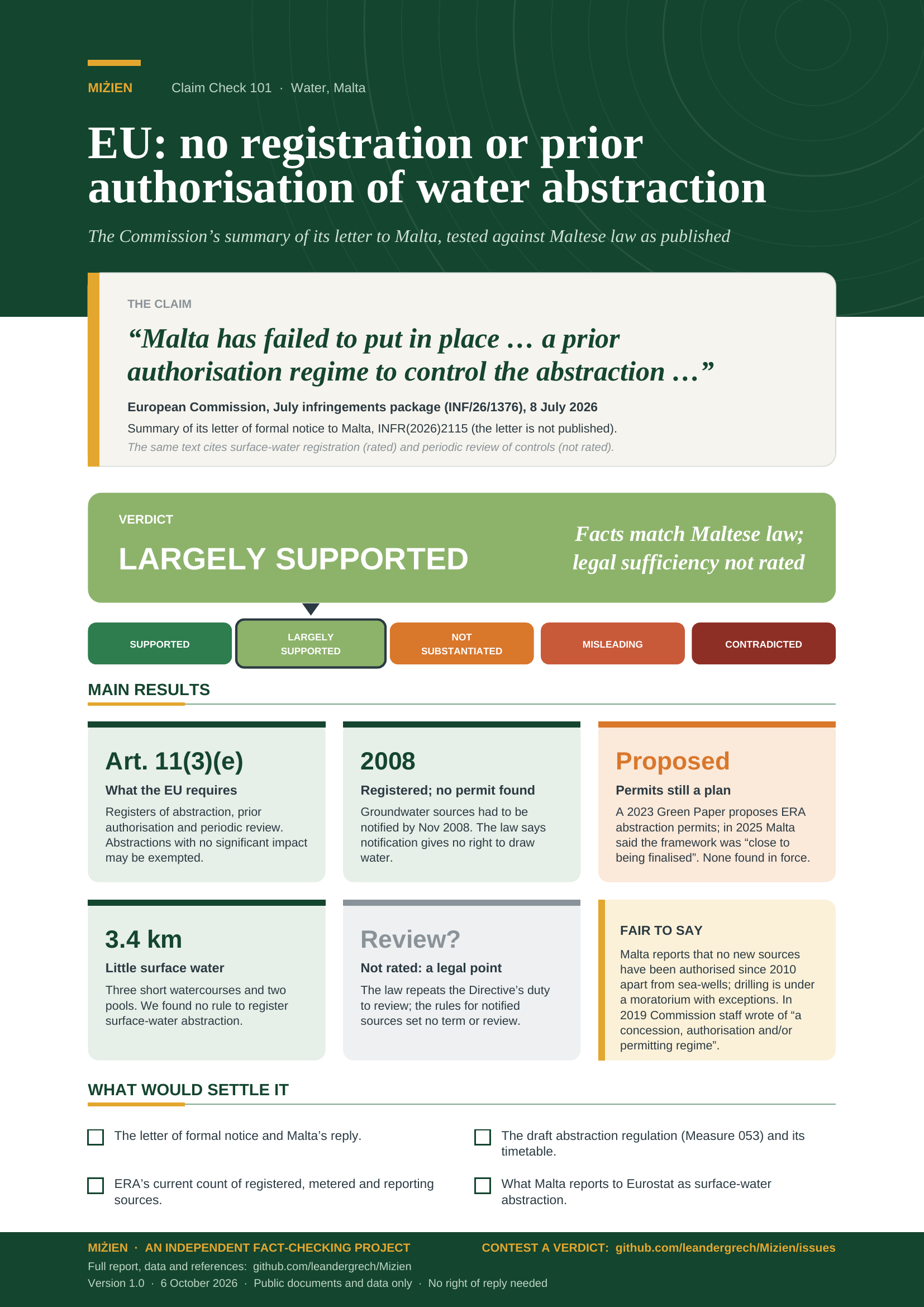
EU: no registration or prior authorisation of water abstraction in Malta
Largely supported Moderate confidence Draft: no right of reply needed
Parts of this claim
The claim is split into parts that are tested separately, as in the report below. Each part has its own number.
- CC-101A The Directive requires abstraction controls, with registers and prior authorisation, reviewed periodically (the Commission’s premise, not its words)Not rated as a statement of the speaker. For context, Article 11(3)(e) says so; abstractions with no significant impact on water status may be exempted [3].
- CC-101B Malta has failed to put in place a registration requirement for surface water abstractionRated on the facts: no instrument read requires registration of surface-water abstraction. Malta’s register covers groundwater sources only [5]; no surface-water provision in the instruments, Acts and titles searched [4–9, 21]; Malta’s 2nd plan notes a “lack of knowledge” of surface-water abstraction [12]. Surface water is small: three watercourses (3.4 km), two pools [17]; Eurostat estimates 2.96 million m³ a year [16].
- CC-101C Malta has failed to put in place a prior authorisation regime to control the abstraction of surface and groundwaterRated on the facts: no permit to abstract water in the instruments read. Notification and drilling permits give no right to draw water [5, 6]; the Green Paper and 3rd plan treat an abstraction permit as still to be created [10, 11], and we found none in force [21]. Caveat: the instruments do contain a register of groundwater sources, drilling permits judged on impact on water resources (reg. 7(3)), metering, and powers to close a source or reduce abstraction [5–7]; Malta’s 2025 report describes the register as the control [11]. Whether these are a “prior authorisation regime” is a legal question, not rated (section 6, Q1).
- CC-101D Maltese law does not ensure a periodic review of the controls over the abstraction of surface and groundwater having a significant impact on water bodiesS.L. 549.100 copies the Directive’s review duty (reg. 12(3)(e)) and provides for review of permits and authorisations where objectives are at risk (reg. 12(5)(b)) and of programmes every six years (reg. 12(8)) [4]; the instruments that run the controls set no term, renewal or review for a notified source, while drilling permits may carry a term and be suspended (regs 8(3)(a), 11) [5–7]; the Green Paper proposes fixed terms and periodic review [10]. Whether this “ensures” review is a legal question (section 6, Q2).
Claim Check 101 · EU law and the national record
EU: no registration or prior authorisation of water abstraction in Malta
Testing the Commission’s description of Malta’s abstraction controls against the law as published
“Malta has failed to put in place a registration requirement for surface water abstraction and a prior authorisation regime to control the abstraction of surface and groundwater.”
European Commission, July infringements package (INF/26/1376), 8 July 2026.
Summary of its letter of formal notice INFR(2026)2115; the letter itself is not published.
Verdict: Largely supported Facts match Maltese law as published; legal points not rated
Version 1.0 · 6 October 2026
TL;DR
On 8 July 2026 the European Commission opened an infringement procedure against Malta (INFR(2026)2115). Its published summary says: “Malta has failed to put in place a registration requirement for surface water abstraction and a prior authorisation regime to control the abstraction of surface and groundwater. In addition, Maltese law does not ensure a periodic review of the controls over the abstraction of surface and groundwater having a significant impact on water bodies.” [1] We tested the facts it rests on against the law as published and Malta’s own documents; breach of EU law is for the Commission and the Court.
- What the Directive asks. Abstraction controls “including a register or registers of water abstractions and a requirement of prior authorisation”, reviewed periodically; insignificant abstractions may be exempted [3].
- Malta registers groundwater sources; the instruments read contain no permit to abstract. Sources had to be notified by November 2008 and drilling is under a moratorium with exceptions, but notification and drilling permits give no “right ... to draw water” [5, 6].
- Malta’s documents differ on what the control is. The Green Paper and 3rd plan treat an abstraction permit as still to be created [10, 11]; Malta’s April 2025 report to the Commission describes the register as the control [11]. We found no permit in force [21].
- Surface water: little of it, and no register found. Three short watercourses (3.4 km) and two tiny pools, none with abstraction as a significant pressure [17]; no rule to register its abstraction found.
- Verdict: largely supported (moderate confidence). Facts match Maltese law as published; legal sufficiency and the review sentence not rated. It covers the Commission’s first sentence and the facts we could check. In 2019 Commission staff wrote of “a concession, authorisation and/or permitting regime to control groundwater and a register of groundwater use” [13].
- Supported
- Largely supported
- Not substantiated
- Misleading
- Contradicted
What would move the verdict up
The letter or Malta’s reply, if published, showing the facts are not in dispute (no permit to abstract water; no register of surface-water abstraction): Supported.
What would move it down
A Maltese instrument in force that we missed, which grants a permit to abstract or requires registration of surface-water abstraction; or the Commission narrowing its sentence after Malta’s reply.
IN THIS REPORT
1 The claim and what we could verify
The speaker is the European Commission. The words are from its July 2026 infringements package, published in the Commission’s press corner (INF/26/1376) and on its Representation in Malta’s website, both dated 8 July 2026 and identical [1, 2]. They summarise a letter of formal notice, which is not published. The same paragraph covers a letter to Spain (INFR(2026)2099), under the heading “Commission calls on Spain and Malta to ensure periodic review of water permits”, and says the two countries “now have two months to respond”.
| Document | What it is | Access |
|---|---|---|
| INF/26/1376, July infringements package, 8 July 2026 [1] | The Commission’s published summary; the claim | Read in full (press corner print copy) |
| Representation in Malta page, 8 July 2026 [2] | The same text | Read in full |
| Letter of formal notice INFR(2026)2115 | The legal document the summary describes | Not published |
| Infringement decisions register | The case record | Not reachable from our network (404) |
| Malta’s reply (due about two months after 8 July) | The Government’s answer | Not published; none found |
Our record’s title, “EU: no registration or prior authorisation of water abstraction in Malta”, condenses the Commission’s first sentence and is not itself rated; we rate the Commission’s words quoted above. Malta does issue permits to drill boreholes [6]; in the instruments read we found no permit to abstract water (section 4).
2 Method
Question. Does Maltese law, as published, contain (a) a requirement to register surface-water abstraction, (b) a permit to abstract surface water or groundwater, and (c) provisions for reviewing abstraction controls periodically? And what do Malta’s own documents and the EU’s data say about them?
Evidence. This is a documentary check. We read the Directive’s text [3] and the consolidated Maltese instruments on legislation.mt [4–9]. To look for any other abstraction instrument we searched, in its official sitemap, the titles of all 943 Legal Notices of 2024–2026, the full text of all 101 Acts of 2024–2026 and the titles of 344 subsidiary instruments in the environment, energy-and-water and Water Services Corporation series [21]. We read Malta’s Green Paper on groundwater abstraction (2023) [10], its April 2025 report to the Commission on its programme of measures [11], its 2nd water plan [12], and the Commission’s assessments of Malta’s plans [13–15]. Data: Eurostat abstraction by source and sector [16] and Malta’s 2022 Water Framework Directive reporting in the EEA’s WISE system [17, 18]. Every number is recomputed by tools/cc-101-report/calc.py from data/cc-101/; Eurostat’s flags are kept. Each “not found” statement has a search log in literature/CC-101/notes.md. All documents were read on 6 October 2026.
Grades. Legislation, official plans and reports and official statistics are grade C on our scale; there is no experimental or observational evidence to grade for a question of what a law says. News reports are used only to locate material and are marked ◆ where they report data we have not seen. Verdicts follow the five-point scale in Appendix A.
3 What the Directive asks, and Malta’s waters
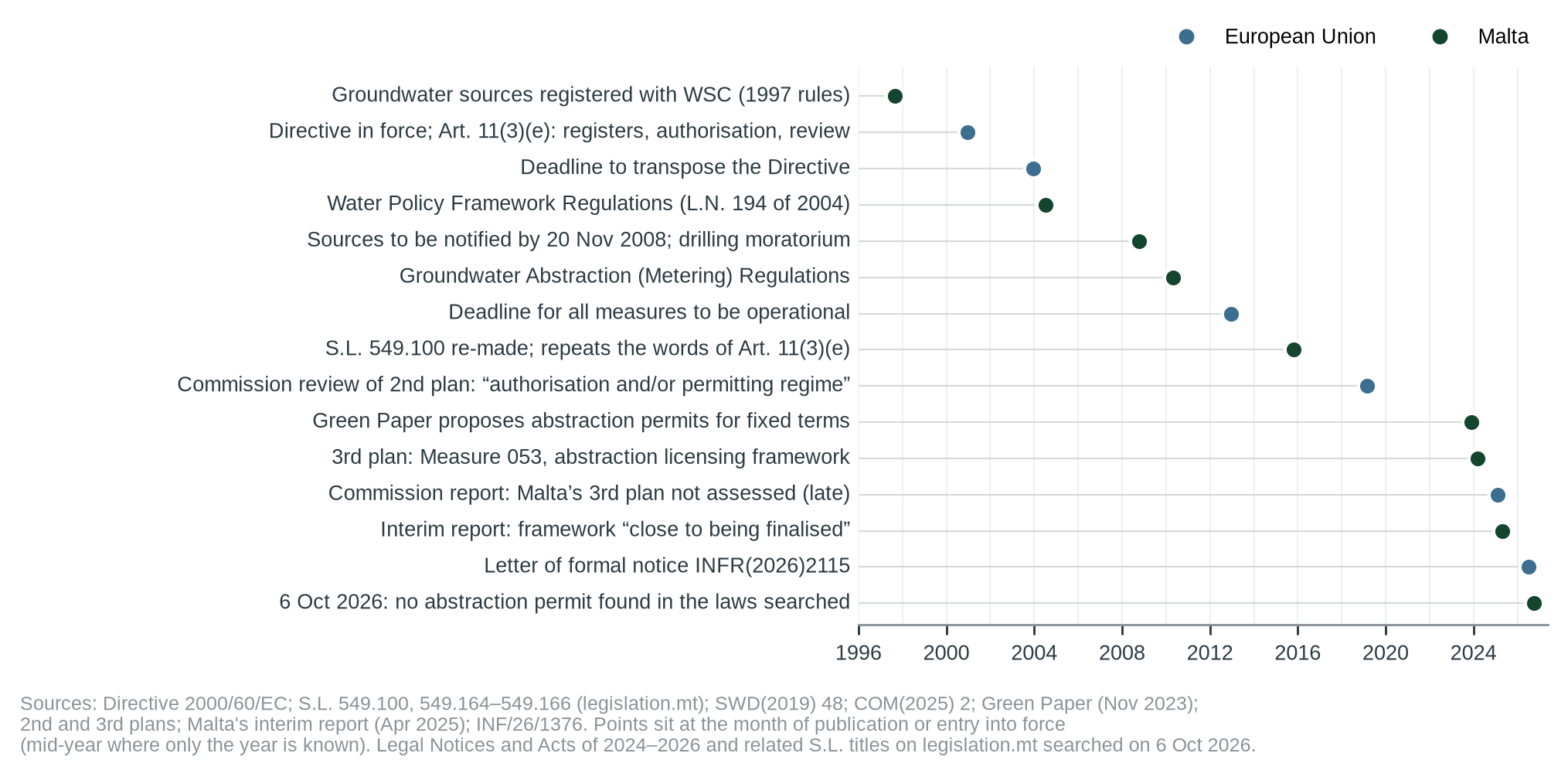
Article 11 of the Water Framework Directive requires a programme of measures for each river basin district. Among its basic measures, Article 11(3)(e) requires “controls over the abstraction of fresh surface water and groundwater, and impoundment of fresh surface water, including a register or registers of water abstractions and a requirement of prior authorisation for abstraction and impoundment. These controls shall be periodically reviewed and, where necessary, updated. Member States can exempt from these controls, abstractions or impoundments which have no significant impact on water status” [3]. The Directive was to be transposed by 22 December 2003 (Article 24) and its measures made operational by 22 December 2012 (Article 11(7)). Article 11(5) separately asks for permits to be examined and reviewed where a water body is unlikely to reach its objectives [3].
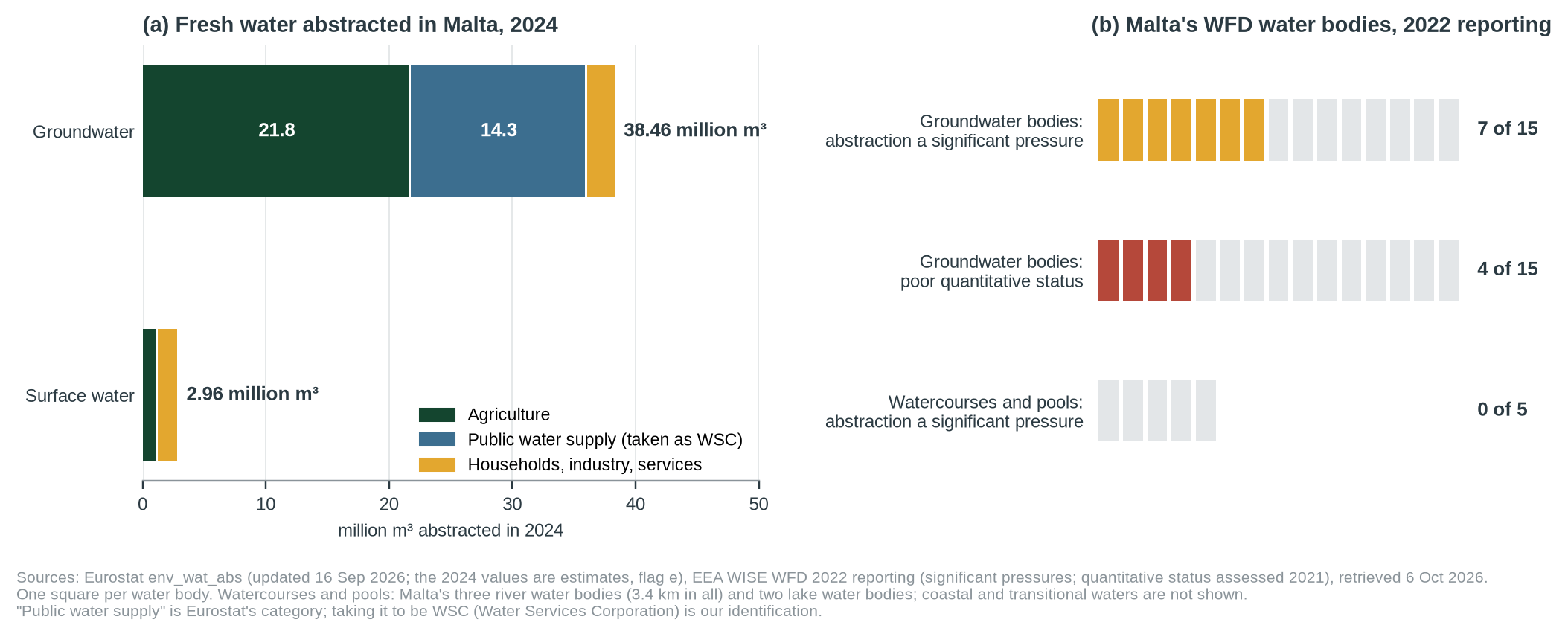
Malta’s natural fresh water is almost all groundwater: 92.9% of the fresh water abstracted in 2024 [16]; desalinated seawater is not counted as abstraction. Its 2nd water plan says “there are no rivers in the Maltese islands” [12]. In its 2022 EU reporting Malta lists three river water bodies, the watercourses of Wied il-Baħrija, Wied il-Luq and Wied il-Lunzjata (1.5, 1.3 and 0.6 km), and two lake water bodies of at most 0.001 km², besides coastal and transitional waters [17]. None of its surface water bodies lists abstraction as a significant pressure; seven of its 15 groundwater bodies do, and four groundwater bodies are in poor quantitative status [17, 18]. Malta told the Commission in 2019 that its only impoundments are small masonry dams in dry valleys holding less than 125,000 m³ in total [13].
Eurostat nevertheless records about 2.96 million m³ of “fresh surface water” abstraction a year in Malta (2019–2024), 7.1% of fresh water abstracted in 2024, split between households (1.71) and agriculture (1.25) [16]. The values are estimates (flag e) and are identical every year within 2010–2018 and within 2019–2024, so they are not a metered series. Eurostat does not say what this water is. The Government’s Green Paper counts harvested rainwater as 8% of agricultural supply in 2022 [10], which may be part of it; that is our reading, not Eurostat’s.
4 What Maltese law contains
Malta’s groundwater rules date from 2008–2010 and were made under the Malta Resources Authority Act. In 2024 Act XVII moved them to the Environment Protection Act and to the Environment and Resources Authority (ERA), “until other provision is made” [9]. Together with the regulations that transpose the Directive, they are the instruments a reader would look to for registration, authorisation and review.
| Instrument | What it does | Register? | Permit to abstract? | Review? |
|---|---|---|---|---|
| S.L. 549.100 Water Policy Framework Regs (2015) [4] | Reg. 12(3)(e) repeats Article 11(3)(e) almost word for word as a duty of the “competent authority”, including “These controls shall be periodically reviewed”. Reg. 12(5)(b) and (8): permits and authorisations are reviewed where objectives are at risk; programmes of measures every six years. Schedule VII: the plan summarises controls on abstraction “including reference to the registers”. | Duty stated | Duty stated | Duty stated |
| S.L. 549.164 Notification of Groundwater Sources (2008) [5] | Every groundwater source not registered under the 1997 rules had to be notified by 20 Nov 2008 (reg. 3); reg. 3A (2011) lets some old sources (dug before 1955; some shafts) be notified later, once ERA has decided. Reg. 6: notification “does not in any way give any right ... to draw water”; ERA may order closure “at any time”. | Yes: groundwater sources only | No | None in the text |
| S.L. 549.165 Borehole Drilling (2008) [6] | A permit is needed to drill into the saturated zone (reg. 4). Applications are barred for “a minimum period of twelve months ... or until such further period of time as the Authority may subsequently decide” (reg. 6(1)), with exceptions (reg. 6(2)): sea-wells, foundations, replacing a collapsed registered farm borehole and, from 27 Dec 2024, research boreholes of public entities. Permits turn on “no significant impact on water resources” (reg. 7(3)), may carry a “term” (reg. 8(3)(a)) and can be suspended or revoked at any time (reg. 11). Reg. 9: no “right to draw water”. Reg. 10: ERA may order extraction stopped or reduced. | Drilling permits (reg. 12) | No | Term; may be suspended (regs 8, 11) |
| S.L. 549.166 Metering (2010) [7] | Registered and notified sources are to be metered by WSC; exemptions for sources without pumps, cultural property and domestic perched-aquifer sources under 1 m³ a day. | — | No | No |
| S.L. 545.14 Water Supply and Sewerage Services (2004) [8] | Licences for water suppliers, including tankers. “Supply of water” is defined to exclude “water abstraction”. | Licensed suppliers | No | Licence term |
| S.L. 545.02 Control of Water Pumps and Wells Order (1946-47) [8] | Declares the whole of Malta and of Gozo “a water-controlled area”. The text has no register, permit or review provision. | No | No | No |
Also read: S.L. 549.168 (users of a source), S.L. 549.172 (environmental permits; no abstraction category), S.L. 549.21 (quality of surface water used for drinking water), S.L. 549.53 and 549.155 (groundwater pollution), and the WSC Act, whose licensing articles 43–45 are marked deleted (2000) [7, 9]. None registers surface-water abstraction or grants a permit to abstract.
So the instruments read contain a register of groundwater sources (notification was due by 20 November 2008, with a later route for some old sources), a drilling-permit scheme with a moratorium and exceptions, metering rules, and powers to close a source or reduce its abstraction. We found in them no register of surface-water abstractions and no permit to abstract water. S.L. 549.100 states the Directive’s duty (reg. 12(3)(e)) in general terms, and we found in its text no provision that creates a register or a permit to abstract.
5 What Malta’s plans and reports say
The Government proposes the missing permit. The November 2023 Green Paper, by the Energy and Water Agency (EWA) and ERA, lists the 2008–2010 regulations as the current framework and proposes a new one: “Following the enactment of the legal framework, no groundwater source will be utilized for the abstraction of groundwater unless an abstraction permit or clearance has been issued by the Environment and Resources Authority (ERA)”, with “permit conditions ... renewable for defined fixed term periods”, a public register of abstractors, quotas for farmers and tariffs for commercial and domestic users, “periodically reviewed” [10]. WSC’s own sources would be outside the framework, with its abstraction capped at 14 million m³ a year to 2030 [10].
Malta’s report to the Commission. Malta’s April 2025 interim report on its 3rd water plan (March 2024) lists the proposal as Measure 053, “Development of a Groundwater Abstraction Licensing Framework” [11]. In that report, under Article 11(3)(e), Malta wrote that “National legislation requires all groundwater abstraction stations, regardless of yield, to be registered with the ERA. Only these registered sources are permitted to extract groundwater, and no new sources have been authorised since 2010, apart from seawater sources” [11]. The same report says the licensing framework is “close to being finalised. The next step will be for the proposed regulation to be issued for public consultation and eventually adopted by Government”, and that the resources to run it are “still being secured and configured” [11]. Its section on Article 11(3)(e) does not mention surface water.
Where things stand. Of the 943 Legal Notices of 2024–2026 on legislation.mt, one title mentions groundwater, abstraction, boreholes, wells or water policy: L.N. 374 of 2024, which adds research boreholes by public entities to the exceptions from the drilling moratorium (read in full). We found no notice that creates an abstraction permit (titles only, apart from L.N. 374). Of the 101 Acts of 2024–2026 on the site, only Act XVII of 2024, which moved the groundwater regulations to ERA, mentions groundwater, abstraction or boreholes in its text, and the titles of 344 subsidiary instruments under S.L. 549, 423, 545, 355 and 427 turned up no abstraction instrument beyond those in section 4 [5–7, 21]. A news investigation reports that ERA said nothing had happened since the Green Paper beyond “internal discussions” ◆ [20].
Registered and metered sources
| What | Number | Source | Grade |
|---|---|---|---|
| Boreholes operated by agriculture | 3,553 | Green Paper, 2023 [10] | C |
| Boreholes registered for commercial activities | 245 | Green Paper, 2023 [10] | C |
| Registered low-yield sources (spieri), mostly without pumps, so not metered | 3,405 | Green Paper, 2023 [10] | C |
| WSC boreholes (plus 12 pumping stations); abstraction “fully accounted for” | 110 | Green Paper, 2023 [10] | C |
| Private sources metered | “most” (2025); “more than 3 000” (2019) | Malta, interim report [11]; Malta’s clarification in SWD(2019) 48, p. 124 n. 65 [13] | C |
| Registered commercial boreholes reporting no abstraction data | more than 63% ◆ | ERA data reported by Amphora Media, 2026 [20] | D |
We found no current count of metered sources. Malta told the Commission in 2019 that more than 3,000 private groundwater sources had been metered [13, p. 124 n. 65] (“practically all”, p. 84), and in 2025 that “most” registered sources have been [11]; a 2020 review by an Energy and Water Agency author describes agricultural use being managed “through the progressive metering of groundwater abstraction sources” [19, p. 30]. These are Malta’s statements, not counts we could check. The ◆ figure is second-hand (a news report of ERA records we have not seen) and is not used for any rating. Domestic boreholes (pools, gardens) have no count in the Green Paper.
6 Where the documents point different ways
Q1 Does Malta’s register of groundwater sources amount to a “prior authorisation regime”?
DOCUMENTS DIFFER; LEGAL QUESTION, NOT RATEDEVIDENCE FOR THE COMMISSION’S STATEMENT
Malta’s laws say notification and drilling permits give no right to draw water [5, 6], and we found no permit to abstract in the instruments read. The Government’s Green Paper treats an abstraction permit as new, to be created by “the enactment of the legal framework” [10], and Malta’s April 2025 interim report lists it as a measure still to be delivered [11]. In 2019 the Commission’s staff document says abstraction “should be included under cross compliance once the legislation on authorisations of abstraction is in place” [13, p. 125]. The Commission’s 2026 summary says Malta “failed to put in place” such a regime [1].
EVIDENCE THAT POINTS THE OTHER WAY
Malta reports that “Only these registered sources are permitted to extract groundwater” and that no new sources have been authorised since 2010 apart from sea-wells [11]. In 2019 the Commission’s staff wrote that “in Malta there is a concession, authorisation and/or permitting regime to control groundwater and a register of groundwater use”, while noting that the plan gave no information on the procedures and resources in place to control abstractions [13, p. 121].
Q2 Does Maltese law “ensure” periodic review?
NOT RATED; LEGAL ASSESSMENTEVIDENCE FOR THE COMMISSION’S STATEMENT
For a notified source, the operative instruments contain no term, expiry, renewal or review [5, 7]. S.L. 549.165 lets a drilling permit carry a “term” (reg. 8(3)(a)) and be suspended or revoked at any time on listed grounds (reg. 11), and its register of permits “shall be kept under review and up to date” (reg. 12(2)) [6]. The Green Paper proposes fixed-term abstraction permits and periodic review of quotas and tariffs [10].
EVIDENCE THAT POINTS THE OTHER WAY
S.L. 549.100 reg. 12(3)(e) copies the Directive’s words: “These controls shall be periodically reviewed and, where necessary, updated” [4]. Its reg. 12(5)(b) says that where objectives are unlikely to be met “relevant permits and authorisations are examined and reviewed as appropriate”, and reg. 12(8) that programmes of measures are reviewed every six years [4]. ERA may also order a source closed or its abstraction reduced where it has a significant impact [5, 6].
7 Testing the claim
| Sub-claim | What the evidence shows | Rating |
|---|---|---|
| A. The Directive requires abstraction controls, with registers and prior authorisation, reviewed periodically (the Commission’s premise, not its words) | Not rated as a statement of the speaker. For context, Article 11(3)(e) says so; abstractions with no significant impact on water status may be exempted [3]. | PREMISE, NOT RATED |
| B. Malta has failed to put in place a registration requirement for surface water abstraction | Rated on the facts: no instrument read requires registration of surface-water abstraction. Malta’s register covers groundwater sources only [5]; no surface-water provision in the instruments, Acts and titles searched [4–9, 21]; Malta’s 2nd plan notes a “lack of knowledge” of surface-water abstraction [12]. Surface water is small: three watercourses (3.4 km), two pools [17]; Eurostat estimates 2.96 million m³ a year [16]. | ACCURATE (LAWS SEARCHED) |
| C. Malta has failed to put in place a prior authorisation regime to control the abstraction of surface and groundwater | Rated on the facts: no permit to abstract water in the instruments read. Notification and drilling permits give no right to draw water [5, 6]; the Green Paper and 3rd plan treat an abstraction permit as still to be created [10, 11], and we found none in force [21]. Caveat: the instruments do contain a register of groundwater sources, drilling permits judged on impact on water resources (reg. 7(3)), metering, and powers to close a source or reduce abstraction [5–7]; Malta’s 2025 report describes the register as the control [11]. Whether these are a “prior authorisation regime” is a legal question, not rated (section 6, Q1). | LARGELY ACCURATE (ON THE FACTS) |
| D. Maltese law does not ensure a periodic review of the controls over the abstraction of surface and groundwater having a significant impact on water bodies | S.L. 549.100 copies the Directive’s review duty (reg. 12(3)(e)) and provides for review of permits and authorisations where objectives are at risk (reg. 12(5)(b)) and of programmes every six years (reg. 12(8)) [4]; the instruments that run the controls set no term, renewal or review for a notified source, while drilling permits may carry a term and be suspended (regs 8(3)(a), 11) [5–7]; the Green Paper proposes fixed terms and periodic review [10]. Whether this “ensures” review is a legal question (section 6, Q2). | NOT RATED (LEGAL ASSESSMENT) |
Why these ratings. Sub-claim A is the Commission’s premise, not something it says about Malta, so it is not rated. Sub-claim B is “accurate” on a bounded search: we read every instrument a registration rule would sit in and searched the titles of recent Legal Notices, the text of recent Acts and the titles of related subsidiary instruments, but not every Chapter of the Laws of Malta. Sub-claim C is rated on what the instruments contain, not on the word “regime”: they contain no permit to abstract water (accurate on the same bounded search). It is “largely accurate” because the summary does not mention the controls that do exist: the register of groundwater sources, drilling permits judged on their impact, metering, and powers to close a source or reduce abstraction.
8 Verdict and requests for evidence
Facts match Maltese law as published; legal sufficiency and the review sentence not rated. The verdict covers the Commission’s first sentence and the facts we could check. Confidence: moderate.
Why. (1) The Directive asks for what the Commission’s sentences presuppose (A, a premise, not rated). (2) Malta’s registration rules cover groundwater sources only, and we found no requirement to register surface-water abstraction (B). (3) We found no permit to abstract water in the instruments read: the laws say notification and drilling permits give no right to draw water, and the Green Paper and 3rd plan treat an abstraction permit as still to be created; we found none in force on 6 October 2026 (C). (4) Caveats: Malta’s April 2025 report describes the register as the control; the register, drilling permits, moratorium, metering and closure powers are real, if partial, controls that the summary does not mention; and in 2019 Commission staff wrote of “a concession, authorisation and/or permitting regime to control groundwater and a register of groundwater use” [13]. (5) The review sentence turns on what “ensure” requires in EU law, so it is shown, not rated (D). Confidence is moderate: we read the Commission’s summary, not its letter; Malta’s reply and its 3rd plan itself were not available to us; and the absence of a provision is shown by a bounded search.
What this verdict does and does not say. It covers the Commission’s first sentence, tested on the facts we could check. It does not rate the second sentence (periodic review) or whether Maltese law is sufficient under the Directive. It does not say that Malta is in breach of EU law, that anyone abstracts unlawfully, or how much over-abstraction there is. Groundwater status is covered in CC-009 and CC-047. A Largely supported verdict needs no right of reply.
Evidence we are asking for
- The Commission: the letter of formal notice INFR(2026)2115, or its legal reasoning on Malta’s existing register.
- The Government (ERA, EWA): Malta’s reply to the letter, and the draft groundwater abstraction regulation under Measure 053 with its timetable for consultation and adoption.
- ERA: the current number of registered groundwater sources, how many are metered (Malta told the Commission in 2019 that more than 3,000 private sources were) and how many report readings each year.
- EWA or the National Statistics Office: what Malta reports to Eurostat as fresh surface-water abstraction (2.96 million m³ a year), and how it is estimated.
9 Limitations
- We read the Commission’s published summary [1, 2], not the letter of formal notice, which may set out more detail or different reasoning.
- Malta’s reply was due in about September 2026; we found none published.
- Malta’s 3rd water plan could not be read from our network (its host refuses scripts and the web archive was unreachable); its Programme of Measures is known here through Malta’s April 2025 interim report on it [11].
- “Not found” statements rest on the search recorded in the notes: the instruments listed in section 4, the titles of all Legal Notices of 2024–2026, the text of all Acts of 2024–2026 and the titles of S.L. 549, 423, 545, 355 and 427 on legislation.mt [21]. A provision elsewhere in the Laws of Malta (including by-laws), a draft not yet published, or an instrument not yet on the site would not have been found.
- Eurostat’s abstraction figures for Malta are estimates; the surface-water series is flat within periods and unexplained.
- The 2nd water plan was read from a copy hosted outside ERA’s site (same title and content; hash in the notes).
- We give no legal opinion; the meaning of “prior authorisation” and “ensure ... periodic review” in the Directive is for the Commission and the Court of Justice.
References
- [1] European Commission (8 Jul 2026). July infringements package: key decisions. INF/26/1376, section 1, “Commission calls on Spain and Malta to ensure periodic review of water permits”. Read in full 6 Oct 2026. https://ec.europa.eu/commission/presscorner/detail/en/inf_26_1376
- [2] European Commission Representation in Malta (8 Jul 2026). July infringements package: key decisions. Read 6 Oct 2026. https://malta.representation.ec.europa.eu/news/july-infringements-package-key-decisions-2026-07-08_en
- [3] Directive 2000/60/EC (Water Framework Directive), OJ L 327, 22.12.2000, p. 1: Articles 11(3)(e), 11(5), 11(7), 24. https://data.europa.eu/eli/dir/2000/60/oj
- [4] Water Policy Framework Regulations, S.L. 549.100 (L.N. 345 of 2015, as amended), regs 12(3)(e), 12(5)(b), 12(8) and Schedule VII. https://legislation.mt/eli/sl/549.100/eng
- [5] Notification of Groundwater Sources Regulations, S.L. 549.164 (L.N. 255 of 2008), regs 3, 3A, 6. https://legislation.mt/eli/sl/549.164/eng
- [6] Borehole Drilling and Excavation Works within the Saturated Zone Regulations, S.L. 549.165 (L.N. 254 of 2008, as amended to L.N. 374 of 2024), regs 4, 6, 7, 8, 9, 10, 11, 12. https://legislation.mt/eli/sl/549.165/eng
- [7] Groundwater Abstraction (Metering) Regulations, S.L. 549.166 (L.N. 241 of 2010), regs 3, 8; Users of Groundwater Sources (Application) Regulations, S.L. 549.168. https://legislation.mt/eli/sl/549.166/eng
- [8] Water Supply and Sewerage Services Regulations, S.L. 545.14 (L.N. 525 of 2004), regs 2, 3, 6; Control of Water Pumps and Wells Order, S.L. 545.02 (Proclamations V of 1946 and II of 1947; ELI page sl/545.2). https://legislation.mt/eli/sl/545.14/eng
- [9] Environment Protection Act, Cap. 549, as amended by Act XVII of 2024 (transfer of the groundwater regulations to ERA); S.L. 549.172, 549.21, 549.53, 549.155; Water Services Corporation Act, Cap. 355. https://legislation.mt/eli/cap/549/eng
- [10] Energy and Water Agency and Environment and Resources Authority (Nov 2023). Green Paper on the Regulation of Groundwater Abstraction in the Maltese Islands. PDF pp. 3–7. https://energywateragency.gov.mt/wp-content/uploads/2023/11/GREEN-PAPER.pdf
- [11] Malta (Apr 2025). Interim reporting on the implementation of the Programme of Measures identified under the 3rd River Basin Management Plan. pp. 4, 13, 15, 22–23, 35. https://energywateragency.gov.mt/wp-content/uploads/2025/12/Interim-Report-2025-Final-Version.pdf
- [12] Sustainable Energy and Water Conservation Unit and ERA (2015). The 2nd Water Catchment Management Plan for the Malta Water Catchment District 2015–2021. pp. 1, 2, 15, 312, 339, 342, 373. Read from a copy on ampeid.org. https://era.org.mt/wp-content/uploads/2019/05/2nd_Water_Catchment_Management_Plan-Malta_Water_in_Maltese_Islands.pdf
- [13] European Commission (26 Feb 2019). Second River Basin Management Plans – Member State: Malta. SWD(2019) 48 final, pp. 84, 121–125. http://publications.europa.eu/resource/celex/52019SC0048
- [14] European Commission (4 Feb 2025). Report on the implementation of the Water Framework Directive and the Floods Directive. COM(2025) 2 final, pp. 3, 24. http://publications.europa.eu/resource/celex/52025DC0002
- [15] European Commission (4 Feb 2025). Staff Working Document, EU overview of the third river basin management plans. SWD(2025) 13 final, pp. 51–52. http://publications.europa.eu/resource/celex/52025SC0013
- [16] Eurostat. env_wat_abs Annual freshwater abstraction by source and sector; updated 16 Sep 2026, retrieved 6 Oct 2026, with flags. doi:10.2908/ENV_WAT_ABS. https://ec.europa.eu/eurostat/databrowser/view/env_wat_abs/default/table
- [17] European Environment Agency. WISE Water Framework Directive 2022 reporting: surface water bodies and significant pressures (surface water and groundwater), Malta. Retrieved 6 Oct 2026. https://water.discomap.eea.europa.eu/arcgis/rest/services/WISE_WFD
- [18] European Environment Agency. WISE Water Framework Directive 2022 reporting: groundwater bodies, quantitative status, Malta (assessed 2021). Retrieved 6 Oct 2026. https://water.discomap.eea.europa.eu/arcgis/rest/services/WISE_WFD/WFD2022_GroundWaterBody_WM/MapServer/0
- [19] Sapiano M. (2020). Integrated Water Resources Management in the Maltese Islands. Acque Sotterranee 9(3):25–32 (pages as printed in the article). doi:10.7343/as-2020-477. Open access; context, p. 30. https://doi.org/10.7343/as-2020-477
- [20] ◆ Amphora Media (Aug 2026). Profit In Every Drop: The Companies Pumping Malta’s Groundwater For Free. News report of ERA data we have not seen. https://www.amphora.media/2026/08/profit-in-every-drop-malta-groundwater
- [21] Miżien. data/cc-101/ and tools/cc-101-report/calc.py, including from legislation.mt’s ELI sitemap the titles of every Legal Notice and Act of 2024–2026 (with text-search counts for the Acts) and of S.L. 549, 423, 545, 355 and 427.
Appendix A: series standards and verdict scale
Every investigation in this series follows the same rules so that verdicts are comparable and challengeable.
| Verdict | Meaning |
|---|---|
| SUPPORTED | Evidence consistently backs the claim as stated. |
| LARGELY SUPPORTED | Backed by the evidence, with minor caveats that do not change the substance. |
| NOT SUBSTANTIATED | Stated more strongly than the evidence offered or available allows. May be true in some conditions but has not been shown. |
| MISLEADING | Omits material facts so that the overall impression is inaccurate, even if individual statements are defensible. |
| CONTRADICTED | The available evidence points against the claim. |
Confidence
High: multiple independent lines of evidence agree. Moderate: evidence is relevant but incomplete or indirect. Low: evidence is thin, second-hand or conflicting.
Evidence grades
A experiment · B observational study with a control or gradient · C review, guidance, official statistics, legislation or official reports · D assertion or anecdote. ◆ marks a source known only second-hand.
Standards
- Quote the speaker, not the headline, with outlet and date, and link the original where possible.
- Separate the claim from the evidence offered for it, and say who made which statement.
- Grade the evidence and show differing views side by side where the evidence is unsettled.
- State what we could not access or verify, and what would change the verdict either way.
- Ask for the missing evidence in specific, answerable requests.
- Offer a right of reply where a check finds a claim Not substantiated, Misleading or Contradicted (or a pledge Not measurable, Off track or Missed), before wider circulation, and append responses.
- Correct errors openly with a version number and change log.
- Whistle-blow only on evidence: a verdict of Misleading or Contradicted requires documents or data that can be shown, not inference.
- Check every side. Government, opposition, NGOs and developers are held to the same standard.
Appendix B: revision log
| Version | Date | Change |
|---|---|---|
| 1.0 | 6 Oct 2026 | First issue. No right of reply needed for a Largely supported verdict. |
Sources and archived copies
-
July infringements package: key decisions (INF/26/1376), European Commission (press corner), 2026-07-08.
Original · Archived copy
The claim. Read in full on 6 Oct 2026 via the press corner's print PDF; section 1, item "Commission calls on Spain and Malta to ensure periodic review of water permits". Summary of the letter of formal notice, which is not published. -
July infringements package: key decisions, European Commission Representation in Malta, 2026-07-08.
Original · fetched and fingerprinted 2026-10-10; no public snapshot yet
Same wording, read 6 Oct 2026. A letter of formal notice is an opening step, not a finding by the Court. -
Green Paper on the Regulation of Groundwater Abstraction in the Maltese Islands, Energy and Water Agency and Environment and Resources Authority, November 2023.
Original · fetched and fingerprinted 2026-10-10; no public snapshot yet
Primary evidence. Proposes abstraction permits or clearances issued by ERA, renewable for fixed terms; borehole counts. Read in full 6 Oct 2026. -
Interim reporting on the implementation of the Programme of Measures identified under the 3rd RBMP, Government of Malta (hosted by the Energy and Water Agency), April 2025.
Original · fetched and fingerprinted 2026-10-10; no public snapshot yet
Primary evidence. Section 3.3 (Article 11(3)(e)) and Measure 053, "close to being finalised". Read in full 6 Oct 2026. -
Notification of Groundwater Sources Regulations (S.L. 549.164) and Borehole Drilling and Excavation Works within the Saturated Zone Regulations (S.L. 549.165), Laws of Malta (legislation.mt), 2008, consolidated.
Original · Archived copy
Primary evidence. Registration of groundwater sources and drilling permits; both state they give no right to draw water. Read in full 6 Oct 2026, with S.L. 549.100, 549.166, 549.168, 549.172, 549.21, 549.53, 549.155, 545.14 and 545.02. -
Second River Basin Management Plans - Member State Malta, SWD(2019) 48 final, European Commission, 26 Feb 2019.
Original · fetched and fingerprinted 2026-10-10; no public snapshot yet
The Commission's earlier description of Malta's Article 11(3)(e) controls ("a concession, authorisation and/or permitting regime to control groundwater and a register of groundwater use", p. 121; it lists L.N. 254 and 255 of 2008 among the regulatory framework, p. 122; abstraction to come under cross compliance "once the legislation on authorisations of abstraction is in place", p. 125; Malta's clarification that more than 3 000 private sources were metered, p. 124 n. 65). Read 6 Oct 2026.
Right of reply
Not needed: this check finds the claim supported. A right of reply is sought when a check finds a claim Not substantiated, Misleading or Contradicted.
Connections
How this claim relates to the others: who made it, the themes it shares with other claims, and the patterns it shows. A connection is a reason to read two checks side by side. It does not make either one right or wrong. How connections are found.
Who made it
Other claims by European Commission 10
- CC-005 “92% excellent” bathing water (Supported)
- CC-094 Commission: Malta to emit more in 2030 than in 2005 (Supported)
- CC-109 EU: transport is 48% of effort-sharing emissions (Largely supported)
- CC-110 EU: 37.7% of new cars zero-emission (Supported)
- CC-111 EU: 621 kg of waste a head, 74% landfilled (Supported)
- CC-117 EU: Malta missed recycling targets (reasoned opinion) (not yet checked)
- CC-125 EU: Malta Social Climate Plan EUR 60.6 million (not yet checked)
- CC-127 EU: Malta has the lowest organic share in the EU (not yet checked)
- CC-128 EU: Malta missed the water-plan timetable (not yet checked)
- CC-129 EU: Malta has not updated its air pollution programme (not yet checked)
Linked directly 8
Claims that share a theme with this one. A theme is a cause, a mechanism, a target or a way of presenting figures that the editors have found in several claims; its strength says how close the link is.
Water chain: farm waste, sewage, sea, aquifer Shared cause · Weak (indicative)
The Commission blames farm waste in the sewers for poor treatment; agricultural nitrates are behind groundwater failure. Treated water also feeds 'new water' irrigation.
- CC-009 More RO, less WSC groundwater (Largely supported)
- CC-039 Net Zero Impact Utility (pledge: Not measurable)
- CC-047 Nitrates in the aquifer (Largely supported)
- CC-108 Net-zero impact on the groundwater environment (pledge: Not measurable)
- CC-118 Council: Malta second-highest water stress, groundwater failing (Largely supported)
EU findings of unmet obligations Shared mechanism · Weak (indicative)
Commission documents record Malta missing an EU environmental obligation: water-permit controls (CC-101), recycling targets (CC-117), the river basin plan timetable (CC-128) and the update of the air pollution control programme (CC-129). Indicative until a report tests what each finding rests on and whether it has since been closed.
Two steps away 5
Not linked to this claim directly, but linked to a claim that is. These are found by following the links, not chosen by the editors, so they are looser: they show where one theme meets another.
- CC-004 'Strong progress' in waste separation (Not substantiated)through EU findings of unmet obligationsCC-117Waste and construction
- CC-005 “92% excellent” bathing water (Supported)through Water chain: farm waste, sewage, sea, aquiferCC-009Water chain: farm waste, sewage, sea, aquifer
- CC-041 Sewage plants compliant by 2026 (not yet checked)through Water chain: farm waste, sewage, sea, aquiferCC-118Water chain: farm waste, sewage, sea, aquifer
- CC-081 Landfill share rising (not yet checked)through EU findings of unmet obligationsCC-117Waste and construction
- CC-111 EU: 621 kg of waste a head, 74% landfilled (Supported)through EU findings of unmet obligationsCC-117Waste and construction
Three steps away 9
One step further again. At this distance a connection says more about how the themes fit together than about this claim.
- CC-002 Comino tree compensation (Largely supported)through EU findings of unmet obligationsCC-117Waste and constructionCC-004Waste and construction
- CC-003 Per-capita emissions vs 2030 projection (Misleading)through EU findings of unmet obligationsCC-117Waste and constructionCC-004Selective-metric pattern
- CC-007 Within EU limits vs WHO guideline (Largely supported)through EU findings of unmet obligationsCC-117Waste and constructionCC-004Selective-metric pattern
- CC-008 Flyovers and congestion (Not substantiated)through EU findings of unmet obligationsCC-117Waste and constructionCC-004Waste and construction
- CC-010 Tree-planting counts (Largely supported)through EU findings of unmet obligationsCC-117Waste and constructionCC-004Selective-metric pattern
- CC-017 Land reclamation outside the Freeport (Not substantiated)through EU findings of unmet obligationsCC-117Waste and constructionCC-004Waste and construction
- CC-042 'From Blue Flag to Red Alert' (Largely supported)through Water chain: farm waste, sewage, sea, aquiferCC-009Water chain: farm waste, sewage, sea, aquiferCC-005Water chain: farm waste, sewage, sea, aquifer
- CC-043 13 Blue Flag beaches (not yet checked)through Water chain: farm waste, sewage, sea, aquiferCC-009Water chain: farm waste, sewage, sea, aquiferCC-005Water chain: farm waste, sewage, sea, aquifer
- CC-079 Waste-to-energy: 4.5% of energy (Misleading)through EU findings of unmet obligationsCC-117Waste and constructionCC-004Waste and construction
Similar wording
Claims whose own words overlap with this one, with the words they share. Found by comparing the wording of the claims, not their verdicts; a lead to read them together, not a finding.
- CC-108 Net-zero impact on the groundwater environment (pledge: Not measurable)shares: abstraction, groundwater, impact
- CC-118 Council: Malta second-highest water stress, groundwater failing (Largely supported)shares: surface, bodies, groundwater
- CC-039 Net Zero Impact Utility (pledge: Not measurable)shares: abstraction, impact, water
Timeline
What was said, what was published before and after it, and each step of this check, in date order. Statements and sources carry the date they were published. The steps of the check carry the date the research was done, from the check's research log. Other statements by the same body on the same topic show whether a position was repeated, changed or corrected.
2000
- 23 October 2000 Evidence published Directive 2000/60/EC (Water Framework Directive), Art. 11(3)(e), 11(5), 11(7), 24, European Parliament and Council (OJ L 327, 22.12.2000)
2015
- 2015 Evidence published The 2nd Water Catchment Management Plan for the Malta Water Catchment District 2015-2021, Sustainable Energy and Water Conservation Unit and Environment and Resources Authority
2019
- 26 February 2019 Evidence published Second River Basin Management Plans - Member State: Malta, SWD(2019) 48 final, European Commission
2020
- 2020 Evidence published Integrated Water Resources Management in the Maltese Islands (Sapiano), Acque Sotterranee – Italian Journal of Groundwater 9(3):25–32
2023
- November 2023 Evidence published Green Paper on the Regulation of Groundwater Abstraction in the Maltese Islands, Energy and Water Agency
2025
- 4 February 2025 Evidence published Report on the implementation of the WFD and Floods Directive (third RBMPs), COM(2025) 2 final, European Commission
- 4 February 2025 Evidence published Staff Working Document, EU overview of third RBMPs, SWD(2025) 13 final, European Commission
- April 2025 Evidence published Interim reporting on the implementation of the Programme of Measures identified under the 3rd RBMP, Government of Malta (hosted by the Energy and Water Agency)
- 2025 Earlier statement by European Commission on Water CC-005 “92% excellent” bathing water (Supported)
2026
- 8 July 2026 The statement European Commission (this claim)
- 8 July 2026 Statement published July infringements package: key decisions (INF/26/1376), section 1 (Malta and Spain, water permits), European Commission (press corner)
- 8 July 2026 Evidence published July infringements package: key decisions, European Commission Representation in Malta
- August 2026 Reported Profit In Every Drop: The Companies Pumping Malta's Groundwater For Free (part 1; part 2 on industries), Amphora Media
- 16 September 2026 Evidence published Water abstraction by source and sector (env_wat_abs), Eurostat
- 4 October 2026 Added to the claims to check
- 6 October 2026 Check started Check started in the maintainer session. Commission press corner and Representation pages, legislation.mt, EWA documents, Eurostat and EEA WISE reached from the cloud network; era.org.mt and web.archive.org were not.
- 6 October 2026 Exact wording found Verbatim wording read in the Commission's INF/26/1376 (8 Jul 2026, print PDF via the press corner API) and on the Representation in Malta page; identical. The letter of formal notice itself is not published.
- 6 October 2026 Note Maltese law read on legislation.mt (S.L. 549.100, 549.164-549.166, 549.168, 549.172, 545.14, Cap. 549, Cap. 355); titles of S.L. 549.160-549.184 and of all 943 Legal Notices of 2024-2026 in the ELI sitemap checked for a new abstraction instrument (one match, L.N. 374 of 2024, read in full; it adds a research-borehole exception to the drilling moratorium). Green Paper (Nov 2023), Malta's interim report (Apr 2025), the 2nd water plan, SWD(2019) 48, COM(2025) 2 and SWD(2025) 13 read. Eurostat env_wat_abs and WISE 2022 water bodies and pressures downloaded; numbers recomputed in tools/cc-101-report/calc.py.
- 6 October 2026 Note Further searches after review, 6 Oct 2026. Searched the text of all 101 Acts of 2024-2026 on legislation.mt (only Act XVII of 2024 mentions groundwater, abstraction or boreholes) and the titles of 344 subsidiary instruments under S.L. 549, 423, 545, 355 and 427 (found S.L. 545.02, the Control of Water Pumps and Wells Order, which declares Malta and Gozo water-controlled areas and has no licensing text; read S.L. 549.21, 549.53 and 549.155, none of which registers or licenses abstraction). Re-read SWD(2019) 48 pp. 84 and 121-125 (Malta's statement that more than 3 000 private groundwater sources were metered, p. 124 n. 65; abstraction to come under cross compliance once the legislation on authorisations of abstraction is in place, p. 125) and S.L. 549.100 regs 12(5)(b), 12(8), S.L. 549.164 reg. 3A and S.L. 549.165 regs 6-8, 11, 12. Fetched the groundwater-body status from EEA WISE directly. Record title changed to the Commission's own terms; sub-claims C and D restated in the Commission's words and rated on the facts (A, the Directive's requirement, is a premise and not rated).
- 6 October 2026 Version 1.0: first issue First issue. Verdict Largely supported (moderate confidence); no right of reply needed. Verdict in this version: Largely supported, moderate confidence.
- 6 October 2026 Evidence reviewed
2027
- 6 October 2027 Coming up: Evidence review due Each finished check is reviewed against new evidence within a year.
Every change to this claim's record is public: history of the record.
Download the report and flyer