CC-001 · Land & Trees · Open spaces & parks
Upper Barrakka concrete
Not substantiated Moderate confidence Draft: right of reply pending
Parts of this claim
The claim is split into parts that are tested separately, as in the report below. Each part has its own number.
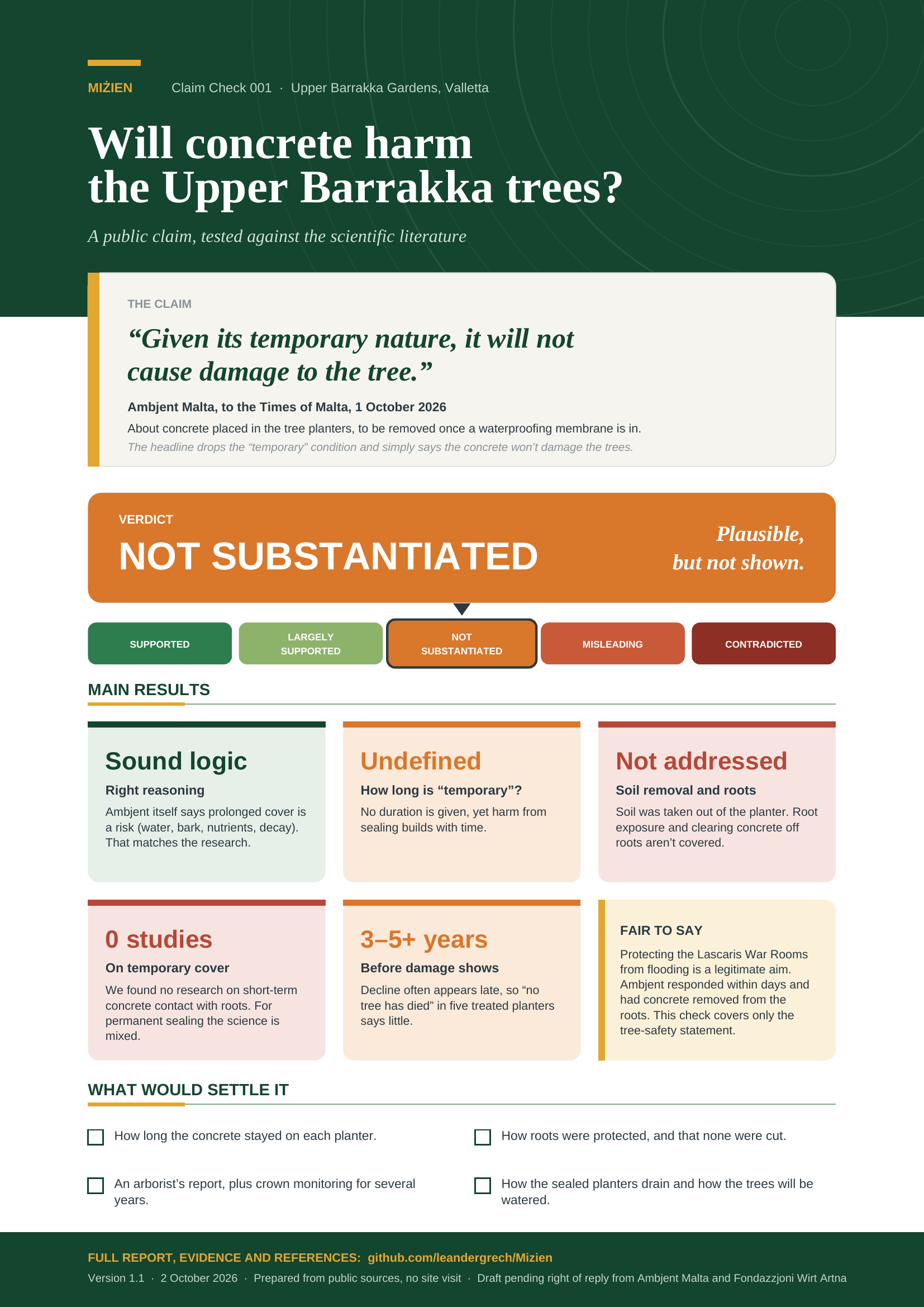
- CC-001A “Given its temporary nature, it will not cause damage to the tree” (Ambjent Malta (Times of Malta))Plausible in direction, since sealing harm builds with time. But “temporary” has no stated duration, no tree-specific assessment is given, and the statement does not address the soil removal or root exposure the article reports.
- CC-001B Prolonged cover would be a concern: water, bark, nutrient transport, decay (Ambjent Malta)Matches mechanisms in the literature (table below). Candid and accurate as far as it goes.
- CC-001C Concrete directly on the roots has since been removed (Times of Malta / Ambjent)The photo and caption show concrete cleared from directly around the trunk, leaving a mound of loose soil and stone. Root and bark condition after removal is not reported.
- CC-001D Ambjent made every effort to save old trees (FWA (Times of Malta))No method statement, root-protection plan or arborist report seen.
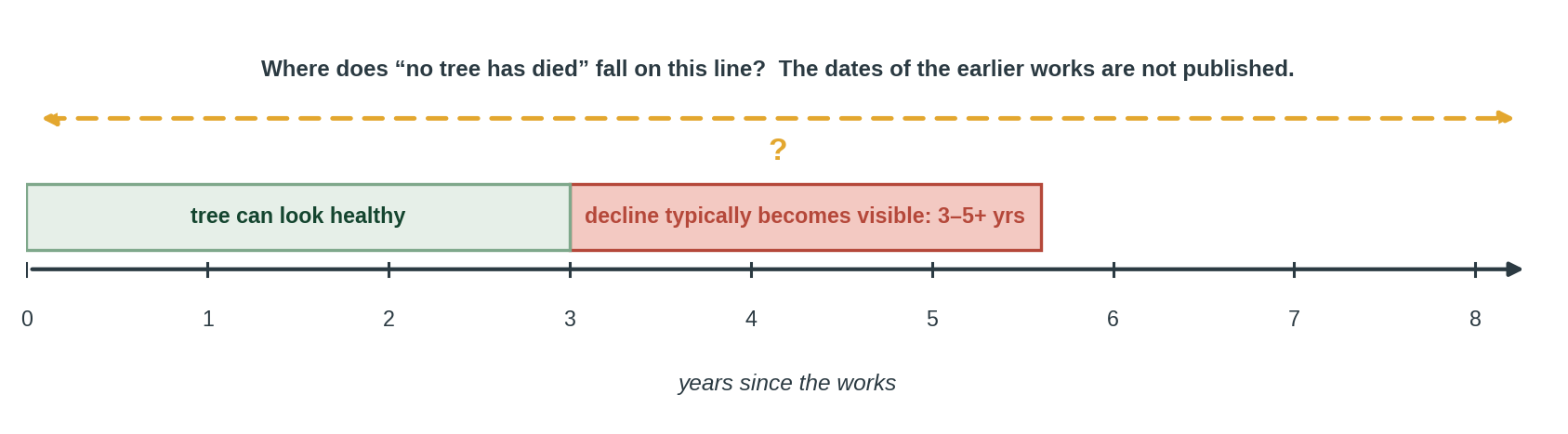
- CC-001E Five treated planters, no tree has died or been removed (FWA (Newsbook))Death is a late, coarse signal; decline may take 3–5+ years. No dates, species or condition data (Figure 3).
- CC-001F Earlier phase: membrane, mulch and pots; trunks and crowns untouched (FWA chairman (MaltaToday, c. Dec 2025))The Oct 2026 article reports soil removed from at least one planter, so “untouched” can only refer to trunks and crowns. Root condition is not addressed.
TL;DR
Ambjent Malta told the Times of Malta that concrete placed in the tree planters at Upper Barrakka will not damage the trees because it is temporary: it stays only until a waterproofing membrane is installed. Ambjent also said prolonged cover would be a concern, and that concrete lying directly on the roots has since been removed. The works protect the historic Lascaris War Rooms from water ingress. That aim is legitimate and is not questioned here. The question is whether the tree-safety statement is backed by evidence.
- The claim is conditional, and its logic points the right way. Ambjent itself says prolonged cover would be a problem, for reasons (less water, bark and nutrient transport, decay) that match the research on sealed soils.
- But “temporary” is undefined, and the claim covers only the concrete. No duration is given. The article also reports that soil was removed from the planter and that concrete lay around the roots. Root exposure, contact with fresh concrete and how it was removed are not addressed.
- No evidence has been published. No species, tree ages, dates, arborist report or monitoring data. The “five planters, no tree died” statement is anecdote, and decline often takes 3–5+ years to show.
- The science: mixed for permanent sealing, silent on temporary cover. Studies of permanent sealing range from no harm in a five-year trial to clear harm in holm oak. We found no study of short-term concrete contact with roots.
- Verdict: not substantiated. Plausible for a short, well-managed cover, but not shown for these trees. Ambjent responded quickly and was candid about the risk.
- Supported
- Largely supported
- Not substantiated
- Misleading
- Contradicted
What would move the verdict up
A stated, short duration with dates; roots shown to have been kept covered and moist and not cut; clean removal of the concrete; arborist inspection before and after; a membrane design that drains; monitoring of crown health for several years.
What would move it down
Concrete in contact with roots or bark for days or weeks; roots left exposed in hot, dry weather or cut; bark damaged on removal; sealed planters that waterlog; monitoring data withheld or never collected.
IN THIS REPORT
1 The claim and what we could verify
The claim comes from a Times of Malta article by Nicole Meilak (1 October 2026), read in full. Its headline says the concrete layer will not damage the trees. Ambjent Malta’s own words are narrower: the concrete is temporary, so it will not cause damage, and prolonged cover would be a concern. We treat Ambjent’s wording as the claim and the headline as the paper’s summary of it. Statements from Fondazzjoni Wirt Artna (FWA), which runs the tunnels, are labelled as FWA’s.
| Source | What it says | Our access | Status |
|---|---|---|---|
| Times of Malta, 1 Oct 2026 [3] | Concrete laid at the bottom of tree planters; soil removed from at least one planter. Ambjent: the concrete is temporary, remaining only until a waterproofing membrane is installed, so it will not damage the tree; harm could arise if left prolonged. Concrete directly on the roots has since been removed (photo caption). No duration given. | Read in full (supplied PDF). | The claim itself |
| Same article, quoting FWA | Severe flooding of the war rooms from storm and irrigation water leaking from the gardens. Ambjent made every effort to save existing trees, especially old ones. Every leak point addressed. | Read in full. | Partner body’s statement |
| Newsbook, 1 Oct 2026, reporting FWA [1] | Waterproofing includes “tanking” of planters. 28 water-infiltration points addressed. Five planters treated so far with no tree dying or removed. | Search excerpt only; page blocks automated access. | Partner body’s statement |
| MaltaToday, c. Dec 2025, quoting FWA’s executive chairman [2] | Waterproofing membrane under the concrete; mulch on top; large pots of flowers and plants; trunks and crowns untouched. | Read in full. | Earlier phase of works |
2 Method and how to read this report
Question. Does pouring concrete over or near the roots of an established tree harm it, and does the research support Ambjent Malta’s position that a temporary layer will not?
Evidence. Targeted searches of peer-reviewed literature and credible grey literature (university extension services, park services, arboricultural reviews), run in October 2026. We favoured studies on established trees with a control. Few studies address poured concrete specifically, so most evidence comes from pavements and soil sealing generally, and we found none on short-term, temporary cover.
Evidence grades used in the tables:
| A | Controlled or randomised experiment on trees | B | Observational field study with a control or gradient |
| C | Review or professional guidance | D | Assertion or anecdote with no data |
Verdicts follow a five-point scale defined in Appendix A. Differing scientific views are shown side by side in Section 5 rather than averaged away. Where the science has not settled, we say so instead of choosing a side.
3 How concrete could harm a tree
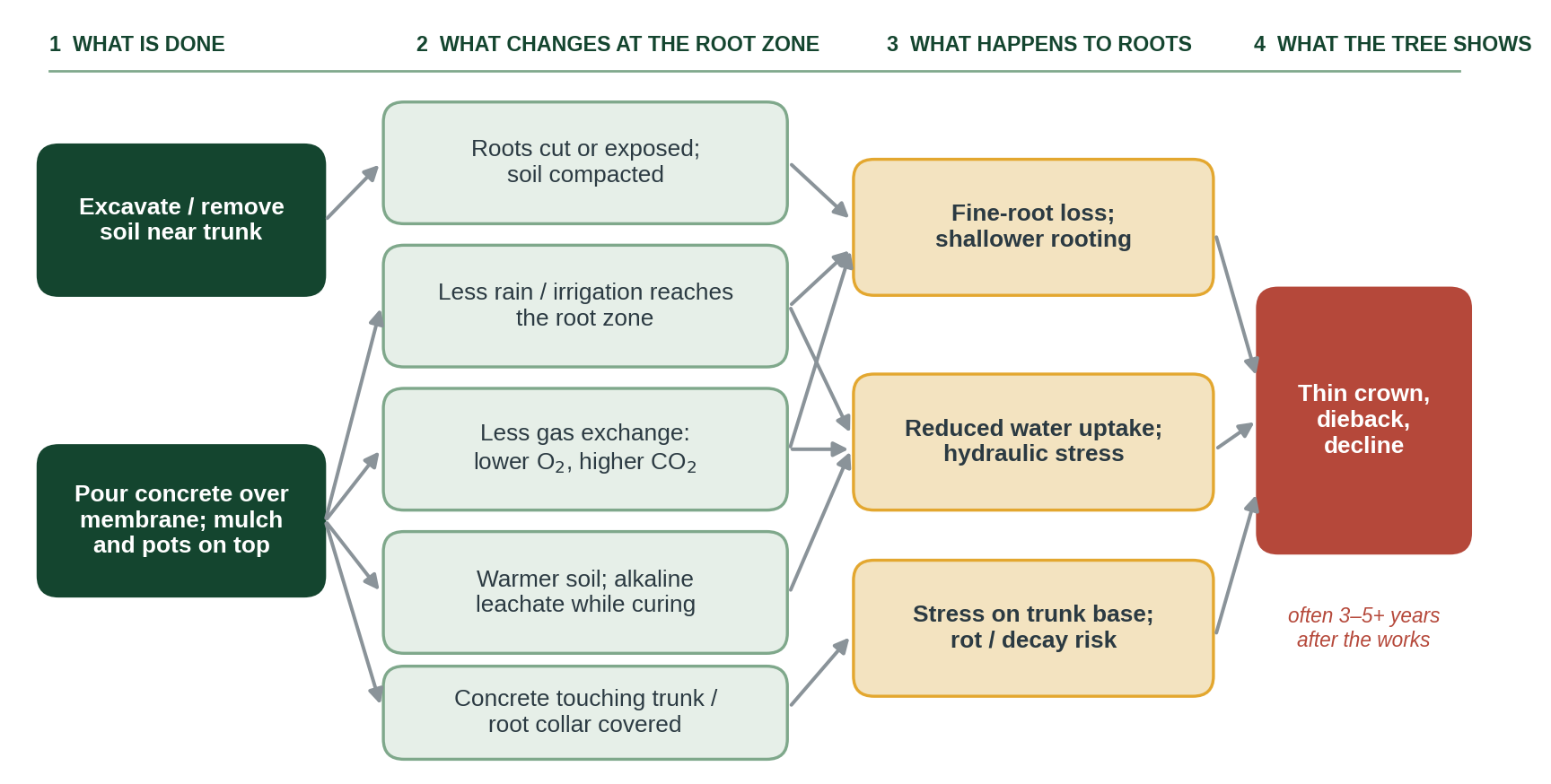
Concrete can affect an established tree in three largely separate ways. The literature treats them very differently, and it is easy to conflate them.
- 1. During the works. Digging, regrading and compaction cut or crush roots, and any root left exposed can dry out quickly, especially in hot or windy weather. Guidance is to avoid hot, dry conditions and to cover exposed roots with soil, mulch or damp burlap as soon as possible [13, 17]. Park-service and extension guidance names compaction and root severance as the commonest causes of construction-related decline, with symptoms sometimes taking years to appear [12, 13].
- 2. After the works: soil sealing. A sealed surface reduces rain and irrigation reaching the soil and slows gas exchange with the air. Sealed soils can run warmer; roots can be killed above roughly 40°C [11]. Reported consequences include lower soil oxygen, higher CO2 and fewer fine roots [4, 5].
- 3. At the trunk and in the chemistry. Fresh cement-based material leaches strongly alkaline water for a time [14, 15]. Industry guidance also cautions against burying the root flare [18]. We found no controlled study of concrete placed against roots or trunks, temporary or permanent. Duration is the unknown: the sealing studies measure months to years.
4 What the studies found
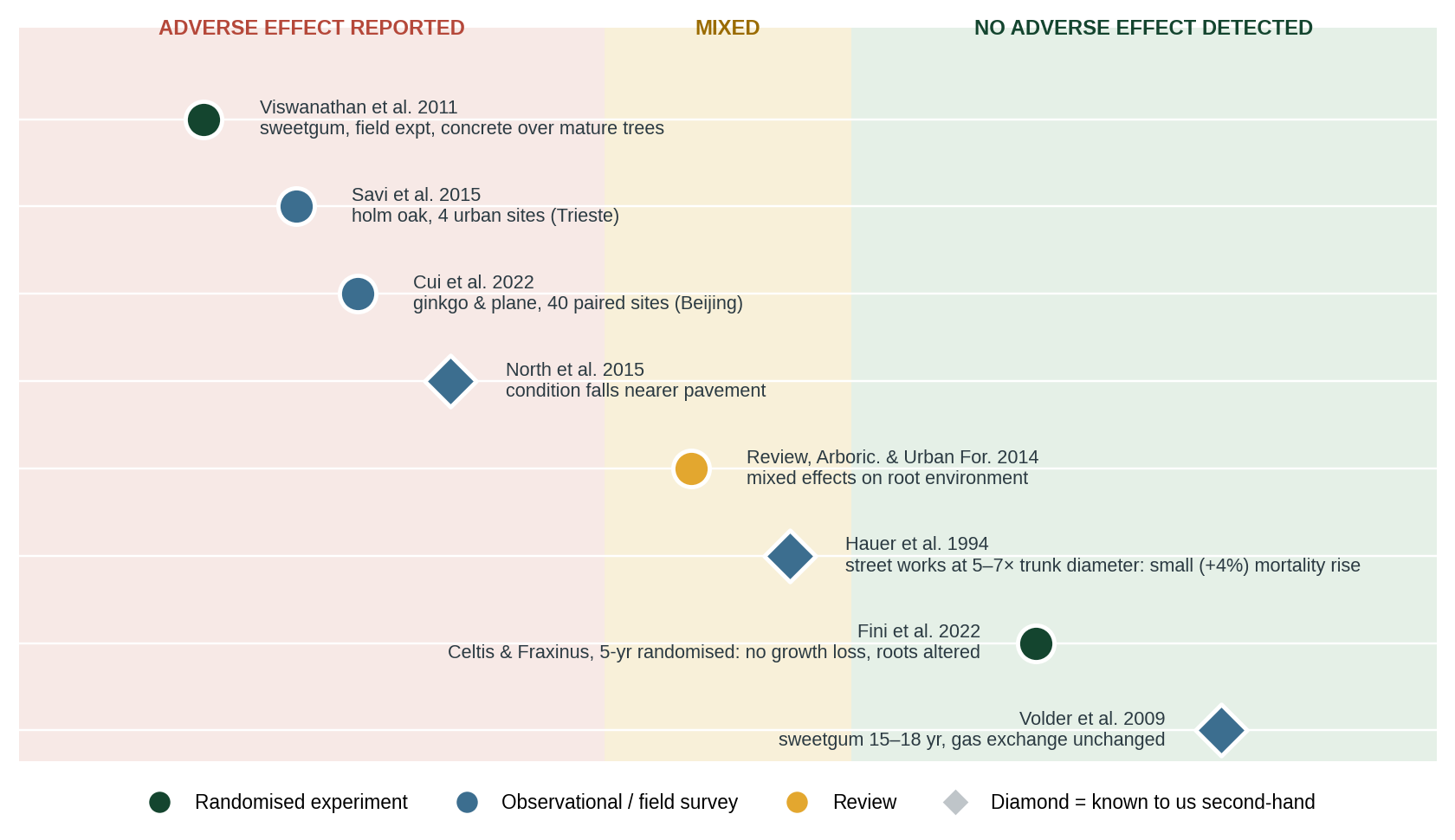
Figure 2 places each source on a qualitative scale from “adverse effect reported” to “no adverse effect detected”. Placement is our judgement of each source’s headline finding. It is not a statistical meta-analysis. Diamonds mark sources we know only through another paper’s summary.
| Source | Design and trees | Key finding | Reading |
|---|---|---|---|
Viswanathan et al. 2011 [4] A | Field experiment: concrete installed over pre-existing mature sweetgum on clay. | Lower soil oxygen under impervious concrete (esp. wet), higher CO2; far less fine-root length than unpaved controls. Pervious concrete did not help on low-permeability clay. | Adverse (roots) |
Fini et al. 2022 [5] A | 5-year randomised trial, 48 trees in 1 m² pits (planted 2012); Celtis australis, Fraxinus ornus; wetter temperate site. | No evidence of drought stress or above-ground growth loss. Impermeable surfaces cut soil moisture, especially winter–spring. Root morphology altered, likely via CO2. | No above-ground effect; roots altered |
Savi et al. 2015 [6] B | Four urban sites with different impervious cover; holm oak (Quercus ilex), Trieste, Italy. | More impervious cover: greater drought stress, reduced leaf gas exchange, more xylem cavitation. | Adverse (Mediterranean species) |
Cui et al. 2022 [7] B | 40 paired paved/vegetated sites in Beijing; Ginkgo biloba, Platanus orientalis. | Growth increments lower on paved land: ginkgo −44.5% diameter, −31.9% height; plane −31.7% and −60.1%. | Adverse |
Volder et al. 2009 [8] ◆ B | Field study, 15–18-year-old sweetgum (as reported in [5]). | Leaf gas exchange, fluorescence and water relations did not differ between paved and unpaved. | No effect detected |
Hauer et al. 1994 [10] ◆ B | Street trees near construction (as summarised in [9]). | Works at 5–7 trunk diameters from the tree: about +4% mortality, −5% condition rating. | Small effect at distance |
North et al. 2015 ◆ B | Cited in a TreeNet summary [11]. | Tree health and condition fall as the pavement edge nears the trunk. | Adverse with proximity |
Arboric. & Urban For. review 2014 [9] C | Review of root-management strategies. | Pavement effects on the root environment are mixed. Soil moisture can be higher under pavement. Benefits of pervious paving not consistently shown. | Mixed |
NPS / extension guidance [12, 13] C | Professional guidance, no new data. | Construction damage may take 3–5+ years to show. Rule of thumb: ~20% root loss tolerated, ~40% likely fatal. | Context |
Wirt Artna via Newsbook [1] D | Five treated planters; species, ages and dates not stated. | No tree has died or been removed. | Anecdote |
Grades: A controlled experiment · B observational · C review/guidance · D anecdote. ◆ known to us second-hand.
Reading across the evidence
- No study we found tests the Upper Barrakka configuration: concrete over a waterproofing membrane around older trees in a Mediterranean climate, and none tests a temporary cover.
- The closest evidence points the wrong way. Holm oak, the Mediterranean species most studied, showed greater hydraulic stress where impervious cover was high. That evidence is observational.
- The best-controlled evidence is more reassuring but transfers poorly. It concerns relatively young trees in small pits at a temperate site averaging about 1,100 mm of rain a year, far wetter than the Maltese Islands.
- Roots react more consistently than crowns, and crowns lag. Several studies find altered roots without an immediate canopy penalty, which is why short monitoring windows can mislead.
5 Where the science disagrees
Six questions drive the dispute. For each we set out the best evidence on each side, why the findings may differ, and what that means for Upper Barrakka.
| Q1 Does sealing cause drought stress in established trees? | UNRESOLVED |
|---|
EVIDENCE OF HARM Holm oak among more impervious cover showed greater drought stress, reduced gas exchange and more xylem cavitation [6]. Ginkgo and oriental plane on paved ground grew markedly less than neighbours on vegetated ground [7]. | EVIDENCE OF LITTLE OR NO HARM A five-year randomised trial on established Celtis and Fraxinus found no drought stress or above-ground growth penalty [5]. Soil moisture can be higher under pavement because evaporation is reduced [9]. Gas exchange in 15–18-year sweetgum was unchanged [8]. |
| Q2 Does a temporary cover matter? | EVIDENCE GAP |
|---|
EVIDENCE OF HARM Exposed roots can dry out quickly in hot or windy weather [13, 17]. Fresh concrete leachate is strongly alkaline [14, 15]. Soil oxygen under impervious concrete was lower than under other surfaces, and roots need oxygen (about 3% is a survival minimum) [4, 16]. | EVIDENCE OF LITTLE OR NO HARM No direct evidence. Ambjent’s premise is that harm comes from prolonged cover. The sealing studies measured effects over months to years [4, 5], which is consistent with duration mattering. That is our inference, not a tested result. |
| Q3 Does it matter whether the surface is permeable? | LEANING: LITTLE CONSISTENT BENEFIT |
|---|
EVIDENCE OF HARM Impervious cover blocks infiltration and gas exchange, and permeable paving has been proposed as a mitigation [5, 9]. | EVIDENCE OF LITTLE OR NO HARM Benefits of pervious paving are not consistently shown [9]. Pervious concrete over low-permeability clay did not improve the root zone of mature trees [4]. Permeable options did not enhance above-ground growth [5]. |
| Q4 Are mature trees more or less vulnerable than young ones? | UNRESOLVED |
|---|
EVIDENCE OF HARM Large established trees transpire more and may deplete soil water if infiltration is blocked. Their root responses are the least certain [5]. Reported dieback occurred in holm oak and linden older than 20 years [5]. | EVIDENCE OF LITTLE OR NO HARM Young trees often establish faster in paved pits, helped by reduced evaporation (e.g. plane trees grew larger in paved than unpaved soil) [5]. |
| Q5 Does concrete alkalinity harm roots? | PROBABLY MINOR; UNDER-STUDIED |
|---|
EVIDENCE OF HARM Fresh cement-based material leaches very alkaline water: crushed non-carbonated concrete reaches pH 13–14 [14], and early-age concrete raised water pH to about 11 in the lab [15]. High pH can limit nutrient availability. | EVIDENCE OF LITTLE OR NO HARM Soil buffers the effect and clay soils slow the alkaline front [14]. In the Italian trial pavements did not change soil chemical traits [5]. We found no field study showing alkaline-leachate death of an established tree. |
| Q6 How much root loss can a tree tolerate? | HEURISTICS, NOT THRESHOLDS |
|---|
EVIDENCE OF HARM Guidance suggests ~20% root loss is tolerated and ~40% probably fatal [13]. Severing roots over about 5 cm (2 in) can reduce stability and uptake [12]. | EVIDENCE OF LITTLE OR NO HARM Street works at 5–7 trunk diameters raised mortality only about 4% [10]. Tolerance depends on species, health and which roots are lost. |
6 Testing the claim at Upper Barrakka
We split the public statements into checkable sub-claims and rated each against the evidence above.
| Sub-claim | Said by | What the evidence shows | Rating |
|---|---|---|---|
| A. “Given its temporary nature, it will not cause damage to the tree” | Ambjent Malta (Times of Malta) | Plausible in direction, since sealing harm builds with time. But “temporary” has no stated duration, no tree-specific assessment is given, and the statement does not address the soil removal or root exposure the article reports. | NOT SUBSTANTIATED |
| B. Prolonged cover would be a concern: water, bark, nutrient transport, decay | Ambjent Malta | Matches mechanisms in the literature (table below). Candid and accurate as far as it goes. | CONSISTENT WITH RESEARCH |
| C. Concrete directly on the roots has since been removed | Times of Malta / Ambjent | The photo and caption show concrete cleared from directly around the trunk, leaving a mound of loose soil and stone. Root and bark condition after removal is not reported. | PARTLY VERIFIED |
| D. Ambjent made every effort to save old trees | FWA (Times of Malta) | No method statement, root-protection plan or arborist report seen. | UNVERIFIED |
| E. Five treated planters, no tree has died or been removed | FWA (Newsbook) | Death is a late, coarse signal; decline may take 3–5+ years. No dates, species or condition data (Figure 3). | WEAK EVIDENCE |
| F. Earlier phase: membrane, mulch and pots; trunks and crowns untouched | FWA chairman (MaltaToday, c. Dec 2025) | The Oct 2026 article reports soil removed from at least one planter, so “untouched” can only refer to trunks and crowns. Root condition is not addressed. | UNVERIFIED / AMBIGUOUS |
Ambjent Malta’s reasoning, checked
| Ambjent’s stated concern | What the research says | Match |
|---|---|---|
| Could restrict water availability around the trunk | Sealed surfaces reduce infiltration and soil moisture in several studies [4, 5]. Effect on established-tree drought stress is contested (Section 5, Q1). | CONSISTENT |
| Could affect the bark and nutrient transport | Fine-root loss reduces uptake [4]; guidance cautions against burying the root flare [18]. No controlled study of concrete against bark. | PLAUSIBLE |
| Could contribute to decay | Guidance links root and trunk-base stress to decay risk [12, 18]. No controlled study of concrete contact. | PLAUSIBLE |
| Only if left in place for a prolonged period | No published threshold for how long cover is tolerated. Delayed symptoms (3–5+ years) mean short-term outcomes can mislead [12]. | UNTESTED |
Why “no tree has died” is weak evidence
Guidance literature stresses that trees damaged in construction can look healthy for years before crown thinning and dieback appear [12]. An absence of deaths therefore says little unless the works are old enough, and the trees are monitored with something finer than survival: canopy density, leaf area, shoot growth, root-collar condition.
7 Verdict and requests for evidence
Why. (1) The claim is conditional and its logic is sound in direction: the research suggests harm from sealing builds with time, and Ambjent itself names prolonged cover as the concern. (2) But no duration is given for “temporary”, and the statement is silent on the soil removal and root exposure the article reports, which guidance literature treats as a major risk. (3) No tree-specific evidence has been published. (4) For permanent sealing the literature is mixed, with holm-oak data pointing toward harm; for temporary cover we found no studies at all.
What this verdict does not say. It does not say the trees have been or will be damaged, that the works were unjustified, or that Ambjent acted in bad faith. Ambjent responded within days, stated the risk plainly and had concrete removed from the roots. A defensible statement would read: “The concrete was in place for [N days]; exposed roots were protected by [method]; an arborist inspected on [date]; we will monitor [indicators] for [years].” That turns a reassurance into something checkable.
Evidence we are asking for
| ☐ | Species, estimated age and trunk diameter of every tree in a treated planter. |
| ☐ | For each planter: when the concrete was placed and when it was removed (duration of contact). |
| ☐ | How the soil was removed, whether roots were exposed, cut or damaged, and how exposed roots were protected (kept covered and moist, work in cooler weather). |
| ☐ | How the concrete was cleared from the roots and trunk base, and photographs of root and bark condition afterwards. |
| ☐ | The membrane design: drainage, the substrate that replaces the soil, and how the trees will be watered. |
| ☐ | Any pre- and post-works arborist report. |
| ☐ | Dates, species and monitoring records behind the “five planters, no tree died” statement. |
| ☐ | Whether any tree is protected under the Trees and Woodlands (Protection) Regulations, and any permit conditions that applied. |
8 Limitations
- This is a targeted review, not a systematic one. Searches were run in October 2026 and may have missed relevant work.
- We found no studies of short-term, temporary concrete contact with roots. The core of Ambjent’s claim is therefore assessed by mechanism and guidance, not by direct evidence.
- The Times of Malta article was read in full from a supplied PDF. The Newsbook page blocks automated access, so we read only a search excerpt. For several papers we read abstracts or summaries, and some sources are known only through other papers (marked ◆).
- Few studies examine concrete over a membrane around old Mediterranean trees. We extrapolate from pavement and soil-sealing research, mostly from wetter sites with different soils.
- No site visit or tree assessment was done; we saw published photographs only.
- Evidence-map positions are our qualitative judgement. Corrections and additional studies are welcome.
References
[1] Micallef D. (1 Oct 2026). Wirt Artna explains concrete around Upper Barrakka tree: ‘It is protecting historic tunnels’. Newsbook. https://newsbook.com.mt/en/wirt-artna-explains-concrete-around-upper-barrakka-tree-it-is-protecting-historic-tunnels/
[2] Parts of Upper Barrakka have been cemented over, but don’t panic just yet… (c. Dec 2025). MaltaToday. https://www.maltatoday.com.mt/environment/environment/138909/parts_of_upper_barrakka_have_been_cemented_over_but_dont_panic_just_yet
[3] Meilak N. (1 Oct 2026). Concrete layer won’t damage Upper Barrakka trees, Ambjent Malta says. Times of Malta. (Read in full from a supplied PDF.)
[4] Viswanathan B. et al. (2011). Impervious and pervious pavements increase soil CO2 concentrations and reduce root production of American sweetgum (Liquidambar styraciflua). Urban Forestry & Urban Greening. https://www.sciencedirect.com/science/article/abs/pii/S1618866711000057
[5] Fini A. et al. (2022). Effects of pavements on established urban trees: growth, physiology, ecosystem services and disservices. Landscape and Urban Planning 226:104501. doi:10.1016/j.landurbplan.2022.104501. https://www.sciencedirect.com/science/article/abs/pii/S0169204622001505
[6] Savi T. et al. (2015). Drought-induced xylem cavitation and hydraulic deterioration: risk factors for urban trees under climate change? New Phytologist 205(3). doi:10.1111/nph.13112. https://nph.onlinelibrary.wiley.com/doi/10.1111/nph.13112
[7] Cui B. et al. (2022). Responses of tree growth, leaf area and physiology to pavement in Ginkgo biloba and Platanus orientalis. Frontiers in Plant Science 13:1003266.
[8] Volder A. et al. (2009). Potential use of pervious concrete for maintaining existing mature trees during and after urban development. Urban Forestry & Urban Greening. (Cited in [5]; not read directly.) https://www.sciencedirect.com/science/article/pii/S1618866709000557
[9] The management of tree root systems in urban and suburban settings II: a review of strategies to mitigate human impacts. Arboriculture & Urban Forestry 40(5):249 (2014). https://auf.isa-arbor.com/content/40/5/249
[10] Hauer R.J., Miller R.W., Ouimet D.M. (1994). Street tree decline and construction damage. Journal of Arboriculture 20:94–97. (Cited in [9]; not read directly.)
[11] TreeNet. Permeable pavements and their influence on tree growth of Melaleuca quinquenervia: a summary (cites North et al. 2015; Kozlowski 1984; Ingram et al. 1989). https://treenet.org/resource/permeable-pavements-and-their-influence-on-tree-growth-of-melaleuca-quinquenervia-a-summary/
[12] US National Park Service. Preservation Matters: protecting historic trees during construction. https://www.nps.gov/articles/000/preservation-matters-landscape-maintenance-protecting-historic-trees-during-construction.htm
[13] Minnesota Department of Natural Resources. Construction damage causes and remedies. https://www.dnr.state.mn.us/treecare/maintenance/construction_damage.html
[14] Washington State Department of Ecology. Recycled concrete aggregate leachate: a literature review (Publication 22-03-003). https://apps.ecology.wa.gov/publications/documents/2203003.pdf
[15] Effect of leaching from freshly cast concrete on pH (laboratory study). ResearchGate. https://www.researchgate.net/publication/272026868_Effect_of_Leaching_from_Freshly_Cast_Concrete_on_pH
[16] A case study of street tree soil aeration in two different soil types (Helsinki). Arboriculture & Urban Forestry 44(4):174 (citing Kozlowski & Davies 1975). https://auf.isa-arbor.com/content/44/4/174
[17] Minnesota Pollution Control Agency, Minnesota Stormwater Manual. Protection of existing trees on construction sites (cites Johnson 1999 on covering exposed roots and avoiding hot, dry weather). https://stormwater.pca.state.mn.us/protection_of_existing_trees_on_construction_sites
[18] Tree Care Advisors. Protecting trees during construction (industry guide; lower evidential weight). https://treecareadvisors.com/guides/construction-damage/
Appendix A: series standards and verdict scale
Every investigation in this series follows the same rules so that verdicts are comparable and challengeable.
| Verdict | Meaning |
|---|---|
| SUPPORTED | Evidence consistently backs the claim as stated. |
| LARGELY SUPPORTED | Backed by the evidence, with minor caveats that do not change the substance. |
| NOT SUBSTANTIATED | Stated more strongly than the evidence offered or available allows. May be true in some conditions but has not been shown. |
| MISLEADING | Omits material facts so that the overall impression is inaccurate, even if individual statements are defensible. |
| CONTRADICTED | The available evidence points against the claim. |
Confidence
High: multiple independent lines of evidence agree. Moderate: evidence is relevant but incomplete or indirect. Low: evidence is thin, second-hand or conflicting.
Standards
- Quote the speaker, not the headline, with outlet and date, and link the original where possible.
- Separate the claim from the evidence offered for it, and say who made which statement.
- Grade the evidence and show differing views side by side where the science is unsettled.
- State what we could not access or verify, and what would change the verdict either way.
- Ask for the missing evidence in specific, answerable requests.
- Offer a right of reply before wider circulation and append responses.
- Correct errors openly with a version number and change log.
- Whistle-blow only on evidence: a verdict of Misleading or Contradicted requires documents or data that can be shown, not inference.
Appendix B: revision log
| Version | Date | Change |
|---|---|---|
| 1.0 | 2 Oct 2026 | First issue. Based on the headline and secondary reporting; the full article was not accessed. Treated the claim as a blanket statement that concrete will not harm trees. |
| 1.1 | 2 Oct 2026 | Incorporates the full Times of Malta article. Claim restated as conditional on the concrete being temporary. Added a check of Ambjent’s own reasoning, a new contested question on temporary cover, and sub-claims B, C and F. Photo description revised. Added references [17] and [18]. Verdict label unchanged (Not substantiated); the reasoning changed from blanket claim overstated to conditional claim plausible but unevidenced. |
Sources and archived copies
-
Concrete layer won't damage Upper Barrakka trees, Ambjent Malta says (N. Meilak), Times of Malta, 1 Oct 2026.
No public link ().
Full text read from a supplied PDF. Add the article URL and archive it. - Wirt Artna explains concrete around Upper Barrakka tree, Newsbook, 1 Oct 2026. Original · Archived copy
- Parts of Upper Barrakka have been cemented over, but don't panic just yet..., MaltaToday, c. Dec 2025. Original · Archived copy
Right of reply
The body concerned has not yet been asked to reply. Its response will be published here, beside the verdict.
Connections
How this claim relates to the others: who made it, the themes it shares with other claims, and the patterns it shows. A connection is a reason to read two checks side by side. It does not make either one right or wrong. How connections are found.
Linked directly 7
Claims that share a theme with this one. A theme is a cause, a mechanism, a target or a way of presenting figures that the editors have found in several claims; its strength says how close the link is.
Sealed soil and concrete Shared mechanism · Strong
Excavation, concrete and sealed surfaces around trees. The EU review notes sealed or degraded soil keeps increasing in Malta.
Replanting as currency Shared mechanism · Strong
Tree losses are justified by promised replacement or transplanting. Test survival and net canopy, not planting counts.
Same pattern
Pattern tags name a recurring way a claim can mislead. They describe the statement, not the speaker.
Conditional-turned-unconditional
A statement with a stated condition is reported or repeated without it.
Two steps away 22
Not linked to this claim directly, but linked to a claim that is. These are found by following the links, not chosen by the editors, so they are looser: they show where one theme meets another.
- CC-003 Per-capita emissions vs 2030 projection (Misleading)through Sealed soil and concreteCC-008Transport, air and climate or Replanting as currencyCC-010Selective-metric pattern
- CC-004 'Strong progress' in waste separation (Not substantiated)through Sealed soil and concreteCC-002Waste and construction or Sealed soil and concreteCC-008Waste and construction or Replanting as currencyCC-010Selective-metric pattern
- CC-007 Within EU limits vs WHO guideline (Largely supported)through Sealed soil and concreteCC-008Transport, air and climate or Replanting as currencyCC-010Selective-metric pattern
- CC-013 Permits keep property prices in check (Largely supported)through Sealed soil and concreteCC-019Planning, housing and land take
- CC-014 Fewer enforcement notices, fewer illegalities (Misleading)through Sealed soil and concreteCC-019Planning, housing and land take
- CC-016 Shore-to-ship: 90% less harbour pollution (Misleading)through Sealed soil and concreteCC-008Transport, air and climate
- CC-017 Land reclamation outside the Freeport (Not substantiated)through Sealed soil and concreteCC-002Waste and construction or Sealed soil and concreteCC-008Waste and construction or Sealed soil and concreteCC-019Planning, housing and land take
- CC-018 IMF 'confirms' MDA on housing (Largely supported)through Sealed soil and concreteCC-019Planning, housing and land take
- CC-021 Malta-Gozo tunnel traffic (not yet checked)through Sealed soil and concreteCC-008Transport, air and climate
- CC-054 Project Green: 100,000 m2 a year (not yet checked)through Replanting as currencyCC-010Replanting as currency
- CC-056 Central Link: 'only 254 trees' (not yet checked)through Sealed soil and concreteCC-008Replanting as currency
- CC-057 1,649 compensation trees (not yet checked)through Replanting as currencyCC-010Replanting as currency
- CC-058 96% of farmland in use (not yet checked)through Sealed soil and concreteCC-019Planning, housing and land take
- CC-059 Subsidies are 20% of farm output (not yet checked)through Sealed soil and concreteCC-019Farmland and farming pressure
- CC-069 82 million bus trips (not yet checked)through Sealed soil and concreteCC-008Transport, air and climate
- CC-072 EUR 15m to take cars off the road (not yet checked)through Sealed soil and concreteCC-008Transport, air and climate
- CC-076 36 more vehicles a day (Supported)through Sealed soil and concreteCC-008Transport, air and climate
- CC-109 EU: transport is 48% of effort-sharing emissions (Largely supported)through Sealed soil and concreteCC-008Transport, air and climate
- CC-115 Chamber: congestion cost EUR 770m, 3.4% of GDP (Not substantiated)through Sealed soil and concreteCC-008Transport, air and climate
- CC-123 KPMG: 8,716 residential units approved in 2024, up 7.4% (not yet checked)through Sealed soil and concreteCC-019Planning, housing and land take
- CC-127 EU: Malta has the lowest organic share in the EU (not yet checked)through Sealed soil and concreteCC-019Farmland and farming pressure
- CC-130 NGOs: ODZ racecourse policy ends protection (not yet checked)through Sealed soil and concreteCC-019Farmland and farming pressure
Three steps away 18
One step further again. At this distance a connection says more about how the themes fit together than about this claim.
- CC-011 Ten minutes' walk to green space (pledge: Not measurable)through Sealed soil and concreteCC-008Transport, air and climateCC-0032030 carbon target
- CC-020 EP study: noise law not the cause (Largely supported)through Sealed soil and concreteCC-008Transport, air and climateCC-007Compliance-not-health pattern
- CC-025 Per-capita emissions down 44% since 2005 (Largely supported)through Sealed soil and concreteCC-008Transport, air and climateCC-0032030 carbon target
- CC-026 EU's largest rise in emissions (Largely supported)through Sealed soil and concreteCC-008Transport, air and climateCC-003Transport, air and climate
- CC-031 Gozo, first climate-neutral region (Largely supported)through Sealed soil and concreteCC-008Transport, air and climateCC-109Shared emissions figures
- CC-033 Delimara: 'much cleaner air' (not yet checked)through Sealed soil and concreteCC-008Transport, air and climateCC-007Compliance-not-health pattern
- CC-035 PM2.5 death rate down two-thirds (Largely supported)through Sealed soil and concreteCC-008Transport, air and climateCC-007Transport, air and climate
- CC-060 7,000 first-time buyers helped (not yet checked)through Sealed soil and concreteCC-019Planning, housing and land takeCC-013Planning, housing and land take
- CC-062 Construction is 9-14% of the economy (Largely supported)through Sealed soil and concreteCC-019Planning, housing and land takeCC-018Planning, housing and land take
- CC-063 Construction waste: 'standstill' warning (Not substantiated)through Sealed soil and concreteCC-002Waste and constructionCC-017Waste and construction
- CC-071 EUR 100m a year for free buses (Not substantiated)through Sealed soil and concreteCC-008Transport, air and climateCC-069Transport, air and climate
- CC-079 Waste-to-energy: 4.5% of energy (Misleading)through Sealed soil and concreteCC-002Waste and constructionCC-004Waste and construction
- CC-081 Landfill share rising (not yet checked)through Sealed soil and concreteCC-002Waste and constructionCC-004Waste and construction
- CC-094 Commission: Malta to emit more in 2030 than in 2005 (Supported)through Sealed soil and concreteCC-008Transport, air and climateCC-0032030 carbon target
- CC-110 EU: 37.7% of new cars zero-emission (Supported)through Sealed soil and concreteCC-008Transport, air and climateCC-007Selective-metric pattern
- CC-111 EU: 621 kg of waste a head, 74% landfilled (Supported)through Sealed soil and concreteCC-002Waste and constructionCC-004Waste and construction
- CC-114 PN: only EU state with rising emissions intensity (Misleading)through Sealed soil and concreteCC-008Transport, air and climateCC-003Selective-metric pattern
- CC-117 EU: Malta missed recycling targets (reasoned opinion) (not yet checked)through Sealed soil and concreteCC-002Waste and constructionCC-004Waste and construction
Timeline
What was said, what was published before and after it, and each step of this check, in date order. Statements and sources carry the date they were published. The steps of the check carry the date the research was done, from the check's research log. Other statements by the same body on the same topic show whether a position was repeated, changed or corrected.
2025
- c. December 2025 Reported Parts of Upper Barrakka have been cemented over, but don't panic just yet..., MaltaToday
2026
- 1 October 2026 The statement Ambjent Malta; Fondazzjoni Wirt Artna (this claim)
- 1 October 2026 Reported Concrete layer won't damage Upper Barrakka trees, Ambjent Malta says (N. Meilak), Times of Malta
- 1 October 2026 Reported Wirt Artna explains concrete around Upper Barrakka tree, Newsbook
- 2 October 2026 Version 1.0: first issue First issue. Based on the headline and secondary reporting; the full article was not accessed. Treated the claim as a blanket statement that concrete will not harm trees.
- 2 October 2026 Evidence reviewed
- 2 October 2026 Version 1.1: corrections Incorporates the full Times of Malta article. Claim restated as conditional on the concrete being temporary. Added a check of Ambjent’s own reasoning, a new contested question on temporary cover, and sub-claims B, C and F. Photo description revised. Added references [17] and [18]. Verdict label unchanged (Not substantiated); the reasoning changed from blanket claim overstated to conditional claim plausible but unevidenced. Verdict in this version: Not substantiated, moderate confidence. all corrections
2027
- 2 October 2027 Coming up: Evidence review due Each finished check is reviewed against new evidence within a year.
Every change to this claim's record is public: history of the record.
Download the report and flyer