CC-018 · Planning & Housing · Housing & affordability
IMF 'confirms' MDA on housing
Largely supported High confidence Draft: no right of reply needed
Parts of this claim
The claim is split into parts that are tested separately, as in the report below. Each part has its own number.
- CC-018A The IMF found the housing market sound (prices aligned with fundamentals, stable ratios)Stated in the report [2]; confirmed by Eurostat [3].
- CC-018B The assessment confirms the sector’s “strength and stability”Yes on valuation; the IMF also lists bank exposure as a vulnerability.
- CC-018C It confirms what the MDA has said for yearsPartly; the MDA’s own study pointed the other way on price-to-income.
- CC-018D The IMF will now assess Malta “every two years”The staff report recommends the 24-month cycle, and the annex says Malta “has moved” to it [2].
- CC-018E Malta is “the first EU economy to be given such a certificate of economic governance”Not the first: Luxembourg was on the 24-month cycle in 2000–2002 [9]. Malta is the only EU member on it today [8]. The IMF’s criteria are size, low perceived risk and consent, not a certificate [7].
- CC-018F Since 2013 GDP per capita “has nearly doubled”The IMF’s own words (US$25,000 → 45,000, 2013–2024) [2]. In euros it more than doubled (×2.2 to 2025); after inflation it rose by about half (×1.5) [10].
- CC-018G GDP per capita is now “far higher than the EU average”The IMF says “higher”. Eurostat, 2025: 1.7% above the EU average at market prices, 10% above in purchasing power [10].
Claim Check 018 · Housing and planning
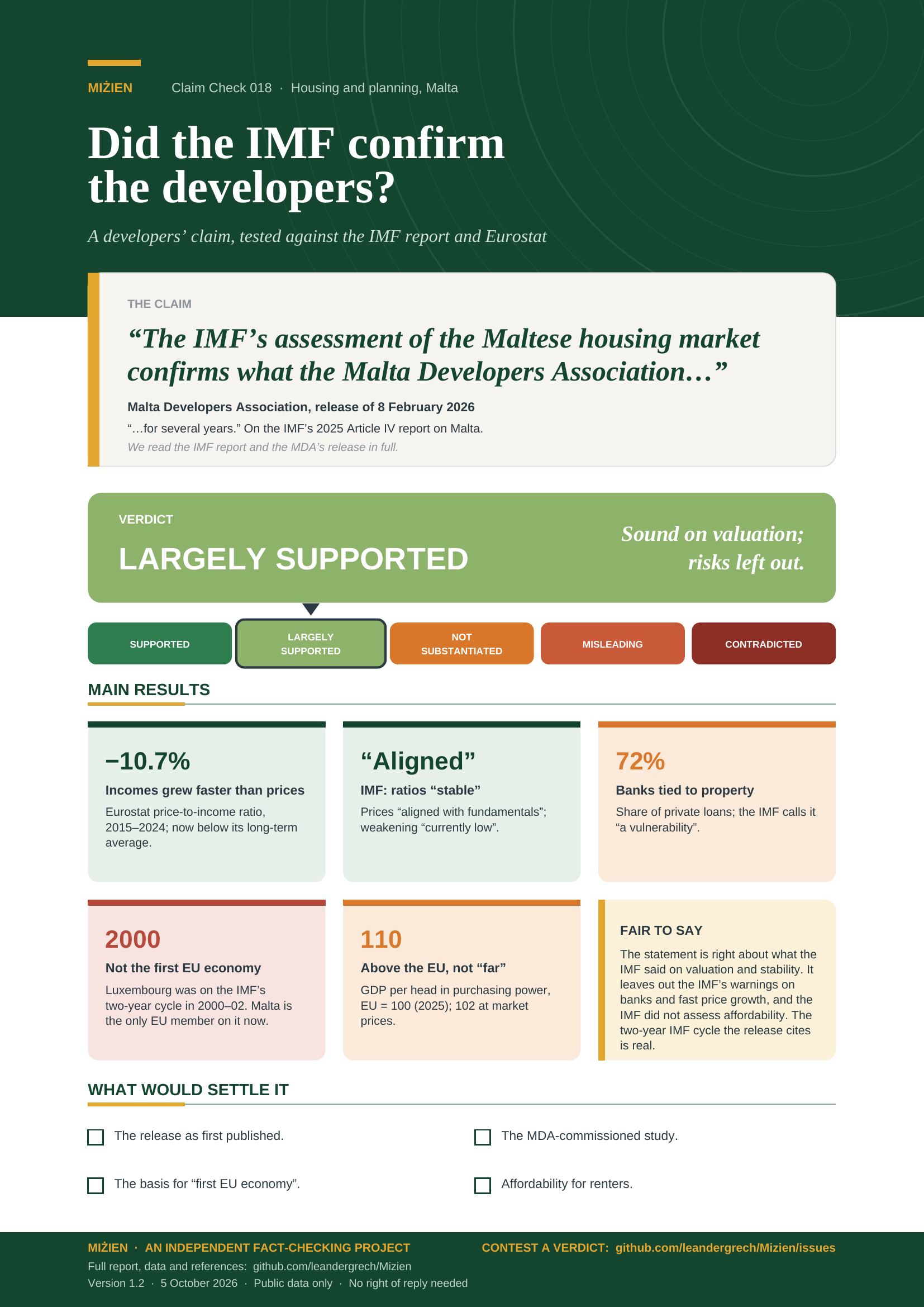
Did the IMF confirm the developers?
Testing a developers’ claim about the IMF’s view of Malta’s housing market against the IMF report and Eurostat
“The IMF’s assessment of the Maltese housing market confirms what the Malta Developers Association has been saying for several years.”
Malta Developers Association, release on its website, 8 February 2026.
On the IMF’s 2025 Article IV consultation with Malta.
Verdict: Largely supported Sound on valuation; the IMF’s bank-exposure warnings omitted
Version 1.2 · 5 October 2026
TL;DR
In February 2026 the Malta Developers Association (MDA) welcomed the IMF’s annual assessment of Malta, saying: “The IMF’s assessment of the Maltese housing market confirms what the Malta Developers Association has been saying for several years.” MaltaToday summarised the statement as the IMF confirming the “strength and stability” of the property sector. We tested it against the IMF report and Eurostat data and, in version 1.2, checked the release’s other statements.
- The IMF does say the market is sound. House prices “remained aligned with fundamentals”, price-to-income and price-to-rent ratios “have been stable”, and the likelihood of a weakening is “currently low”.
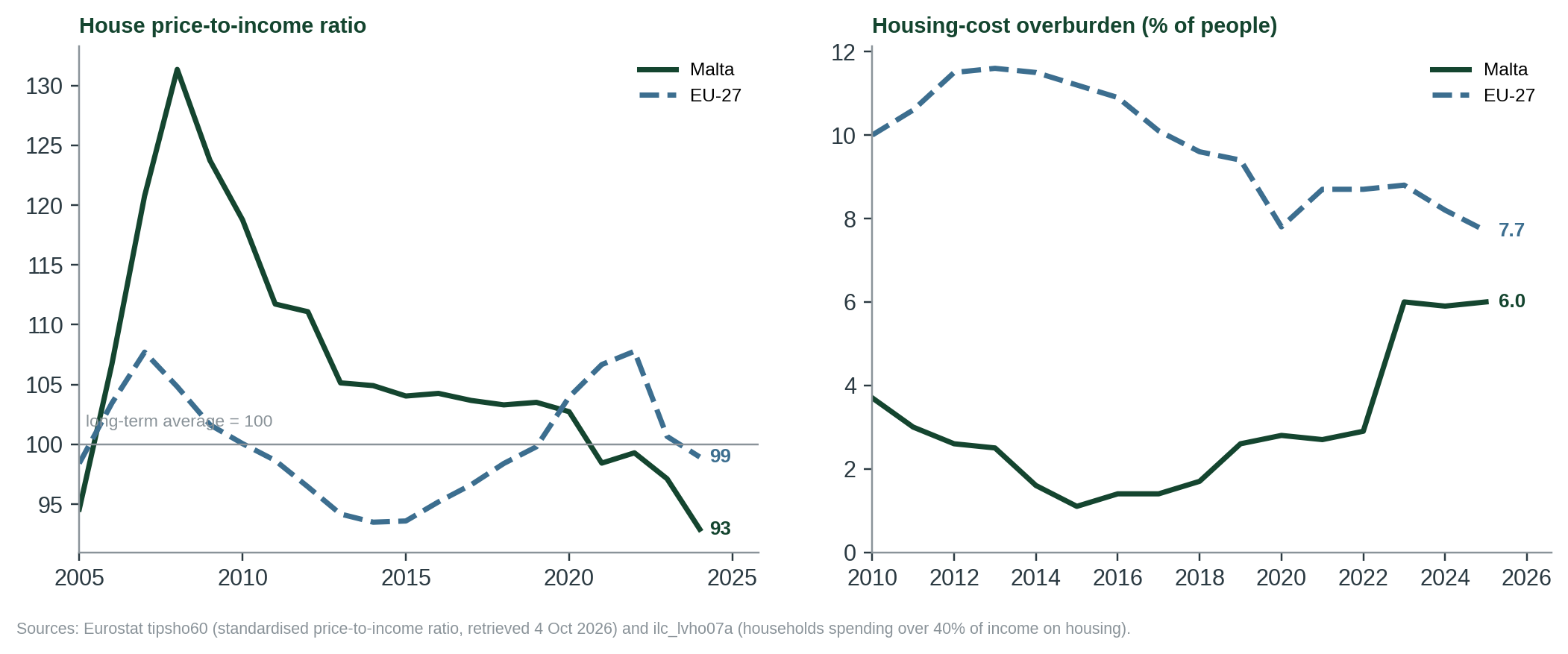
- Independent data agree. Eurostat’s price-to-income ratio for Malta fell 10.7% in 2015–2024 and is below its long-term average: incomes grew faster than house prices.
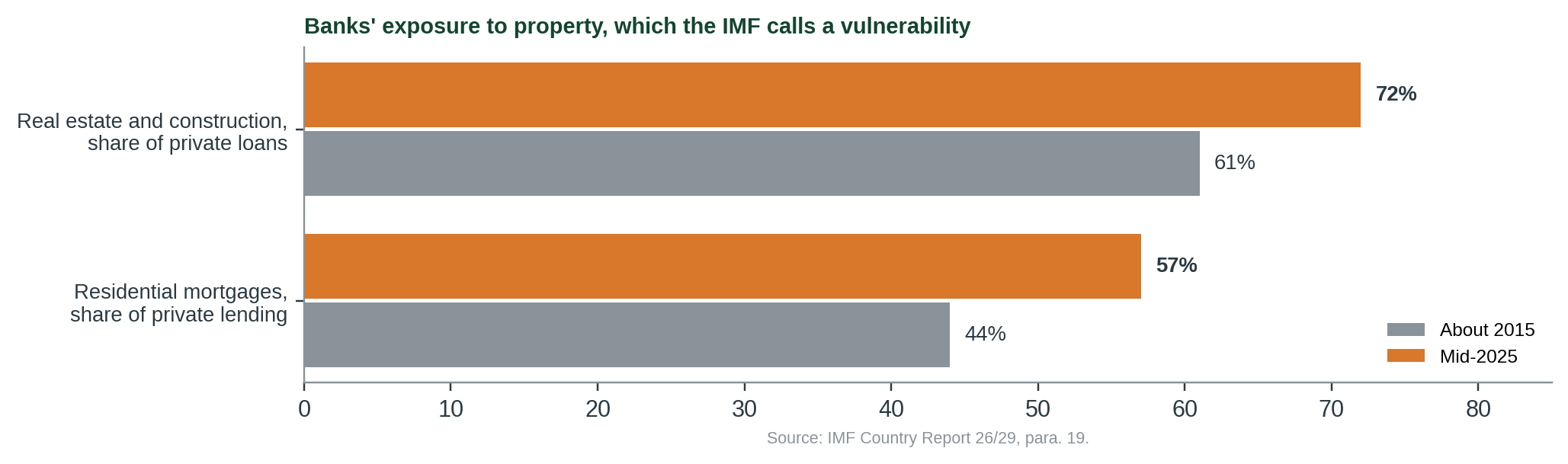
- The IMF also flagged risks the statement leaves out. Banks’ exposure to real estate (72% of private loans) is “a vulnerability”; the Board urged vigilance and staff asked for closer monitoring “in view of rapid house price growth”.
- Stability is not affordability. The IMF did not assess affordability. Housing-cost overburden rose from 1.1% to 2.9% in 2015–2022 on Eurostat’s comparable series; after a 2023 series break it was 6.0%, flat since.
- The release’s other claims are mixed. The IMF did move Malta to a two-year cycle; Malta is the only EU member on it, but not the first (Luxembourg, 2000–2002). GDP per head “nearly doubled” is the IMF’s phrase; “far higher than the EU average” overstates it.
- Verdict: largely supported (high confidence). The IMF and Eurostat back the strength and stability claim; the omitted risks are caveats, not a contradiction. The side claims do not change the verdict.
- Supported
- Largely supported
- Not substantiated
- Misleading
- Contradicted
What would move the verdict up
A statement by the MDA acknowledging the IMF’s warnings on bank exposure, which its release omits.
What would move it down
Evidence that the IMF found overvaluation or instability, or a reading of the statement as a claim about affordability.
IN THIS REPORT
1 The claim and what we could verify
The MDA published the statement on its website on 8 February 2026 [5]; the page was modified on 17 June 2026, and we read that version. Its opening sentence matches the words MaltaToday quoted the same day [1], which abbreviate the association’s name to “the MDA”. The release quotes the IMF’s positive findings on valuation, banks and growth, and does not mention the IMF calling banks’ exposures to real estate “a vulnerability”. The IMF report it refers to is the 2025 Article IV consultation, published as Country Report 26/29 [2], which we read in full.
Two IMF phrases the release quotes, “current data do not suggest overvaluation” and “price increases have been in line with income growth in recent years”, are not in that report. They match an IMF Selected Issues paper on Malta’s growth-at-risk [6], which the IMF published on 13 March 2026, five weeks after the release’s date. The paper also says a sharp fall in prices, though unlikely, could strain banks. Because the release was modified in June, we cannot tell whether these phrases were in the original text.
| What was said | Who | Access |
|---|---|---|
| “The IMF’s assessment of the Maltese housing market confirms what the Malta Developers Association has been saying for several years.” | MDA release [5]; quoted by MaltaToday [1] | Read in full |
| The assessment confirms the “strength and stability” of the property sector | MaltaToday summary [1] | Read in full |
| The IMF “will be doing it every two years. Malta is the first EU economy to be given such a certificate of economic governance” | MDA release [5] | Read in full |
| “Since 2013, GDP per capita in Malta has nearly doubled and now is far higher than the EU average.” | MDA release [5] | Read in full |
| MDA-commissioned study: prices +59% since 2017; price-to-income 14.0 → 14.5 (2024–25) | MaltaToday [1] ◆ | Study not seen |
2 Method
Question. Does the IMF’s 2025 assessment confirm that Malta’s property sector is strong and stable, and does independent data agree? Are the release’s statements about the IMF’s consultation cycle and GDP per head accurate?
Evidence. The MDA’s release [5]; the IMF report, with page references [2]; Eurostat’s standardised house price-to-income ratio [3]; Eurostat real house prices and housing-cost overburden [4]; Eurostat GDP per head, house price index and household income [10]. For the consultation cycle: the IMF’s surveillance guidance [7], the latest staff report of each of the 27 EU members on the IMF eLibrary [8] and Luxembourg’s reports of 2000 and 2002 [9]. Numbers are recomputed by tools/cc-018-report/calc.py.
Grades. Official assessments and statistics are grade C. ◆ marks a source known second-hand.
3 What the IMF report says
| IMF wording (PDF page) | Supports the statement? |
|---|---|
| House prices “remained aligned with fundamentals and price-to-income and price-to-rent ratios have been stable” (p.19) | Yes |
| “The likelihood of weakening of property and housing markets is currently low, it is a prospective risk” (p.12) | Yes, with a caveat |
| Prices +6.7% in 2024; growth moderated in early 2025 “while the house price-to-income ratio remained stable” (p.11) | Yes |
| “Significant exposures of banks to real estate are a vulnerability”: 72% of private loans, from 61% (p.19) | Omitted risk |
| “In view of rapid house price growth, staff recommend enhanced monitoring” (p.20) | Omitted risk |
| Directors “urged vigilance on vulnerabilities from rising exposures to real estate” (p.3) | Omitted risk |
| Population density fifteen times the EU’s, “straining infrastructure, housing and public services” (p.8) | Context |
| “It is recommended that the next Article IV consultation be held on the 24-month cycle” (p.26); “Malta has moved to the 24-month consultation cycle” (p.66) | Yes, on the two-year cycle (Section 5) |
| “Per capita income has nearly doubled since 2013” (p.25); “By 2024, per capita income reached US$45 thousand, higher than the EU average, up from US$25 thousand in 2013” (p.8) | Yes on “nearly doubled”; the IMF says “higher”, not “far higher” |
4 What the data show
| Indicator | Malta | EU-27 | Source | Grade |
|---|---|---|---|---|
| Price-to-income ratio, change 2015–2024 | −10.7% | +5.7% | Eurostat tipsho60 [3] | C |
| Price-to-income vs long-term average, 2024 | 92.9 | 98.9 | Eurostat tipsho60 [3] | C |
| Real house prices 2015–2025 | +34% | +25% | Eurostat tipsho10 [4] | C |
| Housing-cost overburden, 2015 → 2022; 2023 → 2025 (break in Malta’s series in 2023) | 1.1% → 2.9%; 6.0% → 6.0% | 11.2% → 8.7%; 8.8% → 7.7% | Eurostat ilc_lvho07a [4] | C |
| Real estate share of bank private loans | 61% → 72% | – | IMF [2] | C |
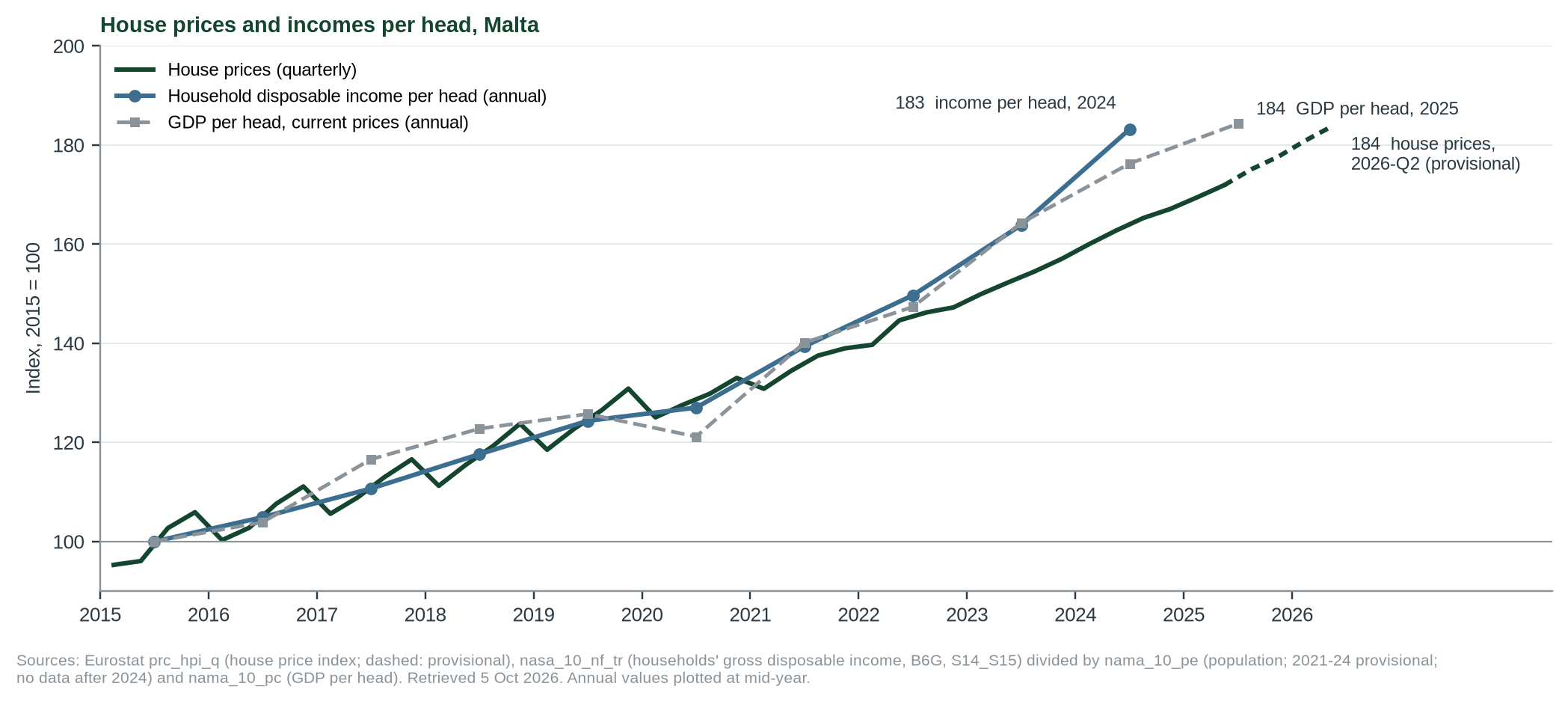
| House prices, annual change, 2026 Q1 and Q2 (provisional) | +6.8%; +6.9% | – | Eurostat prc_hpi_q [10] | C |
All values in data/cc-018/checks.csv.
The slowdown the IMF saw in early 2025 was brief: Eurostat’s house price index rose 6.4–7.0% a year in each quarter of 2024, 5.9% and 5.6% in the first two quarters of 2025, 6.0% over 2025 as a whole, and 6.8% and 6.9% in the first two quarters of 2026 (figures from mid-2025 are provisional) [10].
5 The release’s other statements
The release goes beyond housing. It says the IMF decided that the Maltese economy is “so strong” that its comprehensive assessment will now take place “every two years”, and that “Malta is the first EU economy to be given such a certificate of economic governance”. It also says that since 2013 GDP per capita “has nearly doubled and now is far higher than the EU average” [5].
A two-year cycle, but not the first
The cycle is real. The IMF staff report recommends that the next consultation “be held on the 24-month cycle”, and its annex records that “Malta has moved to the 24-month consultation cycle” [2]. The standard cycle is 12 months. The IMF’s guidance allows up to 24 months only with the member’s consent, and only if it is not of systemic or regional importance, is not perceived to be at risk from policy imbalances or facing pressing policy issues, and owes the IMF little [7]. The move therefore reflects low perceived risk and Malta’s size; the IMF does not describe it as a certificate.
Malta is the only EU member on the 24-month cycle today: the latest staff reports of the other 26, published in 2025 and 2026, all name the standard 12-month cycle [8]. It is not the first. In 2000 the IMF wrote that its next consultation with Luxembourg, then as now an EU member, “is expected to be held on the 24-month cycle”; the next one followed in 2002, two years later, and again proposed the following one “within 24 months” [9].
| IMF document | Member | Cycle | Grade |
|---|---|---|---|
| Country Report 26/29 (Feb 2026), para. 40 and Informational Annex [2] | Malta | 24 months | C |
| Latest staff reports, 2025–2026 [8] | The other 26 EU members | 12 months | C |
| Staff Country Report 00/65 (May 2000), para. 45; Country Report 02/118 (June 2002), para. 34 [9] | Luxembourg | 24 months | C |
Each statement in data/cc-018/imf_consultation_cycles.csv, with its link.
GDP per head
“Nearly doubled” is the IMF’s own phrase, and in US dollars per capita income rose from about $25,000 in 2013 to $45,000 in 2024 [2]. On Eurostat’s figures in euros, it more than doubled, from €19,120 in 2013 to €42,390 in 2025. After inflation, GDP per head rose by about half. “Far higher than the EU average” is the release’s own addition: the IMF says “higher”. At market prices Malta’s GDP per head was 1.7% above the EU average in 2025; adjusted for price levels it was 10% above [10]. GDP per head measures output, not the income of residents.
| Measure | 2013 | Latest | Change | Source |
|---|---|---|---|---|
| Per capita income, US dollars | $25,000 | $45,000 (2024) | ×1.8 | IMF [2] |
| GDP per head, current prices | €19,120 | €42,390 (2025) | ×2.2 | Eurostat nama_10_pc [10] |
| GDP per head, 2020 prices (real) | €22,600 | €34,360 (2025) | ×1.5 | Eurostat nama_10_pc [10] |
| GDP per head vs EU-27, market prices | 72.8% | 101.7% (2025) | +1.7% above | Eurostat nama_10_pc [10] |
| GDP per head vs EU-27, purchasing power | 91 | 110 (2025) | +10% above | Eurostat nama_10_pc [10] |
6 Where the evidence points different ways
Q1 Is the market strong and stable?
YES, ON VALUATIONEVIDENCE FOR THE CLAIM'S IMPRESSION
The IMF finds prices in line with fundamentals and ratios stable; Eurostat’s price-to-income ratio fell 10.7% since 2015 and is below its long-term average.
EVIDENCE AGAINST
The IMF calls weakening a “prospective risk” and wants closer monitoring because prices are rising fast.
Q2 Does the report confirm everything the MDA has said?
NOT SHOWNEVIDENCE FOR THE CLAIM'S IMPRESSION
The MDA has long argued that prices reflect demand and incomes; the IMF and Eurostat agree on that.
EVIDENCE AGAINST
The MDA’s own commissioned study, as reported, said prices outpaced incomes and the price-to-income ratio was rising, the opposite of the IMF and Eurostat finding. The IMF also warns about banks’ exposure to property.
Q3 Is the market working for residents?
OUTSIDE THE IMF’S SCOPEEVIDENCE FOR THE CLAIM'S IMPRESSION
Overcrowding and overburden remain below the EU average (Claim Check 013).
EVIDENCE AGAINST
Overburden rose from 1.1% to 2.9% in 2015–2022 (about 6% since a 2023 series break), and the IMF notes housing is strained by population density.
7 Testing the claim
| Sub-claim | What the evidence shows | Rating |
|---|---|---|
| A. The IMF found the housing market sound (prices aligned with fundamentals, stable ratios) | Stated in the report [2]; confirmed by Eurostat [3]. | SUPPORTED |
| B. The assessment confirms the sector’s “strength and stability” | Yes on valuation; the IMF also lists bank exposure as a vulnerability. | LARGELY SUPPORTED |
| C. It confirms what the MDA has said for years | Partly; the MDA’s own study pointed the other way on price-to-income. | PARTLY |
| D. The IMF will now assess Malta “every two years” | The staff report recommends the 24-month cycle, and the annex says Malta “has moved” to it [2]. | SUPPORTED |
| E. Malta is “the first EU economy to be given such a certificate of economic governance” | Not the first: Luxembourg was on the 24-month cycle in 2000–2002 [9]. Malta is the only EU member on it today [8]. The IMF’s criteria are size, low perceived risk and consent, not a certificate [7]. | CONTRADICTED |
| F. Since 2013 GDP per capita “has nearly doubled” | The IMF’s own words (US$25,000 → 45,000, 2013–2024) [2]. In euros it more than doubled (×2.2 to 2025); after inflation it rose by about half (×1.5) [10]. | LARGELY SUPPORTED |
| G. GDP per capita is now “far higher than the EU average” | The IMF says “higher”. Eurostat, 2025: 1.7% above the EU average at market prices, 10% above in purchasing power [10]. | NOT SUBSTANTIATED |
Sub-claims A to C concern the housing statement on which the verdict rests. D to G, added in version 1.2, are the release’s statements about the wider economy; they are rated separately and do not change the verdict.
8 Verdict and requests for evidence
The IMF and Eurostat back the strength and stability claim; the statement leaves out the IMF’s warnings on bank exposure. Confidence: high.
Why. (1) The IMF report says what the MDA says it says about valuation and stability. (2) Eurostat’s independent ratio agrees. (3) The statement does not mention the IMF’s concern about banks’ growing exposure to property or its call for closer monitoring, and the IMF did not assess affordability. These omissions qualify the claim without reversing it. (4) The release’s statements about the wider economy are mixed: the two-year cycle is real, but Malta is not the first EU economy on it, and GDP per head is above the EU average rather than far above it. They are not part of the housing claim.
Confidence is high. The MDA’s own release has been read and matches the quoted wording, and the IMF report and Eurostat’s independent data agree on the housing findings. One caveat remains: the release was modified on 17 June 2026, after publication, and the original text was not seen.
Evidence we are asking for
- The text of the MDA’s release as first published on 8 February 2026, and what was changed on 17 June 2026.
- The MDA-commissioned study (November 2025) and how its price-to-income ratio is defined.
- The basis for calling Malta “the first EU economy” on the IMF’s two-year cycle.
9 Limitations
- The MDA’s release was modified on 17 June 2026, after publication; we read the modified version and could not see the original.
- Eurostat’s price-to-income ratio uses national-accounts income per head; it can differ from wage-based measures such as the MDA study’s.
- National averages hide differences between first-time buyers, renters and owners.
- Eurostat flags a break in Malta’s housing-cost overburden series in 2023; values before and after it are not comparable.
- House prices from mid-2025 and household income for 2021–2024 are provisional; Malta’s household income is not yet published for 2025 or 2026.
- The comparison of consultation cycles uses each EU member’s latest staff report (2025–2026); earlier years were checked only for Luxembourg, so other earlier cases may exist.
References
- [1] Zammit J. (8 Feb 2026). Malta Development Association welcomes IMF assessment of housing market. MaltaToday. https://www.maltatoday.com.mt/news/national/139634/malta_development_association_welcomes_imf_assessment_housing_market
- [2] International Monetary Fund (2026). Malta: 2025 Article IV Consultation. IMF Country Report No. 26/29. doi:10.5089/9798229038249.002. https://www.imf.org/-/media/files/publications/cr/2026/english/1mltea2026001-source-pdf.pdf
- [3] Eurostat. tipsho60, standardised house price-to-income ratio; retrieved 4 Oct 2026. https://ec.europa.eu/eurostat/databrowser/view/tipsho60/default/table
- [4] Eurostat. tipsho10 (real house prices), retrieved 3 Oct 2026; ilc_lvho07a (housing-cost overburden, with status flags), retrieved 5 Oct 2026. https://ec.europa.eu/eurostat/databrowser/
- [5] Malta Developers Association (8 Feb 2026; modified 17 Jun 2026). A strong housing market supported by excellent fundamentals. Read 5 Oct 2026. https://mda.com.mt/a-strong-housing-market-supported-by-excellent-fundamentals/
- [6] Hasanov F. (13 Mar 2026). Malta’s growth-at-risk: exploring the effects of macro-financial factors on growth. IMF Selected Issues Paper 2026/022. doi:10.5089/9798229041652.018. https://doi.org/10.5089/9798229041652.018
- [7] International Monetary Fund (2022). Guidance note for surveillance under Article IV consultations. Policy Paper 2022/029, para. 123. doi:10.5089/9798400211522.007. https://doi.org/10.5089/9798400211522.007
- [8] International Monetary Fund. Latest Article IV staff reports of the 27 EU members, 2025–2026, on the IMF eLibrary; read 5 Oct 2026. Statements and links in data/cc-018/imf_consultation_cycles.csv. https://www.elibrary.imf.org/
- [9] International Monetary Fund. Luxembourg: Staff Report for the 2000 Article IV Consultation, Staff Country Report 00/65, para. 45, doi:10.5089/9781451824254.002; Staff Report for the 2002 Article IV Consultation, Country Report 02/118, para. 34 and Appendix I, doi:10.5089/9781451824339.002. https://doi.org/10.5089/9781451824254.002
- [10] Eurostat. nama_10_pc (GDP per head), prc_hpi_q and prc_hpi_a (house price index), nasa_10_nf_tr (household gross disposable income) and nama_10_pe (population), with status flags; retrieved 5 Oct 2026. https://ec.europa.eu/eurostat/databrowser/
- [11] MiŻien. Data and calculations: data/cc-018/; tools/cc-018-report/.
Appendix A: series standards and verdict scale
Every investigation in this series follows the same rules so that verdicts are comparable and challengeable.
| Verdict | Meaning |
|---|---|
| SUPPORTED | Evidence consistently backs the claim as stated. |
| LARGELY SUPPORTED | Backed by the evidence, with minor caveats that do not change the substance. |
| NOT SUBSTANTIATED | Stated more strongly than the evidence offered or available allows. May be true in some conditions but has not been shown. |
| MISLEADING | Omits material facts so that the overall impression is inaccurate, even if individual statements are defensible. |
| CONTRADICTED | The available evidence points against the claim. |
Confidence
High: multiple independent lines of evidence agree. Moderate: evidence is relevant but incomplete or indirect. Low: evidence is thin, second-hand or conflicting.
Evidence grades
A experiment · B observational study with a control or gradient · C review, guidance or official statistics · D assertion or anecdote. ◆ marks a source known only second-hand.
Standards
- Quote the speaker, not the headline, with outlet and date, and link the original where possible.
- Separate the claim from the evidence offered for it, and say who made which statement.
- Grade the evidence and show differing views side by side where the evidence is unsettled.
- State what we could not access or verify, and what would change the verdict either way.
- Ask for the missing evidence in specific, answerable requests.
- Offer a right of reply where a check finds a claim Not substantiated, Misleading or Contradicted (or a pledge Not measurable, Off track or Missed), before wider circulation, and append responses.
- Correct errors openly with a version number and change log.
- Whistle-blow only on evidence: a verdict of Misleading or Contradicted requires documents or data that can be shown, not inference.
- Check every side. Government, opposition, NGOs and developers are held to the same standard.
Appendix B: revision log
| Version | Date | Change |
|---|---|---|
| 1.0 | 4 Oct 2026 | First issue. Right of reply to the MDA not yet sent. |
| 1.1 | 5 Oct 2026 | Corrections: (1) “The MDA’s own release was not found” → found and read [5] (published 8 Feb 2026, modified 17 Jun 2026); the quote now uses its wording (“the Malta Developers Association” where MaltaToday wrote “the MDA”) and is no longer second-hand; Section 1 notes that the release does not mention the IMF’s “vulnerability” warning. (2) “Incomes have kept pace with prices” → “incomes grew faster than house prices” (price-to-income −10.7%); flyer “Prices kept pace with incomes” → “Incomes grew faster than prices”. (3) Flyer “IMF: no sign of a bubble” → “IMF: ratios “stable””; sub-claim A “no overvaluation” → “prices aligned with fundamentals”. (4) Housing-cost overburden: Eurostat flags a break in Malta’s series in 2023, so “1.1% → 6.0% (2015–2025)” and “fivefold” → like-for-like runs 1.1% → 2.9% (2015–2022) and 6.0% / 5.9% / 6.0% (2023–2025), in the TL;DR, tile, Figure 1 caption, table, Q3, Limitations and flyer. (5) DOI of the IMF report added to the literature record. Verdict and confidence unchanged. |
| 1.2 | 5 Oct 2026 | Upgrade: (1) New Section 5 and sub-claims D–G test the release’s other statements: the IMF’s two-year cycle (supported [2]); “the first EU economy” on it (contradicted: Luxembourg was on the 24-month cycle in 2000–2002 [9]; Malta is the only EU member on it in the 2025–2026 reports [8]; IMF criteria [7]); GDP per head “nearly doubled” (largely supported) and “far higher than the EU average” (not substantiated) [10]. (2) Section 1: the IMF phrases the release quotes on overvaluation and income growth, not in Country Report 26/29, traced to an IMF Selected Issues paper of 13 March 2026 [6]. (3) Section 4: house prices to the second quarter of 2026 (provisional) and Figure 3, house prices against incomes per head, 2015 = 100. (4) TL;DR, key points, tiles, Section 3 table, Why, requests, limitations and flyer updated; sections renumbered. Verdict unchanged. |
| 1.2 | 5 Oct 2026 | Maintainer decision (5 Oct 2026): confidence raised from Moderate to High, because the MDA’s own release is now verified. |
| 1.2 | 5 Oct 2026 | Maintainer decision (5 Oct 2026): a right of reply is sought only where a check finds a claim Not substantiated, Misleading or Contradicted, so this check needs none; cover, page footer and flyer now say “no right of reply needed”. |
Sources and archived copies
-
A strong housing market supported by excellent fundamentals, Malta Developers Association, 8 Feb 2026.
Original · fetched and fingerprinted 2026-10-10; no public snapshot yet
The claim, primary wording. Read in full 5 Oct 2026 (via the site's WordPress API, post 1574; re-read for v1.2 the same day, content hash unchanged). Page modified 17 Jun 2026, after publication; original text not available. Hashes in literature/CC-018/primary-source.md. -
Malta Development Association welcomes IMF assessment of housing market, MaltaToday, 8 Feb 2026.
Original · fetched and fingerprinted 2026-10-04; no public snapshot yet
The claim in direct speech (abbreviates the association's name to 'the MDA'). Read in full 4 Oct 2026. The MDA's own release, not found in v1.0, was found on 5 Oct 2026 (above). -
Malta: 2025 Article IV Consultation (IMF Country Report No. 26/29), International Monetary Fund, Feb 2026.
Original · fetched and fingerprinted 2026-10-04; no public snapshot yet
Read in full 4 Oct 2026; housing findings pp. 3, 8, 11, 12, 19, 20. DOI 10.5089/9798229038249.002 (Crossref checked 5 Oct 2026). v1.2: next consultation "on the 24-month cycle" (p.26, para. 40); "Malta has moved to the 24-month consultation cycle" (p.66); per capita income US$25,000 (2013) to US$45,000 (2024), "nearly doubled" (pp. 8, 25). -
Malta's Growth-at-Risk: Exploring the Effects of Macro-Financial Factors on Growth (IMF Selected Issues Paper 2026/022), International Monetary Fund (F. Hasanov), 13 Mar 2026.
Original · not yet archived
Read 5 Oct 2026 on the IMF eLibrary. Source of two IMF phrases the MDA release quotes that CR 26/29 does not contain: "current data do not suggest overvaluation (price increases have been in line with income growth in recent years)". Published after the release's 8 Feb date; the release was modified on 17 Jun 2026. DOI 10.5089/9798229041652.018 (Crossref checked). -
Guidance Note for Surveillance Under Article IV Consultations (IMF Policy Paper 2022/029), International Monetary Fund, Jun 2022.
Original · not yet archived
Read 5 Oct 2026. Para. 123: standard cycle 12 months; a longer cycle of up to 24 months only with the member's consent and if it is not of systemic or regional importance, not perceived to be at risk, and owes the Fund no more than 145% of quota. DOI 10.5089/9798400211522.007 (Crossref checked). -
Luxembourg: Staff Reports for the 2000 and 2002 Article IV Consultations (IMF CR 00/65 and 02/118), International Monetary Fund, May 2000; Jun 2002.
Original · Archived copy
Read 5 Oct 2026. 2000, para. 45: next consultation "expected to be held on the 24-month cycle"; 2002, para. 34: next "within 24 months"; the previous one concluded 8 May 2000. DOIs 10.5089/9781451824254.002 and 10.5089/9781451824339.002 (Crossref checked). The latest staff reports of all 27 EU members (2025-26) are in data/cc-018/imf_consultation_cycles.csv: only Malta is on the 24-month cycle.
Right of reply
Not needed: this check finds the claim supported. A right of reply is sought when a check finds a claim Not substantiated, Misleading or Contradicted.
Connections
How this claim relates to the others: who made it, the themes it shares with other claims, and the patterns it shows. A connection is a reason to read two checks side by side. It does not make either one right or wrong. How connections are found.
Linked directly 5
Claims that share a theme with this one. A theme is a cause, a mechanism, a target or a way of presenting figures that the editors have found in several claims; its strength says how close the link is.
Planning, housing and land take Shared driver · Strong
Permit volumes, enforcement and housing demand drive land take. Claims about prices, enforcement, reclamation and land loss rest on the same planning system and the same data (PA permits, NSO prices, land-cover maps).
- CC-013 Permits keep property prices in check (Largely supported)
- CC-014 Fewer enforcement notices, fewer illegalities (Misleading)
- CC-017 Land reclamation outside the Freeport (Not substantiated)
- CC-019 830,000 m2 of land lost in five years (Not substantiated)
- CC-062 Construction is 9-14% of the economy (Largely supported)
Two steps away 12
Not linked to this claim directly, but linked to a claim that is. These are found by following the links, not chosen by the editors, so they are looser: they show where one theme meets another.
- CC-001 Upper Barrakka concrete (Not substantiated)through Planning, housing and land takeCC-019Sealed soil and concrete
- CC-002 Comino tree compensation (Largely supported)through Planning, housing and land takeCC-017Waste and construction or Planning, housing and land takeCC-019Sealed soil and concrete
- CC-004 'Strong progress' in waste separation (Not substantiated)through Planning, housing and land takeCC-017Waste and construction
- CC-008 Flyovers and congestion (Not substantiated)through Planning, housing and land takeCC-017Waste and construction or Planning, housing and land takeCC-019Sealed soil and concrete
- CC-012 Ta' Qali gravel and grass (Contradicted)through Planning, housing and land takeCC-019Sealed soil and concrete
- CC-058 96% of farmland in use (not yet checked)through Planning, housing and land takeCC-019Planning, housing and land take
- CC-059 Subsidies are 20% of farm output (not yet checked)through Planning, housing and land takeCC-019Farmland and farming pressure
- CC-060 7,000 first-time buyers helped (not yet checked)through Planning, housing and land takeCC-013Planning, housing and land take
- CC-063 Construction waste: 'standstill' warning (Not substantiated)through Planning, housing and land takeCC-017Waste and construction
- CC-123 KPMG: 8,716 residential units approved in 2024, up 7.4% (not yet checked)through Planning, housing and land takeCC-013Planning, housing and land take or Planning, housing and land takeCC-014Planning, housing and land take or Planning, housing and land takeCC-019Planning, housing and land take
- CC-127 EU: Malta has the lowest organic share in the EU (not yet checked)through Planning, housing and land takeCC-019Farmland and farming pressure
- CC-130 NGOs: ODZ racecourse policy ends protection (not yet checked)through Planning, housing and land takeCC-019Farmland and farming pressure
Three steps away 16
One step further again. At this distance a connection says more about how the themes fit together than about this claim.
- CC-003 Per-capita emissions vs 2030 projection (Misleading)through Planning, housing and land takeCC-017Waste and constructionCC-004Selective-metric pattern
- CC-007 Within EU limits vs WHO guideline (Largely supported)through Planning, housing and land takeCC-017Waste and constructionCC-004Selective-metric pattern
- CC-010 Tree-planting counts (Largely supported)through Planning, housing and land takeCC-017Waste and constructionCC-002Replanting as currency
- CC-016 Shore-to-ship: 90% less harbour pollution (Misleading)through Planning, housing and land takeCC-017Waste and constructionCC-008Transport, air and climate
- CC-021 Malta-Gozo tunnel traffic (not yet checked)through Planning, housing and land takeCC-017Waste and constructionCC-008Transport, air and climate
- CC-056 Central Link: 'only 254 trees' (not yet checked)through Planning, housing and land takeCC-017Waste and constructionCC-008Replanting as currency
- CC-069 82 million bus trips (not yet checked)through Planning, housing and land takeCC-017Waste and constructionCC-008Transport, air and climate
- CC-072 EUR 15m to take cars off the road (not yet checked)through Planning, housing and land takeCC-017Waste and constructionCC-008Transport, air and climate
- CC-076 36 more vehicles a day (Supported)through Planning, housing and land takeCC-017Waste and constructionCC-008Transport, air and climate
- CC-079 Waste-to-energy: 4.5% of energy (Misleading)through Planning, housing and land takeCC-017Waste and constructionCC-004Waste and construction
- CC-081 Landfill share rising (not yet checked)through Planning, housing and land takeCC-017Waste and constructionCC-004Waste and construction
- CC-082 35 quarries for construction waste (not yet checked)through Planning, housing and land takeCC-017Waste and constructionCC-063Waste and construction
- CC-109 EU: transport is 48% of effort-sharing emissions (Largely supported)through Planning, housing and land takeCC-017Waste and constructionCC-008Transport, air and climate
- CC-111 EU: 621 kg of waste a head, 74% landfilled (Supported)through Planning, housing and land takeCC-017Waste and constructionCC-004Waste and construction
- CC-115 Chamber: congestion cost EUR 770m, 3.4% of GDP (Not substantiated)through Planning, housing and land takeCC-017Waste and constructionCC-008Transport, air and climate
- CC-117 EU: Malta missed recycling targets (reasoned opinion) (not yet checked)through Planning, housing and land takeCC-017Waste and constructionCC-004Waste and construction
Similar wording
Claims whose own words overlap with this one, with the words they share. Found by comparing the wording of the claims, not their verdicts; a lead to read them together, not a finding.
- CC-061 260 homes 30% below market (not yet checked)shares: market, housing
Timeline
What was said, what was published before and after it, and each step of this check, in date order. Statements and sources carry the date they were published. The steps of the check carry the date the research was done, from the check's research log. Other statements by the same body on the same topic show whether a position was repeated, changed or corrected.
2000
- May 2000 Evidence published Luxembourg: Staff Report for the 2000 Article IV Consultation (IMF Staff Country Report 00/65), International Monetary Fund
2002
- June 2002 Evidence published Luxembourg: Staff Report for the 2002 Article IV Consultation (IMF Country Report 02/118), International Monetary Fund
2022
- June 2022 Evidence published Guidance Note for Surveillance Under Article IV Consultations (IMF Policy Paper 2022/029), International Monetary Fund
2026
- 8 February 2026 The statement Malta Developers Association (MDA) (this claim)
- 8 February 2026 Reported Malta Development Association welcomes IMF assessment of housing market, MaltaToday
- February 2026 Evidence published Malta: 2025 Article IV Consultation (IMF Country Report No. 26/29), International Monetary Fund
- 13 March 2026 Evidence published Malta's Growth-at-Risk: Exploring the Effects of Macro-Financial Factors on Growth (IMF Selected Issues Paper 2026/022; F. Hasanov), International Monetary Fund
- 2026 Evidence published tipsho60: Standardised house price-to-income ratio, Eurostat
- 3 October 2026 Added to the claims to check
- 4 October 2026 Version 1.0: first issue First issue. Right of reply to the MDA not yet sent.
- 5 October 2026 Version 1.2 Upgrade: (1) New Section 5 and sub-claims D–G test the release’s other statements: the IMF’s two-year cycle (supported [2]); “the first EU economy” on it (contradicted: Luxembourg was on the 24-month cycle in 2000–2002 [9]; Malta is the only EU member on it in the 2025–2026 reports [8]; IMF criteria [7]); GDP per head “nearly doubled” (largely supported) and “far higher than the EU average” (not substantiated) [10]. (2) Section 1: the IMF phrases the release quotes on overvaluation and income growth, not in Country Report 26/29, traced to an IMF Selected Issues paper of 13 March 2026 [6]. (3) Section 4: house prices to the second quarter of 2026 (provisional) and Figure 3, house prices against incomes per head, 2015 = 100. (4) TL;DR, key points, tiles, Section 3 table, Why, requests, limitations and flyer updated; sections renumbered. Verdict unchanged. Maintainer decision (5 Oct 2026): confidence raised from Moderate to High, because the MDA’s own release is now verified. Maintainer decision (5 Oct 2026): a right of reply is sought only where a check finds a claim Not substantiated, Misleading or Contradicted, so this check needs none; cover, page footer and flyer now say “no right of reply needed”. Verdict in this version: Largely supported, high confidence.
- 5 October 2026 Evidence reviewed
- 5 October 2026 Version 1.1: corrections Corrections: (1) “The MDA’s own release was not found” → found and read [5] (published 8 Feb 2026, modified 17 Jun 2026); the quote now uses its wording (“the Malta Developers Association” where MaltaToday wrote “the MDA”) and is no longer second-hand; Section 1 notes that the release does not mention the IMF’s “vulnerability” warning. (2) “Incomes have kept pace with prices” → “incomes grew faster than house prices” (price-to-income −10.7%); flyer “Prices kept pace with incomes” → “Incomes grew faster than prices”. (3) Flyer “IMF: no sign of a bubble” → “IMF: ratios “stable””; sub-claim A “no overvaluation” → “prices aligned with fundamentals”. (4) Housing-cost overburden: Eurostat flags a break in Malta’s series in 2023, so “1.1% → 6.0% (2015–2025)” and “fivefold” → like-for-like runs 1.1% → 2.9% (2015–2022) and 6.0% / 5.9% / 6.0% (2023–2025), in the TL;DR, tile, Figure 1 caption, table, Q3, Limitations and flyer. (5) DOI of the IMF report added to the literature record. Verdict and confidence unchanged. all corrections
2027
- 5 October 2027 Coming up: Evidence review due Each finished check is reviewed against new evidence within a year.
Every change to this claim's record is public: history of the record.
Download the report and flyer