CC-012 · Land & Trees · Open spaces & parks
Ta' Qali gravel and grass
Contradicted High confidence Draft: right of reply pending
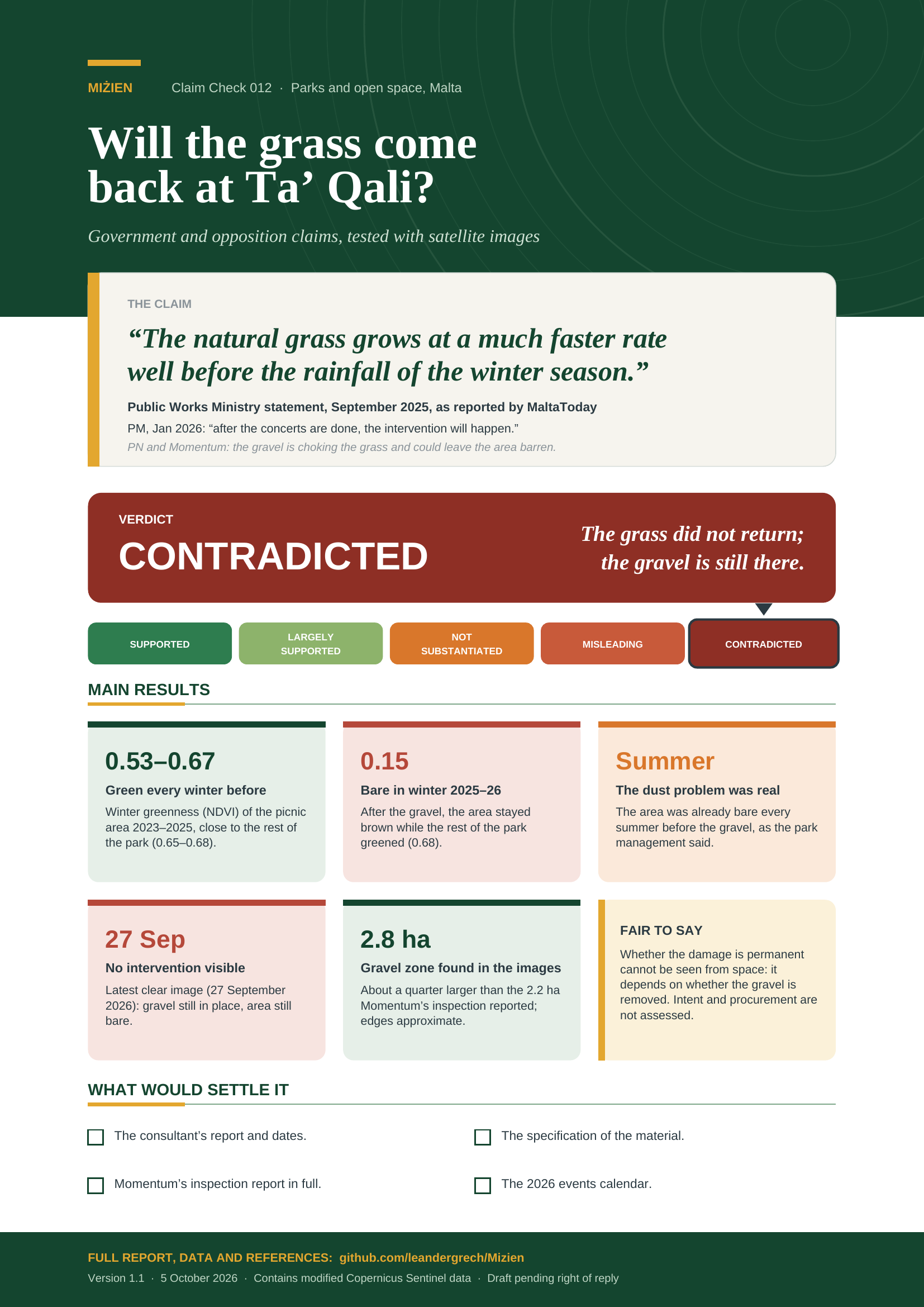
Claim Check 012 · Parks and open space
Will the grass come back at Ta’ Qali?
Testing claims by the government and the opposition against three and a half years of satellite images
“The natural grass grows at a much faster rate well before the rainfall of the winter season.”
Public Works Ministry statement, September 2025, as reported by MaltaToday.
On the sand and gravel laid on the Ta’ Qali picnic area in June 2025.
Verdict: Contradicted The grass did not return; the gravel is still there
Version 1.1 · 5 October 2026
TL;DR
In June 2025 the picnic area at Ta’ Qali National Park was covered in imported sand and gravel. The Public Works Ministry said the material would keep the soil moist so that “the natural grass grows at a much faster rate well before the rainfall of the winter season”. In January 2026 the Prime Minister said the area would be dealt with “after the concerts are done”. Momentum and the Nationalist Party said the gravel was choking the grass and could leave the area permanently barren. We tested what can be tested with three and a half years of Sentinel-2 satellite images.
- The grass did not come back. Before the gravel, the picnic area greened every winter, close to the level of the rest of the park (winter NDVI 0.53–0.67, against 0.65–0.68). In winter 2025–26 it stayed brown (0.15) while the rest of the park greened as usual (0.68).
- The summer dust problem was real. In summer the area was already bare before the gravel (NDVI about 0.15 in 2023 and 2024), as the park management said. The gravel solved a summer problem by removing the winter grass.
- No intervention is visible yet. In the last clear image (27 September 2026) the gravel is still in place and the area is still bare. We could not confirm the 2026 concert dates, so whether the intervention is due yet is not established.
- “Permanently barren” cannot be tested. Satellite greenness shows what grows, not the state of the soil. Whether the damage is permanent depends on whether the gravel is removed and the soil treated.
- Verdict: contradicted. The assurance that grass would regrow through the material is contradicted by the satellite record. The opposition’s description of the present state is supported; its “permanent” warning is not shown.
- Supported
- Largely supported
- Not substantiated
- Misleading
- Contradicted
What would move the verdict up
Ground evidence that grass grew under or through the gravel in winter 2025–26 but is invisible to 10 m satellite pixels.
What would move it down
Nothing: Contradicted is already the lowest rating. Restoration works or soil tests after 27 September 2026 would bear on what happens next and on the “permanent” warning, not on this verdict.
IN THIS REPORT
1 The claims and what we could verify
Both sides made checkable statements. We quote each from the fullest text we could read; no primary government press release or broadcast recording was found, so the government wording is as relayed by news outlets that quote it.
| Claim | Speaker, date | Our access |
|---|---|---|
| The material retains moisture, so “the natural grass grows at a much faster rate well before the rainfall of the winter season”. | Public Works Ministry, Sept 2025 [1] | Statement as relayed by MaltaToday |
| The gravel would curb summer dust while letting the grass grow back with the winter rains. | Jason Micallef, park unit head, Sept 2025 [2, 3] | Paraphrase relayed by two outlets |
| “We will not be making this intervention now, as from April, the area will be hosting concerts … after the concerts are done, the intervention will happen.” | Prime Minister, Jan 2026 [4] | Verbatim, relayed by The Shift |
| The gravel is “choking the grass” and could “permanently transform” the area into a barren zone. | Partit Nazzjonalista, Feb 2026 [5] | Statement as reported |
| Compacted gravel under sand prevents germination; the soil is “unsuitable for natural vegetation”. | Momentum, expert inspection, Feb 2026 [6] | Reported; report not seen |
2 Method
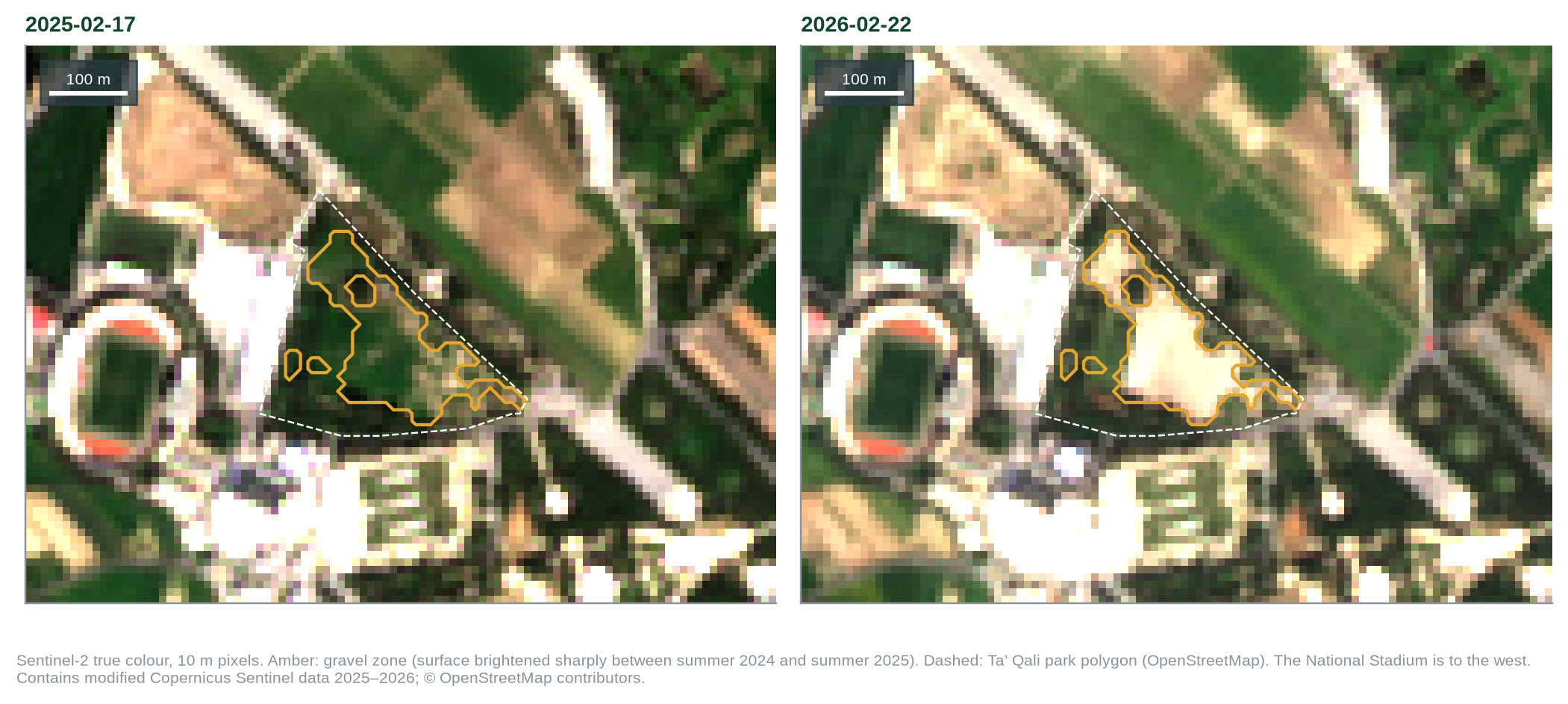
Where. OpenStreetMap does not map the picnic area itself, so we located it from the images. Inside the mapped park polygon east of the National Stadium, we selected the pixels whose surface brightened most between late summer 2024 and late summer 2025 (above the 95th percentile of brightening outside the park), when the gravel was laid. This gives a 2.8 ha zone; Momentum’s inspection independently measured about 2.2 ha. Choosing the zone by brightness rather than greenness keeps the greenness test independent.
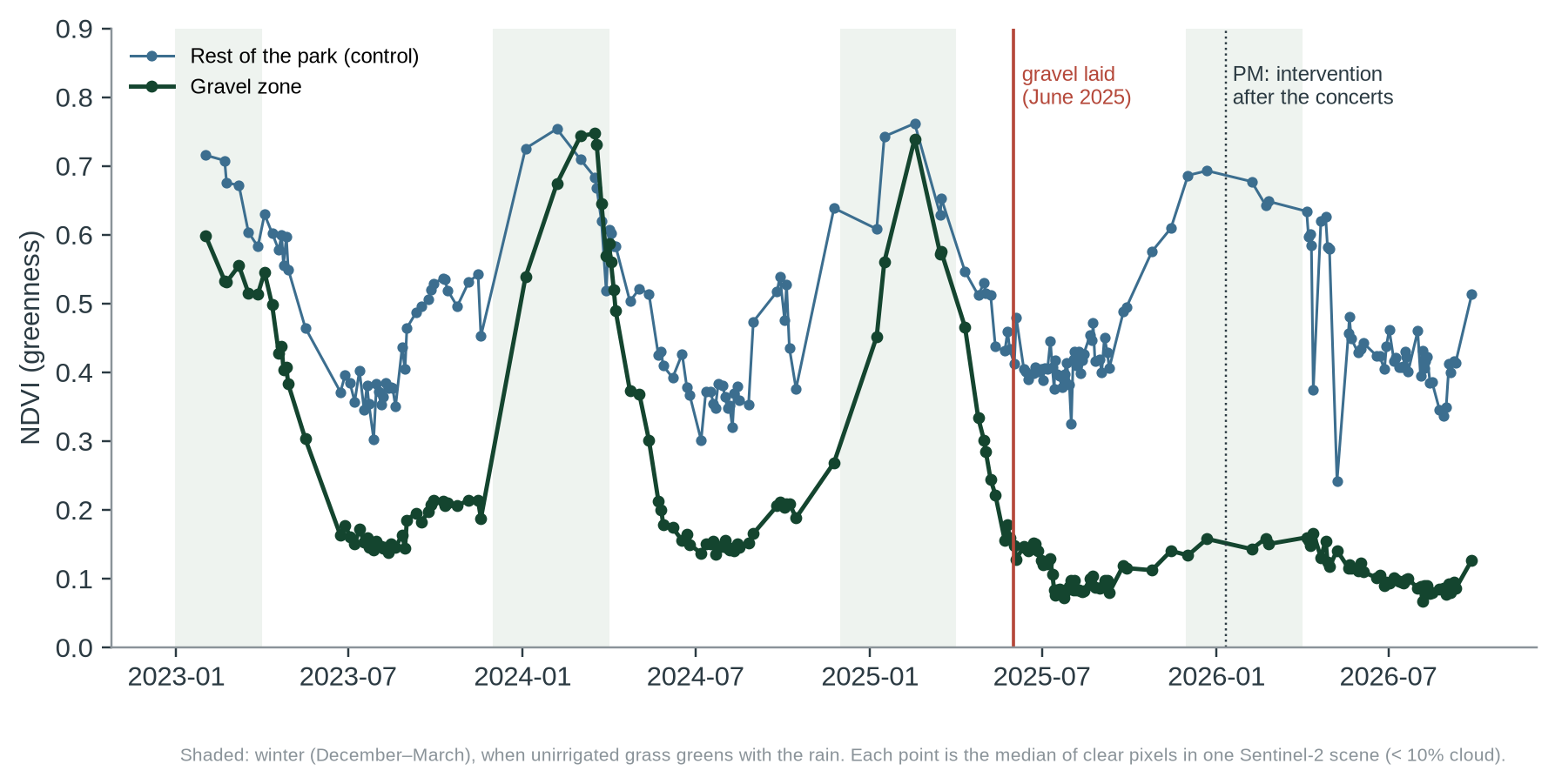
What. NDVI, a standard index of green vegetation from red and near-infrared reflectance, from every Sentinel-2 scene with less than 10% cloud from January 2023 to September 2026, using clear pixels only. Stored values are converted to surface reflectance with each scene’s offset (−1000 for processing baseline 04.00 and later, as its metadata states); version 1.0 omitted this step (Appendix B). The rest of the park polygon (excluding a 20 m buffer) is the control: same soil, same rain. Scripts: tools/cc-012-report/fetch_s2.py and calc.py; data in data/cc-012/.
Grades. Direct satellite measurement against a control area is grade B; soil-science reviews are grade C. Verdicts follow the five-point scale in Appendix A.
3 What the science says
Soil compaction from traffic and trampling, including amenity use, is a well-documented form of soil degradation: it limits water and air infiltration and root penetration [8, 9]. Controlled experiments find that seedling emergence falls as compaction increases [10]. That fits the arborist Jonathan Henwood’s diagnosis that years of mass events had already compacted the picnic area [1], and Momentum’s finding of a compacted gravel layer [6].
The Ministry’s rationale also has a basis: gravel–sand mulch is an established technique for conserving soil water in dry regions [11]. But conserving water under a surface layer is not the same as letting grass grow through it. Whether it does is an empirical question, which the satellite record can answer.
4 What the satellite record shows
Reading across the data
- Three normal winters, then none. Winter medians in the zone were 0.53, 0.67 and 0.57 in 2023–2025, close to the rest of the park (0.65–0.68): across those 18 scenes the zone’s NDVI was typically 0.88 of the park’s. In winter 2025–26 the median was 0.15 while the rest of the park was at 0.68; scene by scene, the zone was typically 0.23 of the park’s.
- No early start either. The Ministry said grass would grow “well before the rainfall”. In autumn and early winter 2025 the zone was browner than in the same months of 2023, before the gravel.
- The summer problem was real. In July–August 2023 and 2024 the zone was already bare (about 0.15), browner than the rest of the park, consistent with a compacted events ground that turned to dust.
- No change visible so far. The surface has stayed bright since June 2025 and was still bare in the last clear images (5, 8, 10 and 27 September 2026).
5 Where the evidence points different ways
Q1 Was the area already in poor condition?
YES, IN SUMMEREVIDENCE FOR THE CLAIM'S IMPRESSION
Summer NDVI was already very low in 2023 and 2024 and the park management’s dust complaint is borne out. Mass events had compacted the soil, as the arborist said [1].
EVIDENCE AGAINST
In winter the same ground greened normally until 2025. The gravel removed the winter grass without restoring the summer cover.
Q2 Could grass be growing that the satellite cannot see?
UNLIKELY AT THIS SCALEEVIDENCE FOR THE CLAIM'S IMPRESSION
Ten-metre pixels average over small patches; a local mayor reported isolated Bermuda grass where no gravel was laid [3].
EVIDENCE AGAINST
Across 2.8 ha the zone was close to the rest of the park in three winters and far below it in the fourth; a change of that size would show if grass had returned.
Q3 Is the damage permanent?
NOT SHOWNEVIDENCE FOR THE CLAIM'S IMPRESSION
Momentum’s inspection describes a compacted layer that seeds in the soil cannot penetrate [6]; compaction is slow to reverse [8, 9].
EVIDENCE AGAINST
Compaction can be alleviated by removing the surface layer and loosening the soil [9]; the government says an expert is advising on restoration [4].
6 Testing the claims
| Claim | What the evidence shows | Rating |
|---|---|---|
| A. Grass would grow faster, before the winter rains (Ministry) | Zone stayed bare through winter 2025–26 (median NDVI 0.15, against 0.53–0.67 in the three winters before) while the rest of the park greened. | CONTRADICTED |
| B. Grass would grow back with the winter rains (park unit head) | As above. | CONTRADICTED |
| C. Intervention after the concerts (Prime Minister) | No change visible to 27 Sep 2026. The 2026 concert dates were not confirmed, so whether it is due yet is not established. | NOT YET DELIVERED |
| D. Gravel is choking the grass (PN, Momentum) | Consistent with the satellite record. | SUPPORTED |
| E. Could become permanently barren (PN) | A prediction; soil condition not measurable from space. | NOT SUBSTANTIATED |
7 Verdict and requests for evidence
The assurance that grass would regrow through the material is contradicted by Sentinel-2 data against a control area. Confidence: high.
Why. The zone greened in each of the three winters before the gravel, close to the level of the surrounding park, and did not green in the winter after it, while the surrounding park did. The Ministry’s claim that grass would grow faster, and the park unit’s that it would return with the rains, are therefore contradicted. The opposition’s description of the current state is supported; its warning of permanent damage is not shown either way.
What this verdict does not say. It does not say why the gravel was chosen, whether procurement rules were followed, or that the area cannot be restored.
Evidence we are asking for
- The landscaping consultant’s report and the restoration plan, with dates.
- The specification of the material laid and the advice on which it was chosen.
- Momentum’s inspection report in full, including sampling locations.
- The 2026 events calendar for the picnic area.
8 Limitations
- NDVI measures green vegetation, not soil health; it cannot show whether the soil is “sterilised”.
- Sentinel-2 pixels are 10 m; patches smaller than a pixel are invisible.
- The zone was located from the images because the picnic area is not mapped; its edges are approximate.
- Government wording is relayed by news outlets; no primary statement or broadcast recording was found.
- Works after 27 September 2026 are not covered.
References
- [1] MaltaToday (Sept 2025). Use of gravel at Ta’ Qali ‘sterilises’ soil, expert says (updated with Public Works Ministry statement). https://www.maltatoday.com.mt/news/national/136863/use_of_gravel_at_ta_qali_sterilises_soil_expert_says_
- [2] The Malta Independent (5 Feb 2026). Momentum inspection on Ta’ Qali gravel shows soil rendered unsuitable for natural vegetation. (Also reports Micallef’s earlier assurance.) https://www.independent.com.mt/articles/2026-02-05/local-news/Momentum-inspection-on-Ta-Qali-gravel-shows-soil-rendered-unsuitable-for-natural-vegetation-6736286987
- [3] MaltaToday (Nov 2025). Ta’ Qali gravel under scrutiny again. https://www.maltatoday.com.mt/environment/nature/137956/ta_qali_gravel_under_scrutiny_again_
- [4] The Shift News (15 Jan 2026). PM contradicted over Ta’ Qali concerts and green grass. https://theshiftnews.com/2026/01/15/pm-contradicted-over-ta-qali-concerts-and-green-grass/
- [5] The Malta Independent (6 Feb 2026). Gravel used to cover Ta’ Qali suppressing grass growth, PN says. https://www.independent.com.mt/articles/2026-02-06/local-news/Gravel-used-to-cover-Ta-Qali-suppressing-grass-growth-PN-says-6736287029
- [6] Momentum expert inspection, as reported in [2] ◆. Report not seen.
- [7] Copernicus Sentinel-2 L2A, tile 33SVV, 2023–2026, via Microsoft Planetary Computer; retrieved 3 Oct 2026, re-fetched 5 Oct 2026 with the reflectance offset applied. https://planetarycomputer.microsoft.com/dataset/sentinel-2-l2a
- [8] Nawaz M.F., Bourrié G., Trolard F. (2013). Soil compaction impact and modelling. A review. Agronomy for Sustainable Development 33(2):291–309. doi:10.1007/s13593-011-0071-8. (Abstract read.) https://doi.org/10.1007/s13593-011-0071-8
- [9] Batey T. (2009). Soil compaction and soil management – a review. Soil Use and Management 25(4):335–345. doi:10.1111/j.1475-2743.2009.00236.x. (Abstract read.) https://doi.org/10.1111/j.1475-2743.2009.00236.x
- [10] Hyatt J., Wendroth O., Egli D.B. (2007). Soil compaction and soybean seedling emergence. Crop Science 47(6):2495–2503. doi:10.2135/cropsci2007.03.0171. (Abstract read.) https://doi.org/10.2135/cropsci2007.03.0171
- [11] Li X.-Y. (2003). Gravel–sand mulch for soil and water conservation in the semiarid loess region of northwest China. Catena 52(2):105–127. doi:10.1016/S0341-8162(02)00181-9. (Metadata only.) https://doi.org/10.1016/S0341-8162(02)00181-9
- [12] MiŻien. Data and scripts: data/cc-012/; tools/cc-012-report/.
Appendix A: series standards and verdict scale
Every investigation in this series follows the same rules so that verdicts are comparable and challengeable.
| Verdict | Meaning |
|---|---|
| SUPPORTED | Evidence consistently backs the claim as stated. |
| LARGELY SUPPORTED | Backed by the evidence, with minor caveats that do not change the substance. |
| NOT SUBSTANTIATED | Stated more strongly than the evidence offered or available allows. May be true in some conditions but has not been shown. |
| MISLEADING | Omits material facts so that the overall impression is inaccurate, even if individual statements are defensible. |
| CONTRADICTED | The available evidence points against the claim. |
Confidence
High: multiple independent lines of evidence agree. Moderate: evidence is relevant but incomplete or indirect. Low: evidence is thin, second-hand or conflicting.
Evidence grades
A experiment · B observational study with a control or gradient · C review, guidance or official statistics · D assertion or anecdote. ◆ marks a source known only second-hand.
Standards
- Quote the speaker, not the headline, with outlet and date, and link the original where possible.
- Separate the claim from the evidence offered for it, and say who made which statement.
- Grade the evidence and show differing views side by side where the evidence is unsettled.
- State what we could not access or verify, and what would change the verdict either way.
- Ask for the missing evidence in specific, answerable requests.
- Offer a right of reply where a check finds a claim Not substantiated, Misleading or Contradicted (or a pledge Not measurable, Off track or Missed), before wider circulation, and append responses.
- Correct errors openly with a version number and change log.
- Whistle-blow only on evidence: a verdict of Misleading or Contradicted requires documents or data that can be shown, not inference.
- Check every side. Government, opposition, NGOs and developers are held to the same standard.
Appendix B: revision log
| Version | Date | Change |
|---|---|---|
| 1.0 | 3 Oct 2026 | First issue. Draft pending right of reply. |
| 1.1 | 5 Oct 2026 | Corrections: (1) Sentinel-2 values recomputed with the reflectance offset (BOA_ADD_OFFSET −1000, processing baseline 04.00 and later) that 1.0 omitted, which had pulled NDVI towards zero. Zone winter NDVI before the gravel 0.37 / 0.47 / 0.38 → 0.53 / 0.67 / 0.57; rest of the park 0.39–0.40 → 0.65–0.68; winter 2025–26 zone 0.11 → 0.15, park 0.38 → 0.68; pre-gravel summers about 0.11 → about 0.15; winter ratio zone/park 0.99 → 0.88 before and 0.30 → 0.23 after (data/cc-012/checks.csv); zone brightness now in reflectance, May → Aug 2025 0.19 → 0.32 (1.0 gave raw values 2881 → 4191). Figures 1 and 2 redrawn; Figure 1 was washed out. Zone (2.8 ha) and scene set (199) unchanged. (2) “Two normal winters” corrected to three (2023, 2024, 2025); “level with the rest of the park” changed to “close to”. (3) Removed the unsourced statement that Summer Daze took place in August 2026. (4) “What would move it down” rewritten: Contradicted is already the lowest rating. (5) Flyer: the 2.8 ha zone was called the “same area” as Momentum’s 2.2 ha; it is about a quarter larger. (6) Layout: removed a near-empty page. Verdict and confidence unchanged. |
Sources and archived copies
-
Use of gravel at Ta' Qali 'sterilises' soil, expert says (updated with Public Works Ministry statement), MaltaToday, Sep 2025.
Original · not yet archived
Ministry statement and arborist comment. Read in full 3 Oct 2026. -
PM contradicted over Ta' Qali concerts and green grass, The Shift News, 15 Jan 2026.
Original · fetched and fingerprinted 2026-10-10; no public snapshot yet
Reports the PM's words and ministry sources disputing the spring-concert timeline. -
Ta' Qali gravel fiasco: more public money needed for grass to grow again, PN says, The Malta Independent, 12 Jan 2026.
Original · not yet archived
Opposition position. -
Gravel used to cover Ta' Qali suppressing grass growth, PN says, The Malta Independent, 6 Feb 2026.
Original · not yet archived
PN statement citing the Momentum report; EUR 310,000 gravel cost. -
Abela's expert took just three days for 'solution' on Ta' Qali grass, The Shift News, 3 Feb 2026.
Original · fetched and fingerprinted 2026-10-10; no public snapshot yet
Consultancy dates and rate. -
Momentum inspection on Ta' Qali gravel shows soil rendered unsuitable for natural vegetation, The Malta Independent, 5 Feb 2026.
Original · not yet archived
Second-hand report of the Momentum-commissioned expert inspection (22,000 m2 picnic area; two layers, sand over compacted fine gravel). Lead to the Momentum report itself; not retrieved. -
Independent expert confirms Ta' Qali picnic area was 'deliberately ruined', Newsbook, Feb 2026.
Original · fetched and fingerprinted 2026-10-10; no public snapshot yet
Second-hand report of the Momentum expert findings. Not retrieved. -
Ta' Qali gravel 'blunder' was intentionally designed to squeeze money out of picnic area, parties claim, MaltaToday, Feb 2026.
Original · not yet archived
Reports Momentum and PN statements. Not retrieved. -
Ta' Qali gravel: Momentum says soil covered with construction-grade gravel, MaltaToday, 2025-26.
Original · not yet archived
Earlier Momentum statement. Not retrieved. -
Grass consultant paid EUR 50 an hour to fix Ta' Qali gravel fiasco, Newsbook, Jan-Feb 2026.
Original · fetched and fingerprinted 2026-10-10; no public snapshot yet
Consultant rate and timeline. Not retrieved. -
Abela wades into Ta' Qali row, endorsing gravel decision but criticising 'communication', Newsbook, Jan 2026.
Original · fetched and fingerprinted 2026-10-10; no public snapshot yet
Reports the PM's interview remarks. Not retrieved. -
Ta' Qali gravel under scrutiny again, MaltaToday, Nov 2025.
Original · not yet archived
Micallef's assurance; no regrowth in autumn 2025. Read in full. -
Sentinel-2 L2A, tile 33SVV, 2023-2026, Copernicus / Microsoft Planetary Computer, 2026.
Original · fetched and fingerprinted 2026-10-10; no public snapshot yet
Primary evidence: tools/cc-012-report/fetch_s2.py; data/cc-012/.
Right of reply
The body concerned has not yet been asked to reply. Its response will be published here, beside the verdict.
Connections
How this claim relates to the others: who made it, the themes it shares with other claims, and the patterns it shows. A connection is a reason to read two checks side by side. It does not make either one right or wrong. How connections are found.
Who made it
Public Works Ministry Jason Micallef, Head of the Ta' Qali park unit for Ta' Qali park unit Robert Abela, Prime Minister for Office of the Prime Minister Partit Nazzjonalista (Nationalist Party) Momentum
Other claims by Robert Abela 6
- CC-016 Shore-to-ship: 90% less harbour pollution (Misleading)
- CC-017 Land reclamation outside the Freeport (Not substantiated)
- CC-027 Power cuts: heat, not generation (not yet checked)
- CC-055 Manoel Island back to the public (Supported)
- CC-064 Grand Harbour regeneration (not yet checked)
- CC-068 Marsaskala marina shelved (not yet checked)
Other claims by Partit Nazzjonalista (Nationalist Party) 7
- CC-042 'From Blue Flag to Red Alert' (Largely supported)
- CC-092 PN: afforestation in a net-zero Gozo (pledge: Not measurable)
- CC-093 PN: buy land for urban parks (not yet checked)
- CC-104 PN: Malta fails EU noise law (not yet checked)
- CC-107 A net-zero Gozo by 2040 (pledge: Not measurable)
- CC-114 PN: only EU state with rising emissions intensity (Misleading)
- CC-126 PN: Labour promised a gas pipeline by 2026 (not yet checked)
Other claims by Momentum 1
Linked directly 4
Claims that share a theme with this one. A theme is a cause, a mechanism, a target or a way of presenting figures that the editors have found in several claims; its strength says how close the link is.
Sealed soil and concrete Shared mechanism · Strong
Excavation, concrete and sealed surfaces around trees. The EU review notes sealed or degraded soil keeps increasing in Malta.
Same pattern
Pattern tags name a recurring way a claim can mislead. They describe the statement, not the speaker.
Promise-without-baseline
A target or pledge with no stated starting point, scope or counting basis.
- CC-008 Flyovers and congestion (Not substantiated)
- CC-010 Tree-planting counts (Largely supported)
- CC-011 Ten minutes' walk to green space (pledge: Not measurable)
- CC-017 Land reclamation outside the Freeport (Not substantiated)
- CC-021 Malta-Gozo tunnel traffic (not yet checked)
- CC-029 First offshore wind farm (Largely supported)
- CC-030 Carbon-neutral airport (Not substantiated)
- CC-031 Gozo, first climate-neutral region (Largely supported)
- CC-039 Net Zero Impact Utility (pledge: Not measurable)
- CC-055 Manoel Island back to the public (Supported)
- CC-079 Waste-to-energy: 4.5% of energy (Misleading)
- CC-092 PN: afforestation in a net-zero Gozo (pledge: Not measurable)
- CC-107 A net-zero Gozo by 2040 (pledge: Not measurable)
- CC-108 Net-zero impact on the groundwater environment (pledge: Not measurable)
- CC-125 EU: Malta Social Climate Plan EUR 60.6 million (not yet checked)
Two steps away 21
Not linked to this claim directly, but linked to a claim that is. These are found by following the links, not chosen by the editors, so they are looser: they show where one theme meets another.
- CC-003 Per-capita emissions vs 2030 projection (Misleading)through Sealed soil and concreteCC-008Transport, air and climate
- CC-004 'Strong progress' in waste separation (Not substantiated)through Sealed soil and concreteCC-002Waste and construction or Sealed soil and concreteCC-008Waste and construction
- CC-007 Within EU limits vs WHO guideline (Largely supported)through Sealed soil and concreteCC-008Transport, air and climate
- CC-010 Tree-planting counts (Largely supported)through Sealed soil and concreteCC-001Replanting as currency or Sealed soil and concreteCC-002Replanting as currency or Sealed soil and concreteCC-008Replanting as currency
- CC-013 Permits keep property prices in check (Largely supported)through Sealed soil and concreteCC-019Planning, housing and land take
- CC-014 Fewer enforcement notices, fewer illegalities (Misleading)through Sealed soil and concreteCC-019Planning, housing and land take
- CC-016 Shore-to-ship: 90% less harbour pollution (Misleading)through Sealed soil and concreteCC-008Transport, air and climate
- CC-017 Land reclamation outside the Freeport (Not substantiated)through Sealed soil and concreteCC-002Waste and construction or Sealed soil and concreteCC-008Waste and construction or Sealed soil and concreteCC-019Planning, housing and land take
- CC-018 IMF 'confirms' MDA on housing (Largely supported)through Sealed soil and concreteCC-019Planning, housing and land take
- CC-021 Malta-Gozo tunnel traffic (not yet checked)through Sealed soil and concreteCC-008Transport, air and climate
- CC-056 Central Link: 'only 254 trees' (not yet checked)through Sealed soil and concreteCC-008Replanting as currency
- CC-058 96% of farmland in use (not yet checked)through Sealed soil and concreteCC-019Planning, housing and land take
- CC-059 Subsidies are 20% of farm output (not yet checked)through Sealed soil and concreteCC-019Farmland and farming pressure
- CC-069 82 million bus trips (not yet checked)through Sealed soil and concreteCC-008Transport, air and climate
- CC-072 EUR 15m to take cars off the road (not yet checked)through Sealed soil and concreteCC-008Transport, air and climate
- CC-076 36 more vehicles a day (Supported)through Sealed soil and concreteCC-008Transport, air and climate
- CC-109 EU: transport is 48% of effort-sharing emissions (Largely supported)through Sealed soil and concreteCC-008Transport, air and climate
- CC-115 Chamber: congestion cost EUR 770m, 3.4% of GDP (Not substantiated)through Sealed soil and concreteCC-008Transport, air and climate
- CC-123 KPMG: 8,716 residential units approved in 2024, up 7.4% (not yet checked)through Sealed soil and concreteCC-019Planning, housing and land take
- CC-127 EU: Malta has the lowest organic share in the EU (not yet checked)through Sealed soil and concreteCC-019Farmland and farming pressure
- CC-130 NGOs: ODZ racecourse policy ends protection (not yet checked)through Sealed soil and concreteCC-019Farmland and farming pressure
Three steps away 20
One step further again. At this distance a connection says more about how the themes fit together than about this claim.
- CC-011 Ten minutes' walk to green space (pledge: Not measurable)through Sealed soil and concreteCC-008Transport, air and climateCC-0032030 carbon target
- CC-020 EP study: noise law not the cause (Largely supported)through Sealed soil and concreteCC-008Transport, air and climateCC-007Compliance-not-health pattern
- CC-025 Per-capita emissions down 44% since 2005 (Largely supported)through Sealed soil and concreteCC-008Transport, air and climateCC-0032030 carbon target
- CC-026 EU's largest rise in emissions (Largely supported)through Sealed soil and concreteCC-008Transport, air and climateCC-003Transport, air and climate
- CC-031 Gozo, first climate-neutral region (Largely supported)through Sealed soil and concreteCC-008Transport, air and climateCC-109Shared emissions figures
- CC-033 Delimara: 'much cleaner air' (not yet checked)through Sealed soil and concreteCC-008Transport, air and climateCC-007Compliance-not-health pattern
- CC-035 PM2.5 death rate down two-thirds (Largely supported)through Sealed soil and concreteCC-008Transport, air and climateCC-007Transport, air and climate
- CC-054 Project Green: 100,000 m2 a year (not yet checked)through Sealed soil and concreteCC-001Replanting as currencyCC-010Replanting as currency
- CC-057 1,649 compensation trees (not yet checked)through Sealed soil and concreteCC-001Replanting as currencyCC-010Replanting as currency
- CC-060 7,000 first-time buyers helped (not yet checked)through Sealed soil and concreteCC-019Planning, housing and land takeCC-013Planning, housing and land take
- CC-062 Construction is 9-14% of the economy (Largely supported)through Sealed soil and concreteCC-019Planning, housing and land takeCC-018Planning, housing and land take
- CC-063 Construction waste: 'standstill' warning (Not substantiated)through Sealed soil and concreteCC-002Waste and constructionCC-017Waste and construction
- CC-071 EUR 100m a year for free buses (Not substantiated)through Sealed soil and concreteCC-008Transport, air and climateCC-069Transport, air and climate
- CC-079 Waste-to-energy: 4.5% of energy (Misleading)through Sealed soil and concreteCC-002Waste and constructionCC-004Waste and construction
- CC-081 Landfill share rising (not yet checked)through Sealed soil and concreteCC-002Waste and constructionCC-004Waste and construction
- CC-094 Commission: Malta to emit more in 2030 than in 2005 (Supported)through Sealed soil and concreteCC-008Transport, air and climateCC-0032030 carbon target
- CC-110 EU: 37.7% of new cars zero-emission (Supported)through Sealed soil and concreteCC-008Transport, air and climateCC-007Selective-metric pattern
- CC-111 EU: 621 kg of waste a head, 74% landfilled (Supported)through Sealed soil and concreteCC-002Waste and constructionCC-004Waste and construction
- CC-114 PN: only EU state with rising emissions intensity (Misleading)through Sealed soil and concreteCC-008Transport, air and climateCC-003Selective-metric pattern
- CC-117 EU: Malta missed recycling targets (reasoned opinion) (not yet checked)through Sealed soil and concreteCC-002Waste and constructionCC-004Waste and construction
Timeline
What was said, what was published before and after it, and each step of this check, in date order. Statements and sources carry the date they were published. The steps of the check carry the date the research was done, from the check's research log. Other statements by the same body on the same topic show whether a position was repeated, changed or corrected.
2025
- September 2025 The statement Public Works Ministry; Jason Micallef (Ta' Qali park unit); Prime Minister Robert Abela; Partit Nazzjonalista; Momentum (this claim)
- September 2025 Reported Use of gravel at Ta' Qali 'sterilises' soil, expert says (with Public Works Ministry statement), MaltaToday
- November 2025 Reported Ta' Qali gravel under scrutiny again, MaltaToday
2026
- 12 January 2026 Reported Ta' Qali gravel fiasco: more public money needed for grass to grow again, PN says, The Malta Independent
- 15 January 2026 Reported PM contradicted over Ta' Qali concerts and green grass, The Shift News
- January 2026 Reported Abela wades into Ta' Qali row, endorsing gravel decision but criticising 'communication', Newsbook
- 3 February 2026 Reported Abela's expert took just three days for 'solution' on Ta' Qali grass, The Shift News
- 5 February 2026 Reported Momentum inspection on Ta' Qali gravel shows soil rendered unsuitable for natural vegetation, The Malta Independent
- 6 February 2026 Reported Gravel used to cover Ta' Qali suppressing grass growth, PN says, The Malta Independent
- February 2026 Reported Independent expert confirms Ta' Qali picnic area was 'deliberately ruined', Newsbook
- February 2026 Reported Ta' Qali gravel 'blunder' was intentionally designed to squeeze money out of picnic area, parties claim, MaltaToday
- 13 May 2026 Later statement by Robert Abela on Land & Trees CC-055 Manoel Island back to the public (Supported)
- 2026 Evidence published Sentinel-2 L2A, tile 33SVV, 2023-2026, Copernicus / Microsoft Planetary Computer
- 3 October 2026 Added to the claims to check
- 3 October 2026 Version 1.0: first issue First issue. Draft pending right of reply.
- 5 October 2026 Evidence reviewed
- 5 October 2026 Version 1.1: corrections Corrections: (1) Sentinel-2 values recomputed with the reflectance offset (BOA_ADD_OFFSET −1000, processing baseline 04.00 and later) that 1.0 omitted, which had pulled NDVI towards zero. Zone winter NDVI before the gravel 0.37 / 0.47 / 0.38 → 0.53 / 0.67 / 0.57; rest of the park 0.39–0.40 → 0.65–0.68; winter 2025–26 zone 0.11 → 0.15, park 0.38 → 0.68; pre-gravel summers about 0.11 → about 0.15; winter ratio zone/park 0.99 → 0.88 before and 0.30 → 0.23 after (data/cc-012/checks.csv); zone brightness now in reflectance, May → Aug 2025 0.19 → 0.32 (1.0 gave raw values 2881 → 4191). Figures 1 and 2 redrawn; Figure 1 was washed out. Zone (2.8 ha) and scene set (199) unchanged. (2) “Two normal winters” corrected to three (2023, 2024, 2025); “level with the rest of the park” changed to “close to”. (3) Removed the unsourced statement that Summer Daze took place in August 2026. (4) “What would move it down” rewritten: Contradicted is already the lowest rating. (5) Flyer: the 2.8 ha zone was called the “same area” as Momentum’s 2.2 ha; it is about a quarter larger. (6) Layout: removed a near-empty page. Verdict and confidence unchanged. Verdict in this version: Contradicted, high confidence. all corrections
2027
- 5 October 2027 Coming up: Evidence review due Each finished check is reviewed against new evidence within a year.
Every change to this claim's record is public: history of the record.
Download the report and flyer