CC-115 · Transport · Cars & traffic
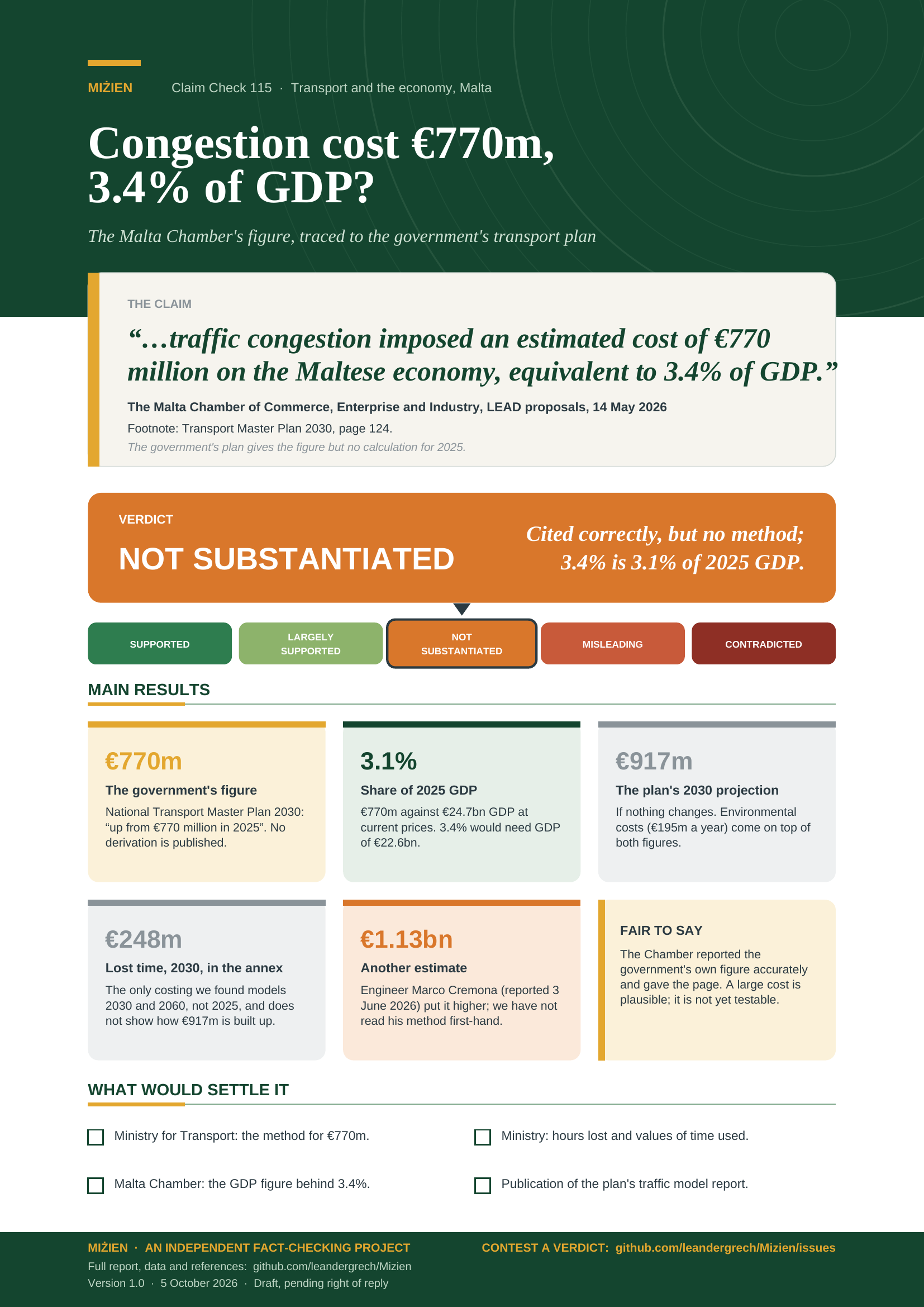
Chamber: congestion cost EUR 770m, 3.4% of GDP
Not substantiated Moderate confidence Draft: right of reply pending
Parts of this claim
The claim is split into parts that are tested separately, as in the report below. Each part has its own number.
- CC-115A Traffic congestion cost the economy an estimated €770 million in 2025 (Malta Chamber [1])Accurately cited from the National Transport Master Plan 2030, p. 124. The plan publishes no derivation for 2025, so the figure cannot be tested.
- CC-115B …equivalent to 3.4% of GDP (Malta Chamber [1])3.12% of 2025 GDP at current prices; 3.34% of 2024 GDP; 3.8–3.9% of real GDP. No published series gives 3.4%.
Claim Check 115 · Economics and transport
Congestion cost €770 million, 3.4% of GDP?
Tracing the Malta Chamber’s figure to the government’s transport plan, and recomputing the share of GDP
“In 2025, traffic congestion imposed an estimated cost of €770 million on the Maltese economy, equivalent to 3.4% of GDP.”
The Malta Chamber of Commerce, Enterprise and Industry, LEAD proposals, 14 May 2026.
Proposals for the 2026–2031 legislature; footnote: Transport Master Plan 2030, p. 124.
Verdict: Not substantiated Cited correctly, but no published method; 3.4% is 3.1%
Version 1.0 · 5 October 2026
TL;DR
In its proposals for the 2026–2031 legislature (“LEAD”, 14 May 2026), the Malta Chamber of Commerce, Enterprise and Industry wrote: “In 2025, traffic congestion imposed an estimated cost of €770 million on the Maltese economy, equivalent to 3.4% of GDP.” We traced the figure to its source and recomputed the share of GDP.
- The €770 million is the government’s own figure, cited correctly. The Chamber’s footnote points to the National Transport Master Plan 2030 (January 2026), which says the cost of congestion is projected to reach €917 million a year by 2030, “up from €770 million in 2025”. The European Commission’s 2026 Country Report repeats the same figures from the same plan.
- But no published method stands behind the 2025 figure. The plan gives no calculation for 2025. Its appraisal annex models 2030 and 2060 only, and two of its tables (lost time and idle fuel) carry identical numbers. We could not reproduce or test the €770 million.
- “3.4% of GDP” does not reproduce. €770 million is 3.1% of Malta’s 2025 GDP at current prices (€24.7 billion, Eurostat), the like-for-like comparison. 3.4% would need GDP of €22.6 billion; 2024 nominal GDP gives 3.3%, and the Chamber’s own real GDP figure gives 3.8%.
- Verdict: not substantiated (moderate confidence). A cost of this order may well be real, but the central figure has no published derivation, and the GDP share is stated higher than the data give. This is not a finding that the Chamber misreported its source: it reported it accurately.
- Supported
- Largely supported
- Not substantiated
- Misleading
- Contradicted
What would move the verdict up
Publication of how the €770 million was estimated (lost hours, value of time, operating costs, base year) and of the GDP figure behind 3.4%.
What would move it down
Evidence that the plan’s 2025 figure was not an estimate for 2025 at all, or a method showing it is much lower.
IN THIS REPORT
1 The claim and what we could verify
The sentence is on the third page of “LEAD – The Malta Chamber Proposals for the 2026–2031 Legislature” [1], published on the Chamber’s website with a press release on 14 May 2026 and read in full on 5 October 2026. Its footnote 2 cites “Transport Master Plan 2030 (Page 124)”. Lovin Malta reported the proposals the same day in its own words [2]. The cited plan is the National Transport Master Plan 2030 (document title “National Transport Strategy 2025 14 JAN26 (REV)”) [3]; the government site refuses automated access, so we read it from an Internet Archive copy of 21 March 2026.
| Source | What it says | Our access | Status |
|---|---|---|---|
| Malta Chamber, LEAD proposals, 14 May 2026 [1] | “In 2025, traffic congestion imposed an estimated cost of €770 million on the Maltese economy, equivalent to 3.4% of GDP. This figure captures lost productivity, higher operating costs for firms, and the misallocation of time and resources.” | Full PDF read, 5 Oct 2026. | The claim |
| National Transport Master Plan 2030, Jan 2026, p. 124 [3] | “By 2030, the economic cost of traffic congestion … is projected to reach €917 million per year, up from €770 million in 2025, unless effective measures are put in place.” Footnote: excludes environmental costs (€195.4 million a year). | Full PDF read (Internet Archive copy, 21 Mar 2026). | The source |
| European Commission, 2026 Country Report, p. 16 [4] | Same €770m and €917m, citing the plan. | Read. | Context |
| Eurostat, nama_10_gdp [5] | Malta’s GDP, current prices and chain-linked volumes. | Downloaded 5 Oct 2026. | Primary data |
2 Method
Question. Where does the €770 million come from, can it be tested, and is it 3.4% of GDP?
Evidence. We read the Chamber’s document and the plan it cites, searched the plan for the derivation of the 2025 figure, and recorded the plan’s figures in data/cc-115/congestion_estimates.csv. We downloaded Malta’s GDP from Eurostat (nama_10_gdp, updated 2 October 2026) and computed the share on each basis (tools/cc-115-report/calc.py; outputs in data/cc-115/checks.csv). A cost in euros of 2025 is compared with GDP in euros of 2025, i.e. at current prices; the other ratios are shown because the Chamber’s document uses real GDP elsewhere (its €11.34 billion for 2015 matches Eurostat’s chain-linked series at 2020 prices).
Grades. Official statistics and the government plan are grade C; the plan’s 2025 figure is an assertion without a published method (D) until its derivation is published. Verdicts follow the five-point scale in Appendix A.
3 What the data show
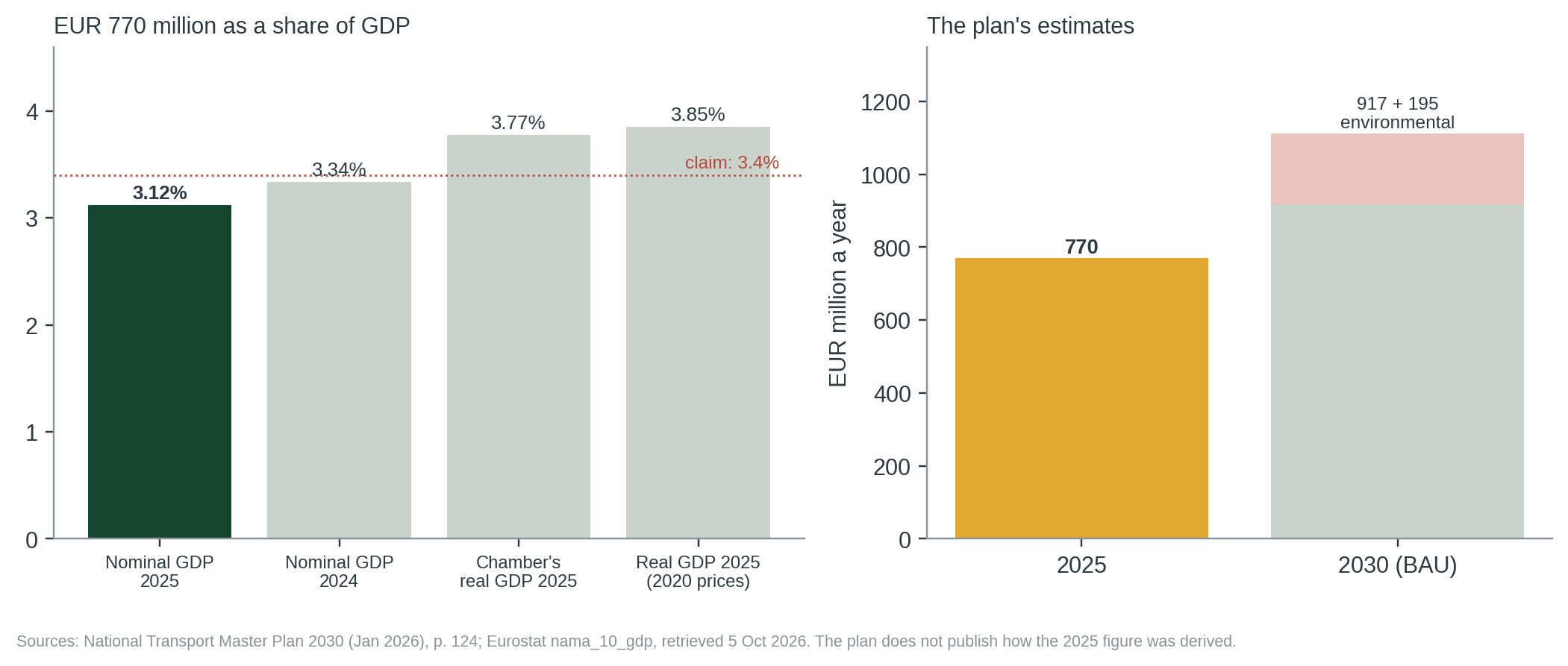
Malta’s GDP in 2025 was €24,664 million at current prices; €770 million is 3.12% of it. Against 2024 GDP (€23,079 million) it is 3.34%, which would round to 3.3%. Against real GDP in 2020 prices it is 3.85%, and against the Chamber’s own real GDP figure (€20.40 billion) 3.77%. None of the published series gives 3.4%; that would need GDP of about €22.6 billion.
In the plan, the only derivation we found is in the appraisal annex (pp. 218–221), which values lost time with HEATCO unit values for 2030 (11.04 million hours a year, €248 million) and 2060. It does not cover 2025, and the plan does not show how the €770 million or the €917 million is assembled.
4 Where the evidence points different ways
Is a congestion cost of this size plausible?
UNTESTEDFOR
The government’s plan and the European Commission both use the figure. Engineer Marco Cremona estimated a higher cost, €1.13 billion a year, in a presentation reported by the Malta News Agency on 3 June 2026 ◆.
AGAINST
No published calculation stands behind €770 million for 2025. The plan’s own appraisal models other years and has two tables with identical numbers. Cremona’s estimate uses its own assumptions (60.8 million hours at €10 an hour plus fuel ◆), which we have not read first-hand.
5 Testing the claim
| Sub-claim | Said by | What the evidence shows | Rating |
|---|---|---|---|
| A. Traffic congestion cost the economy an estimated €770 million in 2025 | Malta Chamber [1] | Accurately cited from the National Transport Master Plan 2030, p. 124. The plan publishes no derivation for 2025, so the figure cannot be tested. | NOT TESTABLE |
| B. …equivalent to 3.4% of GDP | Malta Chamber [1] | 3.12% of 2025 GDP at current prices; 3.34% of 2024 GDP; 3.8–3.9% of real GDP. No published series gives 3.4%. | OVERSTATED |
6 Verdict and requests for evidence
The figure is the government’s, cited correctly, but has no published method; the GDP share does not reproduce. Confidence: moderate.
Why. Our scale rates a claim Not substantiated when its central figure has no evidence that can be checked. The €770 million comes from an official plan but without a published calculation, and the 3.4% does not match Malta’s GDP on the like-for-like basis (3.1%). Confidence is moderate because the plan’s authors may hold a calculation we have not seen.
What this verdict does not say. It does not say congestion is cheap, that the figure is wrong, or that the Chamber misreported its source: the Chamber quoted the government’s plan and gave the page. The missing piece is the plan’s method. A fuller sentence would read: “The government’s transport plan puts the cost of congestion at about €770 million in 2025, roughly 3% of GDP, without publishing how it was estimated.”
Evidence we are asking for
- From the Ministry for Transport and Transport Malta: the calculation behind €770 million (2025) and €917 million (2030): hours lost, values of time, operating costs and base year.
- From the Malta Chamber: the GDP figure used for “3.4% of GDP”.
7 Limitations
- We read the government’s plan from an Internet Archive copy; the live file refuses automated access.
- We searched the plan’s text for the derivation; a calculation could exist in an annex or model report not published with it.
- The Cremona estimate is known to us only from the claim record’s summary of a news report (second-hand, ◆).
- GDP figures are revised; the share would differ slightly with an earlier vintage.
References
- [1] The Malta Chamber of Commerce, Enterprise and Industry (14 May 2026). LEAD – The Malta Chamber Proposals for the 2026–2031 Legislature. Page 3 and footnote 2. https://maltachamber.org.mt/wp-content/uploads/2026/05/LEAD-The-Malta-Chamber-Proposals-for-2026-2031-Legislature.pdf
- [2] Lovin Malta (14 May 2026). Chamber tells political parties: Malta must address productivity crisis or face structural decline. https://lovinmalta.com/news/general-election-2026/chamber-tells-political-parties-malta-must-address-productivity-crisis-or-face-structural-decline/
- [3] Ministry for Transport / Transport Malta (January 2026). National Transport Master Plan 2030 (“National Transport Strategy 2025 14 JAN26 (REV)”). P. 124 and appraisal annex pp. 218–221. Internet Archive copy of 21 Mar 2026. https://infrastructure.gov.mt/wp-content/uploads/2026/01/NATIONAL-TRANSPORT-MASTERPLAN-2030.pdf
- [4] European Commission (3 June 2026). 2026 Country Report – Malta. SWD(2026) 218 final, footnotes 9–10. https://data.consilium.europa.eu/doc/document/ST-10135-2026-ADD-1/en/pdf
- [5] Eurostat. GDP and main components (nama_10_gdp), updated 2 Oct 2026, retrieved 5 Oct 2026. https://ec.europa.eu/eurostat/databrowser/view/nama_10_gdp/default/table
- [6] Malta News Agency (3 June 2026), report of Marco Cremona’s presentation to Momentum (via the CC-115 claim record; not read first-hand ◆).
- [7] MiŻien. Calculation script and outputs: tools/cc-115-report/calc.py; data/cc-115/.
Appendix A: series standards and verdict scale
Every investigation in this series follows the same rules so that verdicts are comparable and challengeable.
| Verdict | Meaning |
|---|---|
| SUPPORTED | Evidence consistently backs the claim as stated. |
| LARGELY SUPPORTED | Backed by the evidence, with minor caveats that do not change the substance. |
| NOT SUBSTANTIATED | Stated more strongly than the evidence offered or available allows. May be true in some conditions but has not been shown. |
| MISLEADING | Omits material facts so that the overall impression is inaccurate, even if individual statements are defensible. |
| CONTRADICTED | The available evidence points against the claim. |
Confidence
High: multiple independent lines of evidence agree. Moderate: evidence is relevant but incomplete or indirect. Low: evidence is thin, second-hand or conflicting.
Evidence grades
A experiment · B observational study with a control or gradient · C review, guidance or official statistics · D assertion or anecdote. ◆ marks a source known only second-hand.
Standards
- Quote the speaker, not the headline, with outlet and date, and link the original where possible.
- Separate the claim from the evidence offered for it, and say who made which statement.
- Grade the evidence and show differing views side by side where the evidence is unsettled.
- State what we could not access or verify, and what would change the verdict either way.
- Ask for the missing evidence in specific, answerable requests.
- Offer a right of reply where a check finds a claim Not substantiated, Misleading or Contradicted (or a pledge Not measurable, Off track or Missed), before wider circulation, and append responses.
- Correct errors openly with a version number and change log.
- Whistle-blow only on evidence: a verdict of Misleading or Contradicted requires documents or data that can be shown, not inference.
- Check every side. Government, opposition, NGOs and developers are held to the same standard.
Appendix B: revision log
| Version | Date | Change |
|---|---|---|
| 1.0 | 5 Oct 2026 | First issue. Verdict Not substantiated (moderate confidence); pending right of reply. |
Sources and archived copies
-
LEAD - The Malta Chamber Proposals for the 2026-2031 Legislature, The Malta Chamber of Commerce, Enterprise and Industry, 2026-05-14.
Original · Archived copy
The claim, page 3; footnote 2 cites Transport Master Plan 2030 p. 124. Read in full 5 Oct 2026. -
National Transport Master Plan 2030, Ministry for Transport / Transport Malta, Jan 2026.
Original · Archived copy
The cited source, p. 124: EUR 917m by 2030 'up from EUR 770 million in 2025'; no derivation for 2025. Read from the Internet Archive copy of 21 Mar 2026 (live site 403). -
Chamber tells political parties: Malta must address productivity crisis or face structural decline, Lovin Malta, 2026-05-14.
Original · Archived copy
Locator: reports the proposals in its own words. -
GDP and main components (nama_10_gdp), Eurostat, updated 2 Oct 2026.
Original · Archived copy
Primary data, retrieved 5 Oct 2026 (data/cc-115/).
Right of reply
The body concerned has not yet been asked to reply. Its response will be published here, beside the verdict.
Connections
How this claim relates to the others: who made it, the themes it shares with other claims, and the patterns it shows. A connection is a reason to read two checks side by side. It does not make either one right or wrong. How connections are found.
Who made it
The Malta Chamber of Commerce, Enterprise and Industry
No other claim by this body is listed yet.
Linked directly 3
Claims that share a theme with this one. A theme is a cause, a mechanism, a target or a way of presenting figures that the editors have found in several claims; its strength says how close the link is.
Transport, air and climate Shared driver · Strong
Fleet growth links traffic claims, air quality and emissions. The climate report names transport and buildings as the lagging sectors.
Two steps away 18
Not linked to this claim directly, but linked to a claim that is. These are found by following the links, not chosen by the editors, so they are looser: they show where one theme meets another.
- CC-001 Upper Barrakka concrete (Not substantiated)through Transport, air and climateCC-008Sealed soil and concrete
- CC-002 Comino tree compensation (Largely supported)through Transport, air and climateCC-008Sealed soil and concrete
- CC-003 Per-capita emissions vs 2030 projection (Misleading)through Transport, air and climateCC-008Transport, air and climate or Transport, air and climateCC-1092030 carbon target
- CC-004 'Strong progress' in waste separation (Not substantiated)through Transport, air and climateCC-008Waste and construction
- CC-007 Within EU limits vs WHO guideline (Largely supported)through Transport, air and climateCC-008Transport, air and climate
- CC-010 Tree-planting counts (Largely supported)through Transport, air and climateCC-008Replanting as currency
- CC-012 Ta' Qali gravel and grass (Contradicted)through Transport, air and climateCC-008Sealed soil and concrete
- CC-016 Shore-to-ship: 90% less harbour pollution (Misleading)through Transport, air and climateCC-008Transport, air and climate
- CC-017 Land reclamation outside the Freeport (Not substantiated)through Transport, air and climateCC-008Waste and construction
- CC-019 830,000 m2 of land lost in five years (Not substantiated)through Transport, air and climateCC-008Sealed soil and concrete
- CC-021 Malta-Gozo tunnel traffic (not yet checked)through Transport, air and climateCC-008Transport, air and climate
- CC-031 Gozo, first climate-neutral region (Largely supported)through Transport, air and climateCC-109Shared emissions figures
- CC-056 Central Link: 'only 254 trees' (not yet checked)through Transport, air and climateCC-008Replanting as currency
- CC-069 82 million bus trips (not yet checked)through Transport, air and climateCC-008Transport, air and climate or Transport, air and climateCC-071Transport, air and climate
- CC-072 EUR 15m to take cars off the road (not yet checked)through Transport, air and climateCC-008Transport, air and climate or Transport, air and climateCC-071Transport, air and climate or Transport, air and climateCC-109Transport, air and climate
- CC-076 36 more vehicles a day (Supported)through Transport, air and climateCC-008Transport, air and climate
- CC-094 Commission: Malta to emit more in 2030 than in 2005 (Supported)through Transport, air and climateCC-1092030 carbon target
- CC-110 EU: 37.7% of new cars zero-emission (Supported)through Transport, air and climateCC-109Transport, air and climate
Three steps away 25
One step further again. At this distance a connection says more about how the themes fit together than about this claim.
- CC-011 Ten minutes' walk to green space (pledge: Not measurable)through Transport, air and climateCC-008Transport, air and climateCC-0032030 carbon target
- CC-013 Permits keep property prices in check (Largely supported)through Transport, air and climateCC-008Waste and constructionCC-017Planning, housing and land take
- CC-014 Fewer enforcement notices, fewer illegalities (Misleading)through Transport, air and climateCC-008Waste and constructionCC-017Planning, housing and land take
- CC-018 IMF 'confirms' MDA on housing (Largely supported)through Transport, air and climateCC-008Waste and constructionCC-017Planning, housing and land take
- CC-020 EP study: noise law not the cause (Largely supported)through Transport, air and climateCC-008Transport, air and climateCC-007Compliance-not-health pattern
- CC-025 Per-capita emissions down 44% since 2005 (Largely supported)through Transport, air and climateCC-008Transport, air and climateCC-0032030 carbon target
- CC-026 EU's largest rise in emissions (Largely supported)through Transport, air and climateCC-008Transport, air and climateCC-003Transport, air and climate
- CC-033 Delimara: 'much cleaner air' (not yet checked)through Transport, air and climateCC-008Transport, air and climateCC-007Compliance-not-health pattern
- CC-035 PM2.5 death rate down two-thirds (Largely supported)through Transport, air and climateCC-008Transport, air and climateCC-007Transport, air and climate
- CC-054 Project Green: 100,000 m2 a year (not yet checked)through Transport, air and climateCC-008Replanting as currencyCC-010Replanting as currency
- CC-057 1,649 compensation trees (not yet checked)through Transport, air and climateCC-008Replanting as currencyCC-010Replanting as currency
- CC-058 96% of farmland in use (not yet checked)through Transport, air and climateCC-008Sealed soil and concreteCC-019Planning, housing and land take
- CC-059 Subsidies are 20% of farm output (not yet checked)through Transport, air and climateCC-008Sealed soil and concreteCC-019Farmland and farming pressure
- CC-063 Construction waste: 'standstill' warning (Not substantiated)through Transport, air and climateCC-008Waste and constructionCC-017Waste and construction
- CC-075 Seventh in the EU for cars (Misleading)through Transport, air and climateCC-109Transport, air and climateCC-110Transport, air and climate
- CC-079 Waste-to-energy: 4.5% of energy (Misleading)through Transport, air and climateCC-008Waste and constructionCC-004Waste and construction
- CC-081 Landfill share rising (not yet checked)through Transport, air and climateCC-008Waste and constructionCC-004Waste and construction
- CC-092 PN: afforestation in a net-zero Gozo (pledge: Not measurable)through Transport, air and climateCC-109Shared emissions figuresCC-031Net-zero Gozo
- CC-107 A net-zero Gozo by 2040 (pledge: Not measurable)through Transport, air and climateCC-109Shared emissions figuresCC-031Net-zero Gozo
- CC-111 EU: 621 kg of waste a head, 74% landfilled (Supported)through Transport, air and climateCC-008Waste and constructionCC-004Waste and construction
- CC-114 PN: only EU state with rising emissions intensity (Misleading)through Transport, air and climateCC-008Transport, air and climateCC-003Selective-metric pattern
- CC-117 EU: Malta missed recycling targets (reasoned opinion) (not yet checked)through Transport, air and climateCC-008Waste and constructionCC-004Waste and construction
- CC-123 KPMG: 8,716 residential units approved in 2024, up 7.4% (not yet checked)through Transport, air and climateCC-008Sealed soil and concreteCC-019Planning, housing and land take
- CC-127 EU: Malta has the lowest organic share in the EU (not yet checked)through Transport, air and climateCC-008Sealed soil and concreteCC-019Farmland and farming pressure
- CC-130 NGOs: ODZ racecourse policy ends protection (not yet checked)through Transport, air and climateCC-008Sealed soil and concreteCC-019Farmland and farming pressure
Similar wording
Claims whose own words overlap with this one, with the words they share. Found by comparing the wording of the claims, not their verdicts; a lead to read them together, not a finding.
- CC-071 EUR 100m a year for free buses (Not substantiated)shares: cost, traffic, congestion
Timeline
What was said, what was published before and after it, and each step of this check, in date order. Statements and sources carry the date they were published. The steps of the check carry the date the research was done, from the check's research log. Other statements by the same body on the same topic show whether a position was repeated, changed or corrected.
2026
- January 2026 Evidence published National Transport Master Plan 2030, Ministry for Transport / Transport Malta
- 14 May 2026 The statement The Malta Chamber of Commerce, Enterprise and Industry (this claim)
- 14 May 2026 Evidence published LEAD - The Malta Chamber Proposals for the 2026-2031 Legislature, The Malta Chamber
- 5 October 2026 Added to the claims to check
- 5 October 2026 Exact wording found Verbatim wording found in the Chamber's own LEAD proposals PDF (14 May 2026); the intake's Lovin Malta source paraphrases. Footnote traced to the National Transport Master Plan 2030, p. 124 (read from an Internet Archive copy).
- 5 October 2026 Note Plan searched for the derivation of EUR 770m (none for 2025). Eurostat nama_10_gdp downloaded; share of GDP computed on four bases (tools/cc-115-report/calc.py).
- 5 October 2026 Version 1.0: first issue First issue. Verdict Not substantiated (moderate confidence); pending right of reply. Verdict in this version: Not substantiated, moderate confidence.
- 5 October 2026 Evidence reviewed
- 6 October 2026 Evidence published GDP and main components (nama_10_gdp), Eurostat
2027
- 5 October 2027 Coming up: Evidence review due Each finished check is reviewed against new evidence within a year.
Every change to this claim's record is public: history of the record.
Download the report and flyer