CC-020 · Noise
EP study: noise law not the cause
Largely supported Moderate confidence Draft: no right of reply needed
Parts of this claim
The claim is split into parts that are tested separately, as in the report below. Each part has its own number.
- CC-020A Only two meaningful non-conformities in the transpositionPer the study’s table [1]; legal comparison not repeated.
- CC-020B No END infringement proceedings, 2015–2025Per the study [1]; register not searched.
- CC-020C Complaints concern sources outside the ENDThe study’s own reading of the 2022 consultation responses and the 2024 petition (ch. 6) [1]: the authors’ judgement, which we did not re-code.
- CC-020D 21% vs 9% survey figureIn ERA’s annex [7] (a comment, no survey named); not in the Marmarà summary [8]; origin unidentified.
Claim Check 020 · Noise
Is the noise law the cause of Malta’s noise?
Testing a European Parliament study on Malta’s implementation of the Environmental Noise Directive
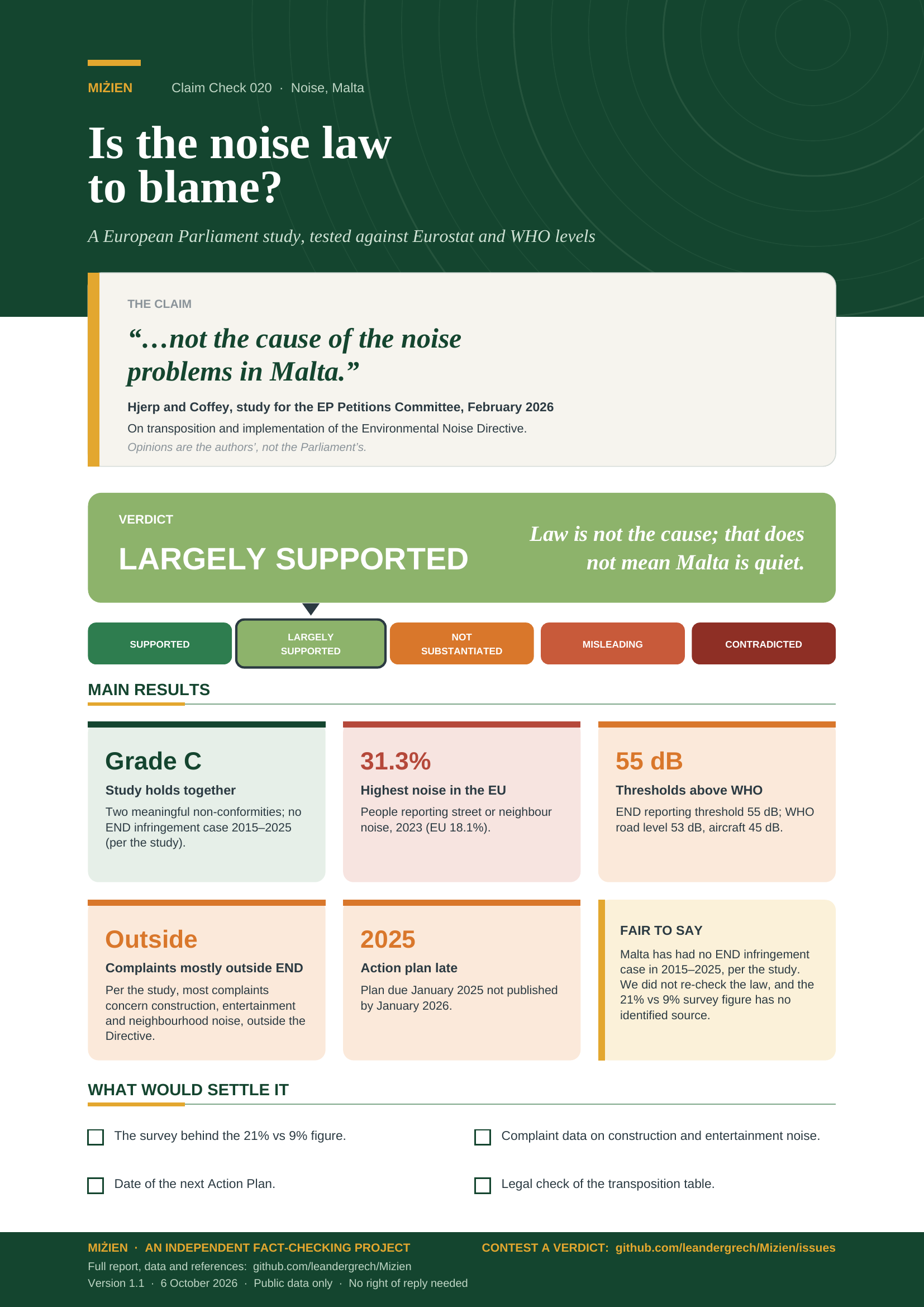
“The transposition and implementation of the END evidently is not the cause of the noise problems in Malta.”
Hjerp and Coffey (Ecocentric Consulting), study for the European Parliament’s Committee on Petitions, February 2026.
Key findings, chapter 6 (PE 783.089).
Verdict: Largely supported Legal conformity is not the cause; that does not mean Malta is quiet
Version 1.1 · 6 October 2026
TL;DR
A study for the European Parliament’s Committee on Petitions (February 2026) examined Malta’s implementation of the Environmental Noise Directive (END). It concluded: “The transposition and implementation of the END evidently is not the cause of the noise problems in Malta.” It found only two meaningful non-conformities, no infringement proceedings in 2015–2025, and that most complaints concern noise the Directive does not cover. We read the full study and tested its reasoning against Eurostat survey data and the WHO guideline levels it reports.
- The study’s reasoning holds together. The Directive sets reporting thresholds, not limits, and covers only major roads, railways, airports and large agglomerations. Construction, entertainment and neighbourhood noise are outside it, so legal conformity cannot explain complaints about them.
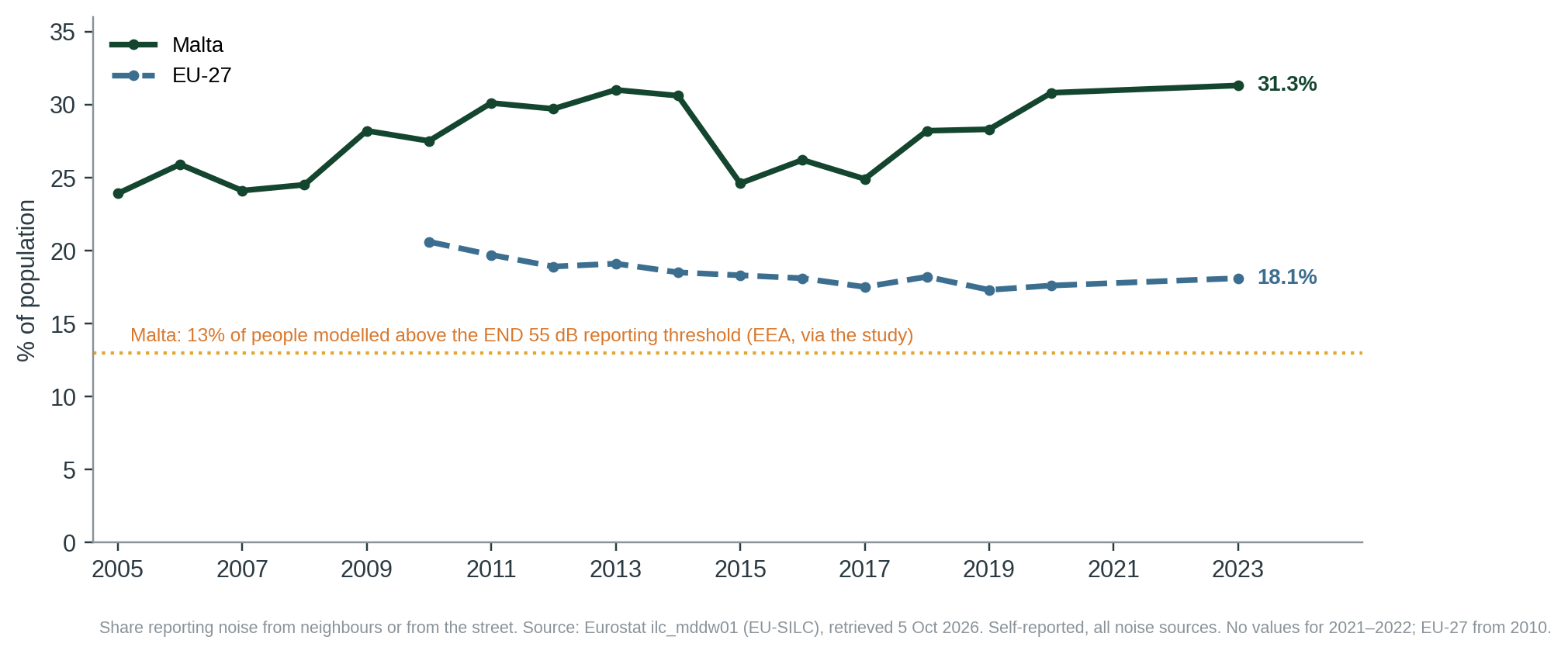
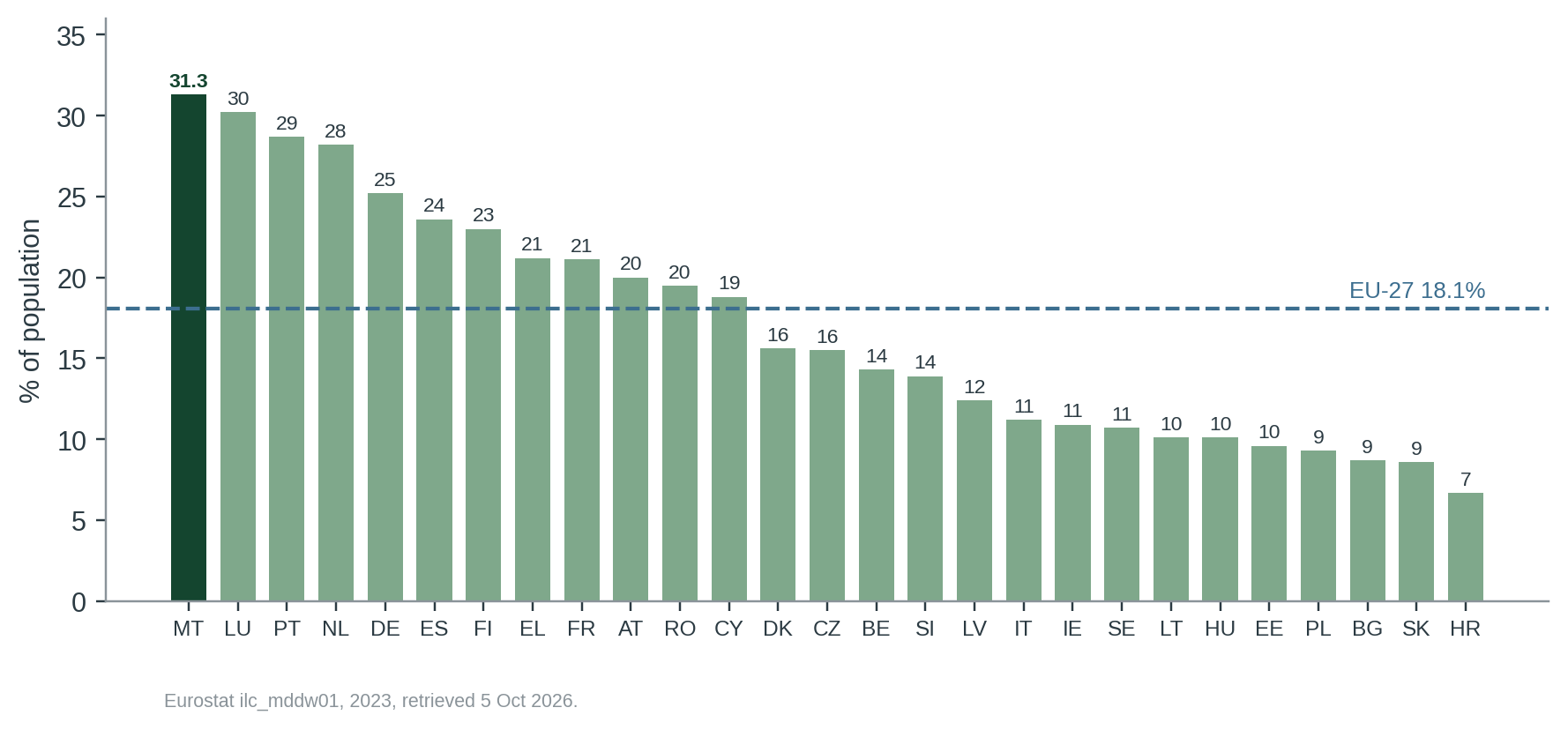
- The noise problem itself is real. 31.3% of people in Malta reported noise from neighbours or the street in 2023, the highest share in the EU (EU-27 18.1%), and Malta has been above the EU average in every available year since 2010.
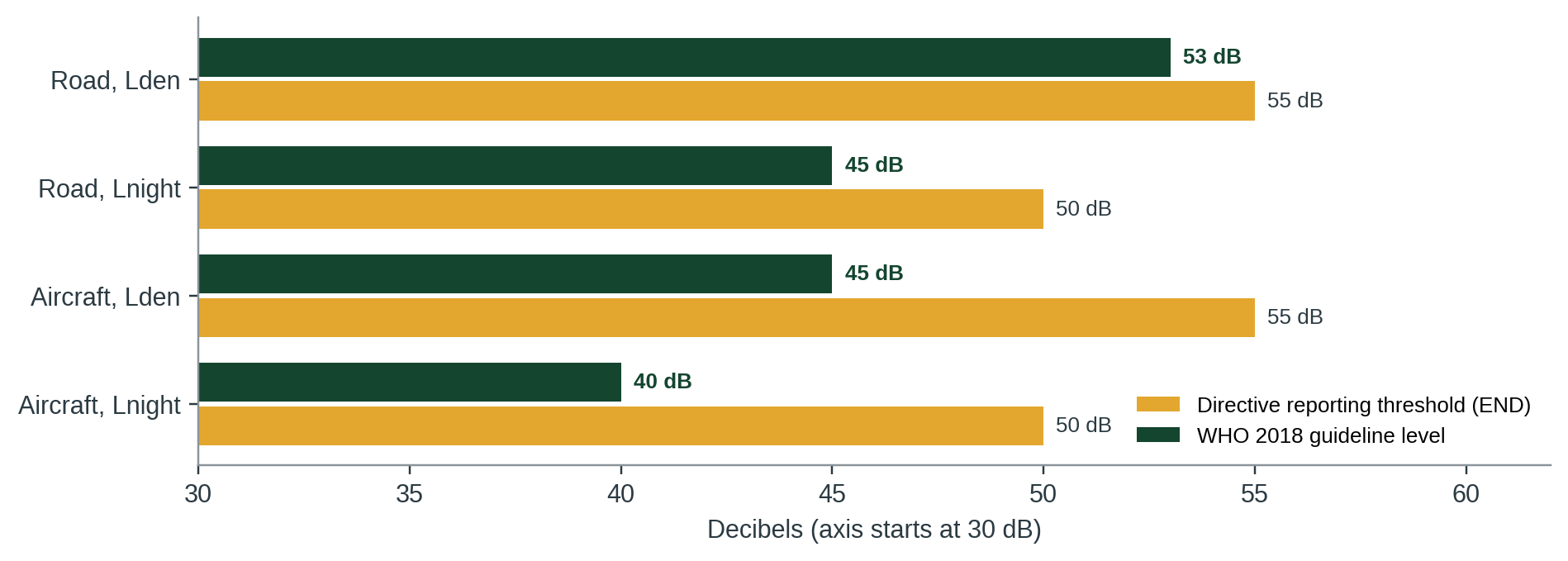
- ‘Compliant’ is not ‘quiet’. The Directive’s 55 dB (day-evening-night) and 50 dB (night) thresholds are above the WHO 2018 guideline levels (53 and 45 dB for roads; 45 and 40 dB for aircraft). The study says so itself, and says health effects occur below the END thresholds.
- Some parts could not be checked independently. We did not re-read the Maltese regulation or search the Commission’s infringement register. The 21% vs 9% survey figure is in ERA’s consultation annex, but the annex names no survey and the figure is not in the Marmarà survey summary, so its origin is unidentified.
- Verdict: largely supported (moderate confidence). The conclusion follows from the evidence the study presents. Caveats: delays in action plans are an END implementation issue, and the verdict covers legal conformity only, not whether Malta is quiet.
- Supported
- Largely supported
- Not substantiated
- Misleading
- Contradicted
What would move the verdict up
Maltese regulation or Commission records showing non-conformity that the study missed, or evidence that END-covered exposure (roads, airport) drives complaints more than the study allows.
What would move it down
A cause for the complaints that does lie in END implementation, for example evidence that delayed action plans left residents unprotected from road noise.
IN THIS REPORT
1 The claim and what we could verify
The claim is the study by Peter Hjerp and Clare Coffey (Ecocentric Consulting), commissioned by the European Parliament’s Committee on Petitions in response to Maltese petitions, PE 783.089, February 2026 [1]. We read the full text from the EU Publications Office. The opinions are the authors’, not the Parliament’s official position.
| What the study says | Where | Access |
|---|---|---|
| “Legal transposition of the END into national legislation is not considered to be the cause of the noise problems in Malta.” | Ch. 3 key findings [1] | Read in full |
| Transposition has “just two issues of non-conformity that are meaningful” (Art. 8(3); Annex V limit values). | Ch. 3 [1] | Read in full |
| “There have been no END infringement proceedings against Malta between 2015 and 2025.” | Ch. 4 [1] | Read; register not searched |
| 21% of participants in a 2019 Maltese survey ranked noise among their four most important environmental issues, against an EU28 average of 9%. | Ch. 6 [1], citing ERA 2023c [7] | Annex read; origin unidentified |
| Complaints concern sources “largely” outside the END, so they do not “significantly reflect a failure in the implementation or enforcement of the END”. | Ch. 6 [1] | Read in full (authors’ reading) |
2 Method
Question. Does the evidence support the conclusion that how Malta transposed and implements the END is not what causes Malta’s noise problems?
Evidence. The study’s own text and tables [1]; Eurostat’s EU-SILC indicator on noise from neighbours or the street [2] for Malta, the EU and all Member States, as a measure of the size of the problem; the WHO guideline levels as reported in the study [1, 5]; and peer-reviewed reviews behind the WHO guidelines [3–4], verified by DOI in Crossref. Numbers are recomputed by tools/cc-020-report/calc.py from data/cc-020/.
Grades. Peer-reviewed reviews are grade C–B by design; official statistics grade C; the study is a commissioned expert report (grade C). Verdicts follow the five-point scale in Appendix A.
3 What the study and the research say
The study compares the Directive with Malta’s 2004 Regulations (as amended in 2007, 2018 and 2022) article by article. By our rough count about 14 of some 219 rows in its table are marked as not transposed; the authors judge only two to matter: the duty to inform the Commission of other criteria used in action plans (Art. 8(3)) and the absence of a reference to limit values under Article 5 [1]. That judgement of relevance is theirs, and we did not repeat the legal comparison.
The Directive itself sets no limit values or reduction targets. It requires noise maps and action plans for major roads, railways, airports and agglomerations above 100,000 inhabitants, with reporting thresholds of 55 dB (Lden) and 50 dB (Lnight) [1]. Malta has no railways. The study, citing the EEA, says the exposure figures reported under it “are likely to be a considerable underestimation” for this reason [1].
The WHO’s 2018 guidelines recommend lower levels than these thresholds, built on systematic reviews of the evidence on annoyance [4] and cardiovascular and metabolic effects [3]; the process is described in [6]. The study itself states that “health impacts already occur at noise levels below the END reporting thresholds”.
4 What the data show
Eurostat’s EU-SILC survey asks households whether they are bothered by noise from neighbours or from the street. It is self-reported and covers all sources, including road traffic, which the Directive does cover. It therefore shows the size of the problem, not what causes it or whether the law is at fault.
| Indicator | Malta | EU / comparison | Source | Grade |
|---|---|---|---|---|
| Noise from neighbours or street, 2023 | 31.3% | 18.1% (EU-27) | Eurostat ilc_mddw01 | C |
| Years since 2010 with Malta above EU | 12 of 12 | – | calculated | C |
| Rank among 27 Member States, 2023 | 1st | next: Luxembourg 30.2% | calculated | C |
| People above Lden 55 dB (END) | 65,100 (13%) | – | Study, citing EEA [1] | C |
| Transposition rows marked ‘No’ | ~14 of ~219 | 2 judged meaningful | Study Annex 1 [1] | C |
| Noise ranked top-4 environmental issue, 2019 | 21% | 9% (EU28) | Study, citing ERA [1, 7] | D |
All values in data/cc-020/checks.csv. The 21% vs 9% row is as stated in ERA’s annex [7], which names no survey; it is not traced to one.
5 Where the evidence points different ways
Q1 Is legal transposition the cause?
SUPPORTEDEVIDENCE FOR THE CLAIM'S IMPRESSION
Only two of the non-conformities the study lists are judged meaningful, the Commission has opened no END case against Malta in 2015–2025 (per the study), and the study reads the consultation responses and petition as concerning mostly sources outside the Directive.
EVIDENCE AGAINST
We did not verify the transposition table against the Maltese regulation or search the infringement register; the relevance judgement and the reading of the complaints are the authors’ own, and we did not re-code the responses.
Q2 Is the noise problem therefore small?
NOT WHAT THE STUDY SAYSEVIDENCE FOR THE CLAIM'S IMPRESSION
The study separates two questions: whether the law is the cause, and whether people are exposed. It reports considerable exposure and, citing the EEA, says the END figures are likely an underestimate.
EVIDENCE AGAINST
Eurostat shows Malta first in the EU for reported noise, 13 points above the average. Directive thresholds sit above WHO levels (2 dB for road Lden, 5 dB for road Lnight, 10 dB for aircraft Lden).
Q3 Are action-plan delays part of END implementation?
A GAP IN THE HEADLINEEVIDENCE FOR THE CLAIM'S IMPRESSION
The study says the delays are the only implementation issue of concern and recommends faster publication.
EVIDENCE AGAINST
The conclusion says implementation “evidently is not the cause”, but the Action Plan due in January 2025 had not been published as of January 2026 [1].
6 Testing the claim
| Sub-claim | What the evidence shows | Rating |
|---|---|---|
| A. Only two meaningful non-conformities in the transposition | Per the study’s table [1]; legal comparison not repeated. | SUPPORTED (study) |
| B. No END infringement proceedings, 2015–2025 | Per the study [1]; register not searched. | NOT CHECKED |
| C. Complaints concern sources outside the END | The study’s own reading of the 2022 consultation responses and the 2024 petition (ch. 6) [1]: the authors’ judgement, which we did not re-code. | SUPPORTED (study) |
| D. 21% vs 9% survey figure | In ERA’s annex [7] (a comment, no survey named); not in the Marmarà summary [8]; origin unidentified. | NOT VERIFIED |
7 Verdict and requests for evidence
The conclusion follows from the evidence presented; legal conformity does not mean low noise. Confidence: moderate.
Why. (1) The Directive’s scope explains why complaints about construction, entertainment and neighbourhood noise are not a transposition failure. (2) Independent data confirm that the problem is large. (3) The caveats are that we could not verify the legal table or the infringement record independently, the survey figure’s origin is unidentified, and action-plan delays are a genuine implementation issue. They do not change the substance, which our scale calls Largely supported.
What this verdict does not say. It does not say that Malta’s noise is acceptable, that thresholds protect health, or that authorities have enforced other noise laws adequately. It addresses only whether the study’s conclusion on the Directive is supported.
Evidence we are asking for
- The name of the survey behind the 21% vs 9% figure in ERA’s consultation annex (2023c), with the EU28 comparison source.
- Complaint and enforcement data for construction and entertainment noise.
- The date the Action Plan due in January 2025 will be published.
8 Limitations
- We did not compare the Maltese regulation with the Directive ourselves, nor search the Commission’s infringement register.
- WHO guideline values and EEA exposure counts are taken from the study (second-hand); the EEA fact sheet and WHO document were not opened.
- The 21% vs 9% figure is in ERA’s annex [7] (pp. 5–6), in a comment from the Office of the Superintendent of Public Health, which names no survey. It is not in the summary of the Marmarà survey of October 2019 [8], which gives only a mean worry score for noise (3.90 out of 5). We do not know its source and have not assumed one.
- Eurostat’s indicator is self-reported, has no 2021–2022 values for Malta, and shows a dip in 2015 we did not investigate.
- Self-reported noise and modelled END exposure are different measures and are not directly comparable.
- Reviews [3, 4, 6] were read as abstracts, or as metadata only where no abstract was available.
References
- [1] Hjerp P., Coffey C. (2026). Analysing Malta’s implementation of Directive 2002/49/EC on the Assessment and Management of Environmental Noise. European Parliament, PE 783.089. doi:10.2861/6278624. (Read in full.) https://doi.org/10.2861/6278624
- [2] Eurostat. ilc_mddw01 Noise from neighbours or from the street (EU-SILC); retrieved 5 Oct 2026. https://ec.europa.eu/eurostat/databrowser/view/ilc_mddw01
- [3] van Kempen E. et al. (2018). WHO Environmental Noise Guidelines for the European Region: a systematic review on environmental noise and cardiovascular and metabolic effects. IJERPH 15(2):379. doi:10.3390/ijerph15020379. (Abstract read.) https://doi.org/10.3390/ijerph15020379
- [4] Guski R., Schreckenberg D., Schuemer R. (2017). WHO Environmental Noise Guidelines for the European Region: a systematic review on environmental noise and annoyance. IJERPH 14(12):1539. doi:10.3390/ijerph14121539. (Abstract read.) https://doi.org/10.3390/ijerph14121539
- [5] World Health Organization Regional Office for Europe (2018). Environmental Noise Guidelines for the European Region. (Second-hand via [1].)
- [6] Jarosińska D. et al. (2018). Development of the WHO Environmental Noise Guidelines for the European Region: an introduction. IJERPH 15(4):813. doi:10.3390/ijerph15040813. (Metadata verified.) https://doi.org/10.3390/ijerph15040813
- [7] Environment and Resources Authority (2023). Public consultation submissions and responses, Noise Action Plan for Malta (Annex I). Read in a Wayback copy on 6 Oct 2026, pp. 5–6. https://web.archive.org/web/2026/https://era.org.mt/wp-content/uploads/2023/12/Annex-I_Noise-Action-Plan-submissions-and-responses_Final.pdf
- [8] Marmarà V. (2019). Environment in Malta: Today and the Future, summary report, October 2019. Environment and Resources Authority. (Read; contains no 21% figure.) https://era.org.mt/wp-content/uploads/2020/07/Citizen-Survey-Environment-in-Malta-Today-and-the-Future.pdf
- [9] Miżien. Data and calculations: data/cc-020/; tools/cc-020-report/calc.py.
Appendix A: series standards and verdict scale
Every investigation in this series follows the same rules so that verdicts are comparable and challengeable.
| Verdict | Meaning |
|---|---|
| SUPPORTED | Evidence consistently backs the claim as stated. |
| LARGELY SUPPORTED | Backed by the evidence, with minor caveats that do not change the substance. |
| NOT SUBSTANTIATED | Stated more strongly than the evidence offered or available allows. May be true in some conditions but has not been shown. |
| MISLEADING | Omits material facts so that the overall impression is inaccurate, even if individual statements are defensible. |
| CONTRADICTED | The available evidence points against the claim. |
Confidence
High: multiple independent lines of evidence agree. Moderate: evidence is relevant but incomplete or indirect. Low: evidence is thin, second-hand or conflicting.
Evidence grades
A experiment · B observational study with a control or gradient · C review, guidance or official statistics · D assertion or anecdote. ◆ marks a source known only second-hand.
Standards
- Quote the speaker, not the headline, with outlet and date, and link the original where possible.
- Separate the claim from the evidence offered for it, and say who made which statement.
- Grade the evidence and show differing views side by side where the evidence is unsettled.
- State what we could not access or verify, and what would change the verdict either way.
- Ask for the missing evidence in specific, answerable requests.
- Offer a right of reply where a check finds a claim Not substantiated, Misleading or Contradicted (or a pledge Not measurable, Off track or Missed), before wider circulation, and append responses.
- Correct errors openly with a version number and change log.
- Whistle-blow only on evidence: a verdict of Misleading or Contradicted requires documents or data that can be shown, not inference.
- Check every side. Government, opposition, NGOs and developers are held to the same standard.
Appendix B: revision log
| Version | Date | Change |
|---|---|---|
| 1.0 | 5 Oct 2026 | First issue. No right of reply needed. |
| 1.1 | 6 Oct 2026 | Corrections after audit: sub-claim C rated on the study’s own analysis (the Eurostat indicator no longer cited as support); the 21% vs 9% figure traced to ERA’s annex, origin still unidentified; EEA underestimate attributed to the EEA; status and layout wording fixed. Verdict unchanged. |
Sources and archived copies
-
Analysing Malta's implementation of Directive 2002/49/EC on the Assessment and Management of Environmental Noise (PE 783.089), European Parliament, Policy Department for Citizens, Equality and Culture, 2026-02.
Original · fetched and fingerprinted 2026-10-10; no public snapshot yet
Primary text (read in full from the EU Publications Office PDF, 5 Oct 2026; maintainer-supplied copy also; key findings and conclusions read). Key findings of chapters 3 and 6 (infringement statement in ch. 4) and the conclusions hold the claim; verbatim passages in literature/CC-020/primary-source.md. -
Malta urged to address construction and entertainment noise, MaltaToday, 2026.
Original · fetched and fingerprinted 2026-10-04; no public snapshot yet
News report of the study; locator only. -
Malta noise fact sheet 2022, European Environment Agency, 2022.
Original · fetched and fingerprinted 2026-10-10; no public snapshot yet
Exposure figures under the Environmental Noise Directive.
Right of reply
Not needed: this check finds the claim supported. A right of reply is sought when a check finds a claim Not substantiated, Misleading or Contradicted.
Connections
How this claim relates to the others: who made it, the themes it shares with other claims, and the patterns it shows. A connection is a reason to read two checks side by side. It does not make either one right or wrong. How connections are found.
Who made it
European Parliament Committee on Petitions (commissioned study)
Other claims by European Parliament Committee on Petitions (commissioned study) 1
Linked directly 4
Claims that share a theme with this one. A theme is a cause, a mechanism, a target or a way of presenting figures that the editors have found in several claims; its strength says how close the link is.
Compliance-not-health pattern Rhetorical pattern · Pattern, not causal
Meeting an EU legal limit or procedure is presented as if it meant a health-protective level: air (WHO PM2.5 guideline) and noise (WHO noise guidelines).
Noise governance Shared target · Weak (indicative)
Claims about whether Malta maps, plans for and acts on noise under Directive 2002/49/EC and the WHO guidelines: the 2026 EP study, the PN petition and ADPD's call for a Freeport and airport study.
Same pattern
Pattern tags name a recurring way a claim can mislead. They describe the statement, not the speaker.
Compliance-not-health
Meeting a legal limit is presented as if it meant a health-protective level.
Two steps away 9
Not linked to this claim directly, but linked to a claim that is. These are found by following the links, not chosen by the editors, so they are looser: they show where one theme meets another.
- CC-003 Per-capita emissions vs 2030 projection (Misleading)through Compliance-not-health patternCC-007Transport, air and climate
- CC-004 'Strong progress' in waste separation (Not substantiated)through Compliance-not-health patternCC-007Selective-metric pattern
- CC-008 Flyovers and congestion (Not substantiated)through Compliance-not-health patternCC-007Transport, air and climate
- CC-010 Tree-planting counts (Largely supported)through Compliance-not-health patternCC-007Selective-metric pattern
- CC-016 Shore-to-ship: 90% less harbour pollution (Misleading)through Compliance-not-health patternCC-007Transport, air and climate
- CC-021 Malta-Gozo tunnel traffic (not yet checked)through Compliance-not-health patternCC-007Transport, air and climate
- CC-033 Delimara: 'much cleaner air' (not yet checked)through Compliance-not-health patternCC-007Compliance-not-health pattern
- CC-035 PM2.5 death rate down two-thirds (Largely supported)through Compliance-not-health patternCC-007Transport, air and climate
- CC-110 EU: 37.7% of new cars zero-emission (Supported)through Compliance-not-health patternCC-007Selective-metric pattern
Three steps away 23
One step further again. At this distance a connection says more about how the themes fit together than about this claim.
- CC-001 Upper Barrakka concrete (Not substantiated)through Compliance-not-health patternCC-007Transport, air and climateCC-008Sealed soil and concrete
- CC-002 Comino tree compensation (Largely supported)through Compliance-not-health patternCC-007Selective-metric patternCC-004Waste and construction
- CC-011 Ten minutes' walk to green space (pledge: Not measurable)through Compliance-not-health patternCC-007Transport, air and climateCC-0032030 carbon target
- CC-012 Ta' Qali gravel and grass (Contradicted)through Compliance-not-health patternCC-007Transport, air and climateCC-008Sealed soil and concrete
- CC-017 Land reclamation outside the Freeport (Not substantiated)through Compliance-not-health patternCC-007Selective-metric patternCC-004Waste and construction
- CC-019 830,000 m2 of land lost in five years (Not substantiated)through Compliance-not-health patternCC-007Transport, air and climateCC-008Sealed soil and concrete
- CC-025 Per-capita emissions down 44% since 2005 (Largely supported)through Compliance-not-health patternCC-007Transport, air and climateCC-0032030 carbon target
- CC-026 EU's largest rise in emissions (Largely supported)through Compliance-not-health patternCC-007Transport, air and climateCC-003Transport, air and climate
- CC-054 Project Green: 100,000 m2 a year (not yet checked)through Compliance-not-health patternCC-007Selective-metric patternCC-010Replanting as currency
- CC-056 Central Link: 'only 254 trees' (not yet checked)through Compliance-not-health patternCC-007Transport, air and climateCC-008Replanting as currency
- CC-057 1,649 compensation trees (not yet checked)through Compliance-not-health patternCC-007Selective-metric patternCC-010Replanting as currency
- CC-069 82 million bus trips (not yet checked)through Compliance-not-health patternCC-007Transport, air and climateCC-008Transport, air and climate
- CC-072 EUR 15m to take cars off the road (not yet checked)through Compliance-not-health patternCC-007Transport, air and climateCC-008Transport, air and climate
- CC-075 Seventh in the EU for cars (Misleading)through Compliance-not-health patternCC-007Selective-metric patternCC-110Transport, air and climate
- CC-076 36 more vehicles a day (Supported)through Compliance-not-health patternCC-007Transport, air and climateCC-008Transport, air and climate
- CC-079 Waste-to-energy: 4.5% of energy (Misleading)through Compliance-not-health patternCC-007Selective-metric patternCC-004Waste and construction
- CC-081 Landfill share rising (not yet checked)through Compliance-not-health patternCC-007Selective-metric patternCC-004Waste and construction
- CC-094 Commission: Malta to emit more in 2030 than in 2005 (Supported)through Compliance-not-health patternCC-007Transport, air and climateCC-0032030 carbon target
- CC-109 EU: transport is 48% of effort-sharing emissions (Largely supported)through Compliance-not-health patternCC-007Transport, air and climateCC-0032030 carbon target
- CC-111 EU: 621 kg of waste a head, 74% landfilled (Supported)through Compliance-not-health patternCC-007Selective-metric patternCC-004Waste and construction
- CC-114 PN: only EU state with rising emissions intensity (Misleading)through Compliance-not-health patternCC-007Transport, air and climateCC-003Selective-metric pattern
- CC-115 Chamber: congestion cost EUR 770m, 3.4% of GDP (Not substantiated)through Compliance-not-health patternCC-007Transport, air and climateCC-008Transport, air and climate
- CC-117 EU: Malta missed recycling targets (reasoned opinion) (not yet checked)through Compliance-not-health patternCC-007Selective-metric patternCC-004Waste and construction
Similar wording
Claims whose own words overlap with this one, with the words they share. Found by comparing the wording of the claims, not their verdicts; a lead to read them together, not a finding.
- CC-104 PN: Malta fails EU noise law (not yet checked)shares: noise, implements, directive
- CC-120 EP study: 54,000 exposed to road noise, likely an underestimate (Largely supported)shares: noise, study, ecocentric
Timeline
What was said, what was published before and after it, and each step of this check, in date order. Statements and sources carry the date they were published. The steps of the check carry the date the research was done, from the check's research log. Other statements by the same body on the same topic show whether a position was repeated, changed or corrected.
2014
- 2014 Evidence published Auditory and non-auditory effects of noise on health (Basner et al., Lancet 2014; doi:10.1016/S0140-6736(13)61613-X), The Lancet
2017
2018
2022
- 2022 Evidence published Malta noise fact sheet 2022, European Environment Agency
2023
- 2023 Evidence published Public Consultation Submissions and Responses, Noise Action Plan for Malta (Annex I), Environment and Resources Authority
2026
- February 2026 The statement Peter Hjerp and Clare Coffey (Ecocentric Consulting), study for the European Parliament Committee on Petitions (PE 783.089) (this claim)
- February 2026 Statement by European Parliament Committee on Petitions (commissioned study) on Noise CC-120 EP study: 54,000 exposed to road noise, likely an underestimate (Largely supported)
- February 2026 Evidence published Analysing Malta's implementation of Directive 2002/49/EC on the Assessment and Management of Environmental Noise (PE 783.089; Hjerp and Coffey, Ecocentric), European Parliament, Policy Department for Citizens, Equality and Culture
- 2026 Reported Malta urged to address construction and entertainment noise, MaltaToday
- 3 October 2026 Added to the claims to check
- 5 October 2026 Version 1.0: first issue First issue. Right of reply not yet sent.
- 5 October 2026 Clarification Right-of-reply status brought into line with the 5 Oct 2026 rule: a reply is sought only where a check finds a claim Not substantiated, Misleading or Contradicted, so this check needs none. Cover, page footer, flyer and the standards appendix now say so. Findings, verdict and confidence unchanged. all corrections
- 6 October 2026 Note Traced the 21% vs 9% figure: the ERA consultation annex (Wayback copy, pp. 5-6) carries it in the Office of the Superintendent of Public Health's comment and names no survey; the Marmarà October 2019 summary has no such figure (noise worry score 3.90 of 5 only). Origin unidentified. Search log in literature/CC-020/notes.md.
- 6 October 2026 Version 1.1 1.1: corrections after the 6 Oct 2026 audit: sub-claim C evidence, 21% vs 9% tracing, EEA attribution, right-of-reply wording, layout, tag. Verdict in this version: Largely supported, moderate confidence.
- 6 October 2026 Evidence reviewed
- 6 October 2026 Correction Sub-claim C now rated on the study's own analysis of consultation responses and the petition (Supported (study)); removed the statement that Eurostat's indicator captures exactly what the Directive does not (it includes road traffic, which the Directive covers). The 21% vs 9% figure is no longer described as untraceable or unopened: annex read, origin unidentified. The EEA underestimate is attributed to the EEA (the study, citing EEA). Tag Compliance-not-health added. Verdict and confidence unchanged. all corrections
- 6 October 2026 Clarification Right-of-reply wording: the 2026-10-05 version 1.0 entry's 'not yet sent' is superseded; no right of reply is needed for a Largely supported verdict. Cover, footers, flyer, revision log and caveats now say 'no right of reply needed'. Layout fix: the data table on pages 5-6 no longer splits. Flyer verdict note reworded; infringement quote location corrected to chapter 4 in the literature record. all corrections
2027
- 6 October 2027 Coming up: Evidence review due Each finished check is reviewed against new evidence within a year.
Every change to this claim's record is public: history of the record.
Download the report and flyer