CC-008 · Transport · Roads & mass transit
Flyovers and congestion
Not substantiated Moderate confidence Draft: right of reply not sought
Claim Check 008 · Transport, Malta
Flyovers and congestion
What has been shown about journey time, air pollution and noise?
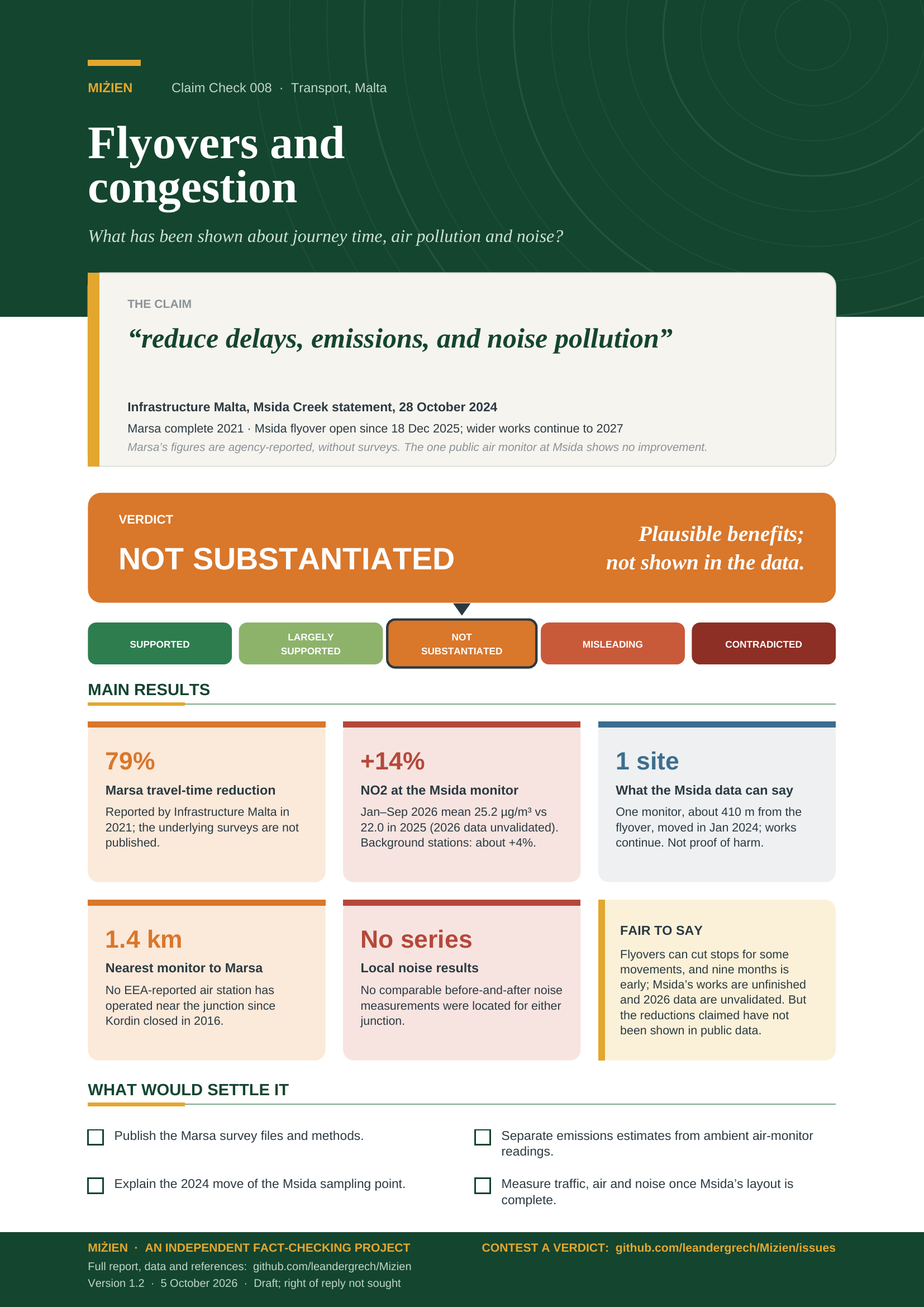
“reduce delays, emissions, and noise pollution”
Infrastructure Malta, Msida Creek statement, 28 October 2024
Marsa Junction completed 2021 · Msida Creek flyover opened 18 Dec 2025; wider works ongoing
Verdict: Not substantiated Marsa figures unpublished; Msida NO2 not down.
Version 1.2 · 5 October 2026
TL;DR
Infrastructure Malta says its Marsa junction cut travel time and air pollution, and that the Msida Creek flyover would cut delays, emissions and noise. The Marsa figures are the agency’s own, without published surveys. The Msida flyover opened on 18 December 2025; in the nine months since, nitrogen dioxide at the Msida roadside monitor rose to 25.2 µg/m³ (January–September), from 22.0 a year earlier. With one monitor, unvalidated data and works still under way, that does not show the flyover made air worse; it shows the promised improvement has not yet appeared where it is measured.
- Marsa has reported figures, not a public dataset. 79% less travel time and up to 70% less particulate matter, 52% less NOx and 50% less CO2, without the surveys or calculations. No EEA-reported air monitor has operated within 1.4 km of the junction since 2016.
- Msida’s statement was a forecast. IM wrote it in October 2024, before works began. The flyover opened to traffic on 18 December 2025; the wider project is due for completion in 2027.
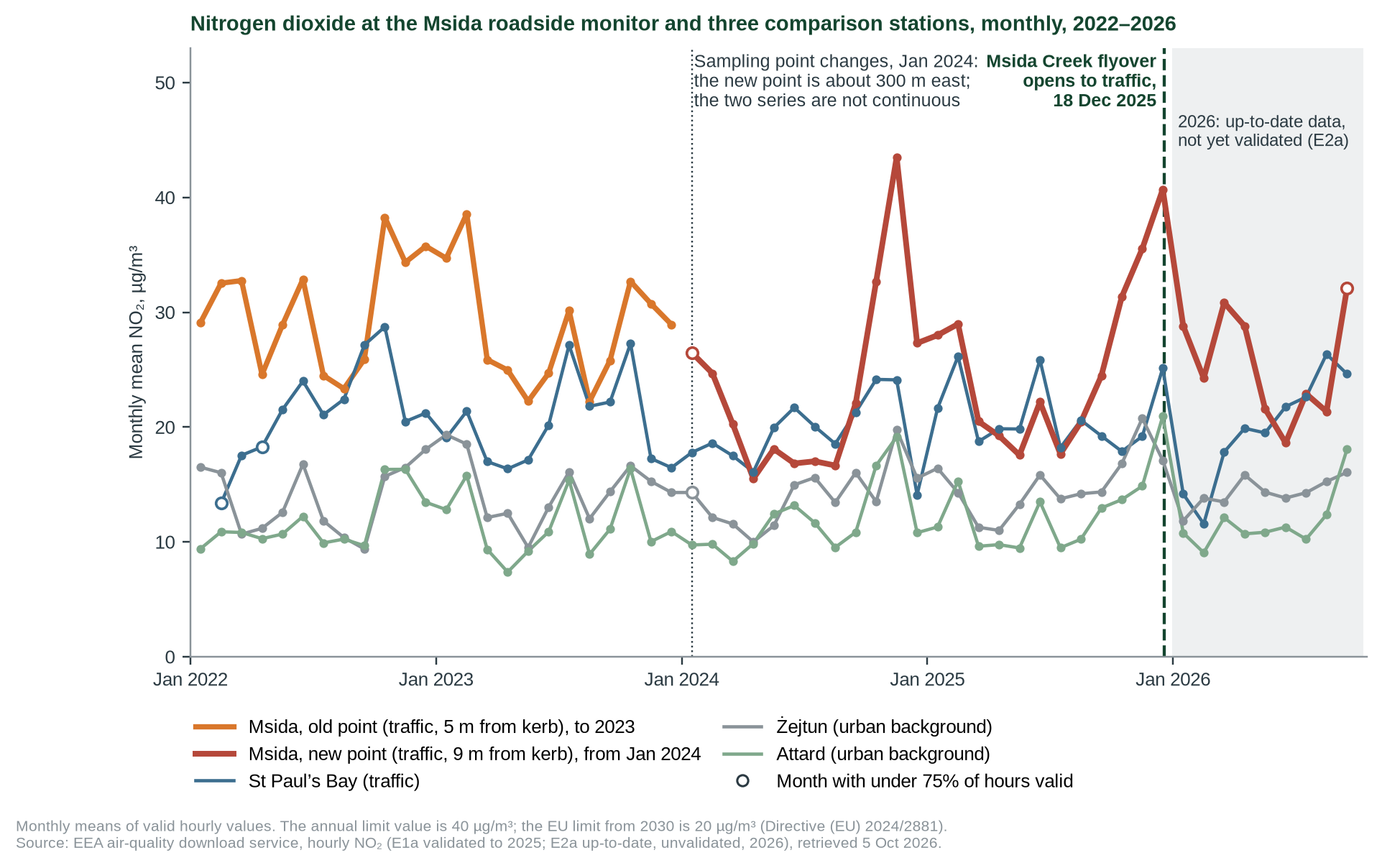
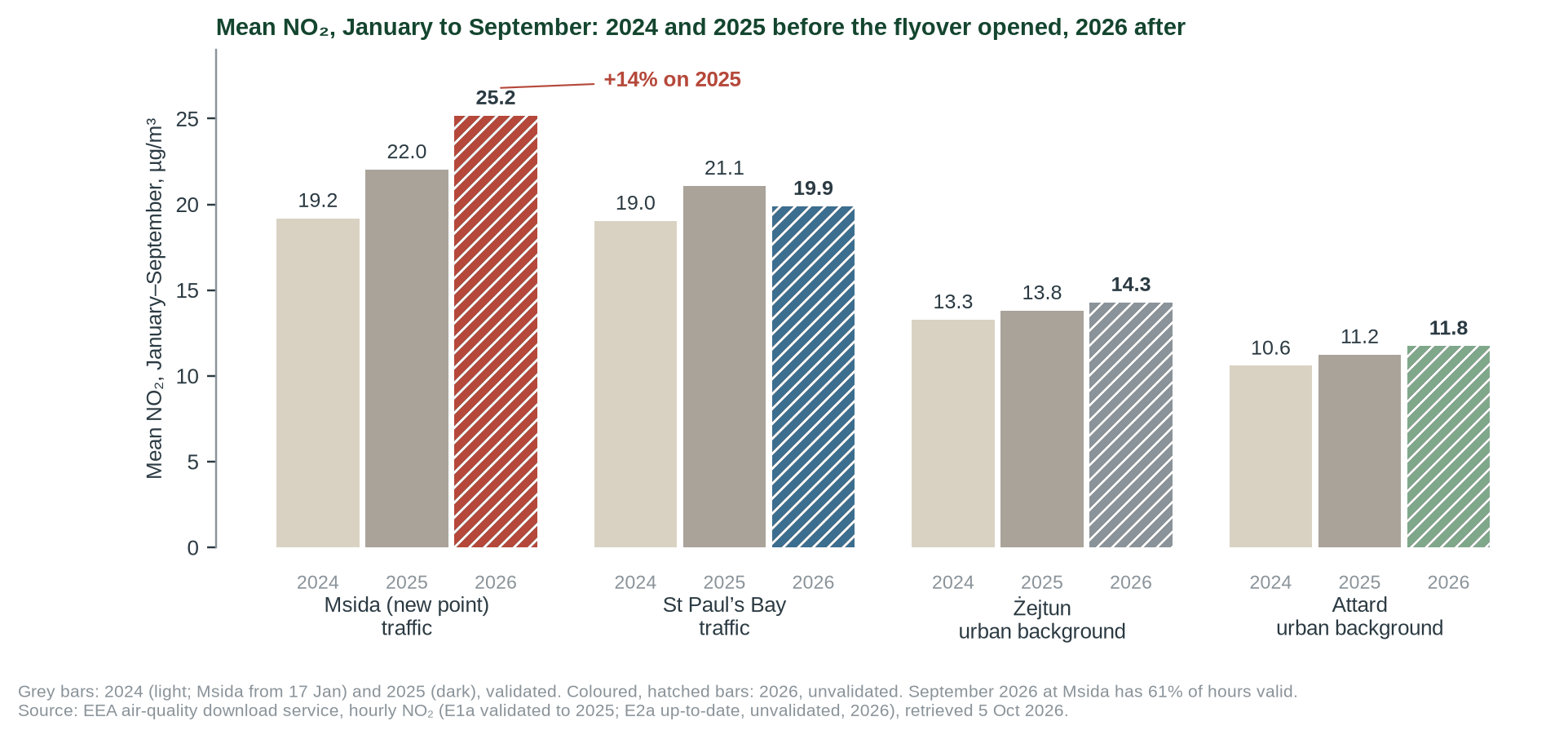
- NO2 at the Msida monitor rose after opening. January–September means: 19.2 (2024), 22.0 (2025), 25.2 µg/m³ (2026, unvalidated), up 14.3% on 2025. Attard and Żejtun rose about 4%; St Paul’s Bay fell 6% (Figures 1 and 2).
- The series has limits. A new sampling point, about 300 m east of the old one and 410 m from the flyover, replaced it in January 2024, so the record is not continuous. No noise data were found for either junction.
- Verdict: not substantiated. The benefits are plausible, but the public evidence does not verify them, and the one measured outcome at Msida does not yet show them.
- Supported
- Largely supported
- Not substantiated
- Misleading
- Contradicted
What would move the verdict up
The underlying Marsa surveys and calculations, and validated Msida traffic, air and noise data, once the full road layout is operating, that show the stated reductions.
What would move it down
Evidence that the agency’s figures are inconsistent with its source measurements, or validated, weather- and traffic-adjusted data from several sites showing that the flyovers raised local pollution or delays.
IN THIS REPORT
1 Wording and project stages
Infrastructure Malta's 28 October 2024 Msida statement says the area has congestion that affects air quality and noise, and describes building a new flyover to replace the traffic-light-controlled junction as “a critical move to reduce delays, emissions, and noise pollution” [1]. The same page says initial work “will focus on strengthening the Msida waterfront quay” and gives 2027 for completion: works had not begun, so the stated reductions were expected effects, not measured results. The vehicle flyover opened to traffic on 18 December 2025, the day after its inauguration, but the wider project continued through 2026 [3].
The two cases have different timelines. Marsa is a completed, multi-level project. Msida's road flyover began operating while other elements, including public spaces and the canal, were still being delivered. A single combined claim therefore needs separate evidence for each location and outcome.
| Source | What it establishes | Evidence limit |
|---|---|---|
| IM Marsa release, 2021 | Agency's stated time and emissions benefits | No linked survey or method |
| Times of Malta, 2021 | IM spokesperson says periodic surveys confirm benefits | Surveys not reproduced; secondary account |
| ERA Msida file | Planning baseline and forecast rationale | 2019 observations; no post-opening test |
| PM, December 2025 | Flyover entered vehicle use; project continued | No outcome measurements |
| EEA air-quality data, 2022–2026 | Hourly NO2 at Msida and comparison stations | One site; new sampling point; 2026 unvalidated |
A planning document and an EIA-screening decision are not after-the-fact environmental measurements. The ERA file records the project process and planning description [4]. Its existence neither proves benefits nor shows that the impacts are absent.
2 What the public records show
Marsa's completion release gives four headline percentages. A Times of Malta report later quoted an Infrastructure Malta spokesperson saying periodic surveys confirmed time and air-quality benefits, even though junction users were reported to be more than 19% above the 2013 level [5]. This is a useful lead to the agency's monitoring, but the surveys and methods were not provided in the article.
| Outcome | Published statement | Needed for independent checking |
|---|---|---|
| Marsa travel time | 79% reduction reported | Routes, survey dates, peak periods, distribution and adjustment for demand |
| Marsa air pollution | PM up to 70%; NOx 52%; CO2 50% reductions reported | Separate emissions estimates from monitor concentrations; publish inputs and locations |
| Msida delay / emissions / noise | Expected reductions stated in 2024 | Comparable data after full road layout is operating |
| Noise, both sites | No local before/after result located | Comparable noise levels, sites, times and traffic conditions |
What do the Marsa percentages measure?
UNDERLYING SERIES NOT PUBLICEVIDENCE FOR THE CLAIM'S IMPRESSION
Infrastructure Malta describes reduced travel time and emissions, and later said its periodic traffic surveys confirmed benefits [2, 5]. The road layout separates several movements and removes the old traffic-light system, a plausible way to reduce delay for some routes.
EVIDENCE AGAINST
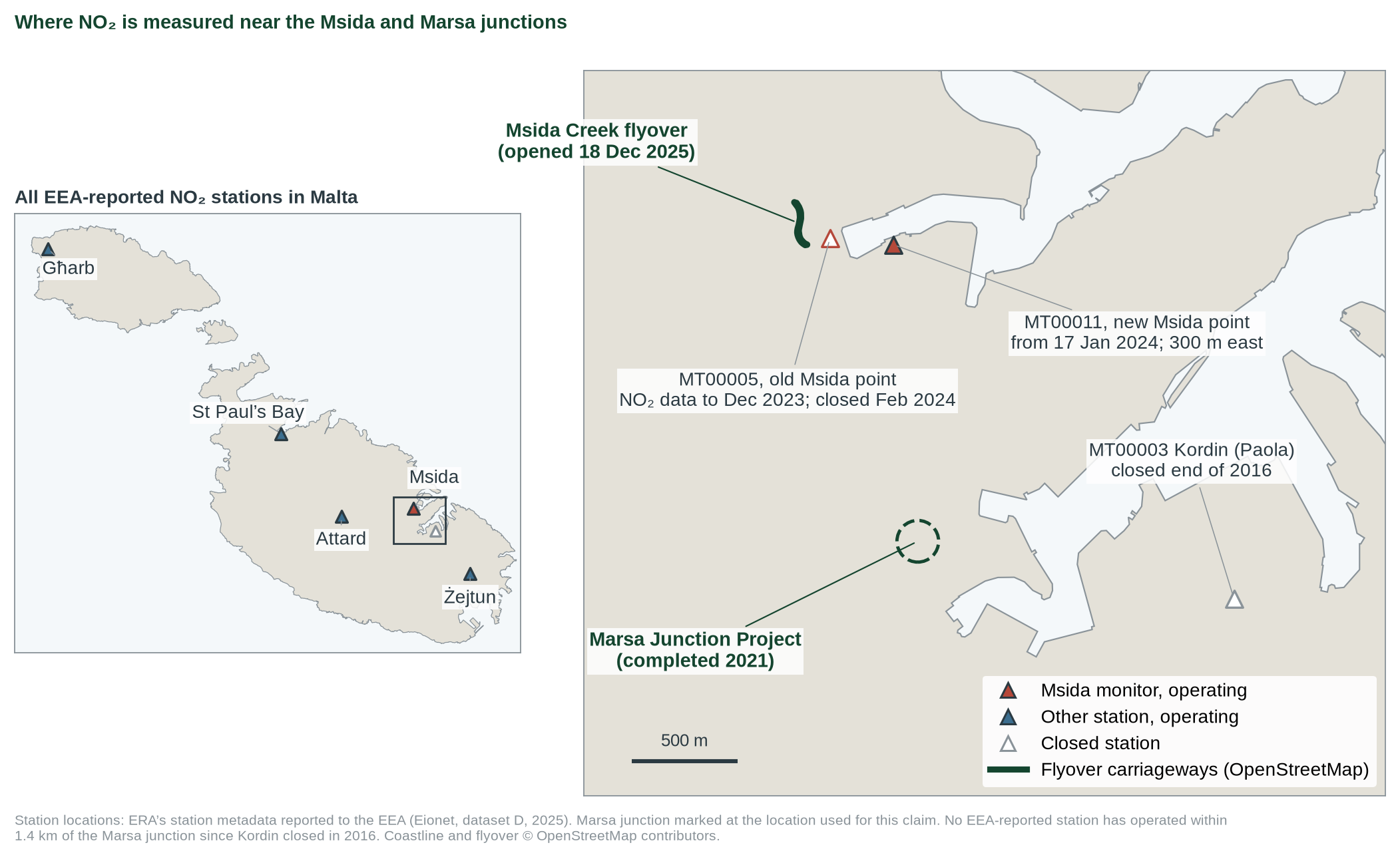
The source release does not identify the survey route, dates, traffic periods, baseline adjustment, pollutant model or uncertainty. “Emissions” does not mean a measured drop in ambient concentrations at every nearby location. Kordin, the EEA-reported station in Paola, closed at the end of 2016, before the works; none has operated within 1.4 km of the junction since (Figure 3). Noise data were not found.
For Msida, the Environmental Resources Authority project file includes the planning statement, which relies on 2019 traffic counts and anticipates reduced travel time and pollution [4]. The 2024 IM wording also forecasts lower noise. Those documents describe the case for a proposed project. They are not evidence of its operating performance.
3 What the Msida air monitor shows
Malta’s air-quality network has a station at Msida classified as a traffic station, sited to measure pollution from road traffic, and its hourly nitrogen dioxide (NO2) readings are reported to the European Environment Agency [7, 9]. It is the one public, independent measurement close to either junction. We downloaded the hourly data for Msida and three comparison stations from January 2022 to September 2026, kept only hours flagged valid, and averaged them by month (Figure 1) and over January to September of each year (Figure 2) [7]. For scale, the annual limit value is 40 µg/m³, falling to 20 µg/m³ from 2030 [8]; the new Msida point averaged 23.3 µg/m³ in 2024 (from 17 January) and 25.5 in 2025.
The monitor moved. The old roadside point (MT00005), 110 m from the flyover as now mapped and 5 m from the kerb, recorded NO2 from 2006; its annual mean fell from 37.5 µg/m³ in 2013 to 28.3 in 2023, and its last valid readings are from December 2023. A new point (MT00011) started on 17 January 2024, about 300 m east and 410 m from the flyover, 9 m from the kerb, according to the station metadata ERA reports to the EEA [9]. The two points never ran side by side with valid data, so the series is not continuous and only the new point can compare before and after the opening.
After the opening. In January–September 2026, the first nine full months after the flyover opened, the new Msida point averaged 25.2 µg/m³, 14.3% more than in the same months of 2025 (22.0) and above 2024 (19.2). At the urban background stations the rise was smaller: Attard 11.2 → 11.8 and Żejtun 13.8 → 14.3. At St Paul’s Bay, the other traffic station, NO2 fell from 21.1 to 19.9 (Figure 2). Msida’s excess over the background average grew from 9.5 µg/m³ in 2025 to 12.2 in 2026; it had already grown from 7.3 in 2024, before the opening.
4 Induced travel and what it means here
Duranton and Turner analysed US cities and found that added interstate lane-kilometres were associated with more vehicle-kilometres travelled [6]. This peer-reviewed evidence supports induced travel as a possible network-level response to added capacity. It is not a direct estimate for a junction in Malta.
The finding cautions against assuming that an initial local delay reduction will guarantee lasting network-wide congestion relief. It does not establish that Marsa had no local travel-time benefit, and it cannot tell us what happened at Msida. A junction-level analysis must distinguish new trips from route changes, time-of-day shifts, demographic growth and other network changes.
5 Verdict and evidence needed
Agency-reported Marsa estimates without public data; at Msida, the one measured outcome has not improved since opening. Confidence: moderate.
Why. Infrastructure Malta reports large Marsa travel-time and emissions reductions, and a later news report says the agency cited periodic surveys. The underlying surveys and calculation methods were not located, and no EEA-reported monitor near Marsa has operated since 2016. For Msida, the statement was made before works began. Since the flyover opened, NO2 at the Msida monitor has risen, not fallen, more than at the comparison stations; no traffic or noise series was found. The combined claim is therefore stronger than the public evidence that can be checked. The Msida data support “not substantiated”, not “contradicted”: one site, a moved sampling point, unvalidated 2026 data and unfinished works cannot show the flyover made things worse. Confidence is moderate because agency claims and one independent series exist, but key data are missing.
What this verdict does not say. It does not say that the infrastructure had no local benefit or that the published figures are false. It says the cited public record does not let readers reproduce or independently confirm the outcomes, and that the one independent measurement does not yet show them.
Evidence that would settle the open questions
- Release Marsa's raw traffic counts and travel-time survey methodology, including routes, dates, time windows, baseline adjustments and uncertainty.
- Show how each emissions percentage was derived; report monitor-based ambient concentrations separately from estimated emissions.
- Publish Msida post-opening traffic, air-quality and noise measurements after the full road arrangement is operating, with defined comparison locations and periods.
- Explain why the Msida sampling point moved in January 2024 and publish any parallel readings from the two points.
- Track junction and wider-network outcomes for several years, accounting for fleet/population growth and route or time shifts.
Right of reply. Not sought in this draft, at the maintainer's direction. Handle before wider circulation.
6 Sources
- [1] Infrastructure Malta, Msida Creek: enhancing connectivity and community spaces, 28 October 2024 (wording checked 5 October 2026). https://www.infrastructuremalta.com/news/msida-creek-enhancing-connectivity-and-community-spaces
- [2] Infrastructure Malta, Infrastructure Malta completes the Marsa Junction Project, 15 April 2021. https://www.infrastructuremalta.com/news/infrastructure-malta-completes-marsa-junction-project
- [3] Office of the Prime Minister, Inawgurata l-flyover tal-Imsida Creek, 17 December 2025 (Maltese). The flyover was to open to vehicles the following day. https://primeminister.gov.mt/latest-news/pr252279/
- [4] ERA, PA/02053/20 and PA/06425/20 project record and documents. https://era.org.mt/era-project/pa02053-20_pa06425-20/
- [5] Times of Malta, Roads agency insists Marsa junction cuts travel time by 70%, despite complaints, 29 November 2021 (secondary). https://timesofmalta.com/article/roads-agency-insists-marsa-junction-cuts-travel-time-by-70-despite.913440
- [6] Duranton & Turner, The Fundamental Law of Road Congestion: Evidence from US Cities, American Economic Review 101(6), 2616–2652 (2011). https://doi.org/10.1257/aer.101.6.2616
- [7] European Environment Agency, air-quality download service: hourly NO2 for Malta, sampling points MT00005, MT00011, MT00004, MT00008 and MT00009; validated (E1a) data to 2025 and up-to-date (E2a) data for 2026. Retrieved 5 October 2026; monthly, annual and January–September means in data/cc-008/. https://eeadmz1-downloads-webapp.azurewebsites.net/
- [8] Directive (EU) 2024/2881 on ambient air quality and cleaner air for Europe (recast): NO2 annual limit of 20 µg/m³ from 2030; the limit in force is 40 µg/m³. https://eur-lex.europa.eu/eli/dir/2024/2881/oj
- [9] Environment and Resources Authority, Air Quality e-Reporting dataset D (measurement configuration) for 2025, Eionet Central Data Repository, 3 February 2026: station and sampling-point locations, classification and kerb distance. https://cdr.eionet.europa.eu/mt/eu/aqd/d/envayh2iw/
- [10] OpenStreetMap contributors, Msida Creek flyover carriageways (ways 1460775989 and 1460775991) and coastline, retrieved 5 October 2026 (ODbL). https://www.openstreetmap.org/way/1460775989
Version 1.2 · 5 October 2026 · Draft; right of reply not sought · Evidence register: data/cc-008/assessment.csv
Appendix B: revision log
| Version | Date | Change |
|---|---|---|
| 1.0 | 2 Oct 2026 | First issue. Right of reply not sought, at the maintainer's direction. |
| 1.1 | 5 Oct 2026 | Corrections: the Msida quotation now matches the wording on Infrastructure Malta's page (checked 5 October 2026); the earlier quotation included words (“this project”, “which will be”) not on the page as checked, and the forecast reading now rests on the statement having been published before works began. Added the Marsa release's wording on “significant air quality improvements in Paola and Marsa”. Heading typo “Mars” corrected to “Marsa”. Verdict and confidence unchanged. |
| 1.2 | 5 Oct 2026 | Upgrade: added EEA hourly NO2 data for Msida and three comparison stations, 2022 to September 2026, with a new section and three figures (monthly series, January–September comparison, map of the monitoring points from ERA's station metadata). New finding: in the nine months after the flyover opened (18 December 2025), NO2 at the Msida monitor was 14.3% higher than a year earlier (unvalidated data), with caveats stated: one site, a new sampling point from January 2024, works continuing until 2027. Added that no EEA-reported monitor has operated near Marsa since 2016. Page footer and cover: “pending right of reply” → “right of reply not sought”, matching the text. Verdict and confidence unchanged. |
Sources and archived copies
- No social impact assessment yet for Msida flyovers, MaltaToday, 28 January 2021. Original · Archived copy
- No EIA needed for Msida flyover project, ERA says, MaltaToday, 4 March 2021. Original · not yet archived
- All Marsa Junction Project flyovers now open, MaltaToday, 14 November 2020. Original · Archived copy
- Over 3,000 vehicles added to Malta's roads in three months, MaltaToday (NSO figures), Q2 2026. Original · not yet archived
- Msida Creek: enhancing connectivity and community spaces, Infrastructure Malta, 28 October 2024. Original · Archived copy
- Infrastructure Malta completes the Marsa Junction Project, Infrastructure Malta, 15 April 2021. Original · Archived copy
- Inawgurata l-flyover tal-Imsida Creek, Office of the Prime Minister, 17 December 2025. Original · not yet archived
- ERA planning record PA/02053/20 and PA/06425/20, Environment and Resources Authority, Accessed 2 October 2026. Original · not yet archived
- The Fundamental Law of Road Congestion: Evidence from US Cities, American Economic Association, 2011. Original · not yet archived
- Roads agency insists Marsa junction cuts travel time by 70%, despite complaints, Times of Malta, 29 November 2021. Original · not yet archived
Right of reply
Not sought, at the maintainer's direction.
Connections
How this claim relates to the others: who made it, the themes it shares with other claims, and the patterns it shows. A connection is a reason to read two checks side by side. It does not make either one right or wrong. How connections are found.
Who made it
Other claims by Infrastructure Malta 3
Linked directly 20
Claims that share a theme with this one. A theme is a cause, a mechanism, a target or a way of presenting figures that the editors have found in several claims; its strength says how close the link is.
Sealed soil and concrete Shared mechanism · Strong
Excavation, concrete and sealed surfaces around trees. The EU review notes sealed or degraded soil keeps increasing in Malta.
Replanting as currency Shared mechanism · Strong
Tree losses are justified by promised replacement or transplanting. Test survival and net canopy, not planting counts.
Transport, air and climate Shared driver · Strong
Fleet growth links traffic claims, air quality and emissions. The climate report names transport and buildings as the lagging sectors.
- CC-003 Per-capita emissions vs 2030 projection (Misleading)
- CC-007 Within EU limits vs WHO guideline (Largely supported)
- CC-016 Shore-to-ship: 90% less harbour pollution (Misleading)
- CC-021 Malta-Gozo tunnel traffic (not yet checked)
- CC-069 82 million bus trips (not yet checked)
- CC-076 36 more vehicles a day (Supported)
- CC-072 EUR 15m to take cars off the road (not yet checked)
- CC-109 EU: transport is 48% of effort-sharing emissions (Largely supported)
- CC-115 Chamber: congestion cost EUR 770m, 3.4% of GDP (Not substantiated)
Waste and construction Shared material flow · Weak (indicative)
Inert mineral waste dominates Malta's recycling statistics, which ties waste claims to development projects. ERA and NSO confirm construction waste was about 2.2 of 2.9 Mt generated in 2023; the link to specific projects is still indicative.
Same pattern
Pattern tags name a recurring way a claim can mislead. They describe the statement, not the speaker.
Promise-without-baseline
A target or pledge with no stated starting point, scope or counting basis.
- CC-010 Tree-planting counts (Largely supported)
- CC-011 Ten minutes' walk to green space (pledge: Not measurable)
- CC-012 Ta' Qali gravel and grass (Contradicted)
- CC-017 Land reclamation outside the Freeport (Not substantiated)
- CC-021 Malta-Gozo tunnel traffic (not yet checked)
- CC-029 First offshore wind farm (Largely supported)
- CC-030 Carbon-neutral airport (Not substantiated)
- CC-031 Gozo, first climate-neutral region (Largely supported)
- CC-039 Net Zero Impact Utility (pledge: Not measurable)
- CC-055 Manoel Island back to the public (Supported)
- CC-079 Waste-to-energy: 4.5% of energy (Misleading)
- CC-092 PN: afforestation in a net-zero Gozo (pledge: Not measurable)
- CC-107 A net-zero Gozo by 2040 (pledge: Not measurable)
- CC-108 Net-zero impact on the groundwater environment (pledge: Not measurable)
- CC-125 EU: Malta Social Climate Plan EUR 60.6 million (not yet checked)
Two steps away 26
Not linked to this claim directly, but linked to a claim that is. These are found by following the links, not chosen by the editors, so they are looser: they show where one theme meets another.
- CC-011 Ten minutes' walk to green space (pledge: Not measurable)through Transport, air and climateCC-0032030 carbon target
- CC-013 Permits keep property prices in check (Largely supported)through Waste and constructionCC-017Planning, housing and land take or Sealed soil and concreteCC-019Planning, housing and land take
- CC-014 Fewer enforcement notices, fewer illegalities (Misleading)through Waste and constructionCC-017Planning, housing and land take or Sealed soil and concreteCC-019Planning, housing and land take
- CC-018 IMF 'confirms' MDA on housing (Largely supported)through Waste and constructionCC-017Planning, housing and land take or Sealed soil and concreteCC-019Planning, housing and land take
- CC-020 EP study: noise law not the cause (Largely supported)through Transport, air and climateCC-007Compliance-not-health pattern
- CC-025 Per-capita emissions down 44% since 2005 (Largely supported)through Transport, air and climateCC-0032030 carbon target
- CC-026 EU's largest rise in emissions (Largely supported)through Transport, air and climateCC-003Transport, air and climate
- CC-031 Gozo, first climate-neutral region (Largely supported)through Transport, air and climateCC-109Shared emissions figures
- CC-033 Delimara: 'much cleaner air' (not yet checked)through Transport, air and climateCC-007Compliance-not-health pattern
- CC-035 PM2.5 death rate down two-thirds (Largely supported)through Transport, air and climateCC-007Transport, air and climate
- CC-054 Project Green: 100,000 m2 a year (not yet checked)through Replanting as currencyCC-010Replanting as currency
- CC-057 1,649 compensation trees (not yet checked)through Replanting as currencyCC-010Replanting as currency or Replanting as currencyCC-056Replanting as currency
- CC-058 96% of farmland in use (not yet checked)through Sealed soil and concreteCC-019Planning, housing and land take
- CC-059 Subsidies are 20% of farm output (not yet checked)through Sealed soil and concreteCC-019Farmland and farming pressure
- CC-063 Construction waste: 'standstill' warning (Not substantiated)through Waste and constructionCC-017Waste and construction
- CC-071 EUR 100m a year for free buses (Not substantiated)through Transport, air and climateCC-069Transport, air and climate or Transport, air and climateCC-072Transport, air and climate or Transport, air and climateCC-115Transport, air and climate
- CC-079 Waste-to-energy: 4.5% of energy (Misleading)through Waste and constructionCC-004Waste and construction
- CC-081 Landfill share rising (not yet checked)through Waste and constructionCC-004Waste and construction
- CC-094 Commission: Malta to emit more in 2030 than in 2005 (Supported)through Transport, air and climateCC-0032030 carbon target or Transport, air and climateCC-1092030 carbon target
- CC-110 EU: 37.7% of new cars zero-emission (Supported)through Transport, air and climateCC-007Selective-metric pattern or Transport, air and climateCC-072Transport, air and climate or Transport, air and climateCC-109Transport, air and climate
- CC-111 EU: 621 kg of waste a head, 74% landfilled (Supported)through Waste and constructionCC-004Waste and construction
- CC-114 PN: only EU state with rising emissions intensity (Misleading)through Transport, air and climateCC-003Selective-metric pattern
- CC-117 EU: Malta missed recycling targets (reasoned opinion) (not yet checked)through Waste and constructionCC-004Waste and construction
- CC-123 KPMG: 8,716 residential units approved in 2024, up 7.4% (not yet checked)through Sealed soil and concreteCC-019Planning, housing and land take
- CC-127 EU: Malta has the lowest organic share in the EU (not yet checked)through Sealed soil and concreteCC-019Farmland and farming pressure
- CC-130 NGOs: ODZ racecourse policy ends protection (not yet checked)through Sealed soil and concreteCC-019Farmland and farming pressure
Three steps away 15
One step further again. At this distance a connection says more about how the themes fit together than about this claim.
- CC-022 'Lowest electricity burden in the EU' (Largely supported)through Transport, air and climateCC-0032030 carbon targetCC-025Selective-metric pattern
- CC-024 Renewables target for 2030 (Not substantiated)through Transport, air and climateCC-0032030 carbon targetCC-0112030 carbon target
- CC-060 7,000 first-time buyers helped (not yet checked)through Waste and constructionCC-017Planning, housing and land takeCC-013Planning, housing and land take
- CC-062 Construction is 9-14% of the economy (Largely supported)through Waste and constructionCC-017Planning, housing and land takeCC-018Planning, housing and land take
- CC-075 Seventh in the EU for cars (Misleading)through Transport, air and climateCC-007Selective-metric patternCC-110Transport, air and climate
- CC-080 EUR 75m organic plant (not yet checked)through Waste and constructionCC-004Waste and constructionCC-079Waste and construction
- CC-082 35 quarries for construction waste (not yet checked)through Waste and constructionCC-017Waste and constructionCC-063Waste and construction
- CC-092 PN: afforestation in a net-zero Gozo (pledge: Not measurable)through Transport, air and climateCC-109Shared emissions figuresCC-031Net-zero Gozo
- CC-101 EU: no registration or prior authorisation of water abstraction in Malta (Largely supported)through Waste and constructionCC-004Waste and constructionCC-117EU findings of unmet obligations
- CC-104 PN: Malta fails EU noise law (not yet checked)through Transport, air and climateCC-007Compliance-not-health patternCC-020Noise governance
- CC-105 ADPD: no study of Freeport and airport noise (Largely supported)through Transport, air and climateCC-007Compliance-not-health patternCC-020Noise governance
- CC-107 A net-zero Gozo by 2040 (pledge: Not measurable)through Transport, air and climateCC-109Shared emissions figuresCC-031Net-zero Gozo
- CC-120 EP study: 54,000 exposed to road noise, likely an underestimate (Largely supported)through Transport, air and climateCC-007Compliance-not-health patternCC-020Noise governance
- CC-128 EU: Malta missed the water-plan timetable (not yet checked)through Waste and constructionCC-004Waste and constructionCC-117EU findings of unmet obligations
- CC-129 EU: Malta has not updated its air pollution programme (not yet checked)through Waste and constructionCC-004Waste and constructionCC-117EU findings of unmet obligations
Timeline
What was said, what was published before and after it, and each step of this check, in date order. Statements and sources carry the date they were published. The steps of the check carry the date the research was done, from the check's research log. Other statements by the same body on the same topic show whether a position was repeated, changed or corrected.
2011
- 2011 Evidence published The Fundamental Law of Road Congestion: Evidence from US Cities, American Economic Association
2020
- 14 November 2020 Reported All Marsa Junction Project flyovers now open, MaltaToday
2021
- 28 January 2021 Reported No social impact assessment yet for Msida flyovers, MaltaToday
- 4 March 2021 Reported No EIA needed for Msida flyover project, ERA says, MaltaToday
- 15 April 2021 Statement published Infrastructure Malta completes the Marsa Junction Project, Infrastructure Malta
- 29 November 2021 Reported Periodic Marsa traffic surveys said to confirm benefits, Times of Malta
2024
- 2024 Evidence published Directive (EU) 2024/2881 on ambient air quality and cleaner air for Europe (recast), European Parliament and Council
- 21 October 2024 Evidence published The Msida Creek Project to commence in early November, Infrastructure Malta
- 28 October 2024 The statement Infrastructure Malta (this claim)
- 28 October 2024 Statement published Msida Creek: enhancing connectivity and community spaces, Infrastructure Malta
2025
- 17 December 2025 Evidence published Inawgurata l-flyover tal-Imsida Creek, Office of the Prime Minister
2026
- 3 February 2026 Evidence published AQD_REP_MT_ERA_D-001_2025: Air Quality e-Reporting dataset D (measurement configuration), Environment and Resources Authority (via Eionet CDR)
- 2 October 2026 Version 1.0: first issue First issue. Right of reply not sought, at the maintainer's direction.
- 5 October 2026 Version 1.2 Upgrade: added EEA hourly NO2 data for Msida and three comparison stations, 2022 to September 2026, with a new section and three figures (monthly series, January–September comparison, map of the monitoring points from ERA's station metadata). New finding: in the nine months after the flyover opened (18 December 2025), NO2 at the Msida monitor was 14.3% higher than a year earlier (unvalidated data), with caveats stated: one site, a new sampling point from January 2024, works continuing until 2027. Added that no EEA-reported monitor has operated near Marsa since 2016. Page footer and cover: “pending right of reply” → “right of reply not sought”, matching the text. Verdict and confidence unchanged. Verdict in this version: Not substantiated, moderate confidence.
- 5 October 2026 Evidence reviewed
- 5 October 2026 Version 1.1: corrections Corrections: the Msida quotation now matches the wording on Infrastructure Malta's page (checked 5 October 2026); the earlier quotation included words (“this project”, “which will be”) not on the page as checked, and the forecast reading now rests on the statement having been published before works began. Added the Marsa release's wording on “significant air quality improvements in Paola and Marsa”. Heading typo “Mars” corrected to “Marsa”. Verdict and confidence unchanged. all corrections
2027
- 5 October 2027 Coming up: Evidence review due Each finished check is reviewed against new evidence within a year.
Every change to this claim's record is public: history of the record.
Download the report and flyer