CC-105 · Noise
ADPD: no study of Freeport and airport noise
Largely supported Moderate confidence Draft: no right of reply needed
Parts of this claim
The claim is split into parts that are tested separately, as in the report below. Each part has its own number.
- CC-105A Malta has yet to acknowledge the effect of Freeport noise on nearby residents' health (ADPD [1])The Freeport is not mentioned in any ERA noise document and not among the mapped industrial sites, but a Freeport-commissioned study (2014–15 ◆) and a university study (2022) exist.
- CC-105B Malta has yet to acknowledge the effect of airport noise on nearby residents' health (ADPD [1])Aircraft noise exposure is modelled, mapped and published in three rounds, with WHO levels stated; no health assessment of residents.
- CC-105C A study of the impact of noise from the Freeport and airport on nearby residents is needed (ADPD [1])No health-outcome study found; local work is exposure, annoyance and self-reported symptoms.
Claim Check 105 · Noise
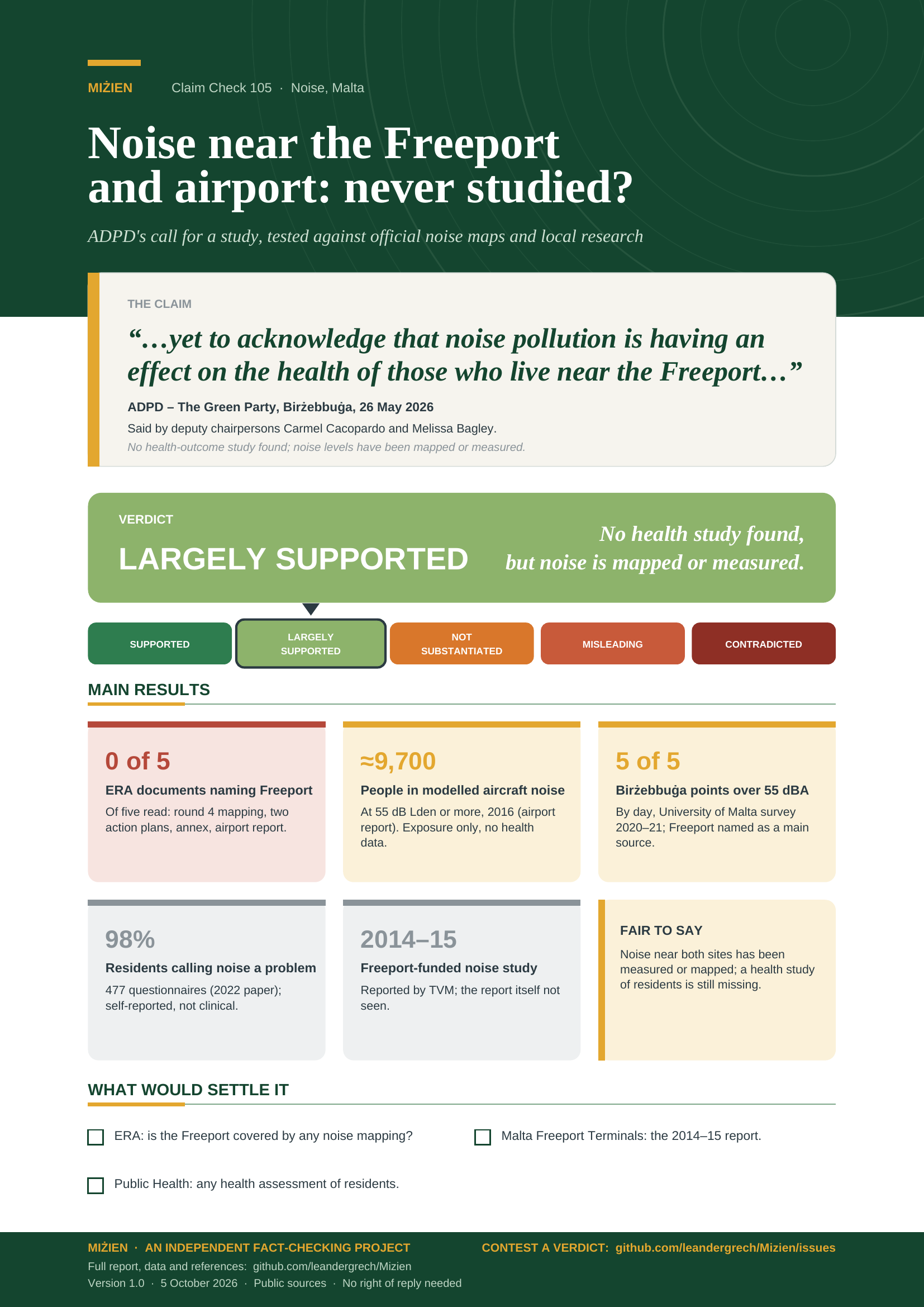
Noise near the Freeport and airport: never studied?
Testing ADPD’s call for a study of noise and health in Birżebbuġa and around the airport
“This country has yet to acknowledge that noise pollution is having an effect on the health of those who live near the Freeport or the airport.”
ADPD – The Green Party, press statement, Birżebbuġa, 26 May 2026.
Deputy chairpersons Carmel Cacopardo and Melissa Bagley.
Verdict: Largely supported No health study found; but noise has been mapped and measured
Version 1.0 · 5 October 2026
TL;DR
At a press conference in Birżebbuġa on 26 May 2026 ADPD – The Green Party said: “This country has yet to acknowledge that noise pollution is having an effect on the health of those who live near the Freeport or the airport” and that “there is a need to study the impact of noise from the Freeport operations and the airport on the surrounding residential community”. We looked for the studies and official documents that would confirm or contradict this.
- Freeport noise is absent from the national noise framework. The word “Freeport” does not appear in any of five Environment and Resources Authority (ERA) noise documents we read in full (round 4 mapping report, two Noise Action Plans, the consultation responses, the airport report). The industrial sites mapped are seven to eight licensed facilities, none of them the Freeport.
- Airport noise is mapped, but only as exposure. ERA has published modelled aircraft noise maps since 2011. In 2016 about 9,700 people lived in dwellings with modelled aircraft noise of 55 dB Lden or more, and about 830 at 50 dB Lnight or more. No health outcome was studied.
- Some local noise research exists, which the statement does not mention. A Freeport-commissioned year-long study (2014–2015, reported by TVM; report not seen ◆) and a University of Malta paper (2022, 477 residents, 329 measurements) found noise above the EU reporting thresholds in Birżebbuġa and residents reporting annoyance, sleep problems and stress.
- Verdict: largely supported (moderate confidence). We found no study of health outcomes (illness, medication, sleep measured objectively) among residents near the Freeport or the airport, and the official framework does not cover the Freeport. But the airport’s noise has been acknowledged and mapped, and Freeport-area noise has been measured, so “yet to acknowledge” is too strong.
- Supported
- Largely supported
- Not substantiated
- Misleading
- Contradicted
What would move the verdict up
Evidence that Maltese authorities have published a health assessment (not only noise levels) for residents near the Freeport or the airport; or that the Freeport noise has been formally assessed and acted on in the national action plan.
What would move it down
A published health-outcome study of these residents, or a Freeport noise assessment inside the national framework; the statement would then be wrong on its main point.
IN THIS REPORT
1 The claim and what we could verify
ADPD published the statement on its website on 26 May 2026, in Maltese with an English version [1]; Newsbook reported it the same day [2]. It was issued by the party’s deputy chairpersons Carmel Cacopardo and Melissa Bagley during the general election campaign. The party names the Freeport Terminal, Malta International Airport and the entertainment industry as noise sources. It also says: “It is essential that we do not rely on international studies alone.” This check covers the Freeport and the airport; entertainment noise is a separate topic. The check is of the statement, not of anyone’s motives.
| Source | What it says | Our access | Status |
|---|---|---|---|
| ADPD press statement, 26 May 2026 [1] | “This country has yet to acknowledge that noise pollution is having an effect on the health of those who live near the Freeport or the airport, including its points of access.” | Read in full, 5 Oct 2026 (English version). | The claim |
| ERA Round 4 mapping report [3], Noise Action Plans [4,5], MIA round 3 report [6] | Strategic noise maps of roads, industry and aircraft; action plan for the agglomeration and major roads. | Read in full (Internet Archive copies; era.org.mt returns 403 to scripts). | Regulator |
| Falzon et al. (2022) [7] | Five-point noise survey in Birżebbuġa, 329 measurements, 477 questionnaires. | Full text read (open access). | Journal |
| TVM news, 29 Dec 2015 [8] | A year-long study commissioned by Malta Freeport Terminals found noise above WHO levels. | Article read; the study itself not seen ◆. | News (second-hand) |
2 Method
Question. Is it true that Malta has yet to acknowledge noise effects on people near the Freeport and the airport, and that such effects have not been studied?
Evidence. We read the ERA noise documents named above in full text and searched them for “Freeport”, “Birżebbuġa” and “Kalafrana” (data/cc-105/doc_search.csv). We tabulated the airport exposure figures and the Birżebbuġa monitoring ranges (tools/cc-105-report/calc.py), then searched OpenAlex, Crossref and the web for other local studies. The European Parliament study PE 783.089 (Hjerp & Coffey 2026) [9] gives the legal context. The Birżebbuġa measurements are LAeq averages, not Lden or Lnight, so comparison with the Noise Directive thresholds is only indicative.
Grades. ERA documents: C (official, modelled). Falzon et al.: B (observational, survey plus measurements, no control). TVM report: D, second-hand. Verdicts follow the five-point scale in Appendix A.
3 What the evidence shows
The Freeport. None of the five ERA documents mentions it. ERA’s round 3 mapping covered eight licensed industrial sites in or next to the Malta agglomeration (for example the Marsa power station and the Sant’Antnin waste plant); round 4 covered seven. The Freeport is not among them [3]. The European Parliament study notes that the Noise Directive covers only major roads, railways, airports and large agglomerations [9], so a port can fall outside the mandatory scope. That explains the gap but does not fill it.
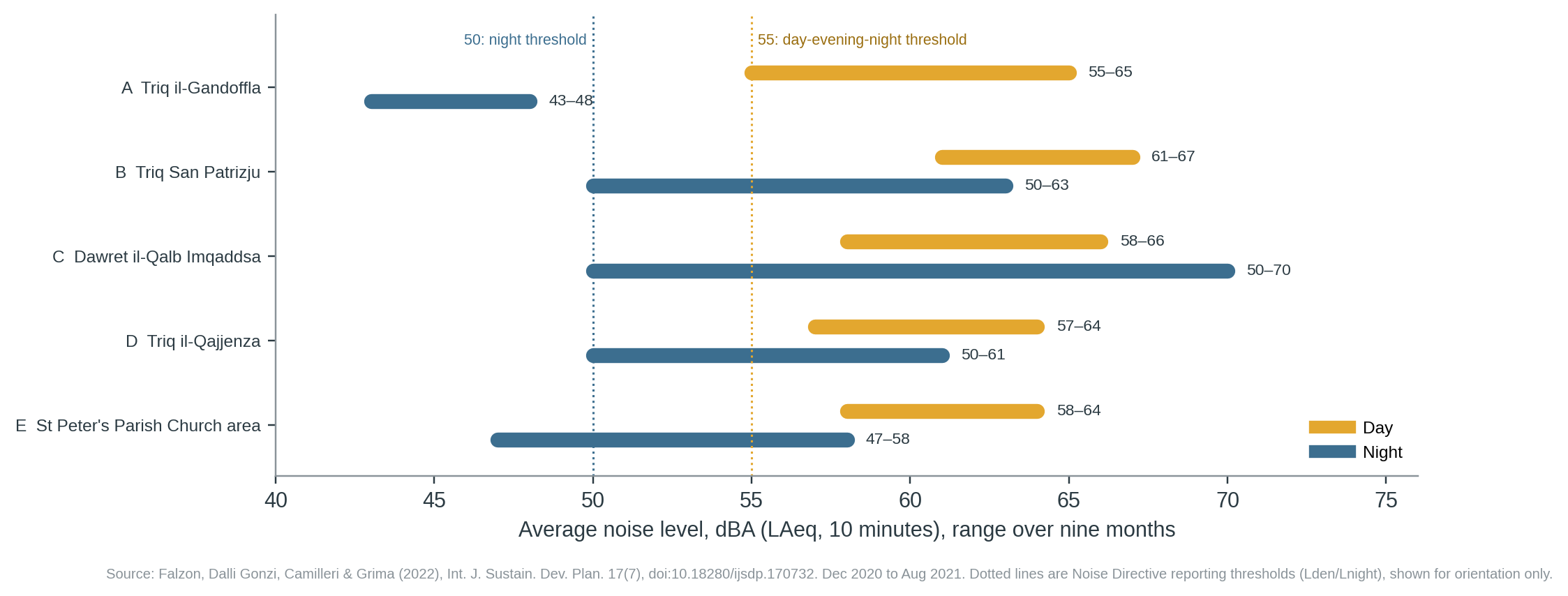
Local Freeport-area noise research does exist. A study commissioned by Malta Freeport Terminals at the request of the Birżebbuġa monitoring board (2014–2015, by Adi Associates Environmental Consultants) was reported by TVM as finding day and night noise above WHO levels ◆ [8]. A University of Malta team measured five residential points between December 2020 and August 2021 [7] (Figure 1). Daytime averages were 55 dBA or higher at all five points, and night averages reached above 50 dBA at four of five. The Freeport’s container handling, alarms and engine hum were named among the predominant sources at four points [7]. In the questionnaire, 98% of 477 respondents said noise was a problem, and 61.6% said annoyance was the main effect on health and well-being, followed by sleep disorders, fatigue and stress [7]. These are self-reported effects, not clinical findings.
The airport. The airport is not a “major airport” under the directive (fewer than 50,000 movements a year; 49,214 in 2021), but ERA has modelled its noise in each mapping round because flight paths cross the agglomeration [3,6]. In round 3 (base year 2016), 9,666 people lived in dwellings with modelled aircraft noise of 55 dB Lden or more (8,054 inside the agglomeration, 1,612 outside), almost all in the 55–59 band, and 827 at 50 dB Lnight or more [6]. The Noise Action Plan states WHO’s 2018 levels for aircraft noise (45 dB Lden, 40 dB Lnight) [4]. The published results are not broken down by locality, so we cannot say how many of these people live in Birżebbuġa.
Health outcomes. We found no Maltese study linking measured exposure to illness, medication use, sleep recordings or other outcomes in residents near either site. Falzon et al. themselves write that “minimal research” exists on exposure–effect studies of community noise in Malta [7]. Our search was of public sources only (see Limitations).
4 Where the evidence points different ways
Has Malta “yet to acknowledge” the effect?
PARTLYFOR THE CLAIM
No ERA noise document mentions the Freeport, the airport’s results are exposure counts without a health assessment, and the 2022 paper itself says exposure–effect research is minimal.
AGAINST
Aircraft noise has been mapped since 2011 and the Noise Action Plan sets out the health effects and WHO levels. A Freeport-funded study and a university study of Birżebbuġa exist, and the mayor said in 2015 the council had “enough information to start addressing the problem”.
5 Testing the claim
| Sub-claim | Said by | What the evidence shows | Rating |
|---|---|---|---|
| A. Malta has yet to acknowledge the effect of Freeport noise on nearby residents' health | ADPD [1] | The Freeport is not mentioned in any ERA noise document and not among the mapped industrial sites, but a Freeport-commissioned study (2014–15 ◆) and a university study (2022) exist. | LARGELY SUPPORTED |
| B. Malta has yet to acknowledge the effect of airport noise on nearby residents' health | ADPD [1] | Aircraft noise exposure is modelled, mapped and published in three rounds, with WHO levels stated; no health assessment of residents. | OVERSTATED |
| C. A study of the impact of noise from the Freeport and airport on nearby residents is needed | ADPD [1] | No health-outcome study found; local work is exposure, annoyance and self-reported symptoms. | LARGELY SUPPORTED |
6 Verdict and requests for evidence
No health study or Freeport coverage in the national framework; but noise near both sites has been mapped or measured. Confidence: moderate.
Why. The substance, that nobody has studied the health of residents near the Freeport and the airport, is consistent with what we found, and the Freeport is missing from the national noise maps and action plans. The words “yet to acknowledge” overstate the case because airport noise is mapped and published, and Freeport-area noise has been measured twice. Confidence is moderate because absence of a study is hard to prove from public sources. What this verdict does not say. It does not say that residents are or are not harmed; it tests only whether the studies and official acknowledgement exist.
Evidence we are asking for
- From ERA: whether the Freeport and Kalafrana port activity are covered by any noise mapping, permit or monitoring requirement.
- From Malta Freeport Terminals: the 2014–2015 Adi Associates report and any later monitoring.
- From the Superintendence of Public Health: any health assessment of noise near the airport or the Freeport.
7 Limitations
- The 2014–2015 Freeport study is known only through a TVM news report and a citation in Falzon et al. (◆).
- We could not search ERA’s site, the MEPS portal or the Superintendence of Public Health for unpublished studies; absence of a health study means none found in public sources.
- Birżebbuġa measurements are LAeq averages, not Lden or Lnight; comparison with thresholds is indicative. The paper’s monitoring figures were read as printed ranges, not digitised.
- Airport exposure is a model of aircraft noise only, from 2016 data; the round 4 (2021) results were not tabulated.
- ERA documents were read from Internet Archive copies because the live site refuses scripts.
References
- [1] ADPD – The Green Party (26 May 2026). It-tniġġis qiegħed iħassrilna saħħitna / Pollution is negatively affecting our health. Read 5 Oct 2026. https://adpd.mt/it-tniggis-qieghed-ihassrilna-sahhitna-adpd/
- [2] Newsbook (26 May 2026). Air and noise pollution are harming our health – ADPD. (Locator.) https://newsbook.com.mt/en/air-and-noise-pollution-are-harming-our-health-adpd/
- [3] Lemitor for ERA (Nov 2024). Round 4 Final Project Report, Strategic Noise Mapping in Malta (SPD8/2022/011). https://era.org.mt/wp-content/uploads/2024/12/R4_Noise_Maps_Malta_Final_Report_compressed.pdf
- [4] ERA (2023). Noise Action Plan, Malta Agglomeration, 2019–2024. https://era.org.mt/wp-content/uploads/2023/12/Noise-Action-Plan-Agglomeration-Interactive.pdf
- [5] ERA (2023). Noise Action Plan for Major Roads in Malta, 2019–2024. https://era.org.mt/wp-content/uploads/2023/12/Noise-Action-Plan-Major-Roads.pdf
- [6] Acustica for ERA (March 2019). Malta International Airport Noise Modelling, Final Report 593-14-2/3 (round 3). https://era.org.mt/wp-content/uploads/2019/10/593-14-2v3-1_Malta-International-Airport-R3-Final-Report.pdf
- [7] Falzon J., Dalli Gonzi R.E., Camilleri M. & Grima S. (2022). Effects of noise pollution on residents living in Birzebbuga and the introduction of effective mitigation measures. Int. J. Sustainable Development and Planning 17(7): 2309–2318. doi:10.18280/ijsdp.170732. https://doi.org/10.18280/ijsdp.170732
- [8] Galea O. (29 Dec 2015). Level of noise disturbance at Birżebbuġa is higher than that established by WHO. TVM news. ◆ https://tvmnews.mt/en/news/level-of-noise-disturbance-at-birzebbuga-is-higher-than-that-established-by-who/
- [9] Hjerp P. & Coffey (2026). Analysing Malta’s implementation of Directive 2002/49/EC. European Parliament PE 783.089. doi:10.2861/6278624. https://doi.org/10.2861/6278624
- [10] MiŻien. Data and calculation: data/cc-105/; tools/cc-105-report/calc.py.
Appendix A: series standards and verdict scale
Every investigation in this series follows the same rules so that verdicts are comparable and challengeable.
| Verdict | Meaning |
|---|---|
| SUPPORTED | Evidence consistently backs the claim as stated. |
| LARGELY SUPPORTED | Backed by the evidence, with minor caveats that do not change the substance. |
| NOT SUBSTANTIATED | Stated more strongly than the evidence offered or available allows. May be true in some conditions but has not been shown. |
| MISLEADING | Omits material facts so that the overall impression is inaccurate, even if individual statements are defensible. |
| CONTRADICTED | The available evidence points against the claim. |
Confidence
High: multiple independent lines of evidence agree. Moderate: evidence is relevant but incomplete or indirect. Low: evidence is thin, second-hand or conflicting.
Evidence grades
A experiment · B observational study with a control or gradient · C review, guidance or official statistics · D assertion or anecdote. ◆ marks a source known only second-hand.
Standards
- Quote the speaker, not the headline, with outlet and date, and link the original where possible.
- Separate the claim from the evidence offered for it, and say who made which statement.
- Grade the evidence and show differing views side by side where the evidence is unsettled.
- State what we could not access or verify, and what would change the verdict either way.
- Ask for the missing evidence in specific, answerable requests.
- Offer a right of reply where a check finds a claim Not substantiated, Misleading or Contradicted (or a pledge Not measurable, Off track or Missed), before wider circulation, and append responses.
- Correct errors openly with a version number and change log.
- Whistle-blow only on evidence: a verdict of Misleading or Contradicted requires documents or data that can be shown, not inference.
- Check every side. Government, opposition, NGOs and developers are held to the same standard.
Appendix B: revision log
| Version | Date | Change |
|---|---|---|
| 1.0 | 5 Oct 2026 | First issue. Verdict Largely supported (moderate confidence); no right of reply needed. |
Sources and archived copies
-
It-tniġġis qiegħed iħassrilna saħħitna / Pollution is negatively affecting our health, ADPD - The Green Party, 2026-05-26.
Original · Archived copy
The claim: party press statement, Maltese and English. Read in full 5 Oct 2026 (WordPress API, post 17576). Also says 'There is a need to study the impact of noise from the Freeport operations and the airport on the surrounding residential community.' -
Round 4 Final Project Report, Strategic Noise Mapping in Malta (Lemitor), Environment and Resources Authority, 2024-11.
Original · Archived copy
Read in full from an Internet Archive copy. Industrial sites mapped (7); the Freeport is not among them; no mention of the Freeport. -
Malta International Airport Noise Modelling, Final Report (round 3), ERA / Acustica, 2019-03.
Original · not yet archived
Table 9.2: 9,666 people at 55 dB Lden or more and 827 at 50 dB Lnight or more (2016). Internet Archive copy. -
Effects of Noise Pollution on Residents Living in Birzebbuga and the Introduction of Effective Mitigation Measures, Int. J. Sustainable Development and Planning 17(7), Falzon et al., 2022.
Original · fetched and fingerprinted 2026-10-05; no public snapshot yet
Open access; read in full; Crossref verified. Five monitoring points, 477 questionnaires. -
Level of noise disturbance at Birżebbuġa is higher than that established by WHO, TVM news, 2015-12-29.
Original · fetched and fingerprinted 2026-10-10; no public snapshot yet
Second-hand report of a year-long study commissioned by Malta Freeport Terminals (report not seen). -
Analysing Malta's implementation of Directive 2002/49/EC (PE 783.089), European Parliament, 2026-02.
Original · fetched and fingerprinted 2026-10-10; no public snapshot yet
Legal context; see CC-020.
Right of reply
Not needed: this check finds the claim supported. A right of reply is sought when a check finds a claim Not substantiated, Misleading or Contradicted.
Connections
How this claim relates to the others: who made it, the themes it shares with other claims, and the patterns it shows. A connection is a reason to read two checks side by side. It does not make either one right or wrong. How connections are found.
Who made it
Other claims by ADPD – The Green Party 2
Linked directly 3
Claims that share a theme with this one. A theme is a cause, a mechanism, a target or a way of presenting figures that the editors have found in several claims; its strength says how close the link is.
Noise governance Shared target · Weak (indicative)
Claims about whether Malta maps, plans for and acts on noise under Directive 2002/49/EC and the WHO guidelines: the 2026 EP study, the PN petition and ADPD's call for a Freeport and airport study.
Two steps away 1
Not linked to this claim directly, but linked to a claim that is. These are found by following the links, not chosen by the editors, so they are looser: they show where one theme meets another.
- CC-007 Within EU limits vs WHO guideline (Largely supported)through Noise governanceCC-020Compliance-not-health pattern
Three steps away 9
One step further again. At this distance a connection says more about how the themes fit together than about this claim.
- CC-003 Per-capita emissions vs 2030 projection (Misleading)through Noise governanceCC-020Compliance-not-health patternCC-007Transport, air and climate
- CC-004 'Strong progress' in waste separation (Not substantiated)through Noise governanceCC-020Compliance-not-health patternCC-007Selective-metric pattern
- CC-008 Flyovers and congestion (Not substantiated)through Noise governanceCC-020Compliance-not-health patternCC-007Transport, air and climate
- CC-010 Tree-planting counts (Largely supported)through Noise governanceCC-020Compliance-not-health patternCC-007Selective-metric pattern
- CC-016 Shore-to-ship: 90% less harbour pollution (Misleading)through Noise governanceCC-020Compliance-not-health patternCC-007Transport, air and climate
- CC-021 Malta-Gozo tunnel traffic (not yet checked)through Noise governanceCC-020Compliance-not-health patternCC-007Transport, air and climate
- CC-033 Delimara: 'much cleaner air' (not yet checked)through Noise governanceCC-020Compliance-not-health patternCC-007Compliance-not-health pattern
- CC-035 PM2.5 death rate down two-thirds (Largely supported)through Noise governanceCC-020Compliance-not-health patternCC-007Transport, air and climate
- CC-110 EU: 37.7% of new cars zero-emission (Supported)through Noise governanceCC-020Compliance-not-health patternCC-007Selective-metric pattern
Timeline
What was said, what was published before and after it, and each step of this check, in date order. Statements and sources carry the date they were published. The steps of the check carry the date the research was done, from the check's research log. Other statements by the same body on the same topic show whether a position was repeated, changed or corrected.
2015
- 29 December 2015 Reported Level of noise disturbance at Birżebbuġa is higher than that established by WHO, TVM news
2019
- March 2019 Evidence published Malta International Airport Noise Modelling, Final Report (round 3), ERA / Acustica
2022
- 2022 Evidence published Effects of Noise Pollution on Residents Living in Birzebbuga (Falzon et al., doi:10.18280/ijsdp.170732), Int. J. Sustainable Development and Planning
2023
- 2023 Evidence published Noise Action Plan, Malta Agglomeration 2019-2024, ERA
2024
- November 2024 Evidence published Round 4 Final Project Report, Strategic Noise Mapping in Malta, ERA / Lemitor
2026
- 26 May 2026 The statement ADPD - The Green Party (this claim)
- 26 May 2026 Reported Air and noise pollution are harming our health: ADPD, Newsbook
- 26 May 2026 Evidence published It-tniġġis qiegħed iħassrilna saħħitna / Pollution is negatively affecting our health, ADPD - The Green Party
- 4 October 2026 Added to the claims to check
- 5 October 2026 Exact wording found Verbatim wording found in the party's own press statement on adpd.mt (26 May 2026), Maltese and English; Newsbook is a paraphrase.
- 5 October 2026 Note Five ERA noise documents read in full and searched for the Freeport (no hits); airport exposure tabulated from the round 3 report; Falzon et al. 2022 verified in Crossref and read; TVM 2015 article read (study itself not seen).
- 5 October 2026 Version 1.0: first issue First issue. Verdict Largely supported (moderate confidence); no right of reply needed. Verdict in this version: Largely supported, moderate confidence.
- 5 October 2026 Evidence reviewed
2027
- 5 October 2027 Coming up: Evidence review due Each finished check is reviewed against new evidence within a year.
Every change to this claim's record is public: history of the record.
Download the report and flyer