CC-095 · Climate & Energy · Electricity & grid
EUR 400m to keep bills low
Not substantiated Moderate confidence Pledge: Not yet due as of 10 October 2026 Draft: right of reply on hold
The pledge in this claim
Not yet due as of 10 October 2026
Not yet due: the pledge is measurable, its deadline or term has not passed, and no progress data have been published yet.
Measurable with the Oil Bulletin and Eurostat price data; the year has not begun. Revisit when 2027 price data are published. The EUR 400m forecast is not part of the pledge.
A pledge gets a label, not a verdict. The verdict above (Not substantiated) is for the factual part of the claim.
- Target
- Energy support kept in 2027, so that retail prices of fuel, electricity and gas stay unchanged ("what there is in the energy sector, come what may, will remain")
- Made in
- Launch of the Pre-Budget Document 2027 (BusinessNow, Lovin Malta, TVM News, Newsbook, 30 Sep 2026) (30 September 2026)
- Deadline
- 31 December 2027
All pledges and how they are labelled · See it on the pledges timeline
Parts of this claim
The claim is split into parts that are tested separately, as in the report below. Each part has its own number.
- CC-095A “in our country, the prices of fuel, electricity and gas have not changed”Pump prices fixed since 15 Jun 2020 (325 weekly reports); electricity index unchanged since Apr 2014, LPG since Apr 2020; energy 0.0% in the year to Aug 2026 against EU +13.0% [8, 9, 10].
- CC-095B Energy subsidies of about EUR 400 million this year (EUR 391.7 million presented)A projection for a year not yet over; no energy-subsidy spending figure yet. Official forecasts rose during 2026 and the Commission expects a higher cost, but no independent source gives the amount; it includes food; the Pre-Budget Document was not read [14, 15, 17].
- CC-095C Past figures: EUR 242.5m (2023), 188.1m (2025), 1,350m over five years2023 close to Eurostat’s crisis rise (258.5) and the IMF (292.8); 2025 between the Government’s plan (177.6) and the IMF (197.3); the five-year total fits Eurostat’s 2022 and 2024 [11, 19, 20].
- CC-095D “I expect those numbers to remain at the same level next year”A forecast the minister made conditional on prices; past forecasts of this spending missed widely [1, 13].
- CC-095E “Malta is the only country that has continued to protect families and businesses ...”Only EU country with no rise in energy prices (Hungary +1.6%); cheapest fuel of 26. But Hungary, Bulgaria and Slovakia spent as much or more on fuel and energy subsidies relative to GDP in 2024 [8, 9, 11].
- CC-095F “what there is in the energy sector, come what may, will remain” (in 2027)A commitment for 2027; prices are measurable; the year has not begun [1, 4].
Claim Check 095 · Energy subsidies and prices
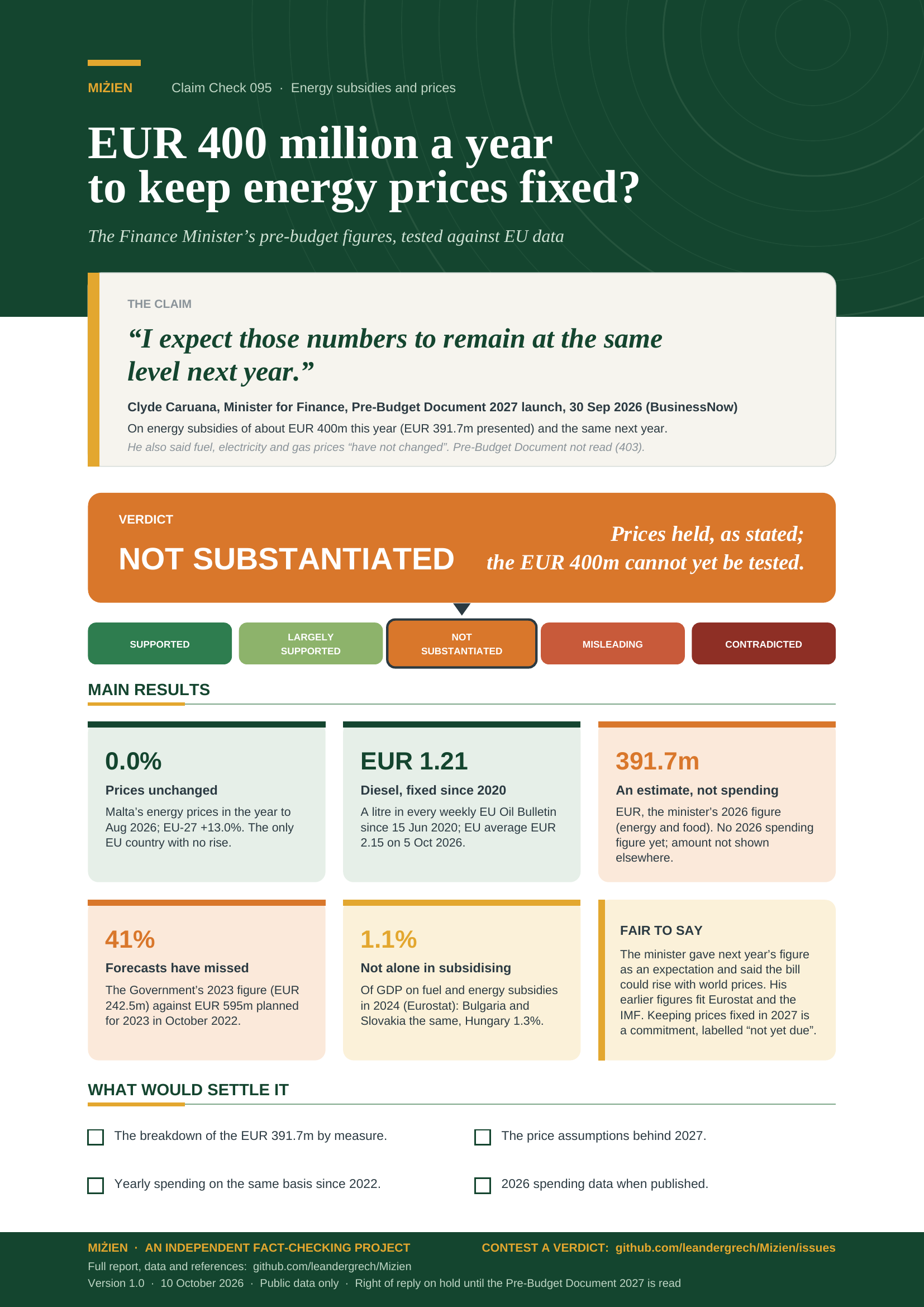
EUR 400 million a year to keep energy prices fixed?
Testing the Finance Minister’s pre-budget figures against Eurostat, the Oil Bulletin and the Government’s own forecasts
“I expect those numbers to remain at the same level next year.” “… in our country, the prices of fuel, electricity and gas have not changed.”
Clyde Caruana, Minister for Finance, launching the Pre-Budget Document 2027, 30 Sep 2026.
Quoted by BusinessNow and Lovin Malta; the cost this year was given as about EUR 400 million (391.7m).
Verdict: Not substantiated Prices held; the EUR 400m is an estimate not yet testable
Version 1.0 · 10 October 2026
TL;DR
Launching the Pre-Budget Document 2027 on 30 September 2026, Finance Minister Clyde Caruana said that energy subsidies would cost about EUR 400 million this year (EUR 391.7 million in the figures he presented) and that “I expect those numbers to remain at the same level next year”; that “in our country, the prices of fuel, electricity and gas have not changed”; and that “what there is in the energy sector, come what may, will remain” [1, 2]. We tested the prices, the cost and the comparison with other countries.
- The prices have not changed. Petrol EUR 1.34 and diesel EUR 1.21 a litre in every weekly EU Oil Bulletin since 15 June 2020; electricity unchanged since 2014. In the year to August 2026 energy prices rose 13.0% in the EU and 0.0% in Malta [8, 9].
- The EUR 400 million is an estimate, not spending. No 2026 spending figure for energy subsidies has been published. Official forecasts rose, but no independent source gives the amount, and the Pre-Budget Document that holds it could not be read [14, 15, 17].
- Past figures fit; past forecasts missed. The minister’s EUR 242.5 million for 2023 fits Eurostat and the IMF [11, 20], but EUR 595 million had been planned for that year in October 2022 [13].
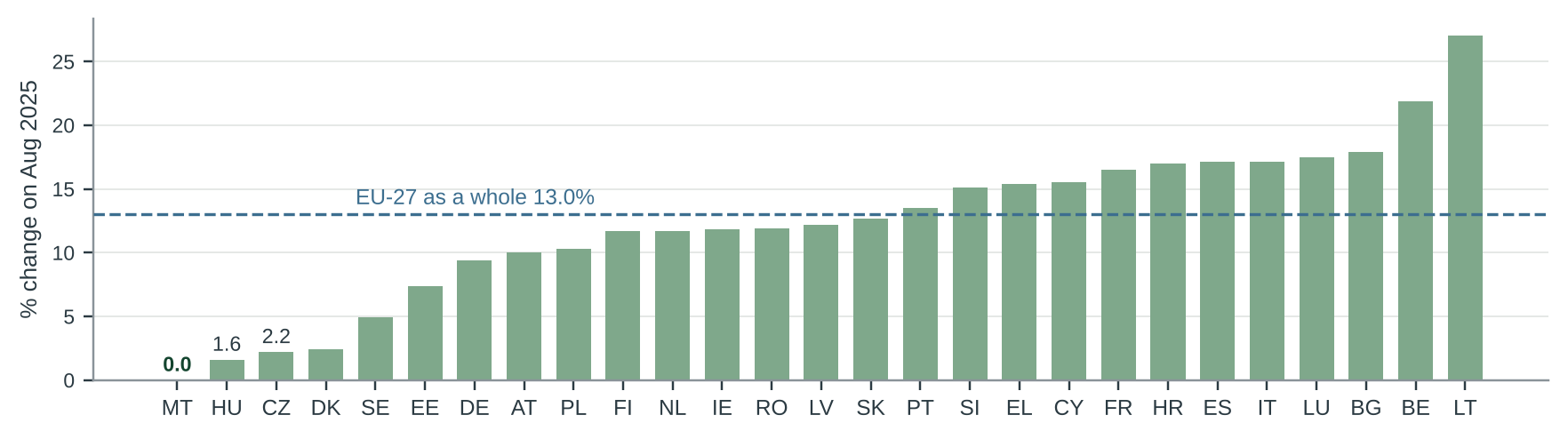
- “The only country” holds for prices, not for support. No other EU country kept energy prices flat, but several subsidise as much relative to GDP [8, 11].
- Verdict: not substantiated (moderate); pledge: not yet due. The price statement is accurate; the central figure, about EUR 400 million in 2026 and 2027, cannot yet be tested. Keeping prices fixed in 2027 is a commitment.
- Supported
- Largely supported
- Not substantiated
- Misleading
- Contradicted
What would move the verdict up
The Pre-Budget Document’s breakdown of the EUR 391.7 million by measure, with its price assumptions; or 2026 spending data (the Financial Estimates 2027 or the National Statistics Office) close to that figure.
What would move it down
2026 spending data well away from EUR 391.7 million, or a breakdown showing that most of it is not energy price support. Evidence that retail energy prices changed in 2026 would also count against.
IN THIS REPORT
1 The claim and what we could verify
Our record came from a news headline, “Malta Spends EUR 400 Million to Keep Energy Bills Low Through 2027” (The Malta Post, 2 October 2026, not 2025 as first recorded) [6]. That article quotes no one. The words are the Finance Minister’s, at the launch of the Pre-Budget Document 2027 in Rabat on 30 September 2026, reported the same day by five outlets [1–5]. He spoke partly in Maltese; the English quotations are the outlets’ renderings. We rate only words inside quotation marks; figures in the reporters’ own text are labelled so.
| What was said | Where (30 Sep 2026) | Form |
|---|---|---|
| “The numbers already clearly show that they are higher than when Russia invaded the Ukraine, and I expect those numbers to remain at the same level next year. If things worsen ... that bill will continue to rise” | BusinessNow [1] | Quotation |
| Energy and fuel subsidies “for this year are expected to cost Government EUR 400 million”; next year “the cost to remain the same”; EUR 500 million next year with energy infrastructure | BusinessNow [1]; TVM [3] | Reporters’ text |
| Figures “presented by the minister”: energy and food subsidies EUR 242.5m (2023), 188.1m (2025), 391.7m (2026), about 400m (2027); EUR 75m for energy infrastructure; EUR 1.35bn over five years | Lovin Malta [2]; also TVM, Italpress/MNA [3, 5] | Reporters’ text |
| “In just a few months, energy prices have risen very significantly. However, in our country, the prices of fuel, electricity and gas have not changed” | Lovin Malta [2] | Quotation |
| “Malta is the only country that has continued to protect families and businesses from these substantial burdens”; “No other European country is doing what we are doing.” | Lovin Malta [2]; TVM [3] | Quotation |
| “what there is in the energy sector, come what may, will remain”; “What we are doing right now, we will sustain” (Maltese: “Dak li qed nagħmlu bħalissa se nsostnuh”) | BusinessNow [1]; Newsbook [4] | Quotation |
| The Pre-Budget Document 2027, Bis-Saħħa Tiegħek (150 pages), which carries the figures | Ministry for Finance [7] | Not read (403) |
What we rate. “Through 2027” is the headline’s phrase; the minister spoke of this year and next. We therefore test: the price statement; the cost this year (EUR 391.7 million, presented as an expected figure); the past figures in the same series; and “the only country”. The 2027 cost is the minister’s forecast, which he made conditional on prices, and keeping the support in 2027 is a commitment: we label it as a pledge.
2 Method
Questions. Have Malta’s fuel, electricity and gas prices stayed unchanged while prices elsewhere rose? Is about EUR 400 million a credible cost for 2026, and do the minister’s earlier figures agree with independent data? Is Malta the only EU country to shield its consumers?
Evidence. On 10 October 2026 we downloaded Eurostat’s harmonised consumer prices (HICP, monthly to August 2026, September flash for energy) for every EU country [8], the Commission’s Weekly Oil Bulletin from 2019 to 5 October 2026 [9], Eurostat’s half-yearly electricity prices for households and businesses [10], its government spending by function (COFOG 04.3, “fuel and energy”, 2015–2024) [11] and GDP [12]. We read the Malta Fiscal Advisory Council’s assessments of the Government’s forecasts [13–16, 22] and the Commission’s spring 2026 forecast [17, 18], and reused, without copying, the draft budgetary plans, IMF and Commission subsidy figures gathered for CC-113 [19–21]. tools/cc-095-report/calc.py recomputes every number from data/cc-095/ into checks.csv. Crossref was searched for peer-reviewed work; none on Malta’s policy was found (search log in literature/CC-095/notes.md).
Grades. Official statistics, fiscal-council assessments and forecasts are grade C; one peer-reviewed panel study with a comparison group is grade B. Verdicts and pledge labels follow Appendix A.
3 How the prices are held
Malta’s retail prices for electricity, fuel and LPG are set by the Government, not by the market. When the cost of supply rises above the fixed price, the state pays the difference: the Commission’s subsidy database describes Malta’s largest measure as energy prices “frozen to their pre-COVID levels as the Governement [sic] is compensating Enemalta for the losses” [21]. The cost therefore depends on international oil, gas and electricity prices, which is why the minister tied next year’s bill to the Strait of Hormuz, diesel exports and the winter [1]. In 2022 the Government’s own model put the price rises avoided at 130.2% for electricity, 47.9% for diesel, 33.6% for petrol and 55.3% for gas [22].
| Study | Design | Finding relevant here | Grade |
|---|---|---|---|
| Rapa (2025), Central Bank of Malta paper on SSRN [23] | Structural model of Malta’s economy; not peer-reviewed; abstract read | Fixed prices supported activity, cut inflation and protected low-income households in 2022–23, and raised the debt ratio by about 4 points of GDP by 2024; abrupt removal would be contractionary, gradual tapering less so. | C |
| Tutar & Erden (2026), Int. J. Sociology and Social Policy [24] | EU-27 panel, 2015–2024, difference-in-differences; abstract read | Effects imprecise on average; targeted cash transfers gave more lasting gains against energy poverty, and better value, than universal price subsidies. | B |
| Arze del Granado, Coady & Gillingham (2012), World Development [25] | Review of fuel-subsidy studies in developing countries; abstract read | Untargeted fuel subsidies leak to richer households: the top fifth receives six times what the bottom fifth receives. | C |
| European Commission, spring 2026 forecast [18] | Review of 2026 measures across the EU | New 2026 measures cost EUR 14.5 billion; three-quarters untargeted; price measures blunt the incentive to cut demand. | C |
Table 1. What the literature says about price subsidies. None tests the size of Malta’s subsidy; they explain why its cost moves with world prices and why its design is debated.
4 What the data show
Prices
| Measure | Malta | EU | Source |
|---|---|---|---|
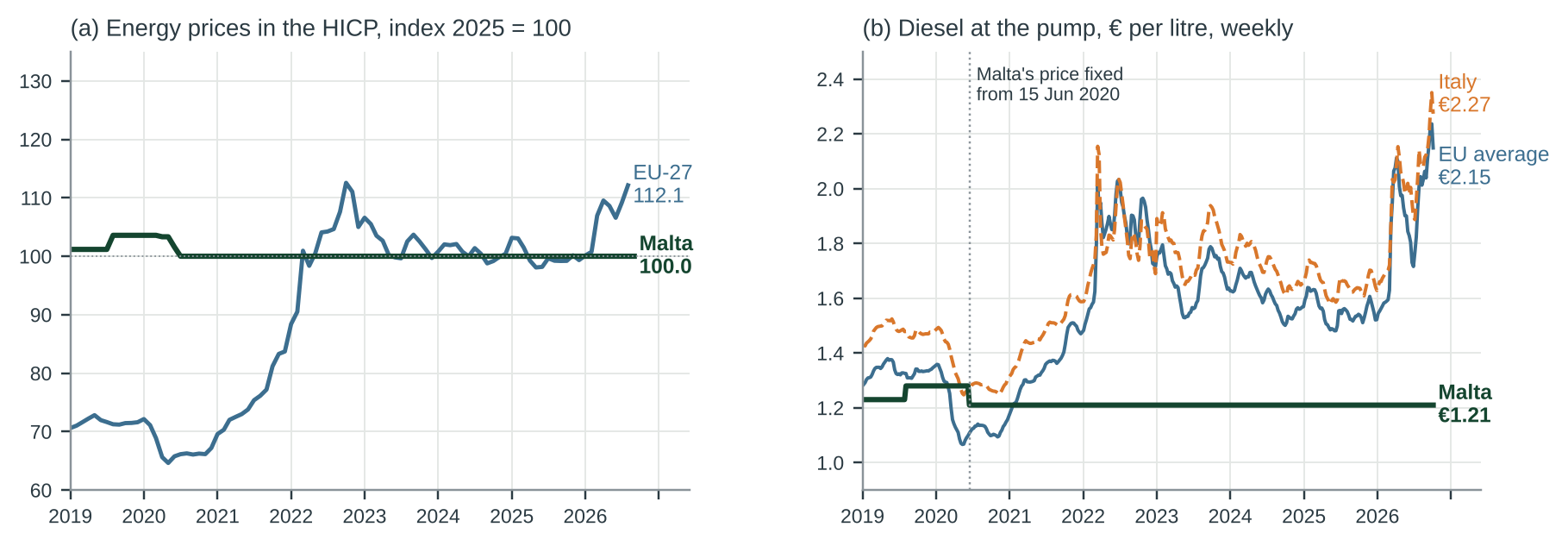
| Electricity index (HICP): unchanged since | Apr 2014 | +2.3% in year to Aug 2026 | [8] |
| Gas (LPG in Malta), diesel, petrol (HICP): unchanged since | Apr 2020; Jul 2020; Jul 2020 | gas +7.2%, diesel +31.2%, petrol +20.5% since Dec 2025 | [8] |
| All energy (HICP), Jan 2020 to Aug 2026 | −3.5% | +55.4% | [8] |
| Petrol and diesel at the pump, 5 Oct 2026 (EUR per litre) | 1.34 and 1.21 (cheapest of 26) | 2.01 and 2.15 (weighted average) | [9] |
| Diesel before taxes, 5 Oct 2026 (EUR per litre) | 0.553 | 1.324 (Italy 1.241) | [9] |
| Household electricity, 2,500–4,999 kWh, all taxes (EUR per kWh) | 0.126–0.132, 2019 to 2026-S1 | 0.290 (2025-S2) | [10] |
| Business electricity, 500–1,999 MWh, excluding VAT (EUR per kWh) | 0.134–0.141, 2019 to 2026-S1 | 0.184 (2025-S2); peak 0.215 (2023-S1) | [10] |
Table 2. Malta’s energy prices against the EU. 2026-S1 electricity prices are provisional. Malta’s price before taxes is 41.8% of the EU average: the gap is what the state covers. The minister compared Malta with one Sicilian pump (EUR 2.34 for diesel, quoted by Newsbook [4]); the Oil Bulletin’s Italian average was EUR 2.35 on 28 September.
What it costs
| Year | Minister (energy and food) [2] | Eurostat COFOG 04.3 subsidies [11] | Other official estimates |
|---|---|---|---|
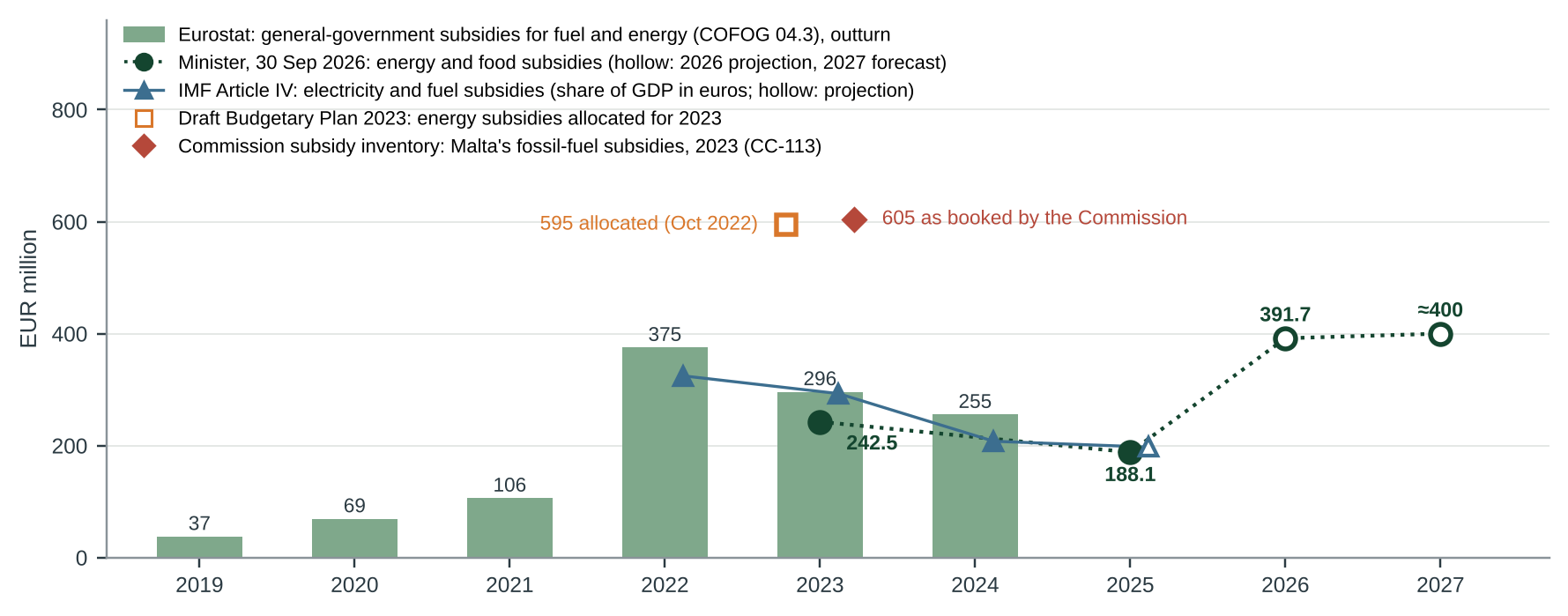
| 2023 | 242.5 (1.16% of GDP) | 295.9; 258.5 above 2019 | IMF 292.8 [20]; Government (Oct 2023, expected, other commodities included) 355.5 [19]; planned Oct 2022: 595 [13]; Commission database 604.7 [21] |
| 2025 | 188.1 (0.76% of GDP) | not yet published | Government plan (Oct 2024) 177.6 [19]; IMF projection 197.3 [20] |
| 2026 | 391.7 (projection) | not yet published | All subsidies: 493.3 forecast in Oct 2025, 560.0 in Apr 2026, with energy about 0.3% of GDP (78.3) higher [14, 15]; first quarter 119.0 [16] |
| 2027 | about 400 (forecast) | – | Commission: subsidies to fall as a share of GDP [17] |
| 2022–26 | 1,350 in five years | 2022 + 2024: 630.3 (555.5 above the 2019 level) | The minister’s total implies 527.7 for 2022 and 2024 together |
Table 3. EUR million. Shares of GDP converted with Eurostat GDP [12]. The minister’s series includes food subsidies (Lovin Malta’s report [2]; BusinessNow says “energy and fuel” [1]); COFOG 04.3 has no food. ◆ A news report of the 2025 Budget gives 2023 as EUR 580 million allocated and “just over EUR 227 million” spent [28].
5 Where the evidence points different ways
Q1 Is about EUR 400 million the right size for 2026?
PLAUSIBLE, NOT YET SHOWNEVIDENCE FOR THE FIGURE
The Government’s forecasts rose through the year: in October 2025 it expected subsidies to fall in 2026 on lower oil prices; in April 2026 it added energy subsidies worth about 0.3% of GDP [14, 15]. The Commission expects spending to rise in 2026 “as a result of the higher cost of energy subsidies” [17]. In the EU, diesel before taxes cost 2.4 times Malta’s regulated pre-tax price on 5 October [9]. The minister’s past figures agree with Eurostat and the IMF.
EVIDENCE THAT IT IS NOT YET SHOWN
No 2026 spending figure for energy subsidies exists yet (only all subsidies, first quarter: EUR 119.0 million [16]), and no independent source gives an amount. The September figure is EUR 125 million above the April energy uplift (indicative: the bases differ) [15]. Forecasts of this spending have missed widely: EUR 595 million was planned for 2023 in October 2022 and EUR 262 million in spring 2023 [13]; the Government now gives EUR 242.5 million [2]. The figure also includes food subsidies.
Q2 Is Malta “the only country” still shielding consumers?
TRUE FOR PRICES, NOT FOR SUPPORTEVIDENCE FOR THE CLAIM
In the year to August 2026 Malta is the only EU country whose energy prices did not rise at all (Figure 2); its diesel and petrol are the cheapest of 26 countries reporting to the Oil Bulletin [8, 9]. The Commission notes the measures “keep retail energy prices unchanged” [17].
EVIDENCE AGAINST
Other governments subsidise too: in 2024 Hungary spent 1.3% of GDP on fuel and energy subsidies and Bulgaria and Slovakia 1.1%, the same as Malta (EU-27 0.4%) [11]. EU countries adopted EUR 14.5 billion of new measures in spring 2026 [18]; Hungary’s energy prices rose only 1.6%.
Q3 Will about EUR 400 million hold in 2027?
A FORECAST; NOT RATEDWHAT POINTS TO ABOUT EUR 400 MILLION
The minister expects costs “to remain at the same level next year” and EUR 75 million of energy investment on top [1, 2]. The policy has been kept since 2020 and both main parties promised stable prices [26, 27].
WHAT COULD CHANGE IT
The minister himself said that if things worsen “that bill will continue to rise” [1]. The Commission expects subsidies to fall as a share of GDP in 2027 [17]. The cost depends on world prices that no one can forecast with confidence, and past forecasts have missed by more than half [13].
6 Testing the claim
| Sub-claim | What the evidence shows | Rating |
|---|---|---|
| A. “in our country, the prices of fuel, electricity and gas have not changed” | Pump prices fixed since 15 Jun 2020 (325 weekly reports); electricity index unchanged since Apr 2014, LPG since Apr 2020; energy 0.0% in the year to Aug 2026 against EU +13.0% [8, 9, 10]. | ACCURATE |
| B. Energy subsidies of about EUR 400 million this year (EUR 391.7 million presented) | A projection for a year not yet over; no energy-subsidy spending figure yet. Official forecasts rose during 2026 and the Commission expects a higher cost, but no independent source gives the amount; it includes food; the Pre-Budget Document was not read [14, 15, 17]. | PLAUSIBLE, NOT SHOWN |
| C. Past figures: EUR 242.5m (2023), 188.1m (2025), 1,350m over five years | 2023 close to Eurostat’s crisis rise (258.5) and the IMF (292.8); 2025 between the Government’s plan (177.6) and the IMF (197.3); the five-year total fits Eurostat’s 2022 and 2024 [11, 19, 20]. | CONSISTENT |
| D. “I expect those numbers to remain at the same level next year” | A forecast the minister made conditional on prices; past forecasts of this spending missed widely [1, 13]. | NOT RATED (FORECAST) |
| E. “Malta is the only country that has continued to protect families and businesses ...” | Only EU country with no rise in energy prices (Hungary +1.6%); cheapest fuel of 26. But Hungary, Bulgaria and Slovakia spent as much or more on fuel and energy subsidies relative to GDP in 2024 [8, 9, 11]. | LARGELY ACCURATE |
| F. “what there is in the energy sector, come what may, will remain” (in 2027) | A commitment for 2027; prices are measurable; the year has not begun [1, 4]. | NOT YET DUE (PLEDGE) |
7 Verdict, pledge and requests for evidence
Prices held, as stated; the central figure, about EUR 400 million a year, is an estimate and a forecast that cannot yet be tested. Confidence: moderate.
Why. (1) The statement that fuel, electricity and gas prices have not changed is accurate on every measure we used. (2) The claim’s central figure is the cost: about EUR 400 million in 2026 and the same in 2027. For 2026 it is the Ministry’s projection for a year still in progress; for 2027 a forecast the minister made conditional on world prices. Independent sources support the direction (a higher cost in 2026) but not the amount, and earlier projections of the same spending were revised by large margins. Under our scale, a central figure that cannot yet be tested is Not substantiated; this says the figure has not been shown, not that it is wrong. (3) “The only country” holds for fixed prices, not for support in general. (4) Confidence is moderate: the Pre-Budget Document, which may explain the figure, could not be read.
What this does not say. It does not say the EUR 391.7 million is wrong or that the policy is right or wrong. A fully supported version would read: “Fuel, electricity and gas prices have not changed. We estimate that energy and food subsidies will cost about EUR 390 million this year; next year depends on world prices.”
Evidence we are asking for
- Ministry for Finance: the Pre-Budget Document 2027’s breakdown of EUR 391.7 million (2026) and about EUR 400 million (2027) by measure (Enemalta compensation, fuel, LPG, cereals and feed) and the price assumptions behind them.
- Ministry for Finance: the yearly outturn of the same series from 2022, so that the EUR 1,350 million can be checked year by year.
- National Statistics Office / Eurostat: 2026 government finance data for fuel and energy subsidies when published.
- DG ENER: whether Malta’s 2023 entries in the subsidy database (EUR 580m and 15m) are the October 2022 allocations, which they equal, rather than spending (see CC-113).
8 Limitations
- The Pre-Budget Document 2027 [7], the Government’s press release and the Financial Estimates could not be read (finance.gov.mt and gov.mt refused our requests; the Wayback Machine was unreachable). The figures are as five outlets reported them; they agree with each other.
- The minister spoke partly in Maltese; English quotations are the outlets’ renderings, checked against the Maltese versions where TVM and Newsbook printed them.
- The HICP measures household prices. Business electricity prices were checked [10]; fuel bought by firms was not tested separately. Malta’s August 2026 HICP is the latest final month; September energy is a flash estimate.
- Eurostat’s COFOG subsidies run to 2024 and include non-crisis items; the minister’s series includes food. The comparison in Table 3 is of orders of magnitude, not a reconciliation.
- The IMF and draft-budgetary-plan figures were read for CC-113 and CC-022 and not re-opened. Literature was read as abstracts only.
- The Commission’s 2026 measures box shows Malta’s cost only in a chart, which we did not measure.
References
- [1] Schembri Orland, K. (30 Sep 2026). Subsidies expected to hit EUR 400 million, minister warns of ‘economic catastrophe’ if stopped. BusinessNow. Read in full 10 Oct 2026. https://businessnow.mt/subsidies-expected-to-hit-e400-million-minister-warns-of-economic-catastrophe-if-stopped/
- [2] Falzon, G. (30 Sep 2026). Malta To Spend Around EUR 400 Million On Energy Subsidies Again In 2027. Lovin Malta. Read in full 10 Oct 2026. https://lovinmalta.com/news/local/malta-to-spend-around-e400-million-on-energy-subsidies-again-in-2027/
- [3] TVM News (30 Sep 2026). Finance Minister warns that without energy subsidies, the country will face “an economic catastrophe” (and Maltese version by A. Rossitto). Read in full 10 Oct 2026. https://tvmnews.mt/en/news/finance-minister-warns-that-without-energy-subsidies-the-country-will-face-an-economic-catastrophe/
- [4] Camilleri, N. and Muscat, C. (30 Sep 2026). Caruana jgħid li s-sussidji se jkomplu, imma jispjega x’jiġri kieku jieqfu / Caruana says subsidies will continue. Newsbook. Read in full 10 Oct 2026. https://newsbook.com.mt/caruana-jghid-li-s-sussidji-se-jkomplu-imma-jispjega-xjigri-kieku-jieqfu/
- [5] Italpress / Malta News Agency (30 Sep 2026). Malta, Finance Minister warns removal of energy subsidies poses a risk. Read 10 Oct 2026. https://www.italpress.com/?p=753654
- [6] Camilleri, S. (2 Oct 2026). Malta Spends EUR 400 Million to Keep Energy Bills Low Through 2027. The Malta Post. Read 10 Oct 2026 (the claim record’s locator). https://themaltapost.com/posts/malta-spends-400-million-to-keep-energy-bills-low-through-2027
- [7] Ministry for Finance (30 Sep 2026). Pre-Budget Document 2027: Bis-Saħħa Tiegħek. Not read (403). https://finance.gov.mt/
- [8] Eurostat. prc_hicp_minr, HICP (ECOICOP ver.2), monthly; updated 2 Oct 2026, retrieved 10 Oct 2026. doi:10.2908/PRC_HICP_MINR. https://ec.europa.eu/eurostat/databrowser/view/prc_hicp_minr/default/table
- [9] European Commission, DG ENER. Weekly Oil Bulletin, price history with and without taxes, to 5 Oct 2026. Retrieved 10 Oct 2026. https://energy.ec.europa.eu/data-and-analysis/weekly-oil-bulletin_en
- [10] Eurostat. nrg_pc_204 (households, band DC) and nrg_pc_205 (non-households, band ID); updated 9 Oct 2026, retrieved 10 Oct 2026. doi:10.2908/NRG_PC_204. https://ec.europa.eu/eurostat/databrowser/view/nrg_pc_204/default/table
- [11] Eurostat. gov_10a_exp, government expenditure by function, COFOG 04.3 fuel and energy; updated 16 Sep 2026, retrieved 10 Oct 2026. doi:10.2908/GOV_10A_EXP. https://ec.europa.eu/eurostat/databrowser/view/gov_10a_exp/default/table
- [12] Eurostat. nama_10_gdp, GDP at current prices, Malta; retrieved 10 Oct 2026. doi:10.2908/NAMA_10_GDP. https://ec.europa.eu/eurostat/databrowser/view/nama_10_gdp/default/table
- [13] Malta Fiscal Advisory Council (2023). Assessment of the Update of Stability Programme 2023–2026, Box C: Energy subsidies – revisions across forecast rounds, Table 5.11, p. 89. Read 10 Oct 2026. https://mfac.org.mt/wp-content/uploads/2024/07/Box-C-Energy-subsidies-Revisions-across-forecast-rounds-Assessment-of-USP-2023-2026.pdf
- [14] Malta Fiscal Advisory Council (Dec 2025). Assessment of the Fiscal Forecasts within the Draft Budgetary Plan 2026, pp. 8, 24–25. Read 10 Oct 2026. https://mfac.org.mt/wp-content/uploads/2025/12/Assessment-of-the-Fiscal-Forecasts-within-the-DBP26.pdf
- [15] Malta Fiscal Advisory Council (Jun 2026). Assessment of the Fiscal Forecasts within the Annual Progress Report 2026, pp. 8, 28–29. Read 10 Oct 2026. https://mfac.org.mt/wp-content/uploads/2026/06/MFAC-Assessment-of-the-Fiscal-Forecasts-within-the-Annual-Progress-Report-2026.pdf
- [16] Malta Fiscal Advisory Council (1 Sep 2026). Economic and Fiscal Developments over the First Half of 2026, Council Note 03/2026, p. 7. Read 10 Oct 2026. https://mfac.org.mt/wp-content/uploads/2026/09/Council-note_Economic-and-Fiscal-Developments-During-the-First-Half-of-2026.pdf
- [17] European Commission (21 May 2026). European Economic Forecast, Spring 2026, Institutional Paper 341, Malta, pp. 136–137. Read 10 Oct 2026. https://economy-finance.ec.europa.eu/document/download/3360898c-cd40-46c0-b170-7adfcb993add_en?filename=ip341_en.pdf
- [18] European Commission (21 May 2026). Policy measures in EU Member States to address the 2026 energy price shock (spring 2026 forecast box). Read 10 Oct 2026. https://economy-finance.ec.europa.eu/economic-forecast-and-surveys/economic-forecasts/spring-2026-economic-forecast-slowdown-growth-energy-shock-drives-inflation/policy-measures-eu-member-states-address-2026-energy-price-shock_en
- [19] Government of Malta. Draft Budgetary Plans 2024 (Oct 2023, PDF p.34) and 2025 (Oct 2024, PDF p.40). Read for CC-113, 6 Oct 2026 (data/cc-113/other_estimates_transcribed.csv). https://economy-finance.ec.europa.eu/document/download/4edb4e16-f5c7-4443-ba70-dc3c0dc4099b_en?filename=2024_dbp_mt_en.pdf
- [20] International Monetary Fund (Feb 2026). Malta: 2025 Article IV Consultation, Country Report 26/29, Table 2. doi:10.5089/9798229038249.002. Read for CC-022, 5 Oct 2026. https://www.imf.org/-/media/files/publications/cr/2026/english/1mltea2026001-source-pdf.pdf
- [21] European Commission, DG ENER, with Enerdata and Trinomics. Inventory of energy subsidies in the EU27, 2024 edition; Malta’s 2023 entries as recorded for CC-113 (data/cc-113/ec_inventory_malta_facts.csv). https://circabc.europa.eu/ui/group/8f5f9424-a7ef-4dbf-b914-1af1d12ff5d2/library/4e6f2b2c-702b-429b-bb19-7aeb48f28f58/details
- [22] Malta Fiscal Advisory Council (2022). Assessment of the Draft Budgetary Plan 2023, Box A: Energy and food-related support measures. Read 10 Oct 2026. https://mfac.org.mt/wp-content/uploads/2024/07/Box-A-Energy-and-Food-related-support-measures-Assessment-of-DBP-2023.pdf
- [23] Rapa, N. (2025). Energy Subsidies in Malta: Estimating the Effects of Current Policies and Hypothetical Exit Strategies. SSRN. doi:10.2139/ssrn.5353671. Not peer-reviewed; abstract read. https://doi.org/10.2139/ssrn.5353671
- [24] Tutar, H. and Erden, C. (2026). Targeted cash transfers vs universal price subsidies: policy persistence and cost-effectiveness in EU energy poverty (2015–2024). International Journal of Sociology and Social Policy, 1–22. doi:10.1108/IJSSP-01-2026-0043. Abstract read. https://doi.org/10.1108/IJSSP-01-2026-0043
- [25] Arze del Granado, F. J., Coady, D. and Gillingham, R. (2012). The Unequal Benefits of Fuel Subsidies: A Review of Evidence for Developing Countries. World Development 40(11):2234–2248. doi:10.1016/j.worlddev.2012.05.005. Abstract read. https://doi.org/10.1016/j.worlddev.2012.05.005
- [26] Partit Laburista (2026). Int Malta: Manifest Elettorali 2026, chapter 16, item 11, PDF p. 187. Read 10 Oct 2026. https://partitlaburista.org/wp-content/uploads/2026/08/Manifest_Elettorali_INT_MALTA_2026.pdf
- [27] Partit Nazzjonalista (2026). Nifs Ġdid, chapter Enerġija u Ilma, pledge 1, as summarised in Miżien’s manifesto list (data/manifesto_pledges.csv, MP-PN-2026-ENI-01). https://pn.org.mt/nifsgdid/energija-u-ilma/kontijiet-orhos-u-tariffi-gusti/
- [28] ◆ Cachia, A. (1 Nov 2024). Energy subsidies for 2025 are set to cost half the amount set aside for 2024. BusinessNow (reporting the 2025 Budget; budget documents not opened). https://businessnow.mt/energy-subsidies-for-2025-are-set-to-cost-half-the-amount-set-aside-for-2024/
- [29] Newsbook (30 Sep and 1 Oct 2026). Green Party calls for targeted energy subsidies instead of blanket support; Sussidji: “Il-Ministru tal-Finanzi qed jipprova jbeżża’ bil-babaw” – Marisa Xuereb. Read 10 Oct 2026. https://newsbook.com.mt/en/green-party-calls-for-targeted-energy-subsidies-instead-of-blanket-support/
- [30] Miżien. Data and calculations: data/cc-095/; tools/cc-095-report/calc.py (checks.csv).
Appendix A: series standards and verdict scale
Every investigation in this series follows the same rules so that verdicts are comparable and challengeable.
| Verdict | Meaning |
|---|---|
| SUPPORTED | Evidence consistently backs the claim as stated. |
| LARGELY SUPPORTED | Backed by the evidence, with minor caveats that do not change the substance. |
| NOT SUBSTANTIATED | Stated more strongly than the evidence offered or available allows. May be true in some conditions but has not been shown. |
| MISLEADING | Omits material facts so that the overall impression is inaccurate, even if individual statements are defensible. |
| CONTRADICTED | The available evidence points against the claim. |
Pledge labels
A pledge is a promise of future action, so it cannot be true or false when it is made. It gets one of these labels instead of a verdict, with the date of the evidence behind it.
| Pledge label | Meaning |
|---|---|
| NOT MEASURABLE | The pledge as worded has no definition, baseline or date against which delivery could be checked. |
| NOT YET DUE | Measurable; the deadline or term has not passed and no progress data have been published yet. |
| ON TRACK | Published progress is at or ahead of a straight-line path (or the pledge's own milestones) to the target by the deadline. |
| OFF TRACK | Published progress is behind that path, and the target has not yet been shown to be met or missed. |
| MET | Documents or data show the target was reached, by the deadline if one was set. |
| MISSED | The deadline or term has passed, and documents or data that can be shown say the target was not reached. |
Confidence
High: multiple independent lines of evidence agree. Moderate: evidence is relevant but incomplete or indirect. Low: evidence is thin, second-hand or conflicting.
Evidence grades
A experiment · B observational study with a control or gradient · C review, guidance or official statistics · D assertion or anecdote. ◆ marks a source known only second-hand (used for context only, never for a deciding figure).
Standards
- Quote the speaker, not the headline, with outlet and date, and link the original where possible.
- Separate the claim from the evidence offered for it, and say who made which statement.
- Grade the evidence and show differing views side by side where the evidence is unsettled.
- State what we could not access or verify, and what would change the verdict either way.
- Ask for the missing evidence in specific, answerable requests.
- Offer a right of reply where a check finds a claim Not substantiated, Misleading or Contradicted (or a pledge Not measurable, Off track or Missed), before wider circulation, and append responses.
- Correct errors openly with a version number and change log.
- Whistle-blow only on evidence: a verdict of Misleading or Contradicted requires documents or data that can be shown, not inference.
- Check every side. Government, opposition, NGOs and developers are held to the same standard.
Appendix B: revision log
| Version | Date | Change |
|---|---|---|
| 1.0 | 10 Oct 2026 | First issue. Verdict Not substantiated (moderate); pledge label Not yet due. Right of reply on hold until the Pre-Budget Document 2027 is read. |
Sources and archived copies
-
Subsidies expected to hit EUR 400 million, minister warns of 'economic catastrophe' if stopped, BusinessNow.mt (K. Schembri Orland), 2026-09-30.
Original · fetched and fingerprinted 2026-10-10; no public snapshot yet
Read in full 10 Oct 2026. The minister's words on the cost in quotation marks ("I expect those numbers to remain at the same level next year. If things worsen ... that bill will continue to rise"); "EUR 400 million" for this year and "the same" next year are the reporter's text. -
Malta To Spend Around EUR 400 Million On Energy Subsidies Again In 2027, Lovin Malta (G. Falzon), 2026-09-30.
Original · fetched and fingerprinted 2026-10-10; no public snapshot yet
Read in full 10 Oct 2026. Quotes on prices and "the only country"; the figures presented by the minister (reporter's text): energy and food subsidies EUR 242.5m (2023), 188.1m (2025), 391.7m (2026), about 400m (2027). -
Finance Minister warns that without energy subsidies, the country will face "an economic catastrophe" (English and Maltese versions), TVM News, 2026-09-30.
Original · fetched and fingerprinted 2026-10-10; no public snapshot yet
Read in full 10 Oct 2026, with the Maltese version (block quotes in the original Maltese). -
Caruana jgħid li s-sussidji se jkomplu, imma jispjega x'jiġri kieku jieqfu (and English version), Newsbook, 2026-09-30.
Original · fetched and fingerprinted 2026-10-10; no public snapshot yet
Read in full 10 Oct 2026. "Dak li qed nagħmlu bħalissa se nsostnuh" ("What we are doing right now, we will sustain"). -
Malta EUR 400m Energy Subsidies: 2027 Plan Confirmed, The Malta Post, 2026-10-02.
Original · fetched and fingerprinted 2026-10-10; no public snapshot yet
Locator (read 10 Oct 2026). Dated 2 Oct 2026, not 2025 as first recorded; quotes no one; "through 2027" is its headline framing. -
Pre-Budget Document 2027: Bis-Saħħa Tiegħek, Ministry for Finance, 2026-09-30.
Original · not yet archived
Not read (finance.gov.mt 403 to every request on 10 Oct 2026; Wayback unreachable). Holds the figures; to be read in a browser.
Right of reply
On hold until the Pre-Budget Document 2027 is read: the reply would rest on a document we have not yet read. Once it is read, a draft will go to the body concerned with a deadline, and its response will be published here.
Connections
How this claim relates to the others: who made it, the themes it shares with other claims, and the patterns it shows. A connection is a reason to read two checks side by side. It does not make either one right or wrong. How connections are found.
Who made it
Clyde Caruana, Minister for Finance for Ministry for Finance
Other claims by Clyde Caruana 1
Linked directly 3
Claims that share a theme with this one. A theme is a cause, a mechanism, a target or a way of presenting figures that the editors have found in several claims; its strength says how close the link is.
Energy subsidies Shared driver · Weak (indicative)
Claims about what energy support costs and what it shields: the lowest-electricity-burden claim, the Finance Minister's EUR 400 million a year (2026-27), and the EEA ranking of fossil-fuel subsidies by share of GDP. They rest on different definitions of subsidy. CC-095 (10 Oct 2026) set them side by side: the IMF figures used in CC-022 and the Government's own 2023 figure fit Eurostat's COFOG fuel-and-energy subsidies, while the Commission database's 2023 entries for Malta used in CC-113 equal the October 2022 budget allocation (EUR 595m), 2.5 times the Government's later 2023 figure (EUR 242.5m, energy and food).
Two steps away 5
Not linked to this claim directly, but linked to a claim that is. These are found by following the links, not chosen by the editors, so they are looser: they show where one theme meets another.
- CC-024 Renewables target for 2030 (Not substantiated)through Energy subsidiesCC-124Renewables delivery
- CC-025 Per-capita emissions down 44% since 2005 (Largely supported)through Energy subsidiesCC-022Selective-metric pattern
- CC-029 First offshore wind farm (Largely supported)through Energy subsidiesCC-124Renewables delivery
- CC-051 'Over 30% of our seas protected' (Misleading)through Energy subsidiesCC-022Selective-metric pattern
- CC-119 Council: renewables 17.2% of energy, almost all solar (not yet checked)through Energy subsidiesCC-124Renewables delivery
Three steps away 4
One step further again. At this distance a connection says more about how the themes fit together than about this claim.
- CC-003 Per-capita emissions vs 2030 projection (Misleading)through Energy subsidiesCC-022Selective-metric patternCC-0252030 carbon target
- CC-011 Ten minutes' walk to green space (pledge: Not measurable)through Energy subsidiesCC-124Renewables deliveryCC-0242030 carbon target
- CC-026 EU's largest rise in emissions (Largely supported)through Energy subsidiesCC-022Selective-metric patternCC-025Selective-metric pattern
- CC-114 PN: only EU state with rising emissions intensity (Misleading)through Energy subsidiesCC-022Selective-metric patternCC-025Selective-metric pattern
Similar wording
Claims whose own words overlap with this one, with the words they share. Found by comparing the wording of the claims, not their verdicts; a lead to read them together, not a finding.
- CC-022 'Lowest electricity burden in the EU' (Largely supported)shares: prices, electricity, eur
- CC-126 PN: Labour promised a gas pipeline by 2026 (not yet checked)shares: gas, prices, months
Timeline
What was said, what was published before and after it, and each step of this check, in date order. Statements and sources carry the date they were published. The steps of the check carry the date the research was done, from the check's research log. Other statements by the same body on the same topic show whether a position was repeated, changed or corrected.
2012
- 2012 Evidence published The Unequal Benefits of Fuel Subsidies: A Review of Evidence for Developing Countries, World Development 40(11) (Arze del Granado, Coady, Gillingham)
2022
- 2022 Evidence published Assessment of the Draft Budgetary Plan 2023, Box A: Energy and food-related support measures, Malta Fiscal Advisory Council
2023
- 2023 Evidence published Assessment of the Update of Stability Programme 2023-2026, Box C: Energy subsidies - revisions across forecast rounds, Malta Fiscal Advisory Council
- October 2023 Evidence published Malta: Draft Budgetary Plan 2024 and 2025 (energy support as % of GDP), Government of Malta
2024
- 6 September 2024 Evidence published Inventory of energy subsidies in the EU27, 2024 edition (Malta 2023 entries), European Commission (DG ENER; Enerdata, Trinomics)
- 1 November 2024 Reported Energy subsidies for 2025 are set to cost half the amount set aside for 2024, BusinessNow.mt (A. Cachia)
2025
- 2025 Evidence published Energy Subsidies in Malta: Estimating the Effects of Current Policies and Hypothetical Exit Strategies, SSRN (N. Rapa)
- December 2025 Evidence published Assessment of the Fiscal Forecasts within the Draft Budgetary Plan 2026, Malta Fiscal Advisory Council
2026
- February 2026 Evidence published Malta: 2025 Article IV Consultation (IMF CR 26/29), Table 2 energy subsidies, International Monetary Fund
- 20 April 2026 Evidence published Targeted cash transfers vs universal price subsidies: policy persistence and cost-effectiveness in EU energy poverty (2015-2024), International Journal of Sociology and Social Policy (Tutar and Erden)
- 21 May 2026 Evidence published European Economic Forecast, Spring 2026 (Institutional Paper 341), Malta, European Commission (DG ECFIN)
- 21 May 2026 Evidence published Policy measures in EU Member States to address the 2026 energy price shock (Spring 2026 forecast box), European Commission (DG ECFIN)
- June 2026 Evidence published Assessment of the Fiscal Forecasts within the Annual Progress Report 2026, Malta Fiscal Advisory Council
- 2026 Statement published Int Malta: Manifest Elettorali 2026, chapter 16 item 11, Partit Laburista
- 2026 Evidence published Economic Outlook 2026:2 and 2026:3, Central Bank of Malta
- 1 September 2026 Evidence published Economic and Fiscal Developments over the First Half of 2026 (Council Note 03/2026), Malta Fiscal Advisory Council
- 16 September 2026 Evidence published General government expenditure by function (COFOG), 04.3 Fuel and energy (gov_10a_exp), Eurostat
- 30 September 2026 The statement Clyde Caruana, Minister for Finance (Pre-Budget Document 2027) (this claim)
- 30 September 2026 Reported Malta, Finance Minister warns removal of energy subsidies poses a risk, Italpress / Malta News Agency
- 30 September 2026 Reported Green Party calls for targeted energy subsidies instead of blanket support, Newsbook (J. Balzan)
- 30 September 2026 Evidence published Subsidies expected to hit EUR 400 million, minister warns of 'economic catastrophe' if stopped, BusinessNow.mt (K. Schembri Orland)
- 30 September 2026 Evidence published Malta To Spend Around EUR 400 Million On Energy Subsidies Again In 2027, Lovin Malta (G. Falzon)
- 30 September 2026 Evidence published Finance Minister warns that without energy subsidies, the country will face 'an economic catastrophe', TVM News (TVM Newsroom)
- 30 September 2026 Evidence published Il-Ministru tal-Finanzi jwissi li mingħajr sussidji tal-enerġija l-pajjiż ikollu 'katastrofi ekonomika', TVM News (A. Rossitto)
- 30 September 2026 Evidence published Caruana jgħid li s-sussidji se jkomplu, imma jispjega x'jiġri kieku jieqfu, Newsbook (N. Camilleri)
- 30 September 2026 Evidence published Caruana says subsidies will continue, but explains what happens if they stop, Newsbook (C. Muscat)
- 30 September 2026 Evidence published Pre-Budget Document 2027: Bis-Saħħa Tiegħek, Ministry for Finance (Malta)
- 1 October 2026 Reported Sussidji: 'Il-Ministru tal-Finanzi qed jipprova jbeżża' bil-babaw' - Marisa Xuereb, Newsbook (N. Camilleri)
- 2 October 2026 Reported Malta EUR 400m Energy Subsidies: 2027 Plan Confirmed, The Malta Post
- 2 October 2026 Evidence published HICP, ECOICOP ver.2, monthly indices and rates of change (prc_hicp_minr), Eurostat
- 4 October 2026 Added to the claims to check
- 5 October 2026 Evidence published Weekly Oil Bulletin: price history (with and without taxes), European Commission, DG ENER
- 9 October 2026 Evidence published Electricity prices for household consumers (nrg_pc_204), Eurostat
- 9 October 2026 Evidence published Electricity prices for non-household consumers (nrg_pc_205), Eurostat
- 10 October 2026 Evidence published GDP at current prices, Malta (nama_10_gdp), Eurostat
- 10 October 2026 Check started Check started. The record's locator (The Malta Post) turned out to be dated 2 Oct 2026, quote no one and point to the Finance Minister's launch of the Pre-Budget Document 2027 on 30 Sep 2026. finance.gov.mt (the document, the Financial Estimates) and gov.mt returned 403; Wayback was unreachable.
- 10 October 2026 Exact wording found Verbatim wording found in four readable outlets of 30 Sep 2026: BusinessNow (the cost: 'I expect those numbers to remain at the same level next year'), Lovin Malta (prices 'have not changed'; 'the only country'; the figures presented), TVM News and Newsbook in English and Maltese. Claim text, speaker and date (2026-09-30, not 2025) restated to the minister's words; the EUR 391.7m and 400m are reporters' text of figures he presented.
- 10 October 2026 Note Data: Eurostat HICP (ECOICOP ver.2; prc_hicp_manr ends in Dec 2025), electricity prices, COFOG 04.3 and GDP; the Weekly Oil Bulletin history; MFAC assessments of the Government's forecasts (DBP 2023, USP 2023-2026, DBP 2026, APR 2026, Council Note 03/2026); the Commission's spring 2026 forecast. Malta's energy prices 0.0% in the year to Aug 2026 (EU-27 +13.0%); pump prices fixed since 15 Jun 2020. The October 2022 plan allocated EUR 595m of energy subsidies for 2023 (500 + 15 + 80), the same as the Commission database's 2023 entries for Malta (580 + 15; CC-113); the Government now reports EUR 242.5m (energy and food).
- 10 October 2026 Version 1.0: first issue First issue. Verdict Not substantiated (moderate confidence): prices unchanged, as stated; the central figure, about EUR 400m in 2026 and 2027, is an estimate and a forecast that cannot yet be tested. Pledge label Not yet due (support kept in 2027). Right of reply on hold until the Pre-Budget Document 2027 is read. Verdict in this version: Not substantiated, moderate confidence.
- 10 October 2026 Evidence reviewed
- 10 October 2026 Pledge label: Not yet due Energy support kept in 2027, so that retail prices of fuel, electricity and gas stay unchanged ("what there is in the energy sector, come what may, will remain")
- October 2026 Evidence published Budget 2027: Malta energy subsidies (analysis page), freemalta.com
2027
- 10 October 2027 Coming up: Evidence review due Each finished check is reviewed against new evidence within a year.
- 31 December 2027 Coming up: Pledge deadline
Every change to this claim's record is public: history of the record.
Download the report and flyer