CC-102 · Governance & Promises · Accountability
Ombudsman: 58% of environment recommendations ignored
Largely supported High confidence Draft: no right of reply needed
Parts of this claim
The claim is split into parts that are tested separately, as in the report below. Each part has its own number.
- CC-102A 58% of the Commissioner for Environment and Planning’s recommendations went unimplemented in 2025 (Table 1.3 counts the 12 sustained cases closed in 2025: 7 not implemented) (Ombudsman [1]; Newsbook [2])7 of 12 sustained cases closed in 2025, status at closure (Table 1.3). Small count; 5 of 12 still open when the report was written.
- CC-102B The highest rate among the commissioners (Newsbook [2] (its comparison, from the Ombudsman’s tables))58% against Education’s 53% of sustained cases; 67% for Education on cases with a recommendation.
- CC-102C 22 reports escalated to Parliament in 2025 (Ombudsman [1]; Newsbook [2])Table 1.22: 22, up from 16 (2024) and 14 (2023).
Claim Check 102 · Governance, computed
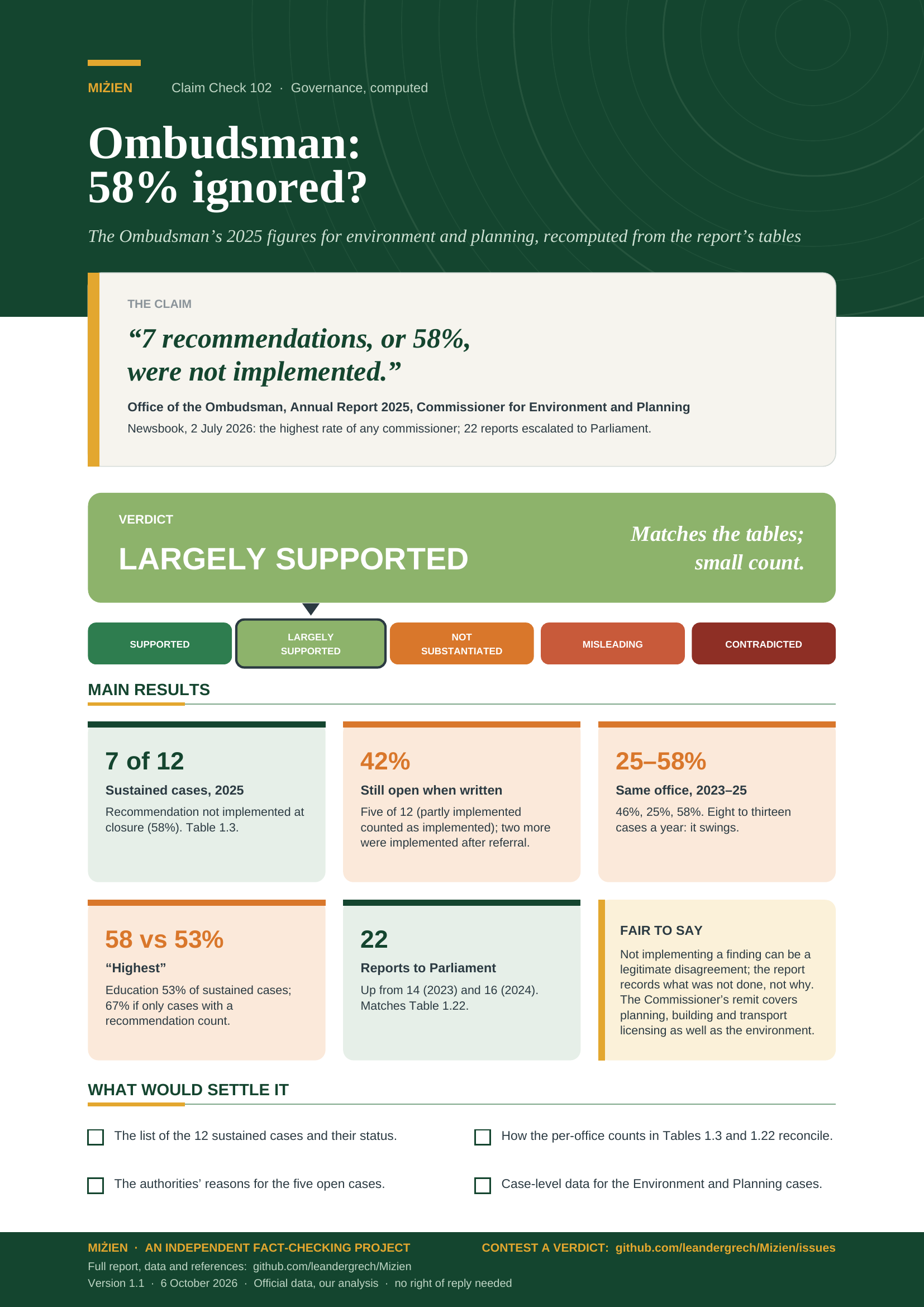
Ombudsman: 58% ignored?
Testing the Ombudsman’s 2025 figures on environment and planning recommendations
“7 recommendations, or 58%, were not implemented.”
Office of the Ombudsman, Annual Report 2025, on the Commissioner for Environment and Planning.
Newsbook, 2 July 2026: the highest rate among the commissioners; 22 reports escalated to Parliament.
Verdict: Largely supported Matches the tables; a small count and a snapshot
Version 1.1 · 6 October 2026
TL;DR
Reporting on the Parliamentary Ombudsman’s 2025 annual report said that 58% of the Commissioner for Environment and Planning’s justified recommendations went unimplemented, the highest rate of any commissioner, and that 22 reports were escalated to Parliament [2]. We read the report itself [1] and recomputed the figures from its tables.
- The number is the Ombudsman’s own. Table 1.3 of the 2025 report [1]: of 12 sustained cases closed by the Commissioner, 7 recommendations (58%) were not implemented. The 22 reports sent to Parliament match Table 1.22.
- It is a small count, and it moves a lot. 7 of 12 is a 95% interval of roughly 32–81%. The same office had 6 of 13 (46%) in 2023 and 2 of 8 (25%) in 2024. Over 2023–2025 it is 15 of 33 (45%).
- It is a snapshot at closure. The Commissioner’s own chapter says that five of the 12 were still unimplemented when the report was written; two more were implemented after being referred to the House. On that basis 42% remain open (counting the one “partly implemented” case of Table 1.3 as implemented).
- “Highest” holds on the Ombudsman’s table, not on every denominator. Environment and Planning 58% against Education 53% of sustained cases. Counting only cases where a recommendation was made, Education is 67% (8 of 12). The Commissioner’s remit is also wider than “environment”: planning, building, transport licensing and heritage.
- Verdict: largely supported (high confidence). The figures match the primary source; the caveats above do not change the substance.
- Supported
- Largely supported
- Not substantiated
- Misleading
- Contradicted
What would move the verdict up
Case-level data for the 2025 cases showing a different count, or a final-opinion list in which fewer than seven recommendations were unimplemented at closure.
What would move it down
A year-on-year series in which 2025 is not unusual, or authorities’ stated reasons showing that the recommendations were not accepted on legal grounds.
IN THIS REPORT
1 The statement and the primary source
Our candidate record took the figures from a Newsbook report of 2 July 2026 [2], which attributes them to the Parliamentary Ombudsman’s Annual Report for 2025. We read the report [1], published on the Office’s website. The Ombudsman’s wording is below. The newspaper’s phrase “justified recommendations” is a paraphrase of “sustained cases”.
| Source | What it says | Our access | Status |
|---|---|---|---|
| Office of the Ombudsman, Annual Report 2025, p. 15 [1] | “The Commissioner for Environment and Planning had 12 sustained cases, representing 15% of the total, of which 7 recommendations, or 58%, were not implemented.” Table 1.22 (p. 37): 22 reports sent to Parliament in 2025. | Full text read (252 pages). | Primary |
| Newsbook, 2 July 2026 [2] | 58% of the Commissioner for Environment and Planning’s justified recommendations “completely unimplemented”; 22 reports escalated to Parliament. | Read in full. | Locator |
2 Method
Question. Do the Ombudsman’s tables support “58% unimplemented”, “highest among commissioners” and “22 reports escalated”, and how stable is the figure?
Data. We typed Table 1.3 (sustained cases closed, by office and outcome) from the 2023, 2024 and 2025 annual reports [1, 3, 4] and Table 1.22 (reports sent to Parliament) from the 2025 report into data/cc-102/ombudsman_sustained_cases.csv, and checked that every row adds up. tools/cc-102-report/calc.py recomputes the rates on two denominators and checks the 2025 totals (81 sustained cases, 22 not implemented, 22 reports). Intervals are Wilson 95%.
Grades. The Ombudsman’s annual reports are official institutional records (C). We have no access to the underlying case files; the case notes were not needed for the counts.
3 What the 58% counts
Table 1.3 counts sustained cases closed during the year, not complaints received and not individual recommendations: one case can carry several. “Not implemented” is the status when the case was closed. The Commissioner’s chapter [1, printed pp. 218–219; PDF pp. 219–220] gives the position later: of the 12 sustained cases, five recommendations were implemented, two more were implemented after referral to the House of Representatives, and five remained unimplemented (including the Planning Authority and the Transport Malta cases it lists). The two accounts reconcile only if the one “partly implemented” case is counted as implemented: Table 1.3 has 4 implemented + 1 partly = 5, which is the chapter’s five, and 7 not implemented at closure = the chapter’s 2 implemented later + 5 still open. The 42% (5 of 12) depends on that reading. The Commissioner’s remit covers planning, building control, transport licensing and heritage as well as environmental matters; the Planning Authority alone accounts for 37 of 86 complaints in 2025 [1, Table 3.4].
4 Results
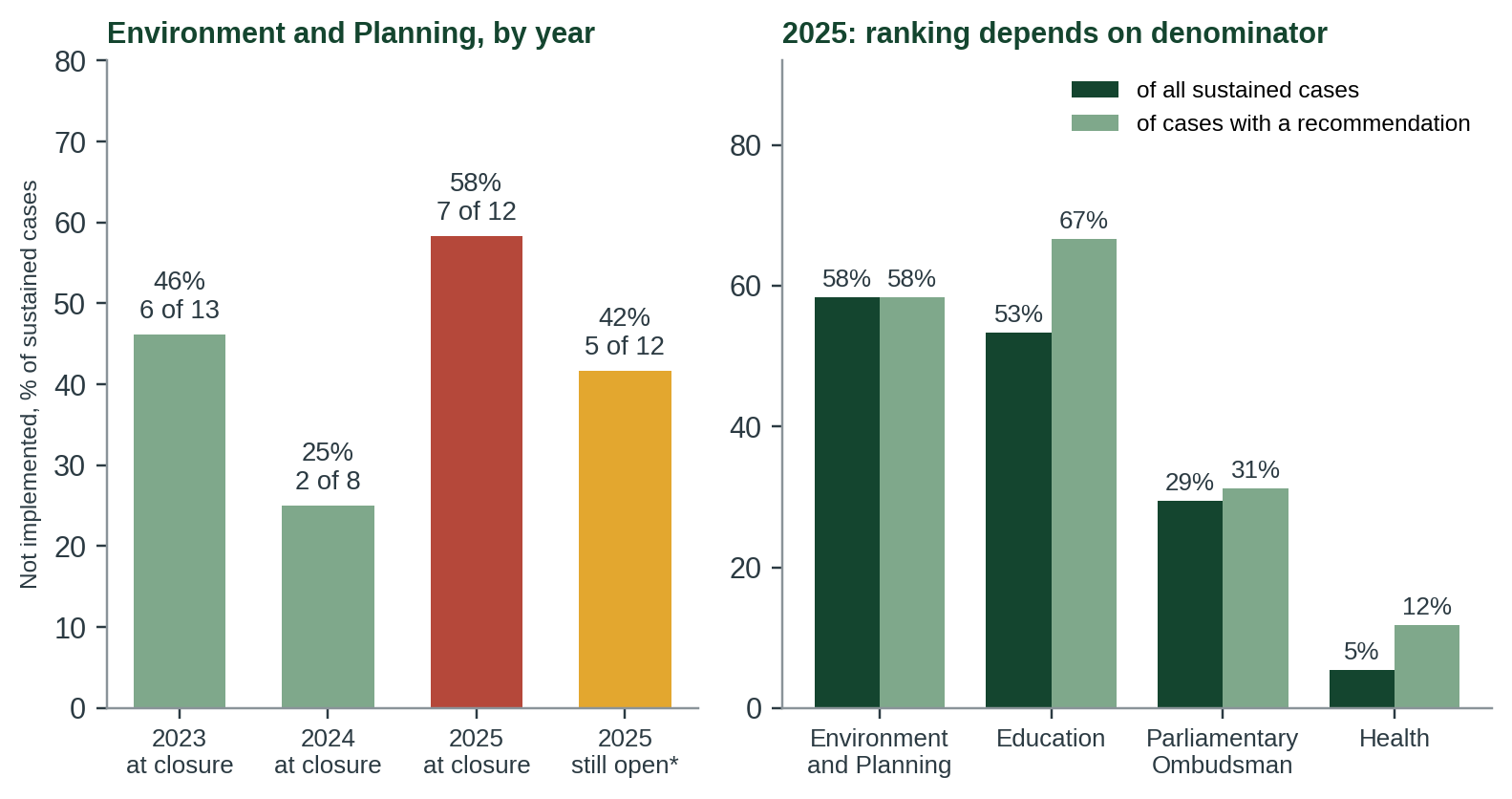
| 2025, by office | Sustained cases | Not implemented | % of sustained | % of cases with a recommendation |
|---|---|---|---|---|
| Environment and Planning | 12 | 7 | 58% | 58% (12) |
| Education | 15 | 8 | 53% | 67% (12) |
| Parliamentary Ombudsman | 17 | 5 | 29% | 31% (16) |
| Health | 37 | 2 | 5% | 12% (17) |
| All offices | 81 | 22 | 27% | 29% (76) |
Source: Table 1.3 [1]; recomputed in data/cc-102/rates.csv. Cases with a recommendation = sustained cases minus those sustained with no recommendation.
What this means for the statement
- The figure is correct as the Ombudsman states it. Both the 58% and the 22 reports match the tables.
- “Highest” is true on the Ombudsman’s own basis (58% against Education’s 53%), but the margin is one case’s worth and reverses if cases with no recommendation are excluded (Education 67%).
- “Went unimplemented” is a status at closure. By the time the report was written two of the seven had been implemented, leaving five (42%).
- Newsbook’s “justified recommendations” reads as a count of recommendations; the table counts sustained cases.
- The 22 reports equals the total of not-implemented cases in Table 1.3, but the split by office differs in two places (Parliamentary Ombudsman 5 vs 4, Health 2 vs 3). Environment and Planning agrees at 7. We report this as a reconciliation point, not an error in the claim.
5 Testing the sub-claims
| Sub-claim | Said by | What the evidence shows | Rating |
|---|---|---|---|
| A. 58% of the Commissioner for Environment and Planning’s recommendations went unimplemented in 2025 (Table 1.3 counts the 12 sustained cases closed in 2025: 7 not implemented) | Ombudsman [1]; Newsbook [2] | 7 of 12 sustained cases closed in 2025, status at closure (Table 1.3). Small count; 5 of 12 still open when the report was written. | CONFIRMED |
| B. The highest rate among the commissioners | Newsbook [2] (its comparison, from the Ombudsman’s tables) | 58% against Education’s 53% of sustained cases; 67% for Education on cases with a recommendation. | DEPENDS ON BASE |
| C. 22 reports escalated to Parliament in 2025 | Ombudsman [1]; Newsbook [2] | Table 1.22: 22, up from 16 (2024) and 14 (2023). | CONFIRMED |
6 Verdict and requests for evidence
The figures match the Ombudsman’s tables; the count is small and the “highest” ranking depends on the base. Confidence: high.
Why. The 58% and the 22 reports are in the Ombudsman’s own report and recompute exactly. We rate the statement Largely supported rather than Supported because it is a snapshot of a very small count, two of the seven were implemented later, and “highest” is not robust to the choice of denominator. None of these changes the substance: a majority of this Commissioner’s sustained cases closed in 2025 without the recommendation being implemented.
What this verdict does not say. It does not say the authorities were wrong not to act, or that the Commissioner’s findings were right in each case. It is not a judgement of any authority or person.
Evidence we are asking for
- From the Office of the Ombudsman: the list of the 12 sustained cases of 2025 with their status at closure.
- From the Office of the Ombudsman: how the per-office counts in Tables 1.3 and 1.22 reconcile.
- From the authorities concerned: the reasons given for not implementing the five open recommendations.
7 Limitations
- Figures are typed from the published tables; we did not see case files. Counts are of cases, not of recommendations.
- Table 1.3 uses status at closure; later implementation is reported only in the Commissioner’s narrative.
- Cases closed in 2025 may have been opened in earlier years, so rates are not a measure of 2025 conduct alone.
- A rate on 8–13 cases a year cannot support a trend claim. We tested no individual case on its merits.
References
- [1] Office of the Ombudsman, Malta (2026). Annual Report 2025, Table 1.3 (pp. 15–16), Table 1.22 (p. 37), Commissioner for Environment and Planning chapter (pp. 214–220), Table 3.4. Page numbers are the printed ones (PDF page = printed page + 1). Presented to the Speaker of the House, June 2026. (Full text read.) https://ombudsman.org.mt/media/0ownfd4k/digital-annual-report-2025-en.pdf
- [2] Newsbook (2 July 2026). Public entities ignore Ombudsman as defiance reaches record high. https://newsbook.com.mt/en/public-entities-ignore-ombudsman-as-defiance-reaches-record-high/
- [3] Office of the Ombudsman, Malta (2025). Annual Report 2024, Table 1.3. https://ombudsman.org.mt/media/q4nbhpzv/annual-report-2024-ombudsman.pdf
- [4] Office of the Ombudsman, Malta (2024). Annual Report 2023, Table 1.3. https://ombudsman.org.mt/media/fr1ndd4u/annual-report-2023-en.pdf
- [5] Miżien. Analysis code and outputs: tools/cc-102-report/; data/cc-102/.
Appendix A: series standards and verdict scale
Every investigation in this series follows the same rules so that verdicts are comparable and challengeable.
| Verdict | Meaning |
|---|---|
| SUPPORTED | Evidence consistently backs the claim as stated. |
| LARGELY SUPPORTED | Backed by the evidence, with minor caveats that do not change the substance. |
| NOT SUBSTANTIATED | Stated more strongly than the evidence offered or available allows. May be true in some conditions but has not been shown. |
| MISLEADING | Omits material facts so that the overall impression is inaccurate, even if individual statements are defensible. |
| CONTRADICTED | The available evidence points against the claim. |
Confidence
High: multiple independent lines of evidence agree. Moderate: evidence is relevant but incomplete or indirect. Low: evidence is thin, second-hand or conflicting.
Evidence grades
A experiment · B observational study with a control or gradient · C review, guidance or official statistics · D assertion or anecdote. The Ombudsman’s annual reports are official institutional records (C).
Standards
- Quote the speaker, not the headline, with outlet and date, and link the original where possible.
- Separate the claim from the evidence offered for it, and say who made which statement.
- Grade the evidence and show differing views side by side where the evidence is unsettled.
- State what we could not access or verify, and what would change the verdict either way.
- Ask for the missing evidence in specific, answerable requests.
- Offer a right of reply where a check finds a claim Not substantiated, Misleading or Contradicted (or a pledge Not measurable, Off track or Missed), before wider circulation, and append responses.
- Correct errors openly with a version number and change log.
- Whistle-blow only on evidence: a verdict of Misleading or Contradicted requires documents or data that can be shown, not inference.
- Check every side. Government, opposition, NGOs and developers are held to the same standard.
Appendix B: revision log
| Version | Date | Change |
|---|---|---|
| 1.0 | 5 Oct 2026 | First issue. Verdict: largely supported, high confidence. No right of reply needed (supported check). |
| 1.1 | 6 Oct 2026 | Corrections after audit: said how the 42% depends on counting “partly implemented” as implemented; gave printed and PDF page numbers for the Commissioner’s chapter; sub-claim A wording says sustained cases closed in 2025; Table 1.3 rows for 2023 and 2024 re-checked against the PDFs; Figure 1 enlarged; layout; status wording (no right of reply needed). |
Sources and archived copies
-
Annual Report 2025 (Table 1.3, Table 1.22, Commissioner for Environment and Planning chapter), Office of the Ombudsman, Malta, 2026-06.
Original · fetched and fingerprinted 2026-10-10; no public snapshot yet
Primary. Read in full 5 Oct 2026 (SHA-256 14fcc0c6...42b0). Quote on p. 15; 22 reports to Parliament in Table 1.22 (p. 37). Printed page numbers (PDF page = printed + 1). -
Public entities ignore Ombudsman as defiance reaches record high, Newsbook, 2026-07-02.
Original · fetched and fingerprinted 2026-10-10; no public snapshot yet
Locator. Read 5 Oct 2026. Its "justified recommendations" paraphrases "sustained cases"; the "highest rate" comparison is the newspaper's, from the Ombudsman's tables. -
Ombudsman presents 2025 Annual Report to Speaker, The Malta Independent, 2026-06-05.
Original · Archived copy
Locator (HTTP 403 to automated fetch); reports the 22 escalated reports. -
Annual Reports 2024 and 2023 (Table 1.3), Office of the Ombudsman, Malta, 2025; 2024.
Original · Archived copy
Read 5 Oct 2026. 2023 report: https://ombudsman.org.mt/media/fr1ndd4u/annual-report-2023-en.pdf. Gives 2 of 8 (2024) and 6 of 13 (2023).
Right of reply
Not needed: this check finds the claim supported. A right of reply is sought when a check finds a claim Not substantiated, Misleading or Contradicted.
Connections
How this claim relates to the others: who made it, the themes it shares with other claims, and the patterns it shows. A connection is a reason to read two checks side by side. It does not make either one right or wrong. How connections are found.
Who made it
Joseph Zammit McKeon, Parliamentary Ombudsman for Parliamentary Ombudsman
No other claim by this body is listed yet.
Linked directly 1
Claims that share a theme with this one. A theme is a cause, a mechanism, a target or a way of presenting figures that the editors have found in several claims; its strength says how close the link is.
Oversight and disclosure Rhetorical pattern · Pattern, not causal
How public bodies respond to scrutiny: an Ombudsman finding left unimplemented, and a request for data refused with a promise to publish later. Useful for tracking follow-through; not evidence of a common cause.
Two steps away 3
Not linked to this claim directly, but linked to a claim that is. These are found by following the links, not chosen by the editors, so they are looser: they show where one theme meets another.
- CC-027 Power cuts: heat, not generation (not yet checked)through Oversight and disclosureCC-103Heat, power cuts and health
- CC-090 20 heat-linked deaths (not yet checked)through Oversight and disclosureCC-103Heat, power cuts and health
- CC-097 Beach workers left exposed to heat (not yet checked)through Oversight and disclosureCC-103Heat, power cuts and health
Three steps away 3
One step further again. At this distance a connection says more about how the themes fit together than about this claim.
- CC-023 Second interconnector by 2026 (not yet checked)through Oversight and disclosureCC-103Heat, power cuts and healthCC-027Energy supply security
- CC-028 76% less network downtime (not yet checked)through Oversight and disclosureCC-103Heat, power cuts and healthCC-027Energy supply security
- CC-126 PN: Labour promised a gas pipeline by 2026 (not yet checked)through Oversight and disclosureCC-103Heat, power cuts and healthCC-027Energy supply security
Timeline
What was said, what was published before and after it, and each step of this check, in date order. Statements and sources carry the date they were published. The steps of the check carry the date the research was done, from the check's research log. Other statements by the same body on the same topic show whether a position was repeated, changed or corrected.
2024
- 2024 Evidence published Annual Report 2023 (Ombudsman, Malta), Office of the Ombudsman
2025
- 2025 Evidence published Annual Report 2024 (Ombudsman, Malta), Office of the Ombudsman
2026
- 5 June 2026 Reported Ombudsman presents 2025 Annual Report to Speaker, The Malta Independent
- June 2026 Evidence published Annual Report 2025 (Ombudsman, Malta), Office of the Ombudsman
- 2 July 2026 The statement Parliamentary Ombudsman (Judge Joseph Zammit McKeon) (this claim)
- 2 July 2026 Reported Public entities ignore Ombudsman as defiance reaches record high, Newsbook
- 4 October 2026 Added to the claims to check
- 5 October 2026 Check started Worker A took the claim from the queue.
- 5 October 2026 Exact wording found Verbatim wording found in the Ombudsman’s Annual Report 2025 (p. 15) on ombudsman.org.mt; 2023 and 2024 reports read for the trend.
- 5 October 2026 Version 1.0: first issue First issue. 7 of 12 and 22 reports confirmed from the tables; caveats: small count, status at closure (5 of 12 still open), ranking depends on denominator. Largely supported, high confidence.
- 6 October 2026 Note Re-checked Table 1.3 rows for 2023 and 2024 (all offices) and Table 1.22 against the PDFs: all match data/cc-102. Newsbook page could not be re-fetched (timeout, connection refused, no Wayback copy); a web-search summary of it (second-hand) says "sustained (justified)", 58% and 53%, 14/16/22. The "highest" comparison is the newspaper's own (first-hand read of 5 Oct 2026); the summary does not repeat it, which does not contradict that read. See literature/CC-102/notes.md.
- 6 October 2026 Version 1.1 1.1: corrections after the 6 Oct 2026 audit: reconciliation of Table 1.3 with the chapter, page cite, sub-claim A wording, status wording, layout, re-checks. Verdict unchanged (Largely supported, high). Verdict in this version: Largely supported, high confidence.
- 6 October 2026 Evidence reviewed
- 6 October 2026 Correction Reconciliation stated: the 42% still open counts the one partly implemented case as implemented (Table 1.3 4+1=5 = chapter five; 7 = 2 later + 5 open); asserted in calc.py. Sub-claim A wording now says the 12 sustained cases closed in 2025. Chapter page cite given as printed pp. 218-219 (PDF pp. 219-220); the printed numbers were already right. all corrections
- 6 October 2026 Clarification Cover, footers, flyer and revision log say "no right of reply needed" (status derived by the template). Figure 1 enlarged with source line moved to the caption; page 6 no longer near-empty. Flyer and cover context attribute "highest" to Newsbook. all corrections
2027
- 6 October 2027 Coming up: Evidence review due Each finished check is reviewed against new evidence within a year.
Every change to this claim's record is public: history of the record.
Download the report and flyer