CC-099 · Tourism & Population · Population & labour
Foreign residents: 31% now, 38% by 2030
Not substantiated Low confidence Draft: right of reply on hold
Parts of this claim
The claim is split into parts that are tested separately, as in the report below. Each part has its own number.
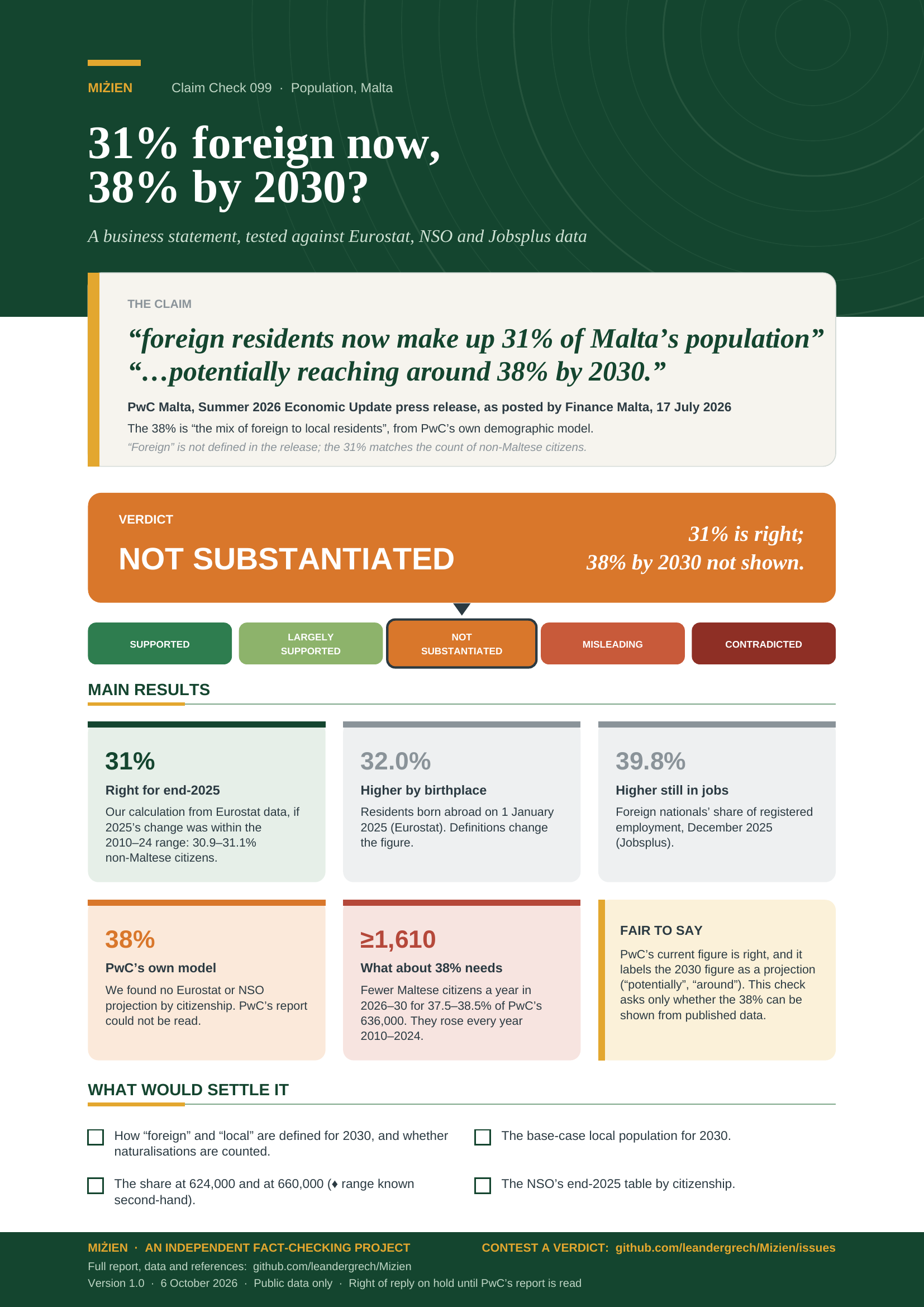
- CC-099A “foreign residents now make up 31% of Malta’s population”Our calculation from Eurostat data: 30.9–31.1% non-Maltese citizens on 1 January 2026 (if 2025’s change was within the 2010–24 range); 29.4% a year earlier [10, 12]. The NSO’s 31.1% agrees ◆ [8]. By country of birth the share is higher (32.0% in 2025) [11].
- CC-099B “the mix of foreign to local residents potentially reaching around 38% by 2030”PwC’s own model; no Eurostat or NSO projection by citizenship found [16, 20]. On citizenship, 37.5–38.5% of 636,000 needs Maltese citizens to fall by at least 1,610 a year in 2026–30; recorded data show a rise every year 2010–2024 [10, 14]. Only a projection without future naturalisations, like the CBM’s ◆, gives such a fall. PwC states neither its definition nor this assumption; report not readable [4].
- CC-099C “…Malta’s population reached 588,254 by year-end 2025 … approximately 14,000 residents (2.4%)” (context)Eurostat: 588,254 on 1 January 2026; +14,004 (2.44%) in 2025 [12].
Claim Check 099 · Population statistics
31% foreign now, 38% by 2030?
Testing PwC Malta’s figures for foreign residents against Eurostat, NSO and Jobsplus data
“…foreign residents now make up 31% of Malta’s population” “…the mix of foreign to local residents potentially reaching around 38% by 2030.”
PwC Malta, Summer 2026 Economic Update press release, as posted by Finance Malta, 17 July 2026.
Two fragments, from paragraphs 2 and 6; the 2030 figure comes from PwC’s own model.
Verdict: Not substantiated 31% right; 38% by 2030 not shown
Version 1.0 · 6 October 2026
TL;DR
PwC Malta’s press release on its Summer 2026 Economic Update (Finance Malta, 17 July 2026) says: “The latest figures show that foreign residents now make up 31% of Malta’s population”, with “the mix of foreign to local residents potentially reaching around 38% by 2030.”
- The 31% is right. Our calculation from Eurostat data gives 30.9–31.1% non-Maltese citizens at the end of 2025 (if 2025’s change was within the 2010–24 range); the NSO reports 31.1% ◆.
- The definition matters. 32.0% of residents were born abroad already on 1 January 2025, and foreign nationals were 39.8% of registered employment in December 2025 (Jobsplus).
- The 38% is PwC’s own projection. We found no Eurostat or NSO projection by citizenship, and PwC’s report, which sets out its model, could not be read.
- Whether about 38% is reachable turns on naturalisations. On citizenship, 37.5–38.5% of PwC’s 636,000 needs Maltese citizens to fall by at least 1,610 a year in 2026–30. They rose every year 2010–2024; only a projection without future naturalisations, like the Central Bank’s ◆, gives such a fall. The release does not say what PwC assumed.
- Verdict: not substantiated (low confidence). The 31% is right. The 38% has not been shown: PwC states neither its definition nor its naturalisation assumption, and its report could not be read.
- Supported
- Largely supported
- Not substantiated
- Misleading
- Contradicted
What would move the verdict up
PwC’s report, or PwC, showing the definition and the naturalisation assumption behind the 38%, reproducible from published inputs: the verdict would move to Largely supported.
What would move it down
Evidence that the 38% is counted on a different basis from the 31% (for example country of birth) without saying so; or a correction to the NSO’s end-2025 figure that moved the 31%.
IN THIS REPORT
1 The claim and what we could verify
The words are PwC Malta’s. Finance Malta posted them on 17 July 2026 as an “Industry Update” from PwC, with PwC’s own boilerplate [1]. The Malta Business Weekly reprinted the same text on 19 July [2], and the Malta Chamber (22 July) and Mondaq, under PwC’s name (23 July), carry it too [3]. The release speaks of “our projections” and quotes PwC Malta’s Territory Senior Partner, so we assess it as PwC’s statement. The two figures are in different paragraphs (2 and 6) of the same release.
| What PwC says | Where | Access |
|---|---|---|
| “…Malta’s population reached 588,254 by year-end 2025. This marks an increase of approximately 14,000 residents (2.4%) from the previous year.” | Para. 1 [1] | Read in full, 6 Oct 2026 |
| “The latest figures show that foreign residents now make up 31% of Malta’s population, with net migration patterns continuing to drive growth.” | Para. 2 [1] | Read in full; no source or definition given |
| “Based on PwC’s demographic modelling, Malta’s population is projected to reach a base case of 636,000 by 2030.” | Para. 2 [1] | Read in full |
| “Our projections are based on varying levels of slowdown in current net migration flows. Nonetheless, population is still expected to increase significantly, with the mix of foreign to local residents potentially reaching around 38% by 2030.” | Para. 6 [1] (para. 7 in [2]) | Read in full; method in the report |
| The Summer 2026 Economic Update itself, which “sets out demographic projections” | pwc.com [4] | Not readable: 403 to scripts; no Internet Archive capture |
| ◆ Quoted by two outlets as the report’s words: “… the results suggest that population would still increase significantly, with the mix of foreign to local reaching around 38% in the base case.” Range 624,000–660,000. | Business Now [5], Newsbook [6] | Second-hand |
The record’s link. Our intake record pointed to a different Malta Business Weekly article (2 June 2025, by Silvan Mifsud, on a Central Bank of Malta policy note) [21]. That article does not contain the claim: it gives 28.1% of the population as foreign nationals in 2023 and “just over 31%” of the working-age population. The claim’s wording matches the July 2026 release, which we rate here.
2 Method
Questions. (1) Were foreign residents 31% of Malta’s population at the time of the release, and on what definition? (2) Does “around 38% by 2030” come from a published projection, and can it be shown from published figures?
Evidence. We downloaded from Eurostat’s dissemination API on 6 October 2026, with Eurostat’s flags: the population on 1 January by citizenship and by country of birth [10, 11], the demographic balance [12], Census 2021 [13], immigration, emigration and acquisitions of citizenship by citizenship [14], births by the mother’s citizenship and deaths by citizenship [15], and the EUROPOP2025 projections [16]. We downloaded Jobsplus’s workbooks on foreign nationals in employment and total employment [18, 19]. The NSO’s release of 9 July 2026 [7] and PwC’s report [4] refused automated access; their figures are used only as reported by news outlets, marked ◆. The Central Bank of Malta’s policy note was read as its abstract (Crossref) [20]. Every figure is recomputed by tools/cc-099-report/calc.py from data/cc-099/. A Crossref search (three queries, logged in literature/CC-099/notes.md) found no peer-reviewed study of Malta’s foreign-population share or its projection.
Definitions. Eurostat counts usual residents (a stay of at least 12 months, or intended to last that long); citizenship is the legal bond with a state, and a non-national is a citizen of another country or stateless [17]. The population on 1 January of a year is the population at the end of the year before: Eurostat’s 1 January 2026 total is 588,254, the figure PwC gives for the end of 2025 [1, 12]. We read “around 38%” as 37.5–38.5%, the values that round to 38, and apply the same tolerance to every reading.
Grades. Official statistics and administrative data are grade C under our scale. Verdicts follow the five-point scale in Appendix A.
3 What “foreign residents” can mean
The release does not define “foreign residents”. Three published measures fit the phrase, and they differ by several points (Figure 1, Table 1). Counted by citizenship, a person born in Malta to foreign parents is foreign, and a foreigner who becomes a Maltese citizen is not. Counted by country of birth, Maltese citizens born abroad are included. Jobsplus reports foreign nationals in registered employment, a share of employment, not of residents.
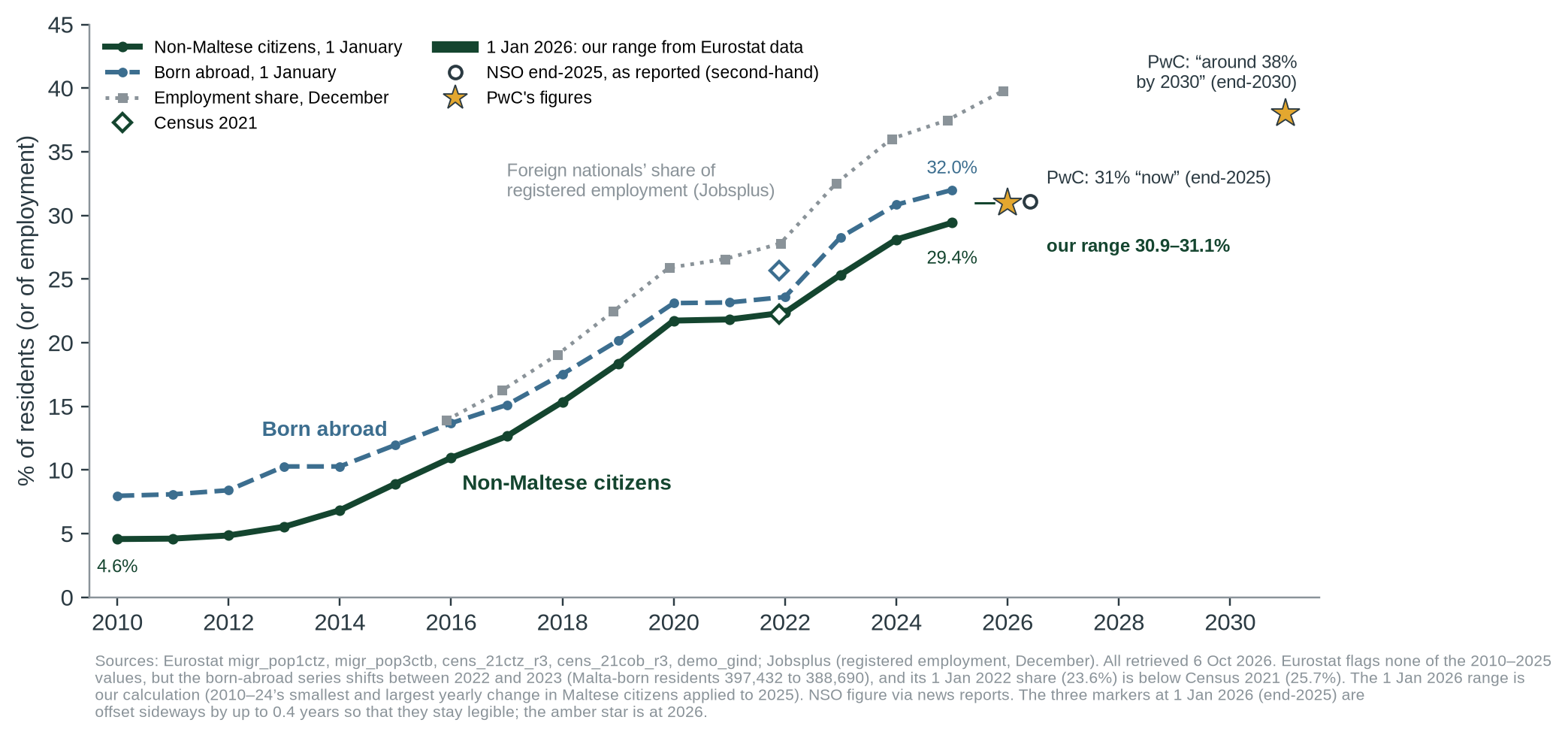
| Measure | Value | Date | Source | Grade |
|---|---|---|---|---|
| Non-Maltese citizens (other EU 8.0%, non-EU 21.4%) | 29.4% (168,938) | 1 Jan 2025 | Eurostat [10] | C |
| Non-Maltese citizens: our calculation from Eurostat data, if 2025’s change was within the 2010–24 range | 30.9–31.1% | 1 Jan 2026 | calculated [10, 12] | C |
| ◆ Non-Maltese citizens, NSO | 31.1% (182,693) | end-2025 | NSO via news [8, 9] | C |
| Born abroad | 32.0% (183,765) | 1 Jan 2025 | Eurostat [11] | C |
| Census: non-Maltese citizens / born abroad | 22.2% / 25.7% | 21 Nov 2021 | Eurostat [13] | C |
| Foreign nationals in registered employment (full- and part-time) | 39.8% (135,417) | Dec 2025 | Jobsplus [18, 19] | C |
| Foreign nationals in full-time registered employment | 42.2% | Dec 2025 | Jobsplus [18, 19] | C |
Table 1. All values in data/cc-099/checks.csv. Eurostat’s 2010–2025 citizenship and birth series carry no flags (earlier years carry a break in 2001 and 2009 and an estimate in 2006). Unflagged, the born-abroad series shifts between 2022 and 2023 (Malta-born 397,432 to 388,690), and its 1 January 2022 share (23.6%) is below Census 2021 (25.7%); we use only its 2025 level. Employment shares are not comparable with shares of residents.
4 Testing the 31%
The latest year for which Eurostat publishes Malta’s population by citizenship is 1 January 2025: 29.4% non-Maltese citizens, up from 28.1% a year earlier and 4.6% in 2010 [10]. PwC’s “latest figures” refer to the end of 2025, a year later. Eurostat already gives that total, 588,254 on 1 January 2026, matching PwC’s figure and its 14,004 rise (2.44%) in 2025 [12].
Eurostat has not yet published the 2026 split, so we bound it ourselves. The number of Maltese citizens rose in every year from 2010 to 2024, by between 237 (2024) and 1,394 (2011) a year [10]. If 2025’s change lay within that range, Maltese citizens numbered 405,549–406,706 on 1 January 2026, and non-Maltese citizens were 30.9–31.1% of 588,254 (our calculation). Both ends round to 31%.
The NSO’s own figure agrees. Its World Population Day release (NR 120/2026, 9 July 2026) is not readable from our network, but four outlets report it: 68.9% Maltese citizens and 31.1% non-Maltese citizens at the end of 2025, or 182,693 people [8, 9] ◆. That implies 405,561 Maltese citizens, 249 more than a year earlier, inside our range. PwC does not name its source; the 31% matches the NSO’s citizenship figure, rounded (our identification). By country of birth the share would be higher: 32.0% were born abroad a year earlier [11].
5 Testing the 38% by 2030
Is it an official projection?
No. Eurostat’s EUROPOP2025 projections (June 2026) give Malta’s population by age and sex only, with no split by citizenship or country of birth [16]. The Central Bank of Malta wrote in 2025 that it projected the native Maltese population itself “in the absence of demographic projections specifically covering the native Maltese population” [20]. The NSO’s website refuses automated access, and a web search found no NSO projection by citizenship; Newsbook reports that a parliamentary reply confirmed the government holds no formal population projections for the next four years ◆ [6]. The 38% is PwC’s own model result: the release attributes it to “our projections”, based on “varying levels of slowdown in current net migration flows” [1].
What “38%” means
“The mix of foreign to local residents” could be read as a ratio of foreign to local. On 1 January 2025 there were already 41.7 non-Maltese citizens for every 100 Maltese citizens [10], so a ratio of 38 would be a fall, which the release does not describe. We read the 38% as a share of all residents, as the 31% is.
What it requires
At PwC’s base case of 636,000 residents, “around 38%” (37.5–38.5%) leaves 391,140–397,500 local residents. On the citizenship basis of the 31%, local residents are Maltese citizens, 405,549–406,706 at the end of 2025 by our calculation (section 4). Reaching 397,500 by the end of 2030 needs a fall of at least 1,610 a year over 2026–2030; exactly 38% needs 2,246–2,477 a year, and 38.5% up to 3,113. (Counted from 1 January 2025, the figures would be 1,302–2,362 a year, but that spreads the fall over 2025, when the count rose.) Figure 2 sets this against what has happened.
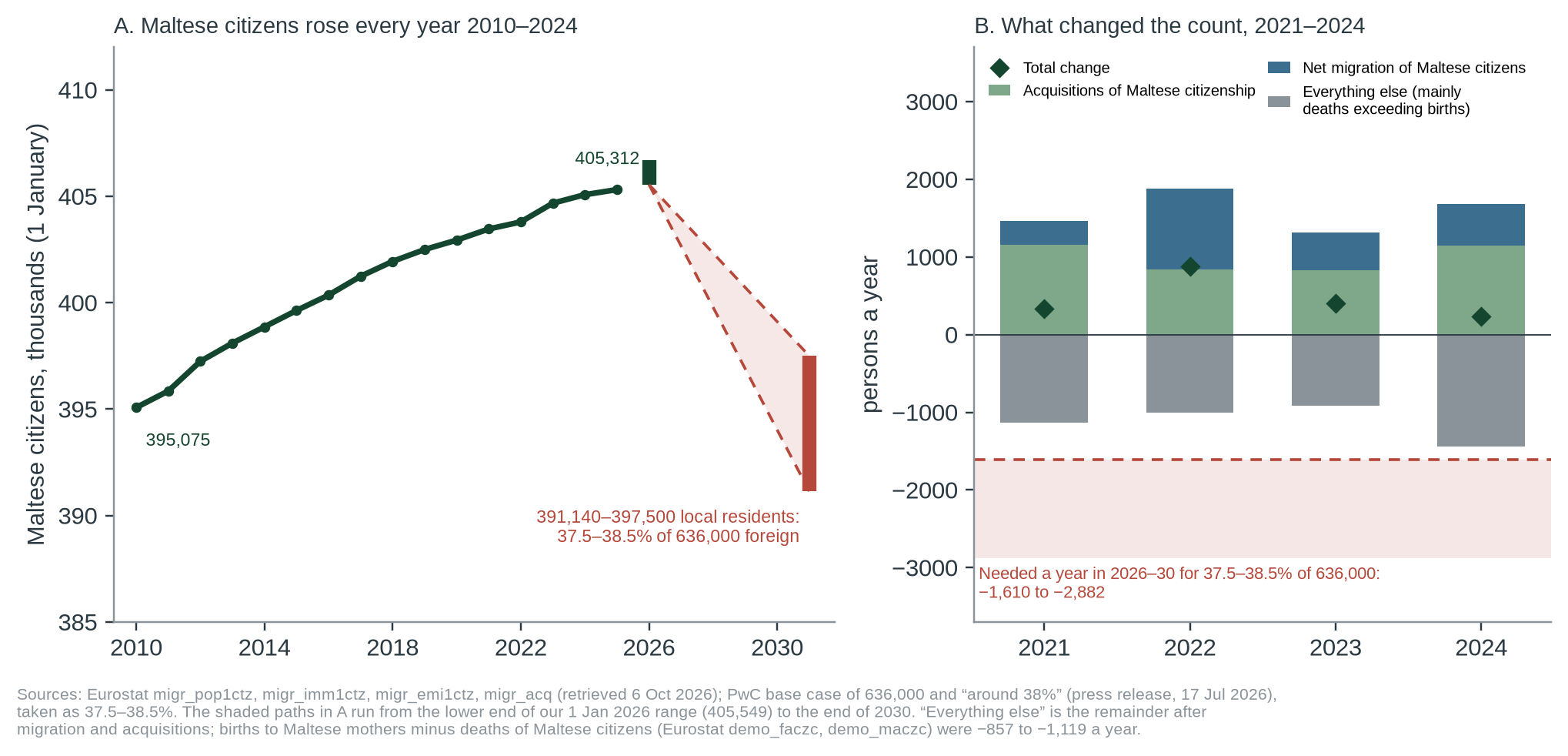
| Year | Total change | Net migration of Maltese | Acquisitions of citizenship | Remainder | Births to Maltese mothers minus deaths of Maltese |
|---|---|---|---|---|---|
| 2021 | +331 | +306 | +1,156 | −1,131 | −900 |
| 2022 | +881 | +1,039 | +842 | −1,000 | −921 |
| 2023 | +400 | +489 | +825 | −914 | −857 |
| 2024 | +237 | +533 | +1,145 | −1,441 | −1,119 |
| Needed a year, 2026–30, for 37.5–38.5% of 636,000 | −1,610 to −2,882 | from 405,549 (−1,841 to −3,113 from 406,706) |
Table 2. Maltese citizens, components of change (persons). Remainder = total change minus net migration and acquisitions; it also includes losses of citizenship and statistical adjustment. Births are counted by the mother’s citizenship, which can differ from the child’s (general context), so the last column is approximate. Eurostat [10, 14, 15]; acquisitions for 2010 carry a break flag (not used).
Even if no foreigner became a Maltese citizen and no Maltese citizen moved in or out, the remainder fell by 914–1,441 a year in 2021–2024, a slower fall than the 1,610 needed. For comparison only, not as forecasts: if 2024’s remainder (−1,441), the largest, repeated every year from our end-2025 range, the non-Maltese share at 636,000 would be 37.2–37.4% (37.6% if 2025 is included), at the edge of “around 38%”; had the count stayed at its 1 January 2025 level, it would be 36.3%. The release gives no local-population path. In Business Now’s paraphrase of the report, the local population “has remained at just over 400,000” ◆ [5].
Other readings come close to 38%. A projection without future naturalisations, like the Central Bank’s ◆, gives about 38% (section 6). On country of birth, 390,485 residents were born in Malta on 1 January 2025 [11]; at that count, 38.6% of 636,000 would be born abroad, just above the band, and 37.5–38.5% would need 655–7,015 more Malta-born residents by 2030. At the top of PwC’s reported range, 660,000 ◆ [5, 6], the 1 January 2025 count of Maltese citizens would leave 38.6% non-Maltese. The release states none of these.
Context: total population
PwC’s base case sits between Eurostat’s projections. EUROPOP2025 gives 621,470 on 1 January 2030 and 628,876 on 1 January 2031 in its baseline, and 650,230 and 663,463 with higher migration [16]. Its baseline for 1 January 2026 (585,012) was already 3,242 below the outcome [12, 16]. We do not rate the 636,000; it is the denominator PwC chose.
6 Where the evidence points different ways
Q1 Could the local population fall fast enough for about 38%?
ONLY IF NATURALISATIONS ARE LEFT OUTEVIDENCE THAT THE LOCAL POPULATION COULD FALL
The Central Bank of Malta projects “a persistent decline and ageing of the native Maltese population” [20]. Its baseline, as reported ◆, falls from 405,075 (2023) to about 350,000 [21] or 347,000 [23] by 2050: about 2,040–2,230 a year on average, faster than the 1,610 needed. Its start equals Eurostat’s Maltese citizens on 1 January 2024 [10], the basis of the 31%, but it leaves out people who acquire citizenship ◆ [23]. Applied to 2026–2030 that average gives 37.8–38.0% at 636,000. Its path to 2030 is not known to us, so this decides nothing.
EVIDENCE AGAINST
The number of Maltese citizens rose in every year 2010–2024 [10]. In 2021–2024, 825–1,156 people a year became Maltese citizens and net migration of Maltese citizens was positive [14]. Even with both set to zero, the remainder fell by at most 1,441 a year, short of the 1,610 needed (Table 2). Births to Maltese mothers were below deaths of Maltese citizens by only 857–1,119 a year [15].
Q2 Is the 38% on the same definition as the 31%?
UNKNOWNEVIDENCE OF THE CITIZENSHIP BASIS
The release uses one phrase for both (“foreign residents”; “the mix of foreign to local residents”) and gives no change of definition. The 31% matches the NSO’s citizenship figure (section 4). In Business Now’s paraphrase, the report puts the local population “at just over 400,000” ◆ [5], which fits Maltese citizens (405,312 on 1 January 2025) rather than Malta-born residents (390,485) [10, 11].
EVIDENCE OF A BIRTHPLACE BASIS
On country of birth, 38.6% would be born abroad at 636,000 with the 1 January 2025 count of Malta-born residents [11]. Business Now’s “In 2019, it was 20 per cent” ◆ [5] matches the born-abroad share on 1 January 2019 (20.2%), not citizenship (18.4%) [10, 11]; and 31% also matches born abroad on 1 January 2024 (30.8%).
7 Testing the claim
The verdict rests on A and B, the two figures in the claim. C is the release’s own context and is rated for completeness.
| Sub-claim | What the evidence shows | Rating |
|---|---|---|
| A. “foreign residents now make up 31% of Malta’s population” | Our calculation from Eurostat data: 30.9–31.1% non-Maltese citizens on 1 January 2026 (if 2025’s change was within the 2010–24 range); 29.4% a year earlier [10, 12]. The NSO’s 31.1% agrees ◆ [8]. By country of birth the share is higher (32.0% in 2025) [11]. | ACCURATE |
| B. “the mix of foreign to local residents potentially reaching around 38% by 2030” | PwC’s own model; no Eurostat or NSO projection by citizenship found [16, 20]. On citizenship, 37.5–38.5% of 636,000 needs Maltese citizens to fall by at least 1,610 a year in 2026–30; recorded data show a rise every year 2010–2024 [10, 14]. Only a projection without future naturalisations, like the CBM’s ◆, gives such a fall. PwC states neither its definition nor this assumption; report not readable [4]. | NOT SUBSTANTIATED |
| C. “…Malta’s population reached 588,254 by year-end 2025 … approximately 14,000 residents (2.4%)” (context) | Eurostat: 588,254 on 1 January 2026; +14,004 (2.44%) in 2025 [12]. | ACCURATE |
8 Verdict and requests for evidence
The 31% is right. The 38% by 2030 has not been shown: PwC does not state its definition of foreign and local residents or its assumption about naturalisations, and its report could not be read. Confidence: low.
Why. (1) The current figure reproduces from our calculation on Eurostat data and agrees with the NSO’s ◆. (2) The 2030 figure is PwC’s own model result, not an official projection, and the release gives one sentence on how it was made. (3) On citizenship, “around 38%” of PwC’s 636,000 needs Maltese citizens to fall by at least 1,610 a year over 2026–2030 (about 2,250 for exactly 38%). Recorded data show them rising every year 2010–2024, because naturalisations and returning citizens outweigh the natural decrease; only a projection that leaves out future naturalisations, as the Central Bank’s does ◆, gives a fall of that size. On country of birth the figure is closer, but the 31% matches citizenship. (4) The release states neither its definition nor its naturalisation assumption, so the figure cannot be checked from what PwC published. (5) Confidence is low: the evidence on the 38% points both ways, the deciding document (PwC’s report) could not be read, and the NSO’s end-2025 figure is second-hand.
What this verdict does not say. It does not say that the share of foreign residents will not rise, that PwC’s population total is wrong, or anything about migration policy. It addresses only whether the two figures are supported by the evidence offered and available.
Right of reply. A reply from PwC Malta is on hold until its Summer 2026 Economic Update is read, because the explanation of the 38% may be in it. If the report shows the method, the verdict will be revisited before any reply is sought.
Evidence we are asking for
- The definition of “foreign” and “local” behind the 38%: citizenship, as in the 31%, or country of birth.
- The base-case number of local residents for 2030, and whether the model counts future naturalisations, with its assumptions for births, deaths and migration.
- The share of foreign residents at the low (624,000) and high (660,000) ends of PwC’s range (range known second-hand ◆).
- From the NSO: the end-2025 population by citizenship as a published table (Eurostat’s 1 January 2026 split was not yet available on 6 October 2026).
9 Limitations
- PwC’s report could not be read (pwc.com refuses automated access and the Internet Archive has no copy); it may explain the 38%.
- The NSO’s end-2025 figures are second-hand (nso.gov.mt refuses automated access; an Internet Archive copy exists but could not be opened from our network). Four outlets agree.
- The 30.9–31.1% for 1 January 2026 is our calculation from Eurostat data, valid if 2025’s change in Maltese citizens lay within the 2010–24 range; Eurostat has not yet published the 2026 split.
- The Central Bank of Malta’s note was read as its abstract; its baseline figures are second-hand (◆), and its path to 2030 is unknown.
- Births are recorded by the mother’s citizenship, so the last column of Table 2 is approximate.
- Jobsplus’s own label is “Foreign Nationals Employed in Malta & Gozo”; “registered employment” is our short name for the series. It counts employment, not residents, so it is not comparable with population shares.
- Figures quoted from the report by Business Now and Newsbook are second-hand (◆) and decide no rating.
References
- [1] Finance Malta (17 Jul 2026). Malta’s rapid population growth creates urgent need to focus on the country’s infrastructure demands… Industry Update / PwC. Read in full, 6 Oct 2026. https://financemalta.org/industry-updates/malta-s-rapid-population-growth-creates-urgent-need-to-focus-on-the-country-s-infrastructure-demands-for-the-future
- [2] The Malta Business Weekly (19 Jul 2026). Same release text. Read in full, 6 Oct 2026. https://maltabusinessweekly.com/population-growth-drives-urgent-infrastructure-needs-pwc-malta-summer-2026-economic-update/30680/
- [3] The Malta Chamber (22 Jul 2026); Mondaq (23 Jul 2026, author PwC). Same text. Read 6 Oct 2026. https://maltachamber.org.mt/maltas-rapid-population-growth-creates-urgent-need-to-focus-on-the-countrys-infrastructure-demands-for-the-future/
- [4] PwC Malta. Economic update summer edition 2026. Not readable (403; no Internet Archive capture). https://www.pwc.com/mt/en/publications/economic-outlook/economic-outlook-summer-2026.html
- [5] ◆ Schembri Orland K. (15 Jul 2026). Malta’s population could reach 636,000 by 2030, PwC projects. Business Now. https://businessnow.mt/maltas-population-could-reach-636000-by-2030-pwc-projects/
- [6] ◆ Balzan J. (17 Jul 2026). PwC: Malta’s population could climb to 660,000 within five years. Newsbook. https://newsbook.com.mt/en/pwc-maltas-population-could-climb-to-660000-within-five-years/
- [7] National Statistics Office (9 Jul 2026). World Population Day: 11 July 2026 (NR 120/2026). Not readable (403), 6 Oct 2026. https://nso.gov.mt/world-population-day-11-july-2026/
- [8] ◆ Newsbook (9 Jul 2026). Malta’s population grows 2.4%, driven entirely by migration. MEETinc and International Adviser agree. https://newsbook.com.mt/en/maltas-population-grows-2-4-driven-entirely-by-migration/
- [9] ◆ Lovin Malta (11 Jul 2026). World Population Day: Malta’s population reaches record 588,254 (NSO: 68.9% / 31.1%). https://lovinmalta.com/news/local/world-population-day-maltas-population-reaches-record-588254/
- [10] Eurostat. migr_pop1ctz Population on 1 January by age group, sex and citizenship; updated 25 Sep 2026, retrieved 6 Oct 2026, with flags. doi:10.2908/migr_pop1ctz. https://ec.europa.eu/eurostat/databrowser/product/page/MIGR_POP1CTZ
- [11] Eurostat. migr_pop3ctb Population on 1 January by age group, sex and country of birth; updated 25 Sep 2026, retrieved 6 Oct 2026. doi:10.2908/migr_pop3ctb. https://ec.europa.eu/eurostat/databrowser/product/page/MIGR_POP3CTB
- [12] Eurostat. demo_gind Population change – demographic balance and crude rates; updated 30 Sep 2026, retrieved 6 Oct 2026. doi:10.2908/demo_gind. https://ec.europa.eu/eurostat/databrowser/product/page/DEMO_GIND
- [13] Eurostat. Census 2021: cens_21ctz_r3, cens_21cob_r3; retrieved 6 Oct 2026. doi:10.2908/cens_21ctz_r3. https://ec.europa.eu/eurostat/databrowser/product/page/CENS_21CTZ_R3
- [14] Eurostat. migr_imm1ctz, migr_emi1ctz, migr_acq (migration and acquisitions by citizenship); retrieved 6 Oct 2026. doi:10.2908/migr_acq. https://ec.europa.eu/eurostat/databrowser/product/page/MIGR_ACQ
- [15] Eurostat. demo_faczc, demo_maczc (births by mother’s citizenship; deaths by citizenship); retrieved 6 Oct 2026. https://ec.europa.eu/eurostat/databrowser/product/page/DEMO_MACZC
- [16] Eurostat. proj_25np Population on 1st January by age, sex and type of projection (EUROPOP2025); updated 11 Jun 2026, retrieved 6 Oct 2026. doi:10.2908/proj_25np. https://ec.europa.eu/eurostat/databrowser/product/page/PROJ_25NP
- [17] Eurostat. International migration statistics, reference metadata (definitions). Read 6 Oct 2026. https://ec.europa.eu/eurostat/cache/metadata/en/migr_immi_esms.htm
- [18] Jobsplus. Foreign nationals employment trends; workbook “Trend of employed foreign nationals 2015–2025”. Retrieved 6 Oct 2026. https://jobsplus.gov.mt/labour-market-trends/foreign-nationals-employment-trends
- [19] Jobsplus. Employment trends: total and full-time employment workbooks, 2015–2025. Retrieved 6 Oct 2026. https://jobsplus.gov.mt/labour-market-trends/employment-trends
- [20] Cumbo L. (2025). The native Maltese population: projections and implications on the labour supply. Central Bank of Malta Policy Note 1/2025. doi:10.2139/ssrn.5356748. Abstract read (Crossref). https://doi.org/10.2139/ssrn.5356748
- [21] Mifsud S. (2 Jun 2025). Malta’s demographic shift: a growing foreign workforce. The Malta Business Weekly. Intake link; not the claim; ◆ for CBM figures. https://maltabusinessweekly.com/maltas-demographic-shift-a-growing-foreign-workforce/29055/
- [22] Eurostat. 2021 censuses, reference metadata: reference dates (Malta, 21 Nov 2021). Read 6 Oct 2026. https://ec.europa.eu/eurostat/cache/metadata/en/cens_21_esms.htm
- [23] ◆ Amphora Media (6 Nov 2025). FATTI: Is Malta’s native population at risk of collapse…? https://www.amphora.media/2025/11/fatti-malta-native-population-numbers-budget-tax-cut-child-parent
- [24] Miżien. Data and calculations: data/cc-099/; tools/cc-099-report/calc.py.
Appendix A: series standards and verdict scale
Every investigation in this series follows the same rules so that verdicts are comparable and challengeable.
| Verdict | Meaning |
|---|---|
| SUPPORTED | Evidence consistently backs the claim as stated. |
| LARGELY SUPPORTED | Backed by the evidence, with minor caveats that do not change the substance. |
| NOT SUBSTANTIATED | Stated more strongly than the evidence offered or available allows. May be true in some conditions but has not been shown. |
| MISLEADING | Omits material facts so that the overall impression is inaccurate, even if individual statements are defensible. |
| CONTRADICTED | The available evidence points against the claim. |
Confidence
High: multiple independent lines of evidence agree. Moderate: evidence is relevant but incomplete or indirect. Low: evidence is thin, second-hand or conflicting.
Evidence grades
A experiment · B observational study with a control or gradient · C review, guidance or official statistics · D assertion or anecdote. ◆ marks a source known only second-hand.
Standards
- Quote the speaker, not the headline, with outlet and date, and link the original where possible.
- Separate the claim from the evidence offered for it, and say who made which statement.
- Grade the evidence and show differing views side by side where the evidence is unsettled.
- State what we could not access or verify, and what would change the verdict either way.
- Ask for the missing evidence in specific, answerable requests.
- Offer a right of reply where a check finds a claim Not substantiated, Misleading or Contradicted (or a pledge Not measurable, Off track or Missed), before wider circulation, and append responses.
- Correct errors openly with a version number and change log.
- Whistle-blow only on evidence: a verdict of Misleading or Contradicted requires documents or data that can be shown, not inference.
- Check every side. Government, opposition, NGOs and developers are held to the same standard.
Appendix B: revision log
| Version | Date | Change |
|---|---|---|
| 1.0 | 6 Oct 2026 | First issue. Right of reply to PwC Malta on hold until its Summer 2026 Economic Update is read. |
Sources and archived copies
-
Malta's rapid population growth creates urgent need to focus on the country's infrastructure demands for the future, Finance Malta (Industry Update / PwC), 17 Jul 2026.
Original · fetched and fingerprinted 2026-10-10; no public snapshot yet
The claim, in PwC Malta's press release (with PwC's boilerplate, "© 2026 PricewaterhouseCoopers"); the earliest copy found. Read in full on 6 Oct 2026. No definition of "foreign" and no source named for the 31%. -
Population growth drives urgent infrastructure needs – PwC Malta Summer 2026 Economic Update, The Malta Business Weekly, 19 Jul 2026.
Original · fetched and fingerprinted 2026-10-10; no public snapshot yet
Later reprint of the same release text (the 38% is paragraph 7 there). Read in full on 6 Oct 2026 (HTML and WordPress API). -
Malta's rapid population growth creates urgent need to focus on the country's infrastructure demands for the future, The Malta Chamber, 22 Jul 2026.
Original · fetched and fingerprinted 2026-10-10; no public snapshot yet
Same press release text. Read 6 Oct 2026. Mondaq carries it too (23 Jul 2026, author PwC). -
Economic update summer edition 2026, PwC Malta, Jul 2026.
Original · not yet archived
Not read (403 to scripts; no Internet Archive capture). Holds the model behind the 38%; right of reply on hold until it is read. -
Malta's population could reach 636,000 by 2030, PwC projects, Business Now, 15 Jul 2026.
Original · not yet archived
Second-hand report of the PwC report (range 624,000–660,000; "around 38% in the base case"; "In 2019, it was 20 per cent" and a local population "at just over 400,000" are the outlet's paraphrase). -
PwC: Malta's population could climb to 660,000 within five years, Newsbook (Jurgen Balzan), 17 Jul 2026.
Original · fetched and fingerprinted 2026-10-10; no public snapshot yet
Second-hand report of the PwC report (quotes its wording on the 38%) and of a parliamentary reply (no formal population projections for the next four years), which we did not read. -
World Population Day: 11 July 2026 (NR 120/2026), National Statistics Office, 9 Jul 2026.
Original · Archived copy
Not read (403). Its end-2025 figures (31.1% non-Maltese citizens, 182,693) known second-hand via Newsbook (9 Jul 2026) and Lovin Malta (11 Jul 2026). -
Population on 1 January by age group, sex and citizenship (migr_pop1ctz), Eurostat, updated 25 Sep 2026.
Original · Archived copy
Primary evidence. Retrieved 6 Oct 2026 with flags (none in 2010–2025). Latest split 1 Jan 2025. -
Population change, demographic balance (demo_gind); EUROPOP2025 projections (proj_25np), Eurostat, updated 30 Sep 2026; 11 Jun 2026.
Original · not yet archived
588,254 on 1 Jan 2026. EUROPOP2025 has no citizenship split. -
Foreign Nationals Employment Trends, Jobsplus, 2026.
Original · Archived copy
Workbooks retrieved 6 Oct 2026 (workforce measure, not residents). -
The native Maltese population: projections and implications on the labour supply (Policy Note 1/2025), Central Bank of Malta (Lynn Cumbo), 2025.
Original · not yet archived
Abstract read via Crossref; full text refused (403). -
FATTI: Is Malta's Native Population At Risk Of Collapse – And Can Tax Cuts Stop It?, Amphora Media, 6 Nov 2025.
Original · Archived copy
Second-hand account of the Central Bank of Malta note (its "native" population leaves out naturalised citizens; about 347,000 by 2050). -
Malta's demographic shift: A growing foreign workforce, Malta Business Weekly, 2 Jun 2025.
Original · Archived copy
The intake record's original link. A different article (Silvan Mifsud, on the CBM policy note) that does not contain the claim; read in full 6 Oct 2026. Source of the CBM baseline figures as reported (405,075 in 2023 to about 350,000 by 2050; second-hand).
Right of reply
On hold until PwC Malta's Summer 2026 Economic Update is read: the reply would rest on a document we have not yet read. Once it is read, a draft will go to the body concerned with a deadline, and its response will be published here.
Connections
How this claim relates to the others: who made it, the themes it shares with other claims, and the patterns it shows. A connection is a reason to read two checks side by side. It does not make either one right or wrong. How connections are found.
Who made it
Other claims by PwC Malta 1
Linked directly 2
Claims that share a theme with this one. A theme is a cause, a mechanism, a target or a way of presenting figures that the editors have found in several claims; its strength says how close the link is.
Tourism pressure and carrying capacity Shared driver · Weak (indicative)
Record arrivals, hotel pipelines and concessions on public land: claims about tourism growth and its limits share one driver. Indicative until a report tests it.
Two steps away 3
Not linked to this claim directly, but linked to a claim that is. These are found by following the links, not chosen by the editors, so they are looser: they show where one theme meets another.
- CC-085 4.7 million tourists needed (Largely supported)through Tourism pressure and carrying capacityCC-089Tourism pressure and carrying capacity
- CC-088 Population 588,254 (Supported)through Tourism pressure and carrying capacityCC-112Tourism pressure and carrying capacity
- CC-122 The Shift: applications for 30,000 more hotel beds (not yet checked)through Tourism pressure and carrying capacityCC-089Tourism pressure and carrying capacity
Three steps away 3
One step further again. At this distance a connection says more about how the themes fit together than about this claim.
- CC-083 Record tourism, 'future-proofed' (not yet checked)through Tourism pressure and carrying capacityCC-089Tourism pressure and carrying capacityCC-085Tourism pressure and carrying capacity
- CC-084 Tourists tripled in 15 years (not yet checked)through Tourism pressure and carrying capacityCC-089Tourism pressure and carrying capacityCC-085Tourism pressure and carrying capacity
- CC-100 Over 10 million airport passengers (Supported)through Tourism pressure and carrying capacityCC-089Tourism pressure and carrying capacityCC-085Tourism pressure and carrying capacity
Timeline
What was said, what was published before and after it, and each step of this check, in date order. Statements and sources carry the date they were published. The steps of the check carry the date the research was done, from the check's research log. Other statements by the same body on the same topic show whether a position was repeated, changed or corrected.
2025
- 21 May 2025 Evidence published Census 2021 population by citizenship and by country of birth (cens_21ctz_r3, cens_21cob_r3), Eurostat
- 2 June 2025 Reported Malta's demographic shift: A growing foreign workforce, Malta Business Weekly
- 2025 Evidence published The native Maltese population: projections and implications on the labour supply (Policy Note 1/2025), Central Bank of Malta (Lynn Cumbo)
- 6 November 2025 Reported FATTI: Is Malta's Native Population At Risk Of Collapse – And Can Tax Cuts Stop It?, Amphora Media
2026
- 11 June 2026 Evidence published EUROPOP2025: population on 1st January by age, sex and type of projection (proj_25np), Eurostat
- 2026 Evidence published Immigration, emigration and acquisition of citizenship by citizenship (migr_imm1ctz, migr_emi1ctz, migr_acq), Eurostat
- 2026 Evidence published Live births by mother's citizenship; deaths by citizenship (demo_faczc, demo_maczc), Eurostat
- 2026 Evidence published Foreign Nationals Employment Trends (workbooks 2015-2025), Jobsplus
- 2026 Evidence published Employment Trends (total and full-time employment workbooks 2015-2025), Jobsplus
- 9 July 2026 Reported Malta's population grows 2.4%, driven entirely by migration, Newsbook
- 11 July 2026 Reported World Population Day: Malta's Population Reaches Record 588,254, Lovin Malta
- 13 July 2026 Reported Almost a third of Malta's population now made up of foreign nationals, International Adviser
- 15 July 2026 Reported Malta's population could reach 636,000 by 2030, PwC projects, Business Now (Kevin Schembri Orland)
- July 2026 Evidence published Economic update summer edition 2026, PwC Malta
- 16 July 2026 Reported Malta's population hits 588,254 with 2.4% growth driven entirely by net migration, MEETinc
- 17 July 2026 The statement PwC Malta (this claim)
- 17 July 2026 Statement published Malta's rapid population growth creates urgent need to focus on the country's infrastructure demands for the future, Finance Malta (Industry Update / PwC)
- 17 July 2026 Reported PwC: Malta's population could climb to 660,000 within five years, Newsbook (Jurgen Balzan)
- 18 July 2026 Reported Population boom: the challenges of population growth Malta, Malta Business (maltabusiness.it)
- 19 July 2026 Statement published Population growth drives urgent infrastructure needs – PwC Malta Summer 2026 Economic Update, The Malta Business Weekly
- 22 July 2026 Later statement by PwC Malta on Tourism & Population CC-089 Growth outpacing infrastructure (Largely supported)
- 23 July 2026 Statement published Malta's Rapid Population Growth Creates Urgent Need To Focus On The Country's Infrastructure Demands For The Future, Mondaq (author PwC; contributor Finance Malta)
- 25 September 2026 Evidence published Population on 1 January by age group, sex and citizenship (migr_pop1ctz), Eurostat
- 25 September 2026 Evidence published Population on 1 January by age group, sex and country of birth (migr_pop3ctb), Eurostat
- 4 October 2026 Added to the claims to check
- 6 October 2026 Check started Check started in the maintainer session. The record's link (Malta Business Weekly, 2 Jun 2025) was read in full and does not contain the claim; searched the outlet's WordPress API and the web for the statement.
- 6 October 2026 Exact wording found Verbatim wording found: PwC Malta's press release on its Summer 2026 Economic Update, read in full on the Malta Business Weekly (19 Jul 2026), the Malta Chamber site (22 Jul) and Mondaq (23 Jul). On review, the earliest copy was found: Finance Malta posted the identical release on 17 Jul 2026 (read in full 6 Oct 2026), so the claim date is 17 Jul 2026. PwC's report and the NSO release of 9 Jul 2026 (NR 120/2026) refused automated access; the NSO's end-2025 figures read through Newsbook, Lovin Malta, International Adviser and MEETinc.
- 6 October 2026 Note Data: Eurostat migr_pop1ctz, migr_pop3ctb, demo_gind, Census 2021, migration flows, acquisitions, births and deaths by citizenship and EUROPOP2025 downloaded with flags; Jobsplus workbooks downloaded; CBM Policy Note 1/2025 DOI checked in Crossref (abstract read); Eurostat dataset DOIs checked in DataCite. Calculations in tools/cc-099-report/calc.py (data/cc-099/checks.csv).
- 6 October 2026 Note Independent review of the draft, fixes made before the first issue: the 38% was tested on a band of 37.5–38.5% ("around 38%") instead of exactly 38.0%, starting from our end-2025 range for Maltese citizens, and the Central Bank of Malta baseline (second-hand: native population 405,075 in 2023 to about 350,000 by 2050, leaving out naturalisations) was added because a projection without naturalisations can fall fast enough for about 38%. The reasoning changed from "does not follow" to "not shown: the definition and the naturalisation assumption are unstated", and confidence from moderate to low. Also: claim date and earliest copy (Finance Malta, 17 Jul 2026); the 2026 share marked as our calculation; second-hand figures marked; clues to PwC's definition added; the born-abroad series' level shift and its gap to Census 2021 disclosed; figures redrawn.
- 6 October 2026 Version 1.0: first issue First issue. Verdict Not substantiated (low confidence): the 31% is right; the 38% by 2030 has not been shown. Right of reply to PwC Malta on hold until its Summer 2026 Economic Update is read. Verdict in this version: Not substantiated, low confidence.
- 6 October 2026 Evidence reviewed
2027
- 6 October 2027 Coming up: Evidence review due Each finished check is reviewed against new evidence within a year.
Every change to this claim's record is public: history of the record.
Download the report and flyer