CC-106 · Nature & Wildlife · Hunting & birds
Shearwaters: 10% of the world population
Largely supported Moderate confidence Draft: no right of reply needed
Parts of this claim
The claim is split into parts that are tested separately, as in the report below. Each part has its own number.
- CC-106A Malta’s population is around 1,600–1,800 pairs (BirdLife Malta [1])Overlaps the regulator’s 1,795–2,635 pairs (2022–2030 plan); the page is undated and its count is the lower.
- CC-106B …approximately 10% of the global population (BirdLife Malta [1])4.4–8.6% with the page’s own count; 5.0–12.5% with the regulator’s; central 6–8%. Global total poorly known.
Claim Check 106 · Conservation science
Shearwaters: 10% of the world population?
Testing BirdLife Malta’s figure for the Yelkouan shearwater against regulator and published estimates
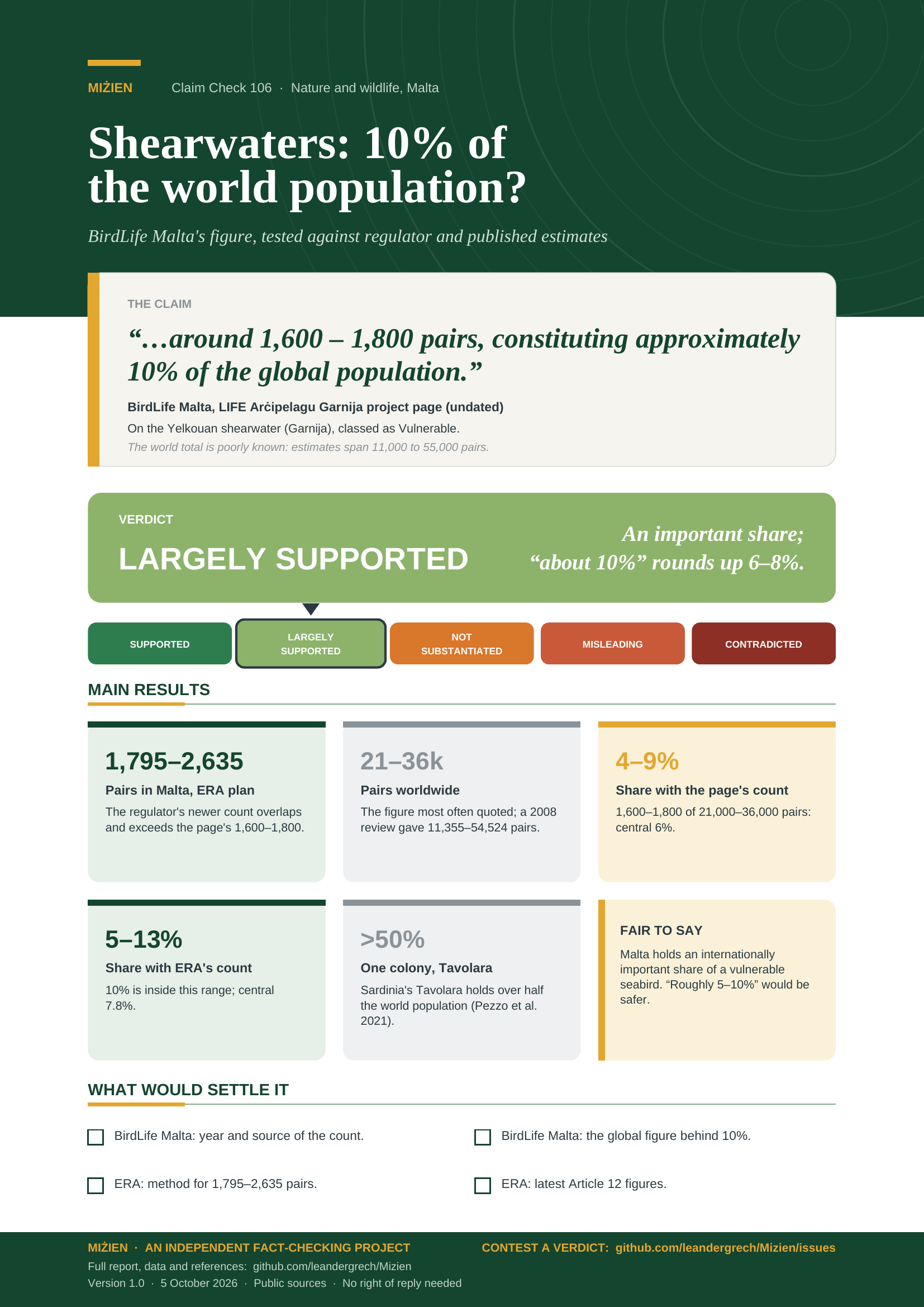
“Malta’s population is estimated to be around 1,600 – 1,800 pairs, constituting approximately 10% of the global population.”
BirdLife Malta, LIFE Arċipelagu Garnija project page (undated; read 5 October 2026).
On the Yelkouan shearwater (Garnija), classed as Vulnerable by the IUCN.
Verdict: Largely supported An important share; “about 10%” rounds up a central 6–8%
Version 1.0 · 5 October 2026
TL;DR
On its page for the LIFE Arċipelagu Garnija project, BirdLife Malta writes that the Yelkouan shearwater (Garnija) “Malta’s population is estimated to be around 1,600 – 1,800 pairs, constituting approximately 10% of the global population.” We compared both numbers with the regulator’s estimate and the published global estimates.
- Malta’s count is plausible but older than the regulator’s. The Environment and Resources Authority’s Species Action Plan 2022–2030 gives 1,795–2,635 breeding pairs, overlapping and above BirdLife Malta’s 1,600–1,800. The BirdLife page is undated; its project ran 2016–2020.
- The global population is poorly known. A peer-reviewed review (Bourgeois & Vidal 2008, Oryx) put it at 11,355–54,524 pairs, adding that most censuses are probably overestimates. The figure most often quoted today is 21,000–36,000 pairs (CIESM guide ◆).
- “About 10%” is at the top of the range. With BirdLife Malta’s own count and 21,000–36,000 global pairs, Malta’s share is 4.4–8.6% (central 6%). With the regulator’s count it is 5.0–12.5% (central 7.8%). The regulator also says “around 10%”.
- Verdict: largely supported (moderate confidence). Malta holds an internationally important share of a vulnerable seabird, which is the point of the sentence. The precise share cannot be pinned down, and the central estimates are closer to 6–8% than 10%.
- Supported
- Largely supported
- Not substantiated
- Misleading
- Contradicted
What would move the verdict up
A current, sourced global estimate under about 20,000 pairs, or a Maltese count near the top of the regulator’s range, either of which would put Malta at about 10%.
What would move it down
A current global estimate well above 36,000 pairs, or a new Maltese census below 1,600 pairs; then “about 10%” would overstate Malta’s share.
IN THIS REPORT
1 The claim and what we could verify
The sentence is on BirdLife Malta’s page for LIFE Arċipelagu Garnija (LIFE14 NAT/MT/000991, 2016–2020) [1], read on 5 October 2026; the page carries no date. The same text appears on the LIFE PanPuffinus project’s species page. The European Commission’s LIFE project page [2] describes the project’s aims (to increase breeding pairs by about 10% and reproductive output by 25%) but gives no population total.
| Source | What it says | Our access | Status |
|---|---|---|---|
| BirdLife Malta, LIFE Arċipelagu Garnija page [1] | “Malta’s population is estimated to be around 1,600 – 1,800 pairs, constituting approximately 10% of the global population.” | Read, 5 Oct 2026. | The claim |
| ERA, Species Action Plan 2022–2030 page [3] | “around 10% of the global breeding population … an estimated population of 1,795–2,635 breeding pairs”. | Internet Archive copy, 8 Aug 2025 (live site 403). | Regulator |
| Bourgeois & Vidal (2008), Oryx [4] | Global population 11,355–54,524 pairs; probably overestimated. | Full text read (free to read). | Peer-reviewed |
| CIESM seabird guide [5] | Global 21,000–36,000 pairs; 46,000–92,000 individuals. | Read; no source given ◆. | Context |
2 Method
Question. Is Malta’s population about 1,600–1,800 pairs, and is that about 10% of the world’s?
Evidence. We searched the peer-reviewed literature (OpenAlex, Crossref) and official sources for Maltese and global estimates, recorded them in data/cc-106/population_estimates.csv, and computed Malta’s share for each combination (tools/cc-106-report/calc.py): the lowest Maltese estimate over the highest global one, the reverse, and the ratio of midpoints. The IUCN Red List and BirdLife International data pages refused automated access, and we could not query the EU Birds Directive (Article 12) reports directly, so the current official global estimate is known to us only through the CIESM guide.
Grades. Bourgeois & Vidal (2008): C (review). ERA plan: C (official). CIESM guide: C, second-hand. Verdicts follow the five-point scale in Appendix A.
3 What the evidence shows
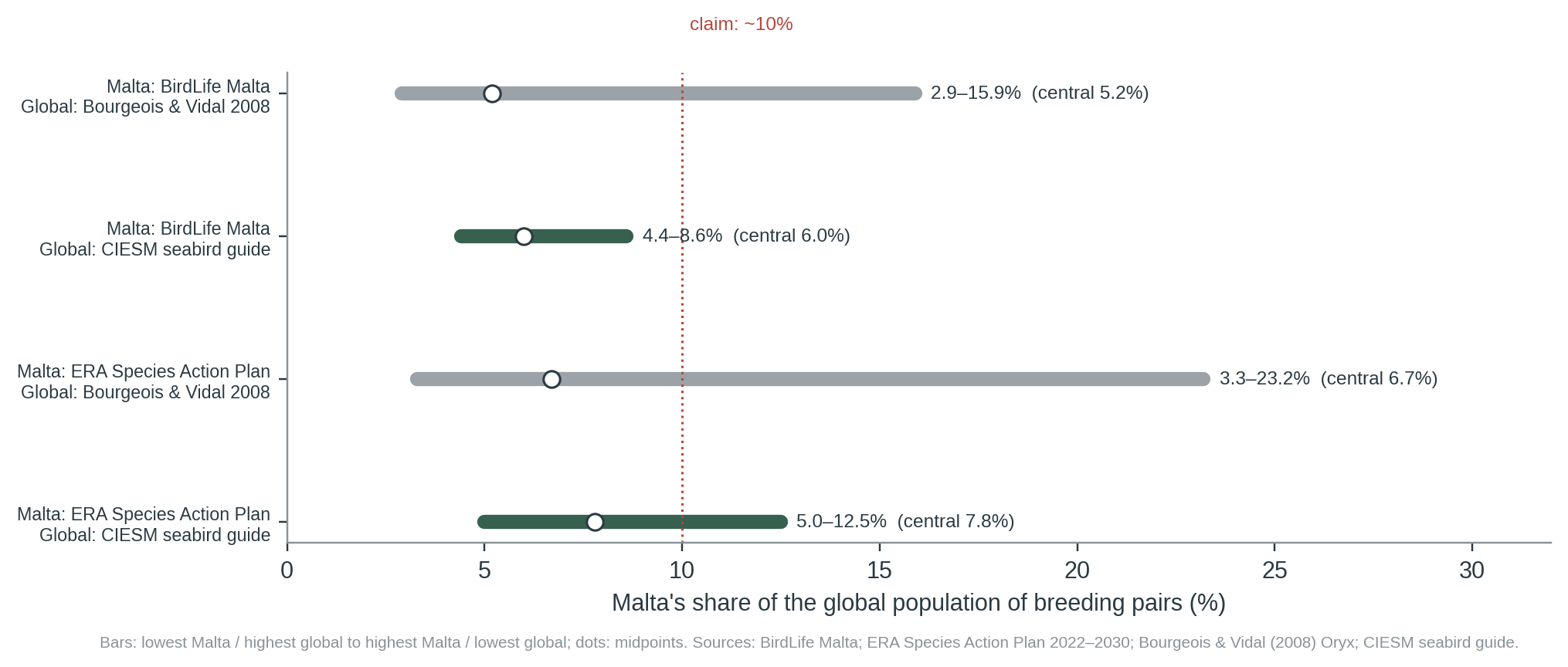
With the counts BirdLife Malta states, Malta’s share cannot exceed 8.6% unless the global population is below about 21,000 pairs. With the regulator’s newer count, 10% falls inside the range. The 2008 review’s range is so wide that it supports anything from 3% to 23%. A study of the largest colony, Tavolara in Sardinia, estimates it holds more than half of the world population (Pezzo et al. 2021) [6].
4 Where the evidence points different ways
Is “approximately 10%” fair?
AT THE TOP OF THE RANGEFOR
The regulator uses the same figure with a higher Maltese count, and 10% lies inside the range for that count (5–12.5%). The global total is uncertain enough that 10% cannot be ruled out.
AGAINST
The page’s own count, with the most-quoted global estimate, gives 4.4–8.6%. Central estimates are 6–8%. No source we found gives a calculation behind “10%”.
5 Testing the claim
| Sub-claim | Said by | What the evidence shows | Rating |
|---|---|---|---|
| A. Malta’s population is around 1,600–1,800 pairs | BirdLife Malta [1] | Overlaps the regulator’s 1,795–2,635 pairs (2022–2030 plan); the page is undated and its count is the lower. | PLAUSIBLE, DATED |
| B. …approximately 10% of the global population | BirdLife Malta [1] | 4.4–8.6% with the page’s own count; 5.0–12.5% with the regulator’s; central 6–8%. Global total poorly known. | UPPER END OF RANGE |
6 Verdict and requests for evidence
Malta holds an important share; “about 10%” rounds up a share closer to 6–8%. Confidence: moderate.
Why. Both numbers are of the right order and consistent with official and scientific sources, but the share is at the upper end of what the estimates allow and the global total is poorly known. Confidence is moderate because we could not read the current IUCN and Article 12 figures directly. What this verdict does not say. It does not question the species’ conservation need or BirdLife Malta’s conservation work; it tests a population share.
Evidence we are asking for
- From BirdLife Malta: the year and source of the 1,600–1,800 pairs, and the global figure behind “10%”.
- From ERA: the method behind 1,795–2,635 pairs and Malta’s latest Article 12 report figures.
7 Limitations
- The IUCN Red List and BirdLife International datazone refused automated access; the 21,000–36,000 figure is from the CIESM guide, which gives no source (◆).
- Seabird colonies in cliffs and caves are hard to census; all estimates are ranges with wide uncertainty.
- The ERA plan page was read from an Internet Archive copy; the plan document itself was not read.
References
- [1] BirdLife Malta (undated). LIFE Arċipelagu Garnija. Read 5 Oct 2026. https://birdlifemalta.org/arcipelagugarnija/
- [2] European Commission, CINEA. LIFE14 NAT/MT/000991 LIFE Arċipelagu Garnija, project page. https://webgate.ec.europa.eu/life/publicWebsite/project/LIFE14-NAT-MT-000991/life-arcipelagu-garnija---securing-the-maltese-islands-for-the-yelkouan-shearwater-puffinus-yelkouan
- [3] Environment and Resources Authority. Malta Yelkouan Shearwater Species Action Plan 2022–2030 (page). Internet Archive copy of 8 Aug 2025. https://era.org.mt/malta-yelkouan-shearwater-species-ap-2022-2030/
- [4] Bourgeois K. & Vidal E. (2008). The endemic Mediterranean yelkouan shearwater Puffinus yelkouan: distribution, threats and a plea for more data. Oryx 42(2):187–194. doi:10.1017/S0030605308006467. https://doi.org/10.1017/S0030605308006467
- [5] CIESM. Mediterranean seabird guide: Yelkouan shearwater. ◆ https://ciesm.org/seabird-guide/yelkouan-shearwater/
- [6] Pezzo F. et al. (2021). Productivity changes in the Mediterranean Sea drive foraging movements of yelkouan shearwater Puffinus yelkouan. Marine Ecology 42:e12668. doi:10.1111/maec.12668. (Abstract read.) https://doi.org/10.1111/maec.12668
- [7] MiŻien. Estimates and calculation: data/cc-106/; tools/cc-106-report/calc.py.
Appendix A: series standards and verdict scale
Every investigation in this series follows the same rules so that verdicts are comparable and challengeable.
| Verdict | Meaning |
|---|---|
| SUPPORTED | Evidence consistently backs the claim as stated. |
| LARGELY SUPPORTED | Backed by the evidence, with minor caveats that do not change the substance. |
| NOT SUBSTANTIATED | Stated more strongly than the evidence offered or available allows. May be true in some conditions but has not been shown. |
| MISLEADING | Omits material facts so that the overall impression is inaccurate, even if individual statements are defensible. |
| CONTRADICTED | The available evidence points against the claim. |
Confidence
High: multiple independent lines of evidence agree. Moderate: evidence is relevant but incomplete or indirect. Low: evidence is thin, second-hand or conflicting.
Evidence grades
A experiment · B observational study with a control or gradient · C review, guidance or official statistics · D assertion or anecdote. ◆ marks a source known only second-hand.
Standards
- Quote the speaker, not the headline, with outlet and date, and link the original where possible.
- Separate the claim from the evidence offered for it, and say who made which statement.
- Grade the evidence and show differing views side by side where the evidence is unsettled.
- State what we could not access or verify, and what would change the verdict either way.
- Ask for the missing evidence in specific, answerable requests.
- Offer a right of reply where a check finds a claim Not substantiated, Misleading or Contradicted (or a pledge Not measurable, Off track or Missed), before wider circulation, and append responses.
- Correct errors openly with a version number and change log.
- Whistle-blow only on evidence: a verdict of Misleading or Contradicted requires documents or data that can be shown, not inference.
- Check every side. Government, opposition, NGOs and developers are held to the same standard.
Appendix B: revision log
| Version | Date | Change |
|---|---|---|
| 1.0 | 5 Oct 2026 | First issue. Verdict Largely supported (moderate confidence); no right of reply needed. |
Sources and archived copies
-
LIFE Arċipelagu Garnija, BirdLife Malta, n/d.
Original · Archived copy
The claim. Undated page (project 2016-2020); read 5 Oct 2026. -
Malta Yelkouan Shearwater Species Action Plan 2022-2030 (page), Environment and Resources Authority, n/d.
Original · Archived copy
1,795-2,635 pairs, 'around 10%'. Live site 403; Internet Archive copy of 8 Aug 2025. -
The endemic Mediterranean yelkouan shearwater Puffinus yelkouan: distribution, threats and a plea for more data, Oryx 42:187-194, 2008.
Original · fetched and fingerprinted 2026-10-05; no public snapshot yet
Peer-reviewed review: global 11,355-54,524 pairs, probably overestimated. -
Yelkouan shearwater (seabird guide), CIESM, n/d.
Original · Archived copy
Global 21,000-36,000 pairs; no source given (second-hand).
Right of reply
Not needed: this check finds the claim supported. A right of reply is sought when a check finds a claim Not substantiated, Misleading or Contradicted.
Connections
How this claim relates to the others: who made it, the themes it shares with other claims, and the patterns it shows. A connection is a reason to read two checks side by side. It does not make either one right or wrong. How connections are found.
Who made it
Other claims by BirdLife Malta 2
Linked directly 0
Not yet linked to another claim by a theme.
Similar wording
Claims whose own words overlap with this one, with the words they share. Found by comparing the wording of the claims, not their verdicts; a lead to read them together, not a finding.
- CC-088 Population 588,254 (Supported)shares: population, estimated
Timeline
What was said, what was published before and after it, and each step of this check, in date order. Statements and sources carry the date they were published. The steps of the check carry the date the research was done, from the check's research log. Other statements by the same body on the same topic show whether a position was repeated, changed or corrected.
2008
- 2008 Evidence published The endemic Mediterranean yelkouan shearwater (Oryx 42:187-194), Bourgeois & Vidal
2025
- 10 October 2025 Statement by BirdLife Malta on Nature & Wildlife CC-049 242 illegal hunting incidents (not yet checked)
2026
- 27 May 2026 Statement by BirdLife Malta on Nature & Wildlife CC-050 'Race to weaken hunting laws' (Not substantiated)
- 4 October 2026 Added to the claims to check
- 5 October 2026 Exact wording found Wording confirmed on the BirdLife Malta page (undated). ERA Species Action Plan page read from an Internet Archive copy.
- 5 October 2026 Note Bourgeois & Vidal (2008) Oryx read in full and verified in Crossref; Pezzo et al. (2021) abstract read; IUCN and BirdLife datazone refused automated access; CIESM guide used for the current global estimate (second-hand).
- 5 October 2026 Version 1.0: first issue First issue. Verdict Largely supported (moderate confidence); no right of reply needed. Verdict in this version: Largely supported, moderate confidence.
- 5 October 2026 Evidence reviewed
2027
- 5 October 2027 Coming up: Evidence review due Each finished check is reviewed against new evidence within a year.
Every change to this claim's record is public: history of the record.
Download the report and flyer