Training RL agents
Answer so far. PPO is at least as good as TRPO on this task and about twice as fast. Across four PPO seeds the best gate ranges from J_T = 1.1e-4 to 9.8e-4. The best seed matches the paper's agent (9.5e-5), so the gap seen in our first TRPO run was seed-to-seed variation, not a flaw in the JAX re-implementation.
Setup for every run: the paper's environment and budget (20M environment steps, 8,192 steps per update, [128, 128] ReLU networks, harmonic learning-rate decay from 3e-4), float64 on the laptop CPU.
Best gate per run
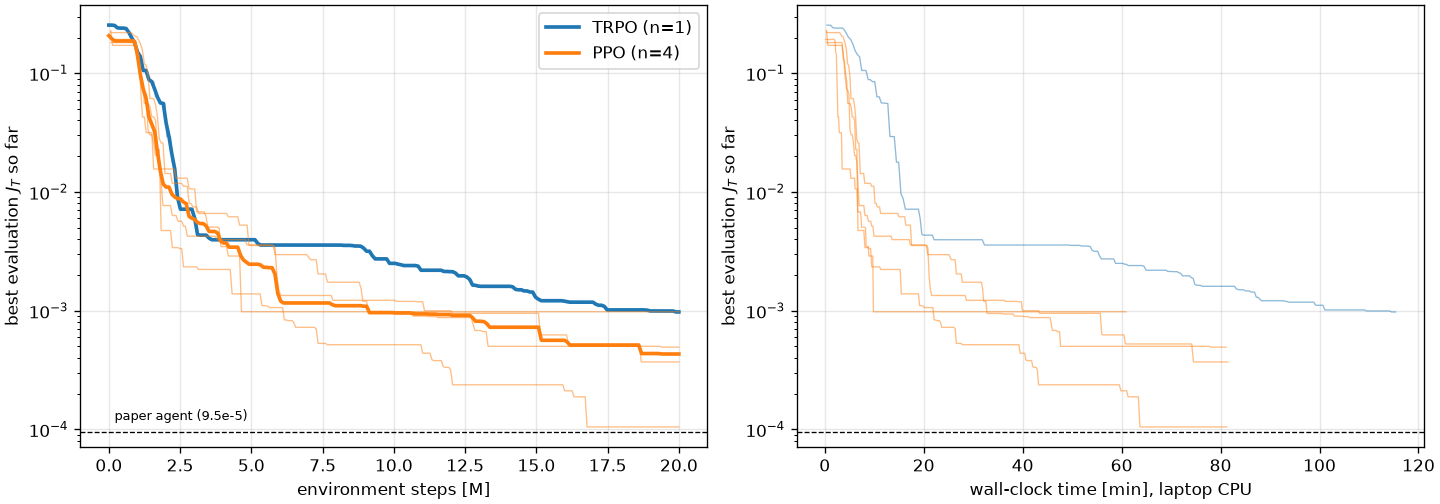
Left: best evaluation J_T so far against environment steps (thin: each seed, thick: median). Right: the same against wall-clock time. Dashed: the paper's agent.
| Run | Best J_T | 1 − U at the best step | Reached at | Steps until J_T < 1e-2 | Wall time |
|---|---|---|---|---|---|
| TRPO, seed 123 | 9.8e-4 | 1.3e-3 | 19.9M | 2.4M | 115 min |
| PPO, seed 123 | 9.8e-4 | 1.3e-3 | 4.7M | 3.1M | 61 min |
| PPO, seed 1 | 4.9e-4 | 6.4e-4 | 19.4M | 1.9M | 81 min* |
| PPO, seed 2 | 3.7e-4 | 4.9e-4 | 18.7M | 2.8M | 81 min* |
| PPO, seed 3 | 1.1e-4 | 1.4e-4 | 16.8M | 1.8M | 81 min* |
| PPO, median of 4 | 4.3e-4 | 5.7e-4 | 2.4M | ||
| Paper agent (v1, TRPO) | 9.5e-5 | 1.3e-4 | 12.6M | ~9 h |
* Seeds 1-3 ran in parallel with other jobs on the same CPU. Alone, a PPO run takes about an hour.
- The breakthrough is reproducible. Every run crosses J_T = 1e-2 between 1.8M and 3.1M steps, where the paper's agent broke through as well.
- The remaining error is leakage. At every best step the concurrence is 1 and J_T ≈ ¾(1 − U). The agent finds the entangling interaction early and then slowly learns to keep population in the computational subspace.
- Seeds matter more than the algorithm. One seed of either algorithm says little: PPO seeds span a factor of 9 in best J_T.
Losses and training diagnostics
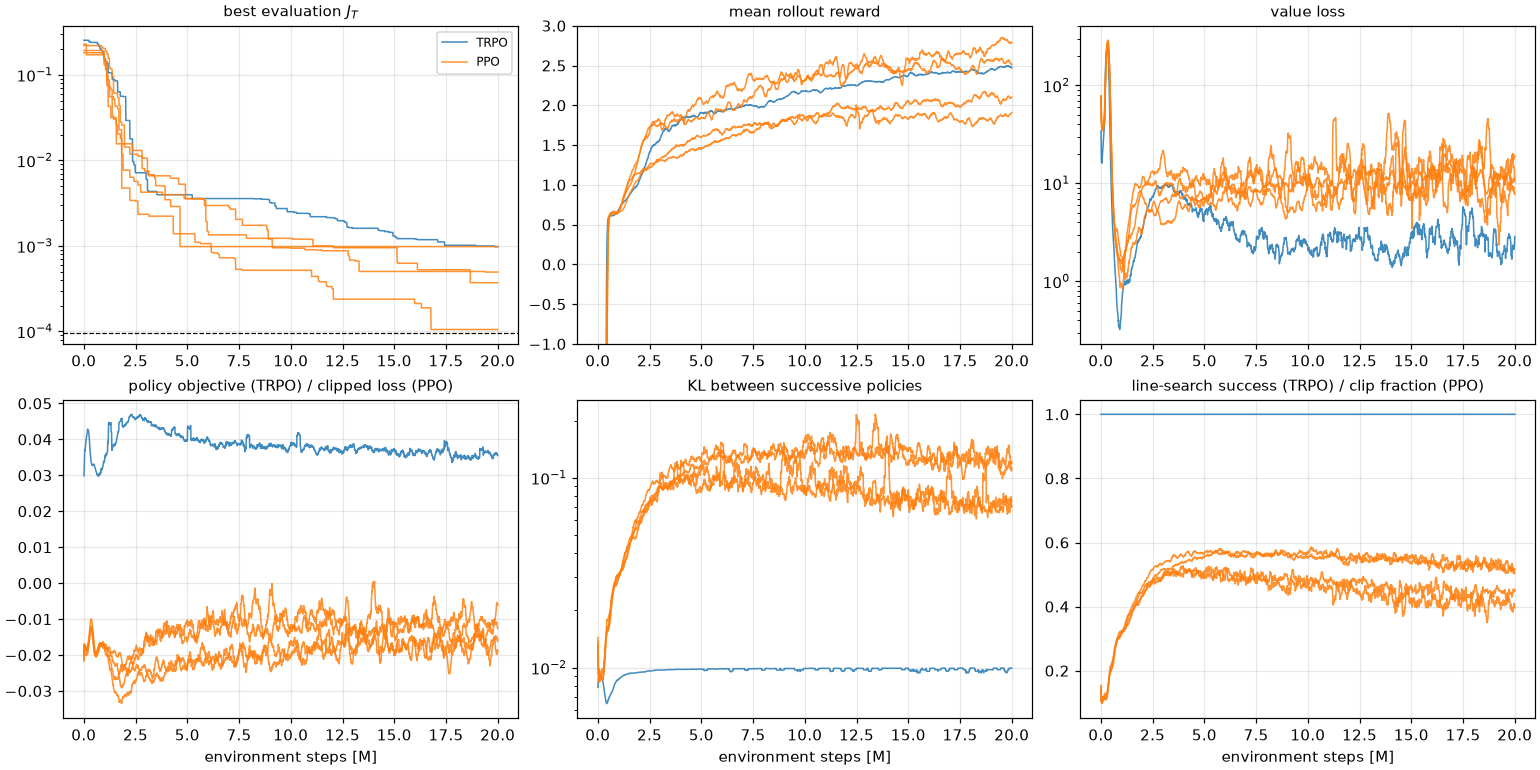
Smoothed over 20 updates. TRPO in blue, the four PPO seeds in orange.
- Mean rollout reward rises within the first million steps as the agent stops leaving the amplitude bound (each violation costs up to −20).
- Value loss spikes during that phase, then settles; it stays higher for PPO than for TRPO.
- KL between successive policies: TRPO holds its 0.01 limit by construction.
- PPO updates are too aggressive. Its KL per update settles near 0.1 and its clip fraction near 0.5; healthy PPO training usually sits around 0.01-0.02 and 0.1-0.2. This is the likely reason PPO's evaluation J_T wanders late in training (seed 123 was at 3e-3 at 20M after 9.8e-4 at 4.7M), so the best checkpoint, not the last, should be kept.
Tried since: a KL brake stalls learning
A target-KL early stop brought the clip fraction down but let through only 2-7 % of the planned minibatch steps late in training, and plain PPO with the brake stalled at J_T ≈ 0.2 (badger). This task needs PPO's large steps; keep the best checkpoint rather than braking the updates. Given the seed spread, compare settings on at least four seeds.
What this means
For the paper's task, a single PPO run on a laptop reaches the paper's result in about an hour. The trained agents' residual leakage is also what GRAPE refinement removes in seconds. The more interesting question is therefore not how to squeeze more out of training but what a trained agent buys over re-optimising: see Robustness to hardware drift.