RLQuantOpt¶
Reinforcement learning that shapes the control pulses of superconducting quantum computers, fast enough to track a drifting device.
Work in progress: open-source active research
This is ongoing research by Leander Grech, shared openly as it happens. Code, results and conclusions may change; the settled results are those of the published paper [grech2026].
-
~10 ns entangling gates
An RL agent finds a perfect-entangling pulse at the quantum speed limit of the model.
-
~100× faster simulation
v2 in JAX: exact, differentiable, ~40k environment steps/s on a laptop CPU.
-
Hardware drift built in
Robustness scored against measured drift of real transmons, from hours to new devices.
-
A gate from one calibration
A policy that reads only a routine frequency calibration (~1e4 shots) plays a √iSWAP pulse open loop on every drifted device. The new MDP
-
An idea farm for sample-efficient RL
Ten ideas, each with a codename, a status stamp and the lessons it taught. The farm
-
Looking for hardware time
We want to test RL-controlled pulses on a real device. Get in touch.
The idea¶
RLQuantOpt is a curiosity-driven research effort. The question: can an agent that learns from trial and error design the microwave-scale control pulses of a quantum processor as well as, or better than, gradient-based optimal control, while adapting when the hardware drifts?
In simulation, the answer so far is encouraging. An RL agent found a two-qubit perfect-entangling gate in about 10 ns, matching the speed limit found by optimal control [grech2026]. Its pulses can be refined further by gradient methods, and a policy can re-generate pulses for a slightly different device without re-optimisation.
Since then the work has turned to what a real device demands: only measurable observations, a gate fidelity a lab reports, finite measurement shots, and as few experiments as possible. The current policies read a routine calibration of the device and play a whole pulse without measuring anything during it (The calibration policy), and a series of research ideas asks, more generally, what makes reinforcement learning sample-efficient on real, drifting systems (the idea farm).
Our outstanding goal is hardware. We are looking for collaborators who can provide time on a superconducting quantum processor, to test RL-generated pulses on a real device and to study how RL can make calibration faster and the use of scarce hardware time more efficient. Get in touch.
How it works (v1, the published design)¶
Since v2.18: a calibration policy
The current policies no longer watch the quantum state. They read a routine frequency calibration of the device and steer a carrier pulse open loop: see The calibration policy (new MDP).
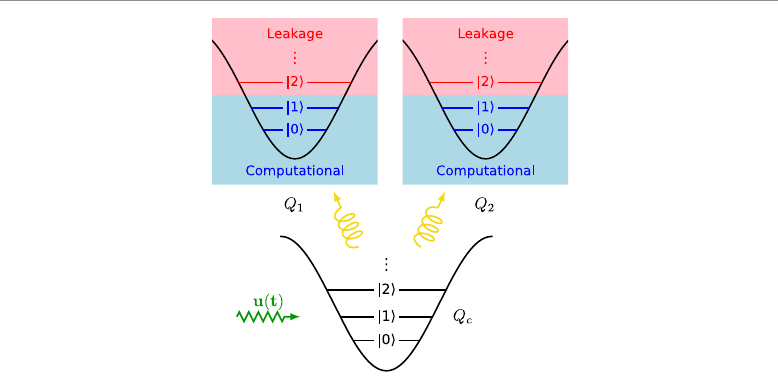
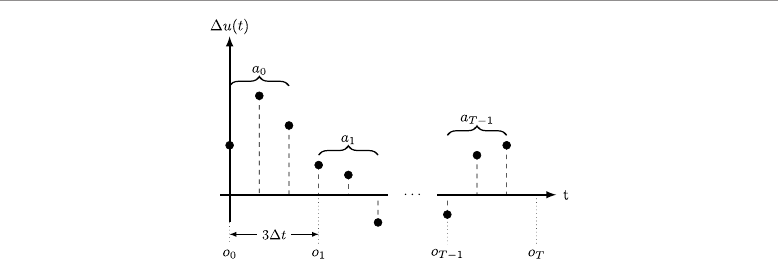
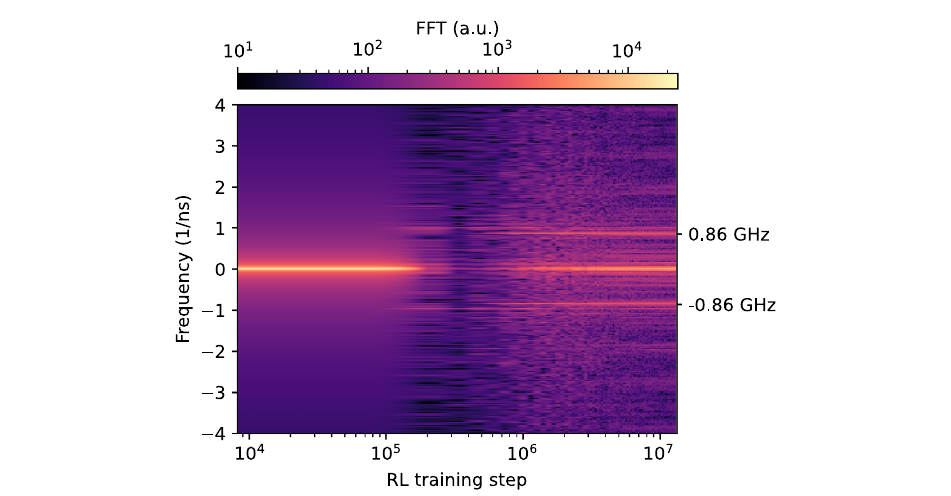
Modulating the bus at the qubit-qubit detuning (0.86 GHz) activates an iSWAP-type interaction, the parametric scheme demonstrated experimentally by [mckay2016]. The agent does not set the pulse amplitude directly. At each step it proposes three amplitude changes, each held for 50 ps, which are added to the previous amplitude:
Why fine, delta-parameterised pulses¶
Earlier RL pulse design used piecewise-constant pulses sampled every 10 ns, about 50 MHz of bandwidth, which cannot represent the GHz-scale features a transmon gate needs ([grech2026], section 1.1). v1 samples every 50 ps and lets the agent move the amplitude in bounded steps, which keeps the pulse continuous-looking and its slew rate limited. The difference is not cosmetic. Re-sampling the paper's RL pulse more coarsely, with the same simulator:
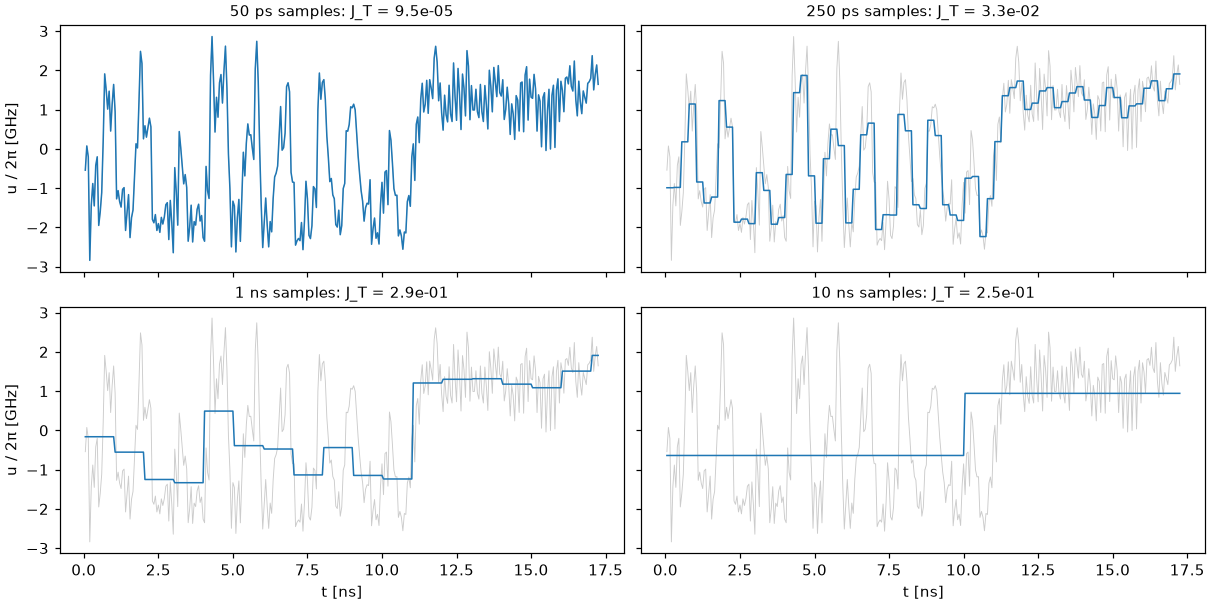
| Sampling of the same pulse | J_T at 17.25 ns |
|---|---|
| 50 ps (v1) | 9.5e-5 |
| 250 ps | 3.3e-2 |
| 1 ns | 2.9e-1 |
| 10 ns | 2.5e-1 (no entangling gate) |
(Coarsening a pulse optimised at 50 ps is harsher than optimising at a coarse sampling from the start; the point is that the gate relies on sub-nanosecond structure.)
How it compares¶
| Gate | Time | Fidelity or error | Setting | |
|---|---|---|---|---|
| This project (v1 RL pulse) | perfect entangler | 17 ns | J_T = 9.5e-5 | simulation, closed system |
| Parametric iSWAP on a tunable bus [mckay2016] | iSWAP | 183 ns | 98.2 % | experiment |
| Tunable coupler, CZ / iSWAP [sung2021] | CZ, iSWAP | — | 99.76 % / 99.87 % | experiment |
| Double-transmon coupler, RL-optimised [li2024] | CZ | — | 99.90 % | experiment |
The simulated number is not comparable to the experimental ones: it has no decoherence, an idealised control line and a perfect-entangler target rather than a named gate. Closing that gap is exactly what hardware collaboration is for.
Current simplifications¶
The paper's model is idealised. Where each simplification stands:
| Simplification in the paper's model | Status |
|---|---|
| Perfect-entangler target, not a named gate | Removed (v2.16): √iSWAP average gate fidelity with free virtual-Z corrections, leakage included (Gate metrics) |
| State amplitudes as observations (not measurable) | Removed (v2.16-v2.18): readout populations and Pauli expectations, finite shots, or only a frequency calibration (the new MDP) |
| RWA couplings, excitation number conserved | Being removed in the realistic device model: counter-rotating terms kept (jackal, in progress) |
| Linear control u·b†b, no flux non-linearity | Being removed: the coupler is tuned through an asymmetric-SQUID flux curve, couplings scale with it (jackal) |
| Unbounded coupler excursion, no flux-line filter | Being removed: bounded flux, 1 ns AWG samples, a first-order flux-line filter (jackal) |
| Closed system, T1/T2 only at evaluation | Open |
| Two qubits, no spectators | Open |
Each is discussed, with what it would take to remove it, in Named gates and a richer model.
History and credits¶
- v1 (2024-2025), the published work [grech2026]: the ZCQPEE environment and TRPO agents. Mirko Consiglio carried out the mathematical and physical validation of v1, and Matthias G. Krauss validated it independently with separate Julia simulations.
- v2 (from September 2026), this site: a JAX re-implementation that runs ~100× faster, is differentiable end to end, reproduces the paper, and adds gradient-based baselines and hardware drift models. Start with Working together or the Model and simulator.
- Since v2.16: a named gate and measurable observations (gecko), data-lean calibration policies (ibis), a realistic tunable-coupler device (jackal), and the idea farm of research agents.
- Next: identifying the drift a calibration cannot see (hippogriff on jackal's device), tracking a drifting device with few samples, and hardware. Collaborate with us.
What changed recently¶
Latest
- Docs consolidated (v2.19): every idea carries a status stamp (🟢 active, 🏁 concluded, 📦 archived); the idea farm states its lessons for sample-efficient RL on real systems and the next step, tracking with improvement equivalence (the farm); the code pages walk through PPO and every research agent (Agents, Research agents).
- Ibis concluded (v2.19): the open-loop calibration policy holds over four seeds (1 − F = 3.7-4.6e-3 on all 24 drifted devices), with a 1.4k-parameter network, with calibration errors 10× larger than in training (92-99 % of devices below 1e-2) and with drift the calibration cannot see; 33 decisions per pulse learn faster (0.46M steps) at 5.2e-3 (ibis).
- A realistic device (jackal, v2.20, in progress): on a tunable-coupler model without RWA, with direct coupling, a SQUID-tuned coupler, 1 ns AWG, a flux-line filter and physical drift, a calibration policy trained on the simplified model loses 35× (1.1e-3 → 3.7e-2); trained on the realistic model it gives 7.2e-3 on drifted devices (75 % below 1e-2), about 5× from what its knobs can reach (jackal).
- The calibration policy (v2.18.0): a policy that sees only a frequency calibration, measured once, and steers the knobs of a carrier reaches 1 − F = 3.9e-3 on all 24 large-coupler-drift devices with about 1e4 shots per device, open loop, in 0.72M training steps (the new MDP, ibis).
- Identifying the drift (v2.18.1): a drift-conditioned policy with an exact Bayesian belief recovers 575-627 of an oracle's 655 in the first episode on toy devices; a linearised belief was overconfident (hippogriff).
The full history is in the changelog.