CC-088 · Tourism & Population · Population & labour
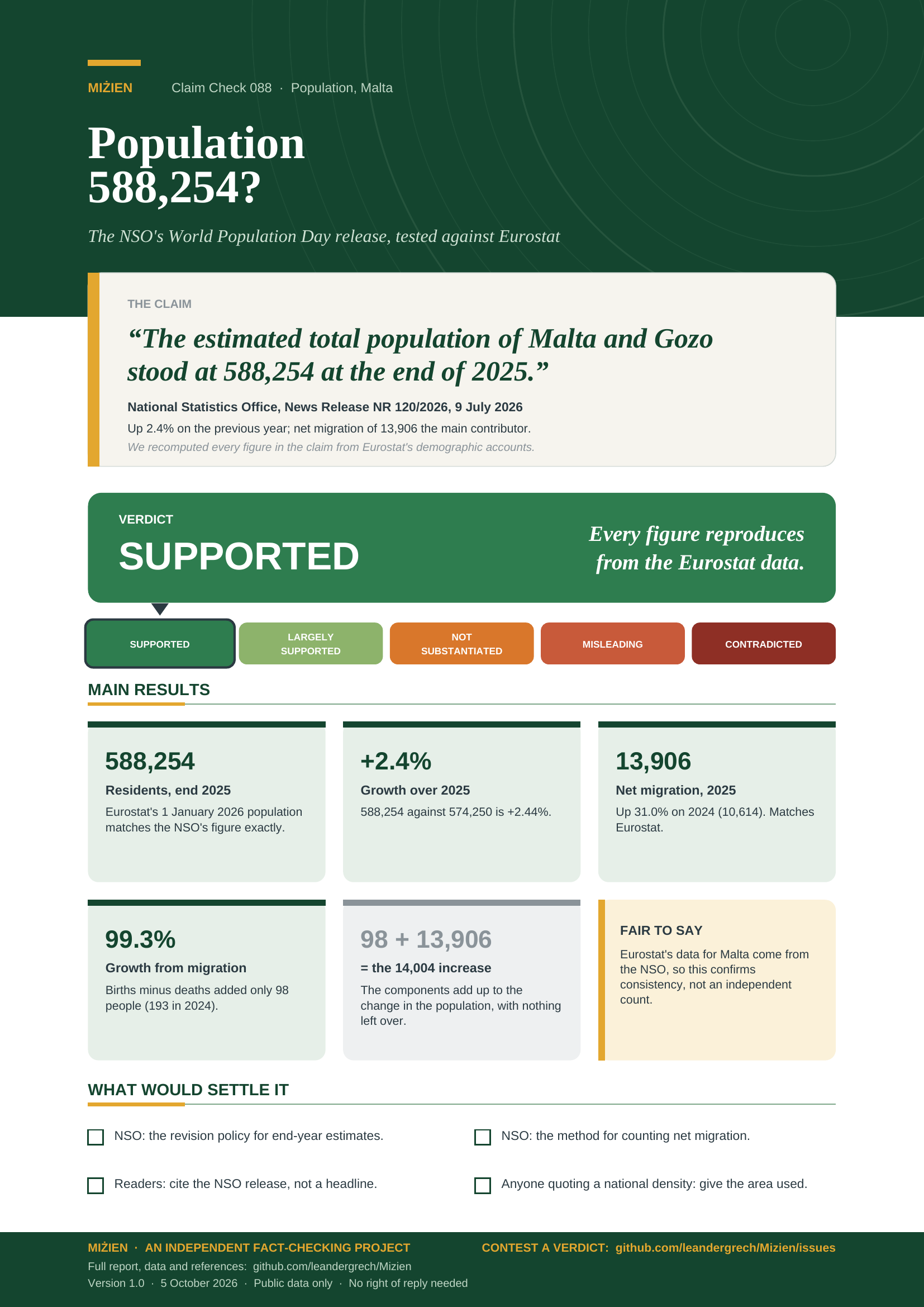
Population 588,254
Supported High confidence Draft: no right of reply needed
Parts of this claim
The claim is split into parts that are tested separately, as in the report below. Each part has its own number.
- CC-088A Population reached 588,254 at the end of 2025 (NSO [1])Eurostat demo_gind: 588,254 on 1 January 2026. Reported as an estimate.
- CC-088B …an increase of 2.4% on the previous year (NSO [1])588,254 / 574,250 = +2.44%, which rounds to 2.4%.
- CC-088C Net migration was 13,906 in 2025, the main contributor to growth (NSO [1])Eurostat: 13,906. Natural increase 98. Migration is 99.3% of the 14,004 increase; net migration up 31.0% on 2024.
Claim Check 088 · Statistics, Malta
Population 588,254?
Testing the NSO’s World Population Day release against Eurostat’s demographic accounts
“The estimated total population of Malta and Gozo stood at 588,254 at the end of 2025.”
National Statistics Office, News Release NR 120/2026, 9 July 2026.
Up 2.4% on the previous year; net migration of 13,906 the main contributor.
Verdict: Supported Every figure reproduces from Eurostat; the release is internally consistent
Version 1.0 · 5 October 2026
TL;DR
On 9 July 2026, for World Population Day, Malta’s National Statistics Office (NSO) published news release NR 120/2026. It says: “The estimated total population of Malta and Gozo stood at 588,254 at the end of 2025, up by 2.4 per cent when compared to the previous year.” It adds that net migration of 13,906 persons “was the main contributor to population growth in 2025”. We read the release and recomputed every figure in the claim from Eurostat’s demographic accounts.
- The headline figure reproduces. Eurostat’s population on 1 January 2026 is 588,254, and 588,254 / 574,250 is +2.44% over 2025.
- Net migration of 13,906 reproduces, and it is the main driver. Net migration was up 31.0% on 2024 (10,614). Births minus deaths added only 98 people (193 in 2024). Migration accounts for 99.3% of the 14,004 increase.
- The arithmetic is consistent. 98 + 13,906 = 14,004 = 588,254 − 574,250, with no statistical adjustment left over. Every other percentage in the release that we could test (births −0.8%, deaths +1.4%, natural increase −49.2%) reproduces.
- Verdict: supported (high confidence). One caveat on independence: Eurostat’s Maltese data come from the NSO, so agreement confirms transmission and arithmetic, not an independent count. The figure is an estimate.
- Supported
- Largely supported
- Not substantiated
- Misleading
- Contradicted
What would move the verdict up
Supported is the top of the scale, so nothing moves it up.
What would move it down
A revision of the 2025 estimate that changes the population or net migration materially. The NSO revises estimates when new data arrive; this check is of the figures as released in July 2026.
IN THIS REPORT
1 The claim and what we could verify
The claim record paraphrases a news report: “Malta’s population rose to 588,254 at the end of 2025 (+2.4%), with net migration of 13,906 the main driver”. The primary text is the NSO’s release NR 120/2026, “World Population Day: 11 July 2026”, dated 9 July 2026 [1]. nso.gov.mt refuses automated downloads, so we read the release in full from an Internet Archive copy. MaltaToday [2] and Lovin Malta [3] report the same figures; they locate the release and are not evidence.
| Source | What it says | Our access | Status |
|---|---|---|---|
| NSO, NR 120/2026, 9 Jul 2026 [1] | “The estimated total population of Malta and Gozo stood at 588,254 at the end of 2025. This is an increase of 2.4 per cent when compared to the previous year.” “Net migration (immigration minus emigration), amounting to 13,906 persons, was the main contributor to population growth in 2025.” | Full text read (Internet Archive copy of the release page). | The claim |
| MaltaToday, 9 Jul 2026 [2] | Reports the same figures from the release. | Read via Internet Archive. | Locator, ◆ second-hand |
| Eurostat, demo_gind [4] | Population on 1 January, births, deaths, natural increase, net migration. | Downloaded 5 Oct 2026 (data/cc-088/). | Cross-check |
2 Method
Question. Do the population, its growth and the size and role of net migration in the NSO’s release reproduce from published data, and are they internally consistent?
Evidence. We downloaded Eurostat’s demographic balance for Malta (demo_gind, updated 30 September 2026) and recomputed each figure in the claim and the percentages the release gives for births, deaths and natural increase (tools/cc-088-report/fetch.py and calc.py; outputs in data/cc-088/checks.csv). Eurostat’s “population on 1 January 2026” is the NSO’s end-2025 figure. We also tested that the components (natural increase plus net migration) add up to the change in the stock. Independence. Eurostat publishes the figures that the NSO transmits, so agreement shows the release is internally consistent and matches the figures Malta reports to the EU. It is not an independent count; the NSO is the only source for Malta’s resident population.
Grades. Official statistics, grade C. No literature is needed to test the figure. Verdicts follow the five-point scale in Appendix A.
3 What the data show
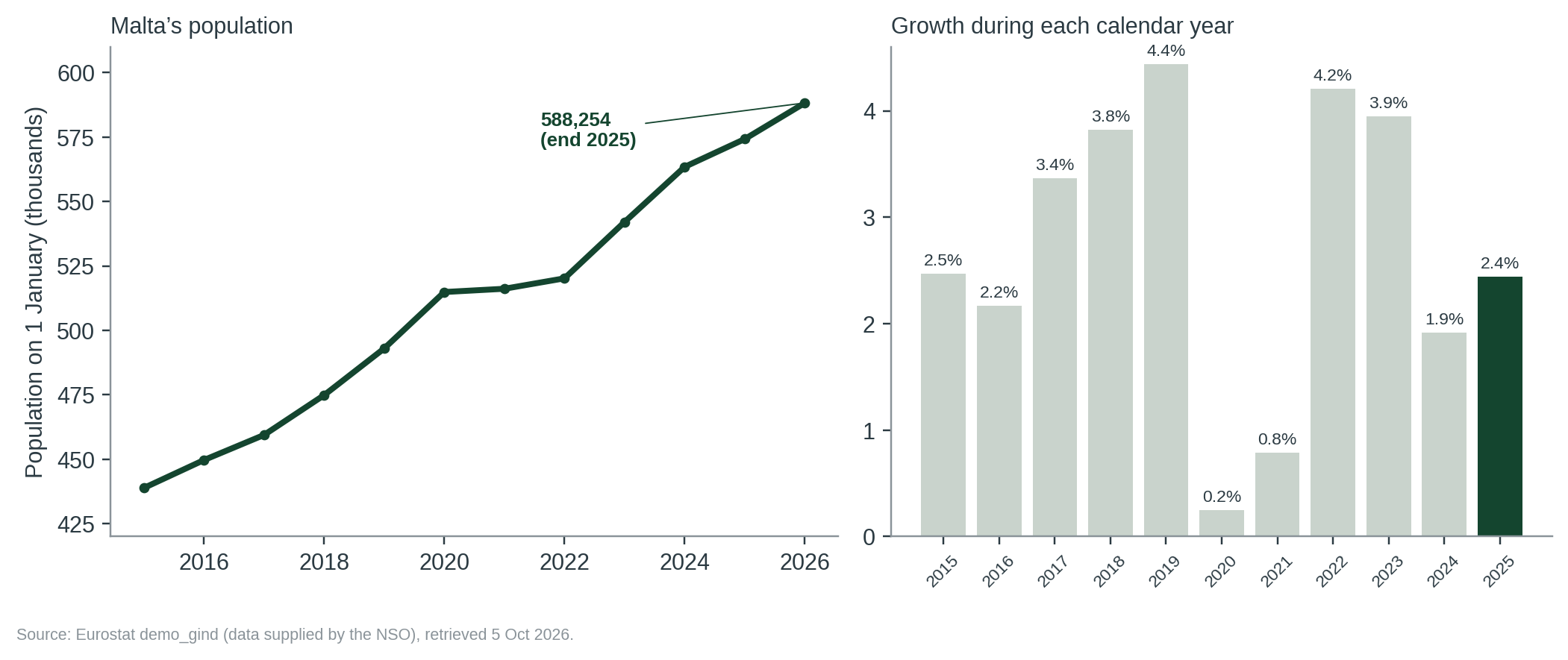
Malta’s population rose from 439 thousand on 1 January 2015 to 588 thousand on 1 January 2026. Growth peaked at 4.2% in 2022 (the year of the highest net migration), slowed to 1.9% in 2024 and recovered to 2.4% in 2025.
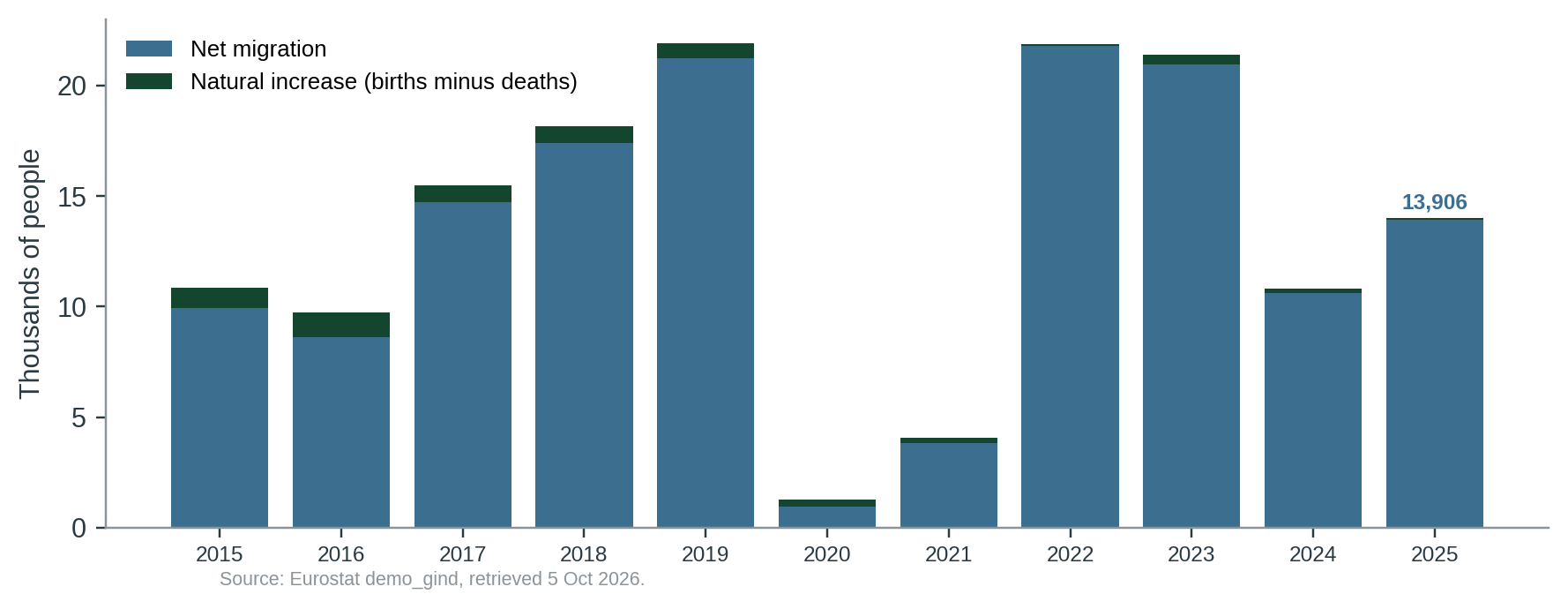
Net migration has accounted for 98–99.6% of annual growth in each of the last four years. The NSO notes that “both immigration and emigration decreased” in 2025, so the rise in net migration from 10,614 to 13,906 reflects emigration falling by more than immigration, not a surge in arrivals. We did not test the immigration and emigration flows themselves.
4 Where the evidence points different ways
Do other sources give different figures?
NOT TESTABLE FROM THE RELEASEAGREEMENT
NSO NR 120/2026 and Eurostat demo_gind give identical population (588,254), net migration (13,906) and natural increase (98) for 2025. We found no published figure that disagrees.
OPEN POINT
The claim record notes that national density figures “differ by source” (1,731 against 1,838 per km²). The release gives densities only for localities (for example Tas-Sliema, 18,186 per km²), not for Malta as a whole; Eurostat’s density table gives 1,817.4 for 2024 and no 2025 value. Density is not part of the claim.
5 Testing the claim
| Sub-claim | Said by | What the evidence shows | Rating |
|---|---|---|---|
| A. Population reached 588,254 at the end of 2025 | NSO [1] | Eurostat demo_gind: 588,254 on 1 January 2026. Reported as an estimate. | ACCURATE |
| B. …an increase of 2.4% on the previous year | NSO [1] | 588,254 / 574,250 = +2.44%, which rounds to 2.4%. | ACCURATE |
| C. Net migration was 13,906 in 2025, the main contributor to growth | NSO [1] | Eurostat: 13,906. Natural increase 98. Migration is 99.3% of the 14,004 increase; net migration up 31.0% on 2024. | ACCURATE |
6 Verdict and requests for evidence
Every figure in the claim reproduces from the Eurostat data and the release is internally consistent. Confidence: high.
Why. The population, its growth, the net migration figure and its role as main driver all match Eurostat’s demographic balance, and the components sum to the change in the stock. The report’s confidence is high for the question asked, which is whether the NSO’s figures are consistent with what Malta reports to Eurostat. What this verdict does not say. It does not assess how the NSO estimates the resident population or migration (the method is outside this check), and it takes no view on migration policy or on the causes of the 2025 change.
Evidence we are asking for
- From the NSO: the source of the national density figures (1,731 and 1,838 per km²) that circulate, if it is an NSO series.
- From the NSO: the revision policy for the end-year estimates and the method used to count net migration.
7 Limitations
- Eurostat’s data for Malta come from the NSO, so the cross-check is not independent. The population is an estimate, and estimates can be revised.
- We read the release from an Internet Archive copy of the NSO page because nso.gov.mt refuses automated access. We did not read the release’s tables (the page links them) and did not test the citizenship, age, sex, district or locality figures.
- We did not test immigration and emigration flows, only their difference.
References
- [1] National Statistics Office, Malta (9 Jul 2026). World Population Day: 11 July 2026. News Release NR 120/2026. Read from the Internet Archive copy of the page. https://nso.gov.mt/world-population-day-11-july-2026/
- [2] ◆ Azzopardi K. (9 Jul 2026). Malta’s population rose to 588,254 by end 2025: NSO. MaltaToday. https://www.maltatoday.com.mt/news/national/143059/maltas_population_rose_to_588254_by_end_2025_nso
- [3] ◆ Attard D. (11 Jul 2026). World Population Day: Malta’s Population Reaches Record 588,254. Lovin Malta. https://lovinmalta.com/news/local/world-population-day-maltas-population-reaches-record-588254/
- [4] Eurostat. Population change – demographic balance and crude rates at national level (demo_gind), updated 30 Sep 2026, retrieved 5 Oct 2026. https://ec.europa.eu/eurostat/databrowser/view/demo_gind/default/table
- [5] MiŻien. Calculation script and outputs: tools/cc-088-report/calc.py; data/cc-088/checks.csv.
Appendix A: series standards and verdict scale
Every investigation in this series follows the same rules so that verdicts are comparable and challengeable.
| Verdict | Meaning |
|---|---|
| SUPPORTED | Evidence consistently backs the claim as stated. |
| LARGELY SUPPORTED | Backed by the evidence, with minor caveats that do not change the substance. |
| NOT SUBSTANTIATED | Stated more strongly than the evidence offered or available allows. May be true in some conditions but has not been shown. |
| MISLEADING | Omits material facts so that the overall impression is inaccurate, even if individual statements are defensible. |
| CONTRADICTED | The available evidence points against the claim. |
Confidence
High: multiple independent lines of evidence agree. Moderate: evidence is relevant but incomplete or indirect. Low: evidence is thin, second-hand or conflicting.
Evidence grades
A experiment · B observational study with a control or gradient · C review, guidance or official statistics · D assertion or anecdote. ◆ marks a source known only second-hand.
Standards
- Quote the speaker, not the headline, with outlet and date, and link the original where possible.
- Separate the claim from the evidence offered for it, and say who made which statement.
- Grade the evidence and show differing views side by side where the evidence is unsettled.
- State what we could not access or verify, and what would change the verdict either way.
- Ask for the missing evidence in specific, answerable requests.
- Offer a right of reply where a check finds a claim Not substantiated, Misleading or Contradicted (or a pledge Not measurable, Off track or Missed), before wider circulation, and append responses.
- Correct errors openly with a version number and change log.
- Whistle-blow only on evidence: a verdict of Misleading or Contradicted requires documents or data that can be shown, not inference.
- Check every side. Government, opposition, NGOs and developers are held to the same standard.
Appendix B: revision log
| Version | Date | Change |
|---|---|---|
| 1.0 | 5 Oct 2026 | First issue. Verdict Supported (high confidence); no right of reply needed. |
Sources and archived copies
-
World Population Day: 11 July 2026, News Release NR 120/2026, National Statistics Office, Malta, 2026-07-09.
Original · Archived copy
The claim. nso.gov.mt refuses scripts; full text read from the Internet Archive copy on 5 Oct 2026. Also says net migration of 13,906 'was the main contributor to population growth in 2025'. -
Population change - demographic balance (demo_gind), Eurostat, updated 30 Sep 2026.
Original · Archived copy
Cross-check, retrieved 5 Oct 2026; data supplied by the NSO, so not independent. Extract and checks in data/cc-088/.
Right of reply
Not needed: this check finds the claim supported. A right of reply is sought when a check finds a claim Not substantiated, Misleading or Contradicted.
Connections
How this claim relates to the others: who made it, the themes it shares with other claims, and the patterns it shows. A connection is a reason to read two checks side by side. It does not make either one right or wrong. How connections are found.
Linked directly 1
Claims that share a theme with this one. A theme is a cause, a mechanism, a target or a way of presenting figures that the editors have found in several claims; its strength says how close the link is.
Tourism pressure and carrying capacity Shared driver · Weak (indicative)
Record arrivals, hotel pipelines and concessions on public land: claims about tourism growth and its limits share one driver. Indicative until a report tests it.
Two steps away 2
Not linked to this claim directly, but linked to a claim that is. These are found by following the links, not chosen by the editors, so they are looser: they show where one theme meets another.
- CC-089 Growth outpacing infrastructure (Largely supported)through Tourism pressure and carrying capacityCC-112Tourism pressure and carrying capacity
- CC-099 Foreign residents: 31% now, 38% by 2030 (Not substantiated)through Tourism pressure and carrying capacityCC-112Tourism pressure and carrying capacity
Three steps away 2
One step further again. At this distance a connection says more about how the themes fit together than about this claim.
- CC-085 4.7 million tourists needed (Largely supported)through Tourism pressure and carrying capacityCC-112Tourism pressure and carrying capacityCC-089Tourism pressure and carrying capacity
- CC-122 The Shift: applications for 30,000 more hotel beds (not yet checked)through Tourism pressure and carrying capacityCC-112Tourism pressure and carrying capacityCC-089Tourism pressure and carrying capacity
Similar wording
Claims whose own words overlap with this one, with the words they share. Found by comparing the wording of the claims, not their verdicts; a lead to read them together, not a finding.
- CC-106 Shearwaters: 10% of the world population (Largely supported)shares: population, estimated
- CC-076 36 more vehicles a day (Supported)shares: end, stood, office
- CC-112 IMF: population up 25% in a decade (Largely supported)shares: population, rose
Timeline
What was said, what was published before and after it, and each step of this check, in date order. Statements and sources carry the date they were published. The steps of the check carry the date the research was done, from the check's research log. Other statements by the same body on the same topic show whether a position was repeated, changed or corrected.
2026
- 9 July 2026 The statement National Statistics Office (NSO) (this claim)
- 9 July 2026 Evidence published World Population Day: 11 July 2026 (NR 120/2026), National Statistics Office, Malta
- July 2026 Reported Malta's population rose to 588,254 by end 2025: NSO, MaltaToday
- 30 September 2026 Evidence published Population change - demographic balance (demo_gind), Eurostat
- 4 October 2026 Added to the claims to check
- 5 October 2026 Exact wording found NSO release NR 120/2026 (9 Jul 2026) read in full from the Internet Archive copy; verbatim wording found. MaltaToday and Lovin Malta are locators only.
- 5 October 2026 Note Eurostat demo_gind downloaded for Malta; all figures in the claim and the release's percentages recomputed (tools/cc-088-report/calc.py). All reproduce.
- 5 October 2026 Version 1.0: first issue First issue. Verdict Supported (high confidence); no right of reply needed. Verdict in this version: Supported, high confidence.
- 5 October 2026 Evidence reviewed
2027
- 5 October 2027 Coming up: Evidence review due Each finished check is reviewed against new evidence within a year.
Every change to this claim's record is public: history of the record.
Download the report and flyer