CC-053 · Nature & Wildlife · Dark skies
Milky Way visible from 13% of Malta
Supported High confidence Draft: no right of reply needed
Parts of this claim
The claim is split into parts that are tested separately, as in the report below. Each part has its own number.
- CC-053A The Milky Way is visible from only about 13% of the islands (UM researchers [1])12.8% (class 4) or 13.5% (atlas threshold); 11.6% area-weighted; world atlas 11%.
- CC-053B 87% of the area has high light pollution (UM researchers [1])87.2% of the area in Bortle class 5 or brighter, 2017/18.
Claim Check 053 · Environmental science
Milky Way visible from 13% of Malta?
Testing a University of Malta study of night-sky brightness, and how it was reported
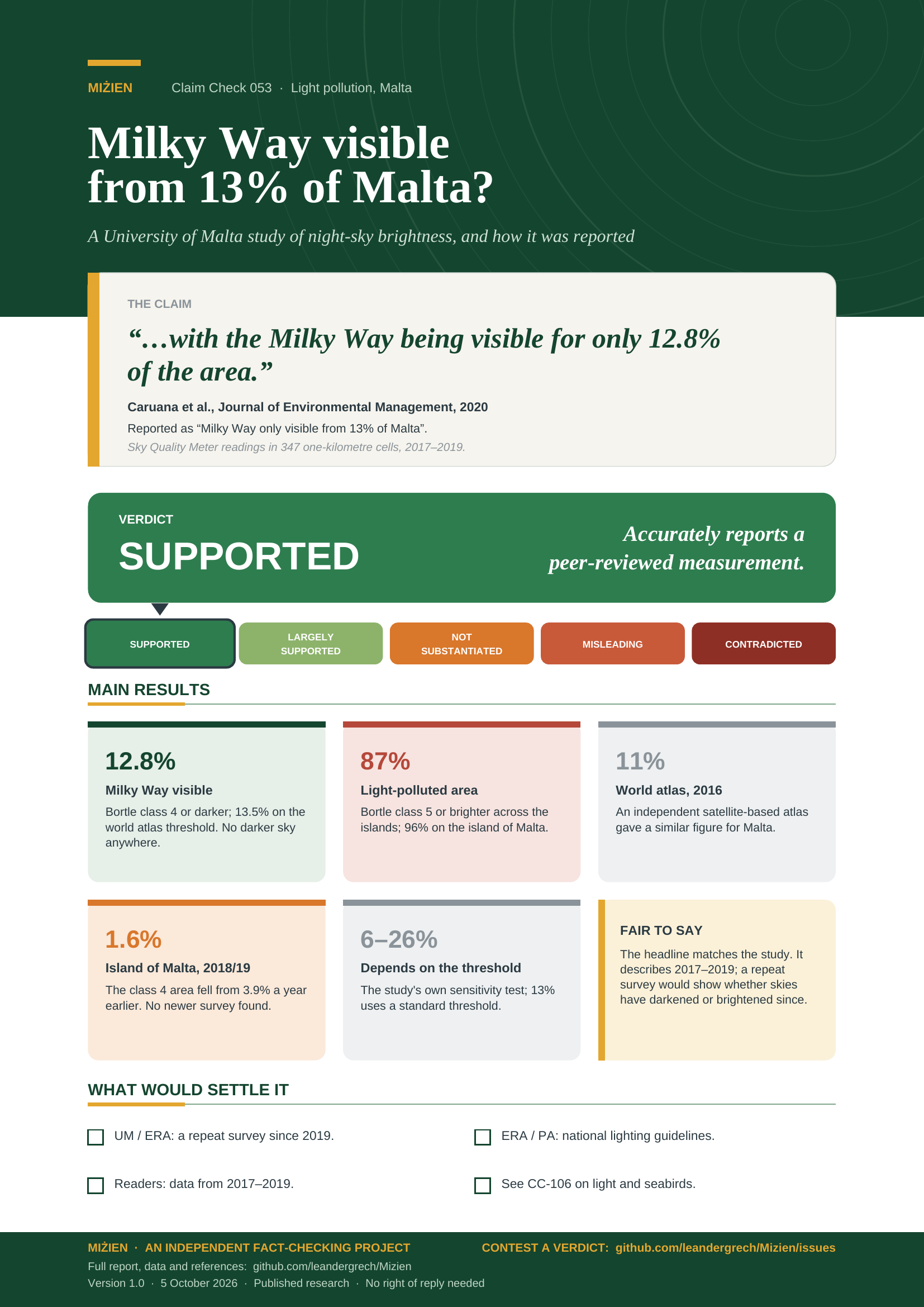
“…87% of the area registering a NSB < 20.39 (Bortle Class 5 or higher) … with the Milky Way being visible for only 12.8% of the area.”
Caruana et al., Journal of Environmental Management, 2020 (University of Malta).
Reported in the news as “Milky Way only visible from 13% of Malta”.
Verdict: Supported Accurately reports a peer-reviewed measurement from 2017–2019
Version 1.0 · 5 October 2026
TL;DR
A University of Malta team measured the brightness of the night sky across the islands and reported, in the Journal of Environmental Management (2020), “87% of the area registering a NSB < 20.39 magSQM/arcsec² (Bortle Class 5 or higher) … with the Milky Way being visible for only 12.8% of the area”. News reports rounded this to “13%”. We checked that the summary matches the study and that the study’s numbers hold together.
- The summary matches the study. The paper gives 12.8% (Bortle class 4 threshold) or 13.5% (the world atlas threshold); “about 13%” is fair. 87% is the share of land in Bortle classes 5–9, as stated.
- The study’s numbers hold together and agree with the world atlas. Weighting the island results by land area gives 11.6% (the paper weights its 347 survey cells, giving 12.8%). The 2016 world atlas of night-sky brightness gave 11% for Malta.
- The threshold matters. On the paper’s own sensitivity test, the visible share is 6.3% to 25.9% depending on the brightness threshold chosen. “About 13%” uses a standard, stated threshold.
- The data are from 2017–2019. Measurements are from 2017–2019. On the island of Malta the class 4 area fell from 3.9% to 1.6% between the two surveys. We found no newer survey.
- Verdict: supported (high confidence). The statement reports a peer-reviewed measurement accurately.
- Supported
- Largely supported
- Not substantiated
- Misleading
- Contradicted
What would move the verdict up
None: Supported is the top of the scale.
What would move it down
A newer survey showing a different share, or a finding that the study’s method misclassifies large areas.
IN THIS REPORT
1 The claim and what we could verify
The claim record came from a MaltaToday headline, “Milky Way only visible from 13% of Malta”, which summarised the study. Following our rule to quote the speaker, not the headline, we read the study itself: Caruana, Vella, Spiteri, Nolle, Fenech and Aquilina (2020), “A photometric mapping of the night sky brightness of the Maltese islands”, Journal of Environmental Management 261:110196 [1], in its accepted version on arXiv [2]. The quoted wording is the paper’s abstract.
| Source | What it says | Our access | Status |
|---|---|---|---|
| Caruana et al. (2020), J. Environ. Manage. [1, 2] | “87% of the area registering a NSB < 20.39 … with the Milky Way being visible for only 12.8% of the area”; 13.5% on the world atlas threshold. | Accepted manuscript read in full (arXiv). | The claim |
| Falchi et al. (2016), Science Advances [3] | World atlas of artificial night-sky brightness: 11% for Malta (as cited by Caruana et al.). | Crossref verified; figure as cited ◆. | Comparison |
| MaltaToday [4] | “Milky Way only visible from 13% of Malta”. | Locator only (site refuses automated access). | Locator |
2 Method
Question. Does the statement report the study accurately, and are the study’s results consistent?
Evidence. We transcribed the study’s Table 1 (share of land area in each Bortle class, by island) into data/cc-053/caruana2020_table1.csv and recomputed the archipelago-wide shares by weighting each island by its land area from OpenStreetMap (tools/cc-053-report/calc.py; outputs in data/cc-053/checks.csv). We compared the result with the paper’s own comparison to the 2016 world atlas and with its threshold sensitivity test.
Grades. Caruana et al. (2020): B (observational measurement with a stated method and comparison). Verdicts follow the five-point scale in Appendix A.
3 What the data show
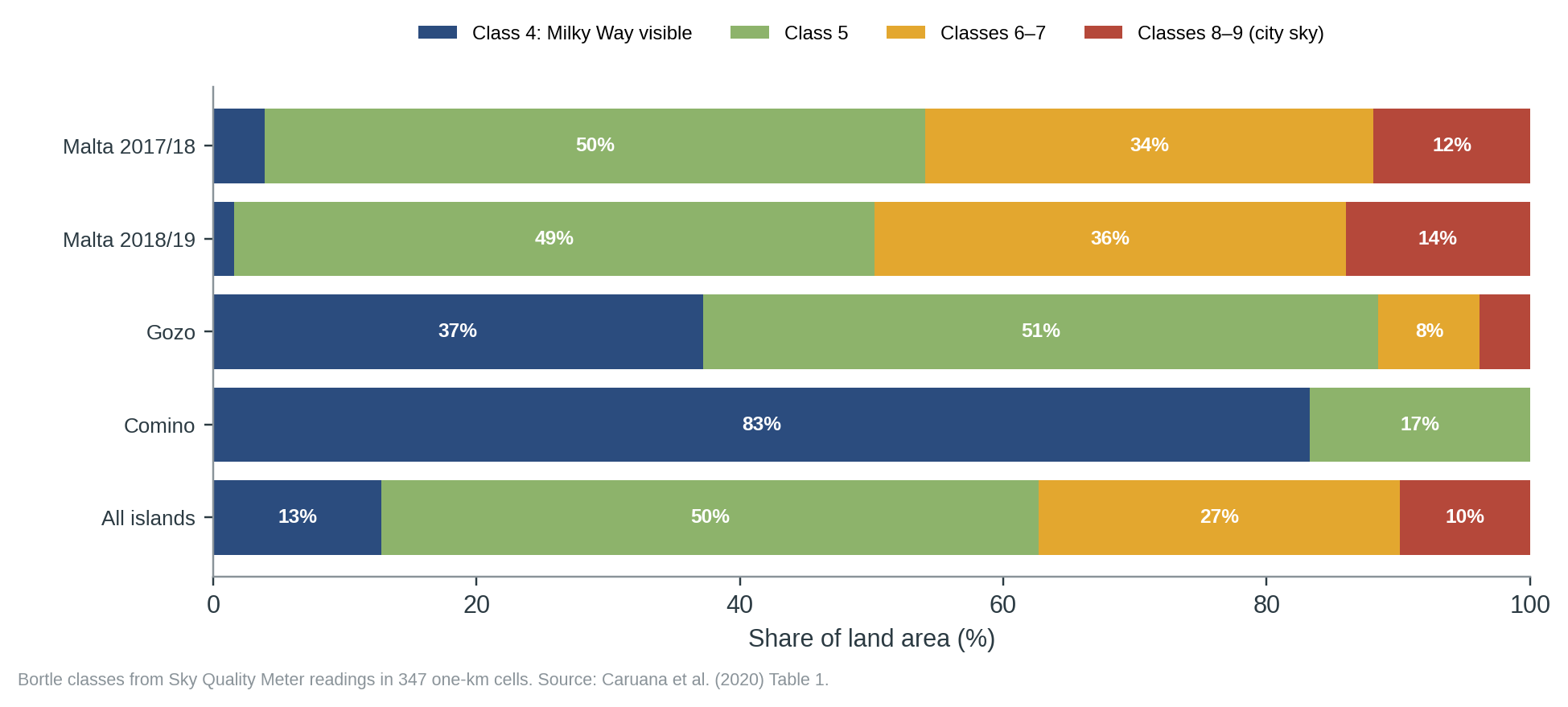
No part of the islands reached Bortle class 3 or darker. Class 4, where the Milky Way is clearly visible, covered 3.9% of Malta, 37.2% of Gozo and 83.3% of Comino in 2017/18, 12.8% of the islands overall. Weighting by land area gives 11.6%; the paper weights its one-kilometre survey cells, which include coastal cells, so the darker coasts count for slightly more. On the island of Malta, the second survey (2018/19) found class 4 had shrunk to 1.6%.
4 Where the evidence points different ways
Is “13%” the right number?
YES, ON A STATED THRESHOLDFOR
12.8% on the Bortle class 4 threshold, 13.5% on the world atlas threshold; the world atlas itself gave 11%.
CAVEATS
With a threshold of 20.6 mag/arcsec² the share is 6.3%; with 20.0 it is 25.9%. The measurements are from 2017–2019.
5 Testing the claim
| Sub-claim | Said by | What the evidence shows | Rating |
|---|---|---|---|
| A. The Milky Way is visible from only about 13% of the islands | UM researchers [1] | 12.8% (class 4) or 13.5% (atlas threshold); 11.6% area-weighted; world atlas 11%. | ACCURATE |
| B. 87% of the area has high light pollution | UM researchers [1] | 87.2% of the area in Bortle class 5 or brighter, 2017/18. | ACCURATE |
6 Verdict and requests for evidence
The statement reports a peer-reviewed measurement accurately. Confidence: high.
Why. Both figures are the study’s own, the study’s parts add up, and an independent atlas agrees. What this verdict does not say. It does not describe the sky in 2026: the survey has not been repeated nationally since 2019.
Evidence we are asking for
- From the University of Malta team or ERA: any repeat survey of night-sky brightness since 2019.
- From ERA and the Planning Authority: the status of national lighting guidelines.
7 Limitations
- We read the accepted manuscript on arXiv; the published version may differ slightly in wording.
- The world atlas figure (11%) is as reported by Caruana et al.; we did not recompute it.
- Sky Quality Meter readings vary with season, cloud and the Milky Way’s position; the study discusses these.
References
- [1] Caruana J., Vella R., Spiteri D., Nolle M., Fenech S. & Aquilina N.J. (2020). A photometric mapping of the night sky brightness of the Maltese islands. Journal of Environmental Management 261:110196. doi:10.1016/j.jenvman.2020.110196. https://doi.org/10.1016/j.jenvman.2020.110196
- [2] Same, accepted manuscript. arXiv:2002.04435. https://arxiv.org/abs/2002.04435
- [3] Falchi F., Cinzano P., Duriscoe D., Kyba C.C.M. et al. (2016). The new world atlas of artificial night sky brightness. Science Advances 2(6):e1600377. doi:10.1126/sciadv.1600377. https://doi.org/10.1126/sciadv.1600377
- [4] MaltaToday. Milky Way only visible from 13% of Malta (locator). https://www.maltatoday.com.mt/news/national/100416/milky_way_only_visible_from_13_of_malta
- [5] MiŻien. Data and calculation: data/cc-053/; tools/cc-053-report/calc.py.
Appendix A: series standards and verdict scale
Every investigation in this series follows the same rules so that verdicts are comparable and challengeable.
| Verdict | Meaning |
|---|---|
| SUPPORTED | Evidence consistently backs the claim as stated. |
| LARGELY SUPPORTED | Backed by the evidence, with minor caveats that do not change the substance. |
| NOT SUBSTANTIATED | Stated more strongly than the evidence offered or available allows. May be true in some conditions but has not been shown. |
| MISLEADING | Omits material facts so that the overall impression is inaccurate, even if individual statements are defensible. |
| CONTRADICTED | The available evidence points against the claim. |
Confidence
High: multiple independent lines of evidence agree. Moderate: evidence is relevant but incomplete or indirect. Low: evidence is thin, second-hand or conflicting.
Evidence grades
A experiment · B observational study with a control or gradient · C review, guidance or official statistics · D assertion or anecdote. ◆ marks a source known only second-hand.
Standards
- Quote the speaker, not the headline, with outlet and date, and link the original where possible.
- Separate the claim from the evidence offered for it, and say who made which statement.
- Grade the evidence and show differing views side by side where the evidence is unsettled.
- State what we could not access or verify, and what would change the verdict either way.
- Ask for the missing evidence in specific, answerable requests.
- Offer a right of reply where a check finds a claim Not substantiated, Misleading or Contradicted (or a pledge Not measurable, Off track or Missed), before wider circulation, and append responses.
- Correct errors openly with a version number and change log.
- Whistle-blow only on evidence: a verdict of Misleading or Contradicted requires documents or data that can be shown, not inference.
- Check every side. Government, opposition, NGOs and developers are held to the same standard.
Appendix B: revision log
| Version | Date | Change |
|---|---|---|
| 1.0 | 5 Oct 2026 | First issue. Verdict Supported (high confidence); no right of reply needed. |
Sources and archived copies
-
A photometric mapping of the night sky brightness of the Maltese islands, Journal of Environmental Management 261:110196, 2020.
Original · fetched and fingerprinted 2026-10-05; no public snapshot yet
The claim (abstract). Accepted manuscript read in full on arXiv (2002.04435). -
Milky Way only visible from 13% of Malta, MaltaToday, n/d.
Original · not yet archived
Locator (news rounding to 13%). -
The new world atlas of artificial night sky brightness, Science Advances 2:e1600377, 2016.
Original · not yet archived
Comparison: 11% for Malta, as cited by Caruana et al.
Right of reply
Not needed: this check finds the claim supported. A right of reply is sought when a check finds a claim Not substantiated, Misleading or Contradicted.
Connections
How this claim relates to the others: who made it, the themes it shares with other claims, and the patterns it shows. A connection is a reason to read two checks side by side. It does not make either one right or wrong. How connections are found.
Linked directly 0
Not yet linked to another claim by a theme.
Timeline
What was said, what was published before and after it, and each step of this check, in date order. Statements and sources carry the date they were published. The steps of the check carry the date the research was done, from the check's research log. Other statements by the same body on the same topic show whether a position was repeated, changed or corrected.
2020
- May 2020 The statement University of Malta researchers (this claim)
- 2020 Evidence published A photometric mapping of the night sky brightness of the Maltese islands (J. Environ. Manage. 261:110196), Caruana et al.
2026
- 4 October 2026 Added to the claims to check
- 5 October 2026 Exact wording found Study located (Caruana et al. 2020, J. Environ. Manage.; Crossref verified) and the accepted manuscript read in full on arXiv; the MaltaToday headline rounds 12.8% to 13%.
- 5 October 2026 Note Table 1 transcribed; shares recomputed with OpenStreetMap island areas (tools/cc-053-report/calc.py); compared with Falchi et al. (2016).
- 5 October 2026 Version 1.0: first issue First issue. Verdict Supported (high confidence); no right of reply needed. Verdict in this version: Supported, high confidence.
- 5 October 2026 Evidence reviewed
2027
- 5 October 2027 Coming up: Evidence review due Each finished check is reviewed against new evidence within a year.
Every change to this claim's record is public: history of the record.
Download the report and flyer